
Road Highway Infrastructure Market Outlook: Size, Share, Trends, Growth Analysis, Competitive Landscape & Forecast, 2026-2033

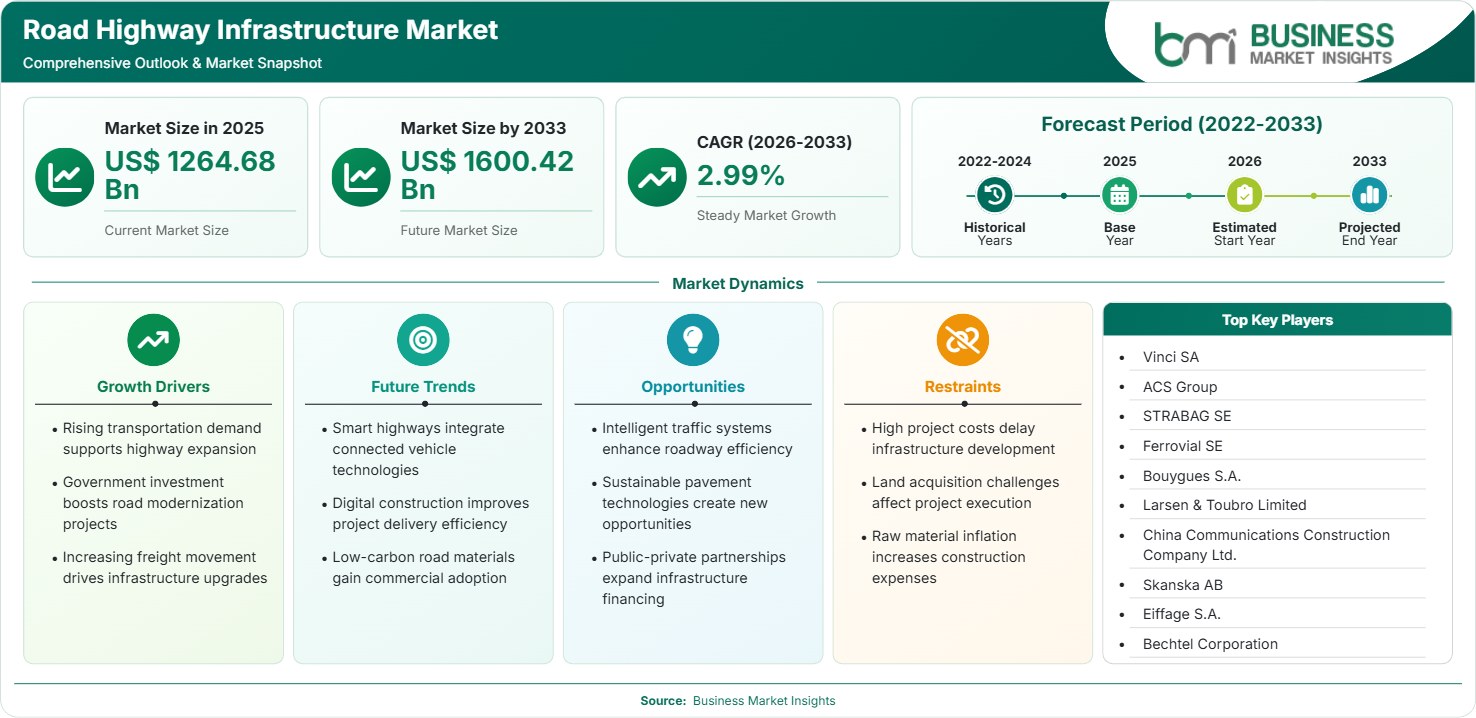
The Road Highway Infrastructure Market size was valued at US$ 1,264.68 billion in 2025 and is projected to reach US$ 1,600.42 billion by 2033, growing at a CAGR of 2.99% during 2026–2033. Rising transportation demand, continuous government infrastructure spending, and increasing freight mobility are accelerating investments in highway modernization, intelligent traffic management systems, and resilient road development worldwide.

Report Coverage
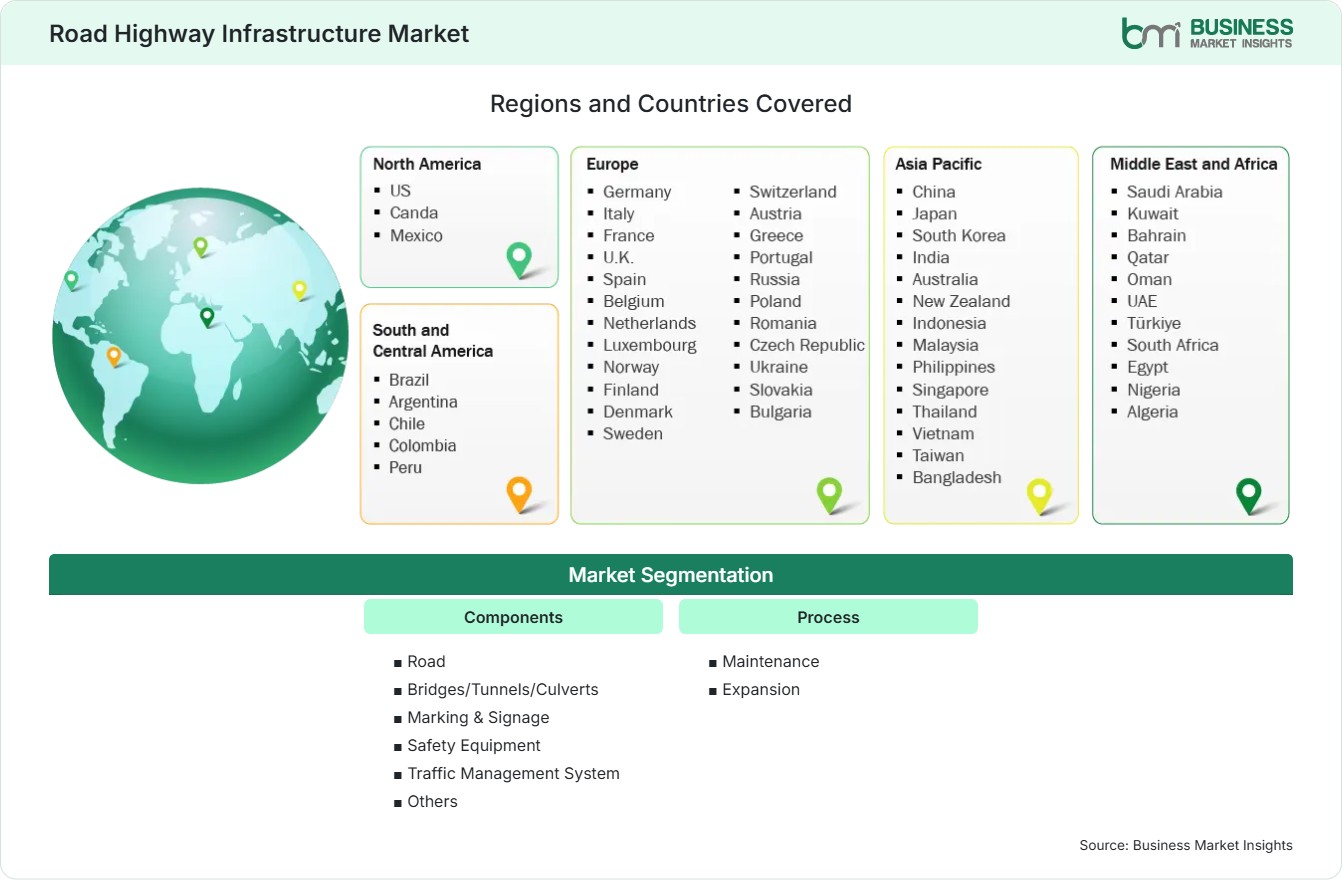
  • Components: Road, Bridges/Tunnels/Culverts, Marking & Signage, Safety Equipment, Traffic Management System, Others
  • Process: Maintenance, Expansion
US$ 1264.68 Bn Market size in 2025
US$ 1600.42 Bn Market Size by 2033
2.99% CAGR, 2026 - 2033
2026-2033 Forecast Period

AI Overview

Road Highway Infrastructure Market Summary

  • North America Region: North America accounts for 23%–26% market share in 2025 and is expected to expand at a CAGR of 2.7%–3.1% during 2026–2033. Federal infrastructure funding, bridge rehabilitation programs, and smart highway deployment continue supporting market expansion. The U.S. remains the dominant regional contributor with a CAGR of 2.8%–3.2%, supported by long-term transportation investment programs and interstate modernization projects.
  • Fastest Growing Region: Asia Pacific holds 39%–42% market share in 2025 and is projected to register a CAGR of 3.4%–3.8%, supported by rapid urbanization, expressway construction, industrial expansion, and sustained public infrastructure investment.
  • Leading Segment: National/Interstate Highways account for 48%–51% market share in 2025 and are anticipated to grow at a CAGR of 3.0%–3.3%, driven by increasing freight transportation, national connectivity projects, and government capital expenditure.
  • High Growth Segment: Expansion represents 56%–59% market share in 2025 and is projected to record a CAGR of 3.2%–3.6%, supported by greenfield highway development, bypass construction, and capacity enhancement initiatives.
  • Key Market Opportunity: Digital highway infrastructure, sustainable pavement technologies, and intelligent traffic management systems are creating long-term opportunities for contractors, technology providers, and infrastructure developers worldwide.
  • Major Market Players: VINCI S.A., ACS Group, STRABAG SE, Ferrovial SE, Bouygues S.A., Larsen & Toubro Limited, China Communications Construction Company Limited, Skanska AB, Eiffage S.A., and Bechtel Corporation.
Strategic Insights

Road Highway Infrastructure Market: Strategic Insights

Road Highway Infrastructure Market Strategic Framework
FREE PDF
Request your free sample
Request free sample
Stakeholder View

Key Takeaways

  • Long-term government infrastructure programs remain the primary source of project funding, supporting stable demand across highway construction, rehabilitation, and maintenance activities.
  • Expansion projects continue generating stronger investment opportunities than maintenance contracts due to increasing urbanization, industrial development, and freight transportation requirements.
  • Intelligent transportation systems, digital asset management, and predictive maintenance technologies are improving project efficiency while reducing lifecycle infrastructure costs.
  • Asia Pacific remains the strongest investment destination because of extensive highway expansion programs, growing logistics infrastructure, and continuous urban development.
  • Public-private partnerships are becoming increasingly important in financing complex infrastructure projects while improving construction efficiency and long-term operational management.
  • Sustainability initiatives encouraging recycled construction materials, low-carbon pavement technologies, and climate-resilient road infrastructure are influencing procurement decisions globally.
Geographic Outlook

Road Highway Infrastructure Market Regional Highlights

North America Road Highway Infrastructure Market

North America accounts for 23%–26% Road Highway Infrastructure Market share in 2025 and is projected to expand at a CAGR of 2.7%–3.1% during 2026–2033. Government infrastructure renewal programs, interstate highway modernization, bridge rehabilitation, and intelligent traffic management investments continue supporting regional development. Contractors increasingly adopt digital engineering, automated construction equipment, and sustainable materials to improve project quality, reduce maintenance costs, and strengthen transportation resilience.

  • Federal transportation funding continues supporting long-term highway reconstruction and bridge replacement projects across the United States and Canada.
  • Intelligent transportation systems improve traffic management, congestion reduction, and roadway safety throughout major urban transportation corridors.
  • Sustainable pavement materials and recycled construction products are increasingly incorporated into new infrastructure projects.
  • Growing freight transportation demand supports continuous expansion of logistics corridors and interstate highway capacity.

US Road Highway Infrastructure Market

The United States contributes 84%–87% of North American revenue and is expected to register a CAGR of 2.8%–3.2% during the forecast period. Federal investment initiatives, freight mobility improvements, and bridge rehabilitation programs continue supporting nationwide transportation infrastructure development and modernization.

  • Interstate modernization projects continue improving freight movement efficiency across national logistics networks.
  • Smart traffic management technologies enhance road safety and reduce congestion in metropolitan transportation systems.
  • Public-private partnerships accelerate delivery of major highway expansion and rehabilitation projects.
  • Digital construction technologies improve project scheduling, quality control, and long-term infrastructure management.

Europe Road Highway Infrastructure Market

Europe represents 24%–27% market share in 2025 and is projected to expand at a CAGR of 2.5%–2.9% through 2026–2033. Infrastructure modernization, climate-resilient transportation investments, and cross-border connectivity projects continue driving regional development. Germany remains the leading market, while Poland records the fastest growth due to substantial investment in national transport corridors and European infrastructure funding.

  • Cross-border highway projects continue strengthening regional freight movement and economic integration.
  • Governments increasingly invest in low-carbon road construction materials and sustainable infrastructure practices.
  • Bridge rehabilitation and tunnel modernization remain priority investment areas across Western Europe.
  • Intelligent mobility solutions improve operational efficiency throughout major transportation corridors.

Asia Pacific Road Highway Infrastructure Market

Asia Pacific accounts for 39%–42% market share in 2025 and is projected to register the fastest 3.4%–3.8% CAGR during 2026–2033. Large-scale expressway construction, industrial corridor development, and expanding urban transportation networks continue supporting regional infrastructure investment. China remains the largest regional market, while India records the fastest growth through national highway expansion, logistics corridor development, and sustained government capital expenditure.

  • Mega infrastructure programs continue expanding national expressway and economic corridor networks.
  • Rapid urbanization increases investment in ring roads, bypasses, and metropolitan transportation systems.
  • Freight transportation growth supports continuous highway capacity enhancement across industrial regions.
  • Digital construction management improves efficiency for complex infrastructure development projects.

Rest of World Road Highway Infrastructure Market

The Rest of World region represents 10%–12% market share in 2025 and is projected to grow at a CAGR of 2.8%–3.2% during the forecast period. Transport corridor development, economic diversification initiatives, and regional connectivity projects continue supporting infrastructure investment across Latin America, the Middle East, and Africa.

  • Brazil remains the leading Latin American market through continued investment in national highway modernization.
  • Saudi Arabia records the fastest regional growth supported by large-scale transport infrastructure development.
  • International financing institutions continue supporting strategic highway construction across emerging economies.
  • Road rehabilitation projects strengthen transportation resilience while improving regional logistics efficiency.
Global Market Geography
FREE PDF
Request your free sample
Request free sample
Segment Analysis

Road Highway Infrastructure Market Segmentation

Road Type

Road type remains the largest classification within infrastructure spending as governments prioritize national connectivity, freight mobility, and regional economic development. This segment accounted for 48%–51% market share in 2025 and is expected to register a CAGR of 3.0%–3.3% during 2026–2033. Continuous highway expansion, urban mobility programs, and cross-border transport initiatives continue widening the Road Highway Infrastructure Market scope, while investments in resilient roadway networks support long-term infrastructure modernization.

  • National/Interstate Highways: Represent the largest category owing to substantial government funding, higher traffic volumes, strategic freight movement, and continuous investments in widening, rehabilitation, and smart highway infrastructure.
  • State Highways: Receive consistent investments to improve regional connectivity, support industrial development, facilitate agricultural transportation, and strengthen links between urban centers and rural communities.
  • Other Roads: Include district, municipal, and rural roads that improve local accessibility, support socioeconomic development, and strengthen last-mile connectivity through regular maintenance and expansion activities.

Components

Infrastructure components collectively determine roadway durability, operational efficiency, and long-term transportation safety. This segment accounted for 37%–40% market share in 2025 and is projected to register a CAGR of 2.9%–3.2% during 2026–2033. Current Road Highway Infrastructure Market trends indicate increasing investments in digital traffic systems, durable construction materials, and intelligent roadway assets to improve operational performance and reduce maintenance costs.

  • Road: Forms the foundation of every highway project, requiring continuous investment in pavement construction, resurfacing, widening, drainage systems, and long-term structural performance improvements.
  • Bridges/Tunnels/Culverts: Support uninterrupted transportation across complex terrain while improving safety, reducing travel time, and strengthening national and regional logistics corridors.
  • Marking & Signage: Enhance driver guidance, traffic regulation, and roadway visibility through durable pavement markings, reflective signs, and intelligent information systems.
  • Safety Equipment: Includes guardrails, crash barriers, lighting systems, impact attenuators, and pedestrian protection infrastructure designed to improve road safety and minimize accident severity.
  • Traffic Management System: Increasingly incorporates intelligent transportation technologies, digital monitoring platforms, adaptive signaling, surveillance systems, and real-time traffic analytics for efficient roadway operations.

Process

Process-based investments remain essential for maintaining transportation efficiency while expanding roadway capacity to accommodate rising traffic volumes. The segment accounted for 56%–59% market share in 2025 and is anticipated to register the highest 3.2%–3.6% CAGR during 2026–2033. Growing Road Highway Infrastructure Market share is supported by expanding greenfield developments, expressway construction, and modernization projects that improve national transportation capacity and long-term infrastructure resilience.

  • Maintenance: Includes pavement rehabilitation, bridge repairs, resurfacing, drainage improvements, lane restoration, and preventive maintenance activities that extend infrastructure lifespan while reducing long-term operating costs.
  • Expansion: Covers construction of new highways, bypasses, additional traffic lanes, interchanges, and economic corridors to accommodate increasing passenger mobility, freight transportation, and regional economic development.
Market Forces

Road Highway Infrastructure Market Dynamics

Key Market Drivers

Rising transportation demand supports highway expansion

Increased passenger movement, urbanization, and business activities are placing greater pressure on existing road networks worldwide. There is currently an emphasis by many governments on undertaking more highway expansion projects to improve connectivity across regions, shorten travel times, and enhance logistics efficiency. The amount of freight being transported has also increased due to higher production and international trade, necessitating wider highways and improved transport routes. These developments collectively support Road Highway Infrastructure Market growth by encouraging long-term investments in new highway construction and transportation infrastructure modernization.

Government investment boosts road modernization projects

National infrastructure programs remain a primary growth catalyst for highway development across developed and emerging economies. Governments are still investing heavily in rebuilding roads and bridges, building tunnels, and installing traffic management technology. Massive infrastructure spending will create jobs, support development, and increase the region's competitiveness. Funding of the projects by international organizations and infrastructure funds will allow executing such projects as well. The policy's focus on resilient infrastructure will create stable demand for engineering services throughout the forecasting period.

Increasing freight movement drives infrastructure upgrades

Growth in the fields of manufacturing, e-commerce, and global trade is contributing to an increased need for freight transportation. This is because the current road network needs to be improved in order to handle increased freight volumes, increased weights of commercial trucks, and increased speeds of transporting goods from industrial plants, ports, and distribution centers. In addition, efforts are being made towards constructing sturdier roads, building dedicated freight routes, using smart transport systems, and designing better interchanges. Continuous expansion of freight networks remains one of the key contributors shaping Road Highway Infrastructure Market trends across global transportation infrastructure.

Key Market Opportunities

Intelligent traffic systems enhance roadway efficiency

Implementation of intelligent transport systems is changing the nature of roads through real time traffic monitoring, adaptive signal control, incident detection and intelligent roadway management. The governments are increasingly turning to digital technologies to manage traffic flow, minimize congestion, ensure traveler safety and efficient infrastructure use. Artificial intelligence, IoT sensors and cloud traffic analysis are becoming important in predictive traffic management and emergency services. Road Highway Infrastructure Market Forecasts indicate that intelligent roadway technologies will become a major investment area as countries modernize transportation infrastructure and strengthen smart mobility ecosystems.

Sustainable pavement technologies create new opportunities

The growing emphasis on environmentally responsible infrastructure development is encouraging the adoption of sustainable pavement materials and innovative construction methods. Contractors are using recycled asphalt pavements, warm-mix asphalt, industrial by-products, and low-carbon concrete in their projects to minimize the impact on the environment without compromising structural stability. Government institutions are now incorporating sustainable elements into their construction procurement processes to foster demand for green construction materials. Future research in pavement technology is anticipated to enhance pavement performance and create business opportunities.

Public-private partnerships expand infrastructure financing

Public-private partnership (PPP) models continue attracting investment for large-scale transportation projects where government funding alone may be insufficient. The private sector’s involvement facilitates access to finance, technological know-how, project management skills, and efficiency at all stages of the infrastructure’s life cycle. There is a general trend of countries building PPPs that will allow for fast development of highways, bridges, and expressways while sharing financial risks between the parties involved. More investor confidence and favorable legislation are likely to foster private participation even further in the future.

Market Restraints and Challenges

High project costs delay infrastructure development

Large-scale highway projects require substantial financial investment covering land preparation, construction materials, engineering services, labor, and advanced equipment. Factor: Rising prices of cement, steel, asphalt, fuel, and construction machinery significantly increase overall project expenditure and financing requirements. Impact: Budget constraints, funding gaps, and escalating construction costs can postpone project approvals, delay completion schedules, and reduce the number of new infrastructure developments undertaken by public authorities and private investors.

Land acquisition challenges affect project execution

Securing land for new highways and expansion projects remains one of the most complex stages of infrastructure development in many countries. Factor: Lengthy approval procedures, ownership disputes, environmental clearances, and community resettlement requirements often extend project preparation timelines. Impact: Construction schedules may be delayed, project costs can increase substantially, and infrastructure developers may encounter contractual and operational challenges that affect overall project delivery efficiency and long-term investment planning.

Company Analysis

Competitive Landscape

The competitive environment is shaped by large engineering and construction companies expanding their capabilities through integrated project delivery, digital construction technologies, and sustainable infrastructure solutions. Road Highway Infrastructure Market analysis indicates that leading contractors are strengthening their positions through public-private partnerships, strategic acquisitions, advanced engineering expertise, and investments in smart transportation infrastructure across developed and emerging economies.

Company Name

Overview

Products and Services Relevant to this Market

VINCI S.A.

Global infrastructure and construction company delivering transportation, energy, and concession projects across multiple international markets.

Highway construction, expressway concessions, bridge engineering, tunnel construction, road maintenance, and intelligent transport infrastructure solutions.

ACS Group

International construction and engineering group executing large-scale civil infrastructure and transportation projects worldwide.

Highway development, bridge construction, road rehabilitation, tunneling, infrastructure management, and engineering services.

STRABAG SE

European construction company specializing in transportation infrastructure, civil engineering, and sustainable road construction projects.

Road construction, asphalt paving, bridge development, highway maintenance, infrastructure modernization, and digital construction services.

Ferrovial SE

Global infrastructure developer with extensive experience in transportation concessions and highway engineering projects.

Toll roads, highway construction, smart mobility solutions, infrastructure maintenance, and transportation asset management services.

Bouygues S.A.

Diversified construction company delivering complex transportation and public infrastructure projects across global markets.

Highway engineering, bridge construction, tunnel projects, transport infrastructure development, and maintenance solutions.

Larsen & Toubro Limited

Indian engineering and construction company executing large transportation infrastructure and highway development projects.

Expressway construction, road engineering, bridge development, EPC contracting, and transportation infrastructure services.

China Communications Construction Company Limited

Leading global infrastructure contractor involved in large transportation and civil engineering developments.

Highway construction, bridges, tunnels, transport corridors, EPC services, and integrated infrastructure development.

Skanska AB

International construction and project development company emphasizing sustainable infrastructure solutions.

Highway construction, road rehabilitation, bridge engineering, civil infrastructure, and environmentally sustainable construction services.

Eiffage S.A.

French infrastructure company providing transportation engineering and long-term highway concession services.

Road construction, motorway concessions, bridge projects, pavement engineering, and transport infrastructure maintenance.

Bechtel Corporation

Global engineering and construction company delivering complex infrastructure projects across transportation and industrial sectors.

Highway construction, project management, tunnel engineering, transportation infrastructure development, and construction consulting services.

Trust & Transparency

Research Methodology

The market analysis combines proprietary research with secondary data from government agencies, company disclosures, regulatory filings, industry databases and expert interviews. Market estimates are validated through data triangulation, cross-market benchmarking and analyst review.

View Full Research Methodology

Questions Answered

Frequently Asked Questions

What does the Road Highway Infrastructure Market Report include?

The Market Report provides comprehensive insights into market dynamics, regional performance, competitive landscape, segmentation, infrastructure investments, technology trends, regulatory developments, and future business opportunities.

Which region is expected to record the fastest growth?

Asia Pacific is projected to witness the fastest growth due to extensive highway expansion, industrial corridor development, urbanization, government capital expenditure, and increasing investments in regional transportation infrastructure.

Why are intelligent traffic management systems becoming increasingly important?

They improve traffic flow, reduce congestion, enhance roadway safety, optimize infrastructure utilization, enable real-time monitoring, and support predictive maintenance through digital technologies and connected transportation networks.

Which road type accounts for the largest market share?

National and Interstate Highways represent the largest segment because governments prioritize strategic transportation corridors that improve freight mobility, regional connectivity, economic development, and long-distance passenger transportation.

What factors are driving the Road Highway Infrastructure Market?

Increasing transportation demand, government investment in highway modernization, expanding freight movement, rapid urbanization, and continuous development of intelligent transportation systems are the primary drivers supporting long-term market expansion.

Access the Full Road Highway Infrastructure Market Report

Get segment-level forecasts, regional estimates, competitive benchmarking, company profiles and downloadable Excel datasets.

Access the full Road Highway Infrastructure Market Report
350 pages PDF & Excel | 2026-08-17
Similar Research

Related Market Reports