Market Summary
Executive Summary and Global Market Analysis
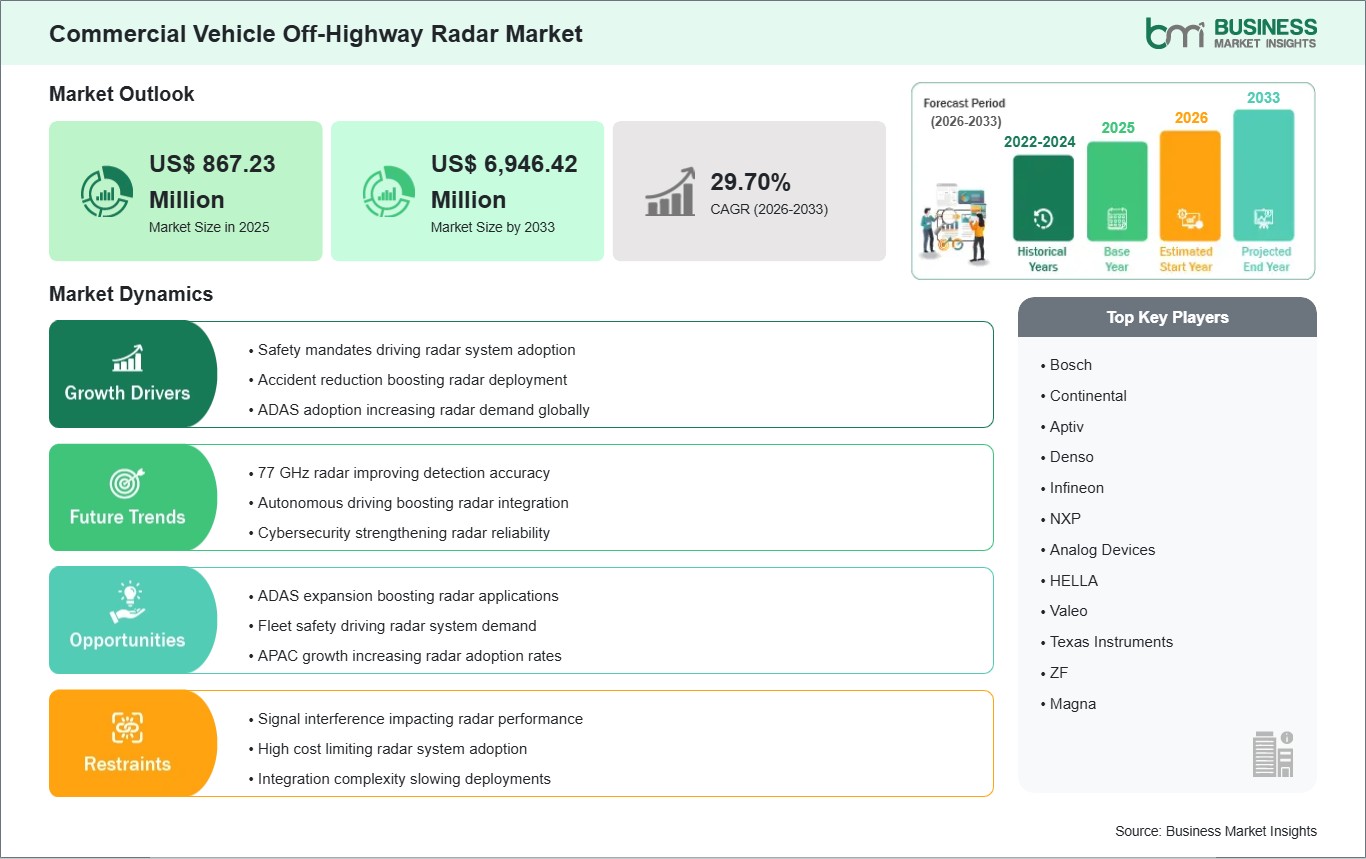
Commercial vehicle and off-highway radar uses sensing technologies to improve driver awareness, automate safety features, and support advanced driver assistance systems. These radar units work on different frequency bands and often combine with cameras and other sensors to provide accurate environmental detection in tough transport and industrial environments. Safety regulations have sped up adoption, with rules now requiring collision avoidance and lane support systems in heavy-duty fleets. More radar use in off-highway machinery highlights the need for reliable detection where visibility is poor and operator safety is critical.
Different segments of the market show varying use of frequency ranges. The 77-81 GHz systems are preferred for long-range accuracy, while 24 GHz is still used for more budget-friendly needs. Components like long-range, short-range, and medium-range radar, along with cameras, allow for multi-sensor systems. These are used in features such as adaptive cruise control, emergency braking, blind spot detection, forward collision warnings, and parking assistance. Technology is moving from single-use radar to integrated sensor fusion systems.
Improvements in resolution, less interference, and smaller sizes are changing how radar is used, and software-defined radar makes it easier to adapt to different vehicle types. Market competition will shift from competing on sensor-only to competing on full system integration solutions. Businesses will pay more attention to complying with safety regulations, creating products for both commercial and off-road vehicles, and contributing to the development of ADAS. Therefore, radar will play an important role in future transportation systems.
Segment Analysis
Commercial Vehicle and Off-Highway Radar Market Segmentation
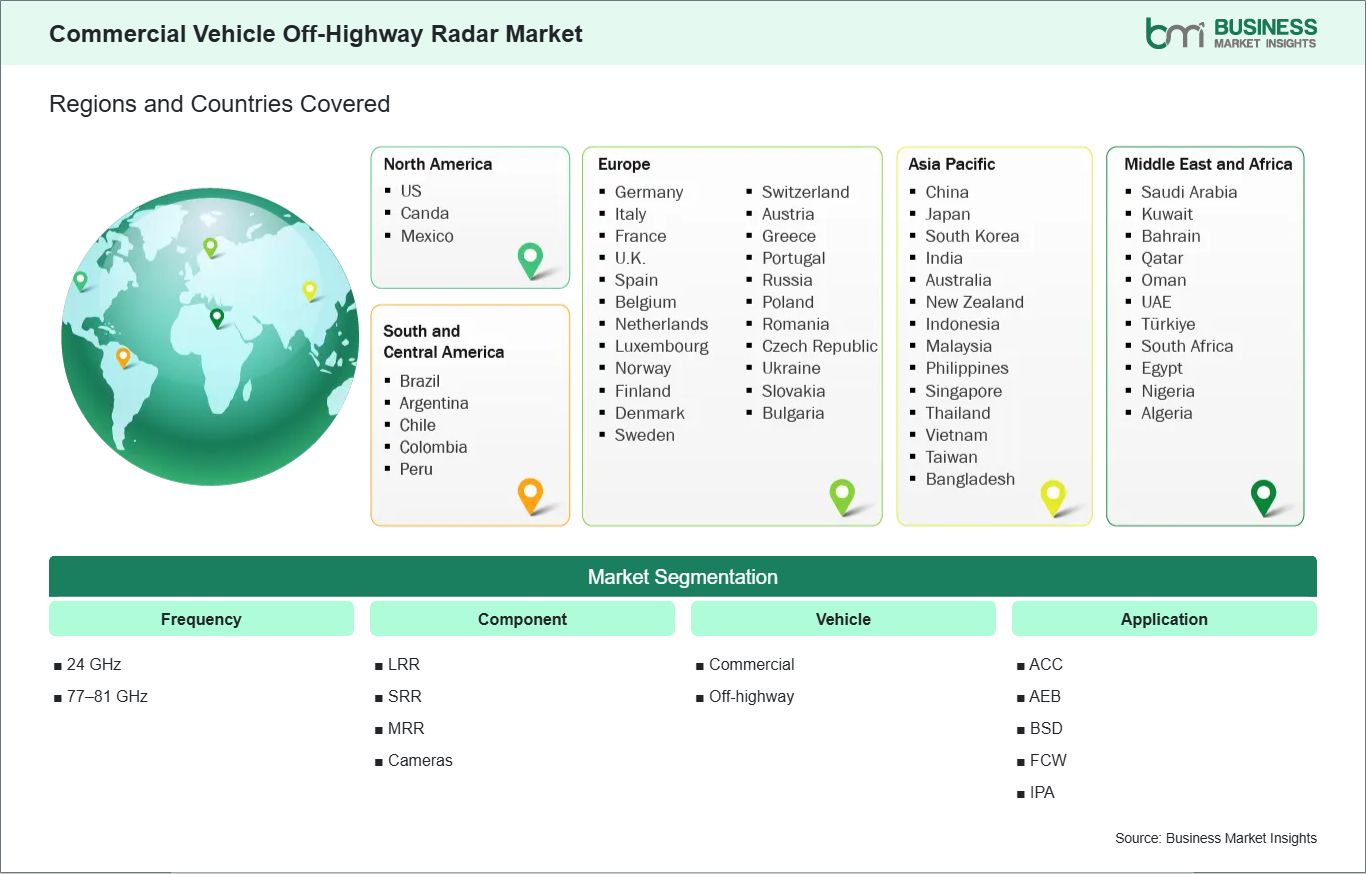
The commercial vehicle and off-highway radar market is segmented by frequency, component, vehicle type, and application, reflecting expanding deployment of advanced driver assistance technologies across regulated transport and industrial mobility systems.
By Frequency
- 24 GHz: Maintains relevance in cost-sensitive deployments requiring basic detection.
- 77 - 81 GHz: Gains preference for high-resolution sensing and long-range accuracy.
By Component
- LRR: Supports highway-speed functions with extended detection range.
- SRR: Facilitates near-field monitoring for collision avoidance.
- MRR: Balances coverage between short and long distances.
- Cameras: Strengthen radar through sensor fusion and visual confirmation.
By Vehicle
- Commercial: Expanding deployment in trucks and buses to meet safety mandates.
- Off-highway: Increasing integration in construction and agricultural machinery for operator protection.
By Application
- ACC: Enhances driver convenience through automated speed regulation.
- AEB: Provides critical intervention in collision scenarios.
- BSD: Improves situational awareness in multi-lane traffic.
- FCW: Alerts operators to imminent hazards ahead.
- IPA: Assists maneuvering in constrained environments.
Market Forces
Commercial Vehicle and Off-Highway Radar Market Drivers and Opportunities
Safety mandates driving radar system adoption
Due to safety guidelines across the world, radar systems have become mandatory rather than optional features in commercial vehicles. It is necessary that collision avoidance systems, lane departure systems, and blind spot detection systems be fitted in all commercial vehicles due to safety regulations from various governments and authorities. The regulations are meant to reduce the number of accidents, protect motorists, and ensure passenger safety since truck accidents are very hazardous. There are various frequencies of radar technology used to facilitate safety in varying conditions, and this helps manufacturers comply with safety standards. Through these regulations, there has been a standardized safety threshold achieved through radar adoption.
Adding radar to fleets improves safety, lowers legal risks, and boosts a company's reputation. Companies that follow safety rules avoid fines and show they care about responsible transport. Radar helps fleets meet safety standards, gives drivers more confidence, and cuts down on time lost to accidents. As more rules are introduced, radar is becoming a must-have part of modern vehicle design and fleet management.
ADAS expansion boosting radar applications
The expansion of advanced driver assistance systems has broadened radar role beyond fundamental detection, opening pathways for innovative applications such as automated parking, predictive collision avoidance, and adaptive cruise control. Integration with cameras and software platforms enhances radar adaptability, enabling sensor fusion that delivers precise environmental perception across diverse vehicle categories. This evolution reflects a shift from single-function radar toward multi-modal systems capable of supporting complex ADAS features. The trend toward automation in both commercial fleets and off-highway machinery underscores radar growing importance as a foundational technology for intelligent mobility.
Looking ahead, radar penetration into off-highway machinery presents significant opportunities. Construction and agricultural vehicles increasingly rely on radar to support autonomous functionality, ensuring operator safety in environments where visibility is compromised. Long-term impact lies in radar transformation into a cornerstone of connected ecosystems, extending its utility across automated logistics, industrial mobility, and smart infrastructure. As ADAS capabilities expand, radar systems will serve as critical enablers of predictive safety and autonomous operation, reinforcing their role in shaping the future of mobility. This trajectory positions radar not merely as a compliance tool but as a strategic technology driving innovation across global transport and industrial domains.
Size and Share Analysis
Commercial Vehicle and Off-Highway Radar Market Size and Share Analysis
The Commercial Vehicle and Off-Highway Radar Market is projected to grow from US$ 867.23 Million in 2025 to US$ 6,946.42 Million by 2033 , registering a CAGR of 29.70% from 2026 to 2033.
By Frequency, the 77-81 GHz category accounts for a significant share due to its advanced resolution capabilities, minimized signal interference, and suitability for long-range detection. These attributes make it indispensable for commercial fleets and off-highway machinery requiring precise environmental monitoring.
By Component, LRR leads the market owing to its essential role in enabling highway-speed safety functions. Its integration into adaptive cruise control and forward collision warning systems ensures reliable detection at extended ranges, positioning it as the dominant technology across regulated transport ecosystems.
Report Coverage
Commercial Vehicle and Off-Highway Radar Market Report Coverage and Deliverables
The "Commercial Vehicle and Off-Highway Radar Market Size and Forecast (2022-2033)" report provides a detailed analysis of the market covering below areas:
- The market size and forecast at the regional and country levels for segments covered under the scope
- The market trends, as well as drivers, restraints, and opportunities
- The market analysis covering key trends, regional framework, major players, regulations, and recent developments
- Industry landscape and competition analysis covering market concentration, heat map analysis, prominent players, and recent developments for the market
- Detailed company profiles, including SWOT analysis
Geographic Insights
Commercial Vehicle and Off-Highway Radar Market Geographic Insights
The commercial vehicle and off-highway radar market shows diverse regional adoption patterns influenced by regulatory mandates, industrial safety priorities, and technological readiness across transportation ecosystems. Global momentum reflects the convergence of compliance requirements and technological innovation, positioning radar as a structural element of modern fleet and machinery design. While adoption levels vary, the underlying rationale remains consistent: radar systems deliver enhanced detection accuracy, operational safety, and alignment with evolving mobility frameworks.
Deployment in North America is driven by stringent safety guidelines and efforts at fleet upgrades. Government initiatives have sped up the adoption of heavy-duty trucks and buses to ensure that standards of collision prevention and blind spot detection are met. Logistics companies have seen radar as a sound investment due to reduced expenses incurred from accidents, especially those that occur during long hauls.
The Asia-Pacific market is characterized by increasing deployment because of the rising infrastructural developments and mechanization processes within industries. The increased use of radar sensors can be attributed to the region's concentration on safety in off-road machinery utilized in the construction industry and the agriculture sector. With rapid urbanization and industrialization, the environment poses visibility issues that require radar sensors to detect hazards. In addition, the focus on mechanization makes radar sensors more than just compliant technology.
Europe continues to show strong growth trends as a result of uniformity in safety laws and innovative automotive designs in the market. Safety regulations throughout Europe ensure the use of radar in different vehicle types, while innovation helps in advancing radar technology as a crucial ADAS solution. Latin America and the Middle East are emerging markets embracing the adoption of radar sensors in fleet operations and industrial machinery.
Industry Activity
Recent Developments
The commercial vehicle and off-highway radar market is evaluated by gathering qualitative and quantitative data post primary and secondary research, which includes important corporate publications, association data, and databases. A few of the key developments in the commercial vehicle and off-highway radar market are:
- In January 2024, NXP Semiconductors announced the expansion of its automotive radar one-chip family to support software-defined vehicle architectures, with HELLA adopting the platform for its seventh-generation radar portfolio.
- In January 2023, Mobileye announced a collaboration with WNC to produce automotive-grade imaging radar systems designed for advanced driver assistance and autonomous driving applications in commercial and passenger vehicles.
- In September 2023, Mobileye and Valeo announced a partnership to develop next-generation imaging radar solutions for automated driving and ADAS systems, targeting global automakers and commercial vehicle platforms.
Trust & Transparency
Research Methodology
The market analysis combines proprietary research with secondary data from government agencies, company disclosures, regulatory filings, industry databases and expert interviews. Market estimates are validated through data triangulation, cross-market benchmarking and analyst
review.
View Full Research Methodology
Key Sources Referred:
Society of Automotive Engineers (SAE International) Institute of Electrical and Electronics Engineers (IEEE) International Electrotechnical Commission (IEC) European Automobile Manufacturers’ Association (ACEA) Japan Automobile Manufacturers Association (JAMA) China Association of Automobile Manufacturers (CAAM) Company Websites Company Annual Reports Company Investor Presentations