
Electric Light Commercial Vehicle Market Outlook: Size, Share, Trends, Growth Analysis, Competitive Landscape & Forecast, 2026-2033

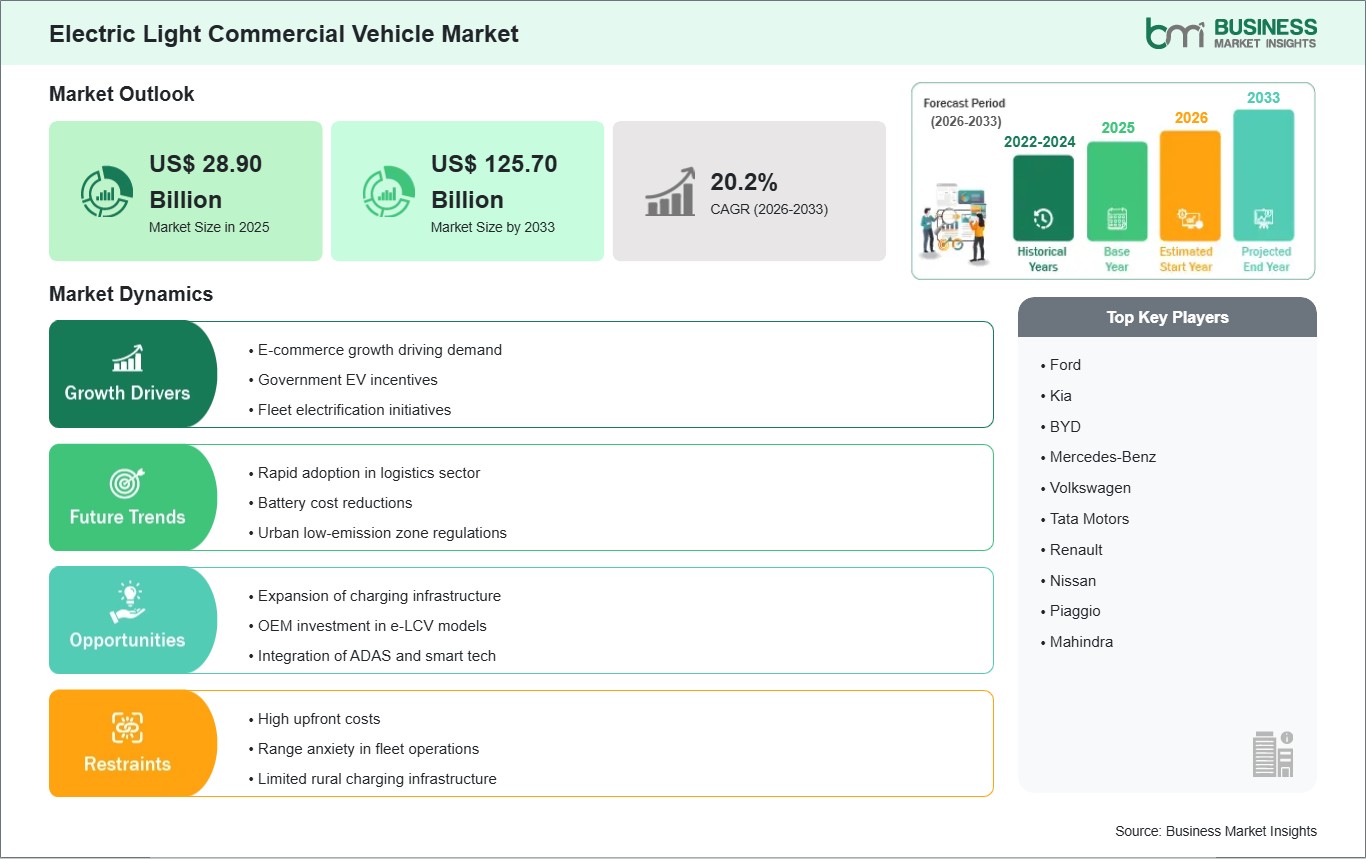
Historic Data: 2022-2024   |   Base Year: 2025   |   Forecast Period: 2026-2033
Report Content: Market Scope, Market Segmentation, Market Dynamics, and Competitive Analysis

Report Coverage:
  • Vehicle Type (Pickup Truck, Van)
  • Propulsion (BEV, PHEV, FCEV, HEV)
  • End Use (Urban Logistics, Last-Mile Delivery, Fleet Operations)

No. of Pages: 400
Report Code: BMIPUB00035583
Category: Automotive and Transportation
Electric Light Commercial Vehicle Market

The electric light commercial vehicle market size is expected to reach US$ 125.70 billion by 2033 from US$ 28.90 billion in 2025. The market is estimated to record a CAGR of 20.2% during 2026 to 2033.

Executive Summary and Global Market Analysis:

Electric light commercial vehicles (e-LCVs) are battery-powered or electrified commercial transportation solutions designed for goods movement, urban logistics, fleet operations, and last-mile delivery services. These vehicles primarily include electric pickup trucks and vans that offer lower operating costs, reduced emissions, and improved energy efficiency compared to conventional internal combustion engine vehicles. As businesses increasingly prioritize sustainable transportation strategies, e-LCVs are becoming a critical component of modern commercial mobility ecosystems.

The market is experiencing strong growth due to accelerating e-commerce activity, rising urbanization, and growing demand for efficient delivery networks. Logistics providers, retailers, and fleet operators are increasingly adopting electric light commercial vehicles to reduce fuel expenses, comply with environmental regulations, and meet corporate sustainability objectives. The transition toward cleaner transportation is further supported by government incentives and vehicle electrification policies worldwide.

Urban delivery operations are undergoing significant transformation as cities introduce low-emission zones and stricter environmental standards. Electric vans and pickup trucks provide a practical solution for commercial operators seeking to maintain delivery efficiency while reducing environmental impact. Their suitability for stop-and-go urban driving conditions further enhances their economic attractiveness.

Technological advancements in battery systems, charging infrastructure, telematics, and vehicle connectivity are improving the performance and reliability of e-LCVs. Increasing battery energy density and declining battery costs are extending vehicle range and reducing total cost of ownership. Smart fleet management technologies are also helping operators optimize routes, monitor vehicle health, and improve operational productivity.

Electric Light Commercial Vehicle Market - Strategic Insights:

global-market-strategic-framework
Get more information on this report

Electric Light Commercial Vehicle Market Segmentation Analysis:

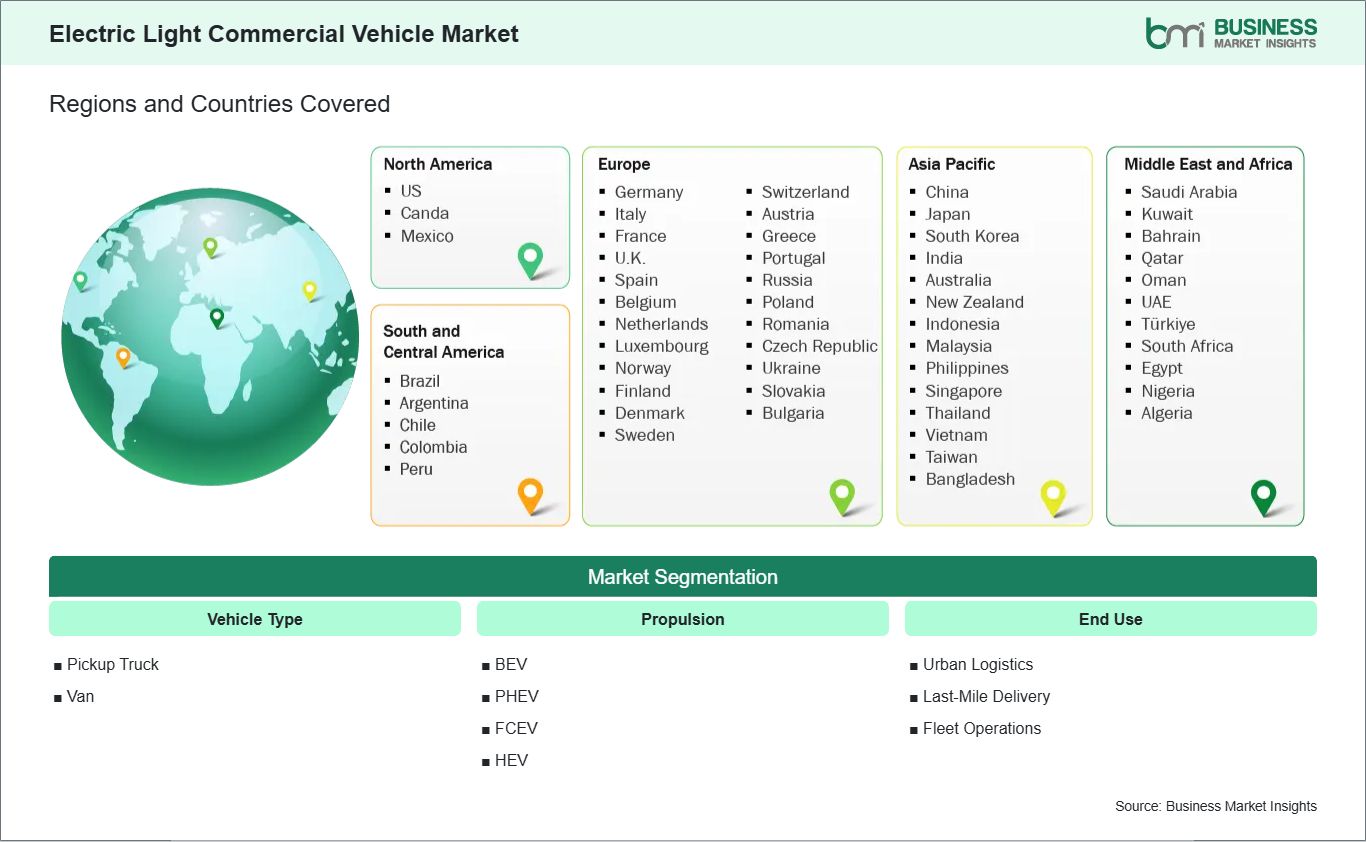
The electric light commercial vehicle market is segmented based on vehicle type, propulsion, and end use, reflecting the growing adoption of electrified transportation solutions across commercial logistics and delivery operations.

By Vehicle Type

  • Pickup Truck: Increasingly adopted for utility services, construction support, municipal operations, and commercial transportation requiring versatility and payload capability.
  • Van: Represents a major market segment due to widespread deployment in urban logistics, parcel delivery, and e-commerce fulfillment operations.

By Propulsion

  • BEV: Dominates market demand owing to zero tailpipe emissions, lower operating costs, and expanding charging infrastructure availability.
  • PHEV: Provides operational flexibility through combined electric and conventional powertrain capabilities, supporting extended driving ranges.
  • FCEV: Emerging in selected commercial applications where rapid refueling and longer driving range requirements are critical.
  • HEV: Maintains adoption in markets transitioning toward full vehicle electrification while seeking improved fuel efficiency.

By End Use

  • Urban Logistics: Accounts for substantial demand due to increasing freight movement within cities and growing sustainability requirements.
  • Last-Mile Delivery: Experiencing rapid growth supported by expanding e-commerce activities and customer expectations for faster deliveries.
  • Fleet Operations: Increasingly adopting electric vehicles to reduce operating expenses, improve efficiency, and achieve environmental goals.
Electric Light Commercial Vehicle Market Drivers and Opportunities:

E-Commerce Growth Driving Demand

Worldwide, e-commerce is rapidly expanding, which is creating a high demand for electric light commercial vehicles (e-LCVs) to deliver products that were ordered on the internet. The number of parcels being delivered has increased due to the growth of online retail, making it increasingly necessary for businesses to have efficient, cost-effective, and environmentally-friendly methods of delivering goods to customers. To handle the increasing volume of shipments and changing shopping behaviours of consumers, logistics companies are adding new trucks and vans to their fleets.

Electric vans and electric pickup trucks work very well in urban and suburban locations because of their lower cost-to-operate, reduced maintenance, and ability to meet low-emission requirements. In addition, the frequent stopping/starting nature of delivery routes makes using an electric propulsion system a very efficient way to drive.

Due to the continued worldwide growth of e-commerce platforms, transportation providers are investing heavily in updating their fleets with newer vehicles through fleet modernization/electrification programs. Therefore, the anticipated growth of commercial vehicle deployments will remain a key driver for electric light commercial vehicle market growth throughout the forecast period.

Expansion of Charging Infrastructure

The electric light commercial vehicle market has a tremendous chance to grow, thanks to the expanding charging networks. Having widespread and dependable charging stations will allow fleets to electrify at scale, while also addressing the issues of range and locating a place to charge an electric vehicle when needed.

Governments, utilities, charging service providers, and vehicle manufacturers all currently invest large amounts in either public or private charging networks. This includes fleets using depot charging systems as well as new fast-charge networks that give operators of commercial vehicles even more flexibility in the operation of their vehicles.

The increased availability of charging technology such as ultra-fast charging solutions and smart energy management systems are contributing to reduced downtime and improved fleet productivity - all of which are beneficial; therefore, as charging hopefully continues to expand, we will see electric light commercial vehicles become more popular in applications such as logistics, delivery, and fleet management.

Electric Light Commercial Vehicle Market Size and Share Analysis:

The electric light commercial vehicle market is projected to grow from US$ 28.90 billion in 2025 to US$ 125.70 billion by 2033, registering a CAGR of 20.2% from 2026 to 2033.

By vehicle type, vans account for a significant market share due to extensive deployment across delivery and logistics operations. Electric pickup trucks are also witnessing strong growth driven by increasing adoption in utility, municipal, and commercial service applications.

By propulsion, BEVs dominate the market owing to strong regulatory support, declining battery costs, and growing charging infrastructure availability. PHEVs and HEVs continue to serve transitional markets where charging networks remain under development, while FCEVs are gradually emerging in specialized commercial applications.

By end use, last-mile delivery represents a major growth segment supported by e-commerce expansion. Urban logistics and fleet operations also contribute significantly to market demand as organizations prioritize transportation efficiency and sustainability.

Electric Light Commercial Vehicle Market Report Highlights:

Report Attribute Details
Market size in 2025 US$ 28.90 Billion
Market Size by 2033 US$ 125.70 Billion
Global CAGR (2026 - 2033)20.2%
Historical Data 2022-2024
Forecast period 2026-2033
Segments Covered By Vehicle Type
  • Pickup Truck
  • Van
By Propulsion
  • BEV
  • PHEV
  • FCEV
  • HEV
By End Use
  • Urban Logistics
  • Last-Mile Delivery
  • Fleet Operations
Regions and Countries Covered
North America US, Canada, Mexico
Europe Germany, Italy, France, U.K., Spain, Belgium, Netherlands, Luxembourg, Norway, Finland, Denmark, Sweden, Switzerland, Austria, Greece, Portugal, Russia, Poland, Romania, Czech Republic, Ukraine, Slovakia, Bulgaria
Asia-Pacific China, Japan, South Korea, India, Australia, New Zealand, Indonesia, Malaysia, Philippines, Singapore, Thailand, Vietnam, Taiwan, Bangladesh
South and Central America Brazil, Argentina, Chile, Colombia, Peru
Middle East and Africa Saudi Arabia, United Arab Emirates, Kuwait, Bahrain, Qatar, Oman, Turkiye, South Africa, Egypt, Nigeria, Algeria
Market leaders and key company profiles
  • Ford
  • Kia
  • BYD
  • Mercedes-Benz
  • Volkswagen
  • Tata Motors
  • Renault
  • Nissan
  • Piaggio
  • Mahindra
Get more information on this report

Electric Light Commercial Vehicle Market Report Coverage and Deliverables:

The "Electric Light Commercial Vehicle Market Size and Forecast (2022 - 2033)" report provides a detailed analysis of the market covering below areas:

  • Market size and forecast at global, regional, and country levels for all key market segments covered under the scope
  • Market trends, along with market dynamics such as drivers, restraints, and key opportunities
  • Market analysis covering key trends, global and regional frameworks, major players, regulations, and recent developments
  • Industry landscape and competitive analysis covering market concentration, heat map analysis, prominent players, and recent developments
  • Detailed company profiles, including SWOT analysis

Electric Light Commercial Vehicle Market Geographic Insights:

Regional variation is evident in the EV commercial vehicle market due to such factors as logistical development, the rollout of charging infrastructure, governmental policies, and transportation electrification initiatives. Demand is constantly changing as commercial fleet operators seek to provide more sustainable mobility solutions.

Significantly, ongoing e-commerce development, fleet electrification programmes, and investment in charging infrastructure are making North America an important market for electric delivery vehicles. Large logistics providers and retailers are transitioning to electric delivery vehicles to reduce both emissions and costs associated with running these fleets.

Environmental regulations, low-emission zones and climate targets that are more stringent than anywhere else in the world have resulted in Europe maintaining a strong level of electric van and pickup truck adoption. As a result, fleet operators are increasingly moving to Evs to comply with regulations and to improve their sustainability initiatives.

The Asia-Pacific region is expected to achieve the most rapid growth in the near term as a result of rapid urbanization, e-commerce and massive government support for electric mobility. Countries such as China, India, Japan, and South Korea are investing heavily in EVs, battery manufacturing, and charging infrastructure to capitalise on this demand.

Similarly, as infrastructure improvements in commercial transportation networks continue to modernize across the Middle East and Africa, and throughout South and Central America, the adoption of electric vehicles will continue to grow as electrification initiatives succeed.

global-market-geography
Get more information on this report

Electric Light Commercial Vehicle Market Research Report Guidance:

  • The report includes qualitative and quantitative data in the Electric Light Commercial Vehicle Market across vehicle type, propulsion, end use, and geography.
  • The report starts with the key takeaways (chapter 2), highlighting key trends and outlook of the market.
  • Chapter 3 focuses on the research methodology of the study.
  • Chapter 4 includes ecosystem analysis.
  • Chapter 5 highlights the major industry dynamics in the market, including factors that are driving the market, prevailing deterrents, potential opportunities, as well as future trends. Impact analysis of these drivers and restraints is also covered in this section.
  • Chapter 6 discusses the market scenario, in terms of historical market revenues, and forecast till the year 2033.
  • Chapters 7 to 10 cover market segments by vehicle type, propulsion, end use, and geography across North America, Asia Pacific, Europe, Middle East and Africa, and South and Central America. They cover the market revenue forecast and factors driving the market.
  • Chapter 11 describes the competitive analysis along with the heat map analysis for the key players operating in the market.
  • Chapter 12 describes the industry landscape analysis. It provides detailed descriptions of business activities such as market initiatives, new developments, mergers, and joint ventures globally, along with a competitive landscape.
  • Chapter 13 provides detailed profiles of the major companies operating in the market. Companies have been profiled on the basis of their key facts, business descriptions, products, financial overview, SWOT analysis, and key developments.
  • Chapter 14, i.e., the appendix, is inclusive of a brief overview of the company, a list of abbreviations, and a disclaimer.

Electric Light Commercial Vehicle Market News and Key Development:

The electric light commercial vehicle market is evaluated by gathering qualitative and quantitative data post primary and secondary research, which includes important corporate publications, association data, and databases. Recent developments and news in the market include:

  • In May 2026, in India, Small e-CVs made up 81% of electric commercial vehicle sales in April 2026, with 1,817 units and 200% YoY growth. Tata Motors led the e-SCV segment with a 44% share (792 units), while Euler Motors recorded a peak of 518 units.
  • In March 2025, Stellantis Pro One and IVECO collaborated for the supply of two electric IVECO-branded vans. This agreement to commercialize two fully electric light commercial vans under the IVECO brand in Europe, with launch planned for mid-2026.

Key Sources Referred:

  • International Energy Agency (IEA)
  • International Organization of Motor Vehicle Manufacturers (OICA)
  • International Monetary Fund (IMF)
  • World Bank - Transport and Logistics Indicators
  • International Trade Administration (ITA)
  • World Trade Organization (WTO)
  • European Automobile Manufacturers Association (ACEA)
The List of Companies - Electric Light Commercial Vehicle Market
  • Ford
  • Kia
  • BYD
  • Mercedes-Benz
  • Volkswagen
  • Tata Motors
  • Renault
  • Nissan
  • Piaggio
  • Mahindra
Frequently Asked Questions
How big is the Electric Light Commercial Vehicle Market?

The Electric Light Commercial Vehicle Market is valued at US$ 28.90 Billion in 2025, it is projected to reach US$ 125.70 Billion by 2033.

What is the CAGR for Electric Light Commercial Vehicle Market by (2026 - 2033)?

As per our report Electric Light Commercial Vehicle Market, the market size is valued at US$ 28.90 Billion in 2025, projecting it to reach US$ 125.70 Billion by 2033. This translates to a CAGR of approximately 20.2% during the forecast period.

What segments are covered in this report?

The Electric Light Commercial Vehicle Market report typically cover these key segments-

  • Vehicle Type (Pickup Truck, Van)
  • Propulsion (BEV, PHEV, FCEV, HEV)
  • End Use (Urban Logistics, Last-Mile Delivery, Fleet Operations)

What is the historic period, base year, and forecast period taken for Electric Light Commercial Vehicle Market?

The historic period, base year, and forecast period can vary slightly depending on the specific market research report. However, for the Electric Light Commercial Vehicle Market report:

  • Historic Period : 2022-2024
  • Base Year : 2025
  • Forecast Period : 2026-2033
  • Who are the major players in Electric Light Commercial Vehicle Market?

    The Electric Light Commercial Vehicle Market is populated by several key players, each contributing to its growth and innovation. Some of the major players include:

  • Ford
  • Kia
  • BYD
  • Mercedes-Benz
  • Volkswagen
  • Tata Motors
  • Renault
  • Nissan
  • Piaggio
  • Mahindra
  • Who should buy this report?

    The Electric Light Commercial Vehicle Market report is valuable for diverse stakeholders, including:

    • Investors: Provides insights for investment decisions pertaining to market growth, companies, or industry insights. Helps assess market attractiveness and potential returns.
    • Industry Players: Offers competitive intelligence, market sizing, and trend analysis to inform strategic planning, product development, and sales strategies.
    • Suppliers and Manufacturers: Helps understand market demand for components, materials, and services related to concerned industry.
    • Researchers and Consultants: Provides data and analysis for academic research, consulting projects, and market studies.
    • Financial Institutions: Helps assess risks and opportunities associated with financing or investing in the concerned market.

    Essentially, anyone involved in or considering involvement in the Electric Light Commercial Vehicle Market value chain can benefit from the information contained in a comprehensive market report.

    Available Report Formats

    pdf-format excel-format pptx-format
    Buy Now
    Sales Assistance
    +1 646 791 7070 (US & UK)
    Customization Form

    Please tell us your area of interest
    (Market Segments/ Regions and Countries/ Companies)