
Light Commercial Vehicle Market Outlook: Size, Share, Trends, Growth Analysis, Competitive Landscape & Forecast, 2026-2033

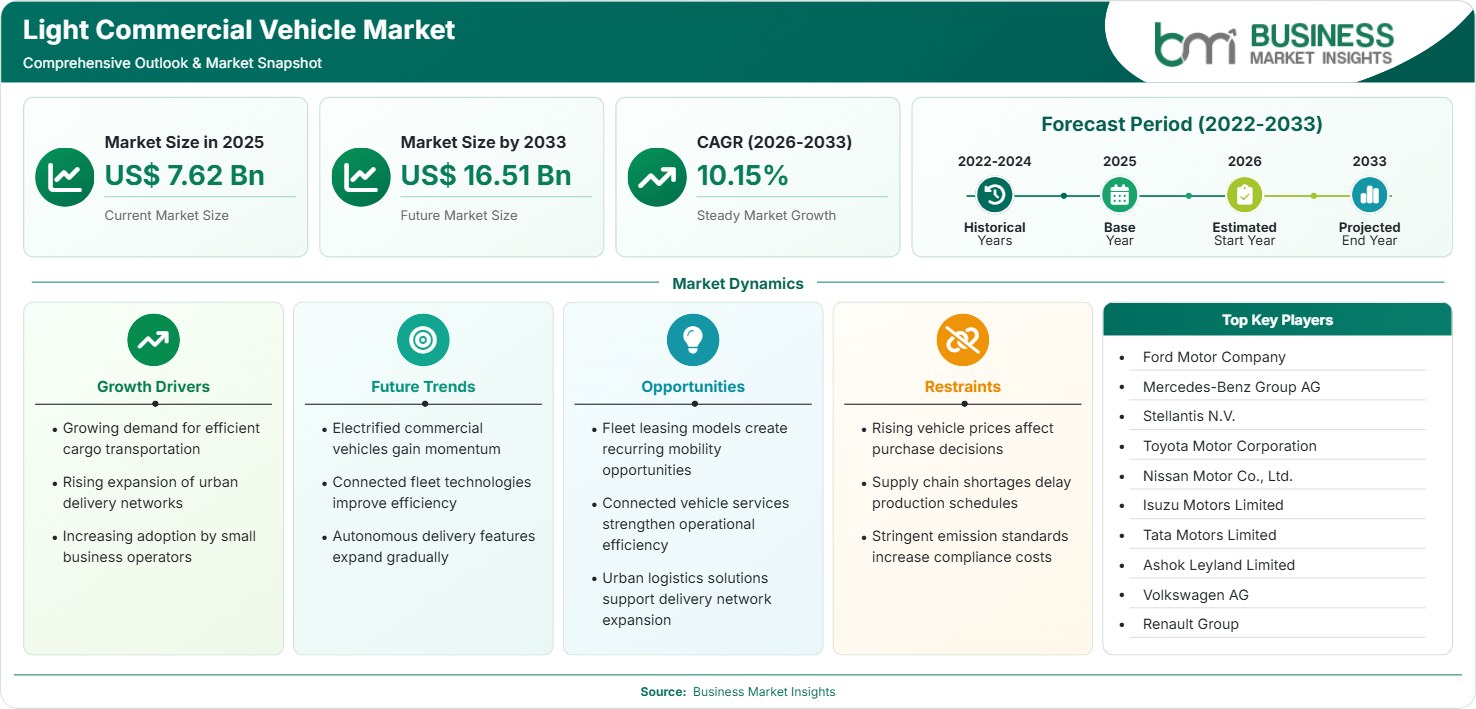
The Light Commercial Vehicle Market size was valued at US$ 7.62 billion in 2025 and is projected to reach US$ 16.51 billion by 2033, growing at a CAGR of 10.15% during 2026–2033. Growing demand for efficient cargo transportation, expansion of urban delivery networks, and increasing adoption by small business operators continue to support sustained market development.

Report Coverage
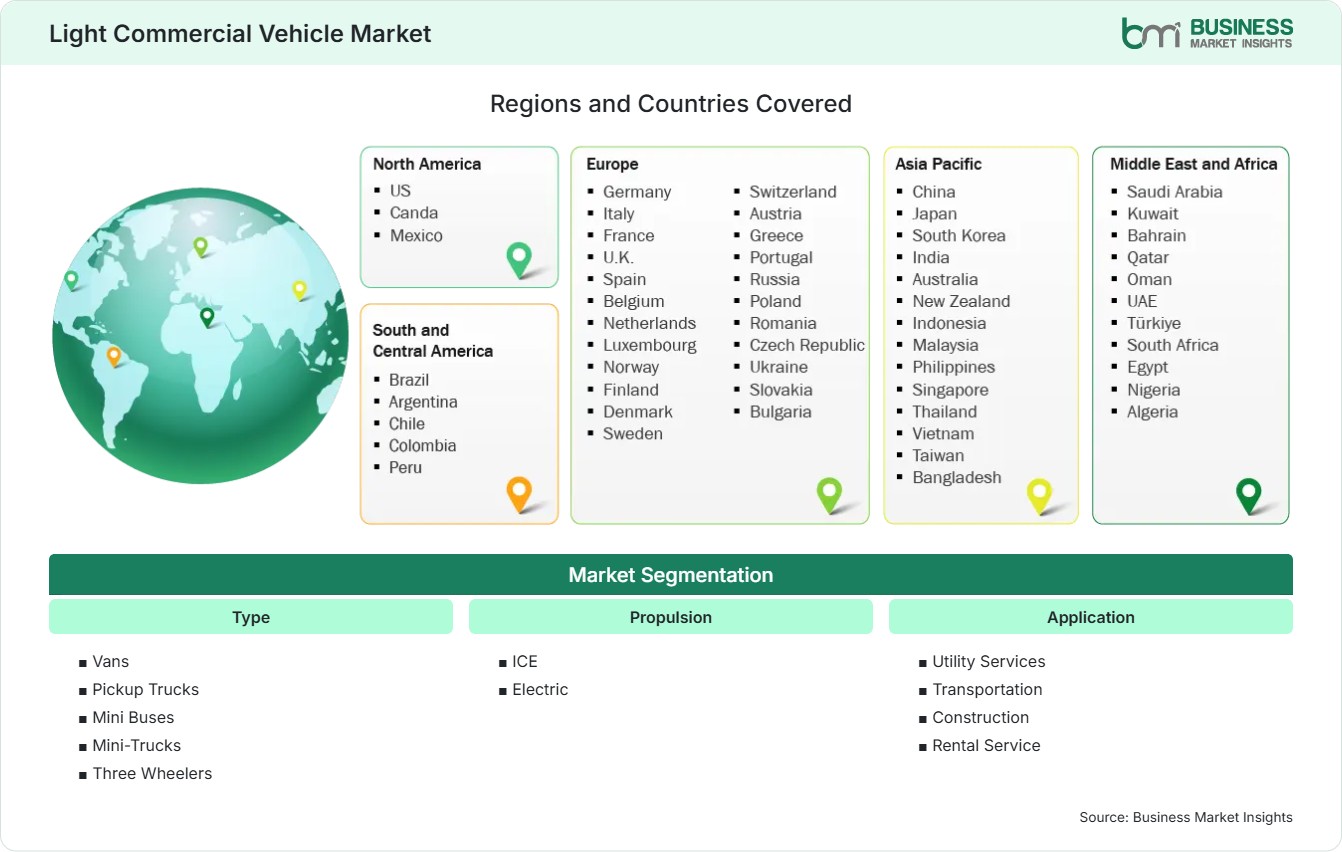
  • Type: Vans, Pickup Trucks, Mini Buses, Mini-Trucks, Three Wheelers
  • Propulsion: ICE, Electric
  • Application: Utility Services, Transportation, Construction, Rental Service
US$ 7.62 Bn Market size in 2025
US$ 16.51 Bn Market Size by 2033
10.15% CAGR, 2026 - 2033
2026-2033 Forecast Period

01 AI Overview

Light Commercial Vehicle Market Summary

  • North America Region: North America accounts for 29%–32% market share in 2025 and is projected to grow at a CAGR of 9.6%–10.1% during 2026–2033. Fleet modernization, expanding e-commerce logistics, and rising commercial vehicle replacement demand continue supporting market expansion. The U.S. remains the leading contributor with a CAGR of 9.7%–10.2%, driven by strong logistics activity and business fleet investments.
  • Fastest Growing Region: Asia Pacific represents 39%–42% market share in 2025 and is expected to register a CAGR of 10.8%–11.4%, supported by rapid urbanization, infrastructure development, growing manufacturing output, and expanding last-mile delivery services.
  • Leading Segment: Vans account for 34%–37% market share in 2025 and are anticipated to expand at a CAGR of 10.3%–10.8%, owing to increasing demand from logistics providers, parcel delivery companies, and urban transportation services.
  • High Growth Segment: Electric propulsion captures 24%–27% market share in 2025 and is projected to record a CAGR of 13.2%–13.8%, supported by emission regulations, government incentives, and fleet electrification initiatives.
  • Key Market Opportunity: Growth in connected fleet management, electric mobility, and urban logistics is creating opportunities for manufacturers to deliver intelligent, efficient, and sustainable commercial vehicle solutions.
  • Major Market Players: Ford Motor Company, Mercedes-Benz Group AG, Stellantis N.V., Toyota Motor Corporation, Nissan Motor Co., Ltd., Isuzu Motors Limited, Tata Motors Limited, Ashok Leyland Limited, Volkswagen AG, and Renault Group.
02 Strategic Insights

Light Commercial Vehicle Market: Strategic Insights

Light Commercial Vehicle Market Strategic Framework
FREE PDF
Request your free sample
Request free sample
03 Stakeholder View

Key Takeaways

  • Growing e-commerce activity and rapid expansion of last-mile delivery networks continue strengthening long-term demand for compact commercial transport solutions.
  • Fleet operators are increasingly prioritizing vehicles with lower operating costs, improved fuel efficiency, and connected technologies that enhance fleet productivity and maintenance planning.
  • Electrification remains one of the strongest innovation areas as manufacturers introduce battery-electric models to comply with tightening emission regulations.
  • Asia Pacific continues offering the strongest investment potential due to expanding industrial production, urban infrastructure development, and rising demand from logistics providers and small businesses.
  • Strategic partnerships involving vehicle manufacturers, fleet operators, and digital mobility providers are accelerating adoption of intelligent fleet management solutions.
  • Continuous investment in telematics, predictive maintenance, and connected vehicle ecosystems is improving fleet utilization while supporting long-term operational efficiency.
04 Geographic Outlook

Light Commercial Vehicle Market Regional Highlights

North America Light Commercial Vehicle Market

North America accounts for 29%–32% Light Commercial Vehicle Market share in 2025 and is expected to register a CAGR of 9.6%–10.1% during 2026–2033. Demand remains supported by expanding logistics operations, replacement of aging commercial fleets, and strong investment in connected vehicle technologies. Fleet operators continue adopting advanced vans and pickup trucks equipped with telematics, improved fuel efficiency, and enhanced driver safety systems.

  • Growth in e-commerce delivery services continues increasing demand for versatile commercial vehicles with higher cargo efficiency.
  • Fleet modernization programs encourage adoption of connected vehicle technologies and advanced driver assistance systems.
  • Electric commercial vehicle investments strengthen sustainable transportation initiatives across urban logistics operations.
  • Commercial fleet leasing continues expanding as businesses seek flexible ownership and lower capital expenditure.

US Light Commercial Vehicle Market

The United States contributes 81%–84% of North American revenue and is forecast to expand at a CAGR of 9.7%–10.2% through 2026–2033. Strong logistics infrastructure, high commercial vehicle utilization, and increasing investments in fleet electrification continue supporting sustained demand across multiple industries.

  • Fleet operators increasingly adopt connected vehicle platforms for operational visibility and predictive maintenance.
  • Logistics providers continue expanding delivery fleets to support rising online retail demand.
  • Infrastructure investments strengthen commercial transportation across urban and regional markets.
  • Businesses increasingly prefer leasing models to improve fleet flexibility and financial efficiency.

Europe Light Commercial Vehicle Market

Europe represents 24%–27% market share in 2025 and is projected to grow at a CAGR of 9.5%–10.0% during the forecast period. Stringent emission regulations, rising electric vehicle adoption, and growing commercial transportation activity continue supporting regional expansion. Germany remains the largest market, while Spain records the fastest growth through increasing logistics investments and fleet electrification.

  • Environmental regulations continue accelerating electric commercial vehicle adoption across regional fleets.
  • Connected mobility technologies improve fleet efficiency and vehicle utilization.
  • Urban freight transportation drives demand for compact and low-emission delivery vehicles.
  • Manufacturers continue expanding electric van production to address changing customer requirements.

Asia Pacific Light Commercial Vehicle Market

Asia Pacific holds 39%–42% market share in 2025 and is expected to register the fastest 10.8%–11.4% CAGR through 2026–2033. Rapid industrialization, urban population growth, expanding logistics infrastructure, and increasing small business activity continue driving commercial vehicle demand. China leads regional sales, while India records the fastest growth supported by infrastructure development and expanding e-commerce networks.

  • Manufacturing expansion increases commercial transportation requirements across industrial supply chains.
  • Government incentives encourage adoption of electric commercial vehicles for urban logistics.
  • Rising infrastructure investments strengthen regional freight movement and distribution efficiency.
  • Growing demand from small businesses supports sales of versatile commercial vehicle platforms.

Rest of World Light Commercial Vehicle Market

The Rest of World region accounts for 6%–9% market share in 2025 and is projected to expand at a CAGR of 9.8%–10.4% during 2026–2033. Improving transportation infrastructure, urban development, and commercial activity continue supporting demand across Latin America, the Middle East, and Africa.

  • Brazil remains the leading regional market supported by expanding logistics and agricultural transportation.
  • GCC countries continue investing in commercial fleet modernization and infrastructure development.
  • Fleet operators increasingly adopt connected mobility solutions to improve operational performance.
  • Expanding construction and industrial activities continue generating demand for light commercial vehicles.
Global Market Geography
FREE PDF
Request your free sample
Request free sample
05 Segment Analysis

Light Commercial Vehicle Market Segmentation

Type

The type segment remains the largest contributor as businesses increasingly require versatile commercial vehicles capable of supporting freight movement, passenger transport, and urban logistics. It accounted for 34%–37% market share in 2025 and is expected to register a CAGR of 10.3%–10.8% during 2026–2033. Expanding logistics operations, rising fleet replacement, and increasing vehicle customization continue broadening the Light Commercial Vehicle Market scope across developed and emerging economies.

  • Vans: Lead the segment due to strong demand from parcel delivery, e-commerce logistics, municipal services, and refrigerated transportation requiring efficient cargo capacity and maneuverability in urban environments.
  • Pickup Trucks: Widely adopted across construction, agriculture, mining, and utility operations because of their durability, payload capacity, towing capability, and suitability for challenging operating conditions.
  • Mini Buses: Continue gaining demand for employee transportation, school services, tourism, and shuttle operations where compact size and operational efficiency provide significant advantages.
  • Mini-Trucks: Preferred by small businesses and local distributors for short-distance cargo transportation, particularly in densely populated urban centers where compact dimensions improve accessibility.
  • Three Wheelers: Experience growing adoption across emerging economies for last-mile deliveries and urban freight movement due to affordability, low operating costs, and high maneuverability.

Propulsion

The propulsion segment is evolving rapidly as governments introduce stricter emission standards and fleet operators focus on lowering operating costs. It represented 73%–76% market share in 2025 and is anticipated to expand at a CAGR of 9.3%–9.8% during 2026–2033. Electrification initiatives, charging infrastructure development, and technological improvements continue accelerating adoption across commercial transportation fleets.

  • ICE (Internal Combustion Engine): Continues dominating global sales because of established fueling infrastructure, higher driving range, strong payload capability, and suitability for long-distance commercial transportation.
  • Electric: Records the fastest expansion as logistics companies invest in zero-emission fleets supported by government incentives, lower maintenance costs, and advancements in battery technology.

Application

Commercial vehicle demand varies according to operational requirements across industries, making application diversity a key market characteristic. This segment accounted for 38%–41% market share in 2025 and is projected to register a CAGR of 10.5%–11.0% through 2026–2033. Current Light Commercial Vehicle Market trends indicate increasing investment in specialized fleet solutions that improve operational flexibility, vehicle utilization, and delivery efficiency.

  • Utility Services: Demand remains strong for vehicles supporting telecommunications, energy, water supply, municipal maintenance, and public infrastructure operations requiring dependable transportation solutions.
  • Transportation: Represents the largest application area as logistics providers, courier companies, distributors, and freight operators expand commercial fleets to meet increasing cargo movement requirements.
  • Construction: Construction contractors continue investing in durable commercial vehicles capable of transporting equipment, construction materials, and workforce across infrastructure development projects.
  • Rental Service: Fleet rental providers are expanding commercial vehicle portfolios to support businesses requiring flexible transportation solutions without significant capital investment or long-term ownership commitments.
06 Market Forces

Light Commercial Vehicle Market Dynamics

Key Market Drivers

Growing demand for efficient cargo transportation

Rapid growth in both internal and international trading activities has led to an increase in the demand for dependable cargo transportation. Companies are spending on vehicles that have high payload capacity, consume less fuel, and operate at lower costs while maintaining delivery times. The International Transport Forum (ITF) indicates that demand for freight transport will keep growing in the next few decades. These developments continue supporting Light Commercial Vehicle Market growth, particularly across logistics, retail distribution, manufacturing, and agricultural supply chains where operational efficiency directly influences profitability.

Rising expansion of urban delivery networks

Growth in e-commerce, food delivery, and on-demand retail services has transformed urban logistics worldwide. The increase in the number of small commercial vehicles in last mile deliveries by companies is due to the ability of these vehicles to operate in busy urban settings while still being efficient and fast with regard to deliveries. The availability of urban consolidation centers and smart route planning together with digital fleet management systems increases the need for versatile light commercial vehicles.

Increasing adoption by small business operators

Small and medium size enterprises will remain an important source of customers for light commercial vehicles since such enterprises will have need for cost-effective transport means that they can use to run their operations. Companies that engage in trade, building activities, maintenance, farming, and local distribution will rely on light commercial vehicles to increase efficiency and widen service provision. These developments continue shaping Light Commercial Vehicle Market trends, encouraging higher adoption across diverse commercial sectors.

Key Market Opportunities

Fleet leasing models create recurring mobility opportunities

Fleet leasing is rapidly emerging as a viable approach to business operations that requires no initial capital investment. Fleet leasing allows companies to upgrade their fleets on a regular basis and minimize their liability for maintenance costs. Commercial fleet operators are developing longer-term leasing schemes involving not only maintenance but also insurance and telematics among other services. Light Commercial Vehicle Market Forecasts suggest that the continued shift toward subscription-based fleet ownership models will create recurring revenue opportunities for manufacturers, leasing companies, and mobility service providers.

Connected vehicle services strengthen operational efficiency

Telematics, real-time vehicle diagnostics, predictive maintenance, and remote fleet monitoring are becoming standard features in commercial transportation. Fleet management companies are adopting advanced connected technologies to achieve optimal routes, driver behavior monitoring, reduced fuel costs, and efficient vehicle usage. The technologies provide operational efficiencies and reduced maintenance costs without unscheduled downtimes. In line with the continued emphasis on data-driven fleet management, companies that will embrace intelligent connectivity technologies will become more competitive.

Urban logistics solutions support delivery network expansion

Rapid urbanization is encouraging logistics companies to redesign delivery operations using compact, efficient, and environmentally friendly commercial vehicles. Smart city programs, delivery zones, and enhanced charging stations are aiding in the adoption of new urban fleets. Car manufacturers are designing vehicles specifically tailored to the demands of constant stopping, short distances, and last mile deliveries. The future success of investments in sustainable logistics infrastructure will provide favorable circumstances for commercial vehicle manufacturers in expanding urban delivery fleets.

Market Restraints and Challenges

Rising vehicle prices affect purchase decisions

Commercial vehicle prices continue increasing due to higher raw material costs, advanced electronic systems, stricter emission technologies, and expanding safety requirements. Factor: Rising acquisition costs place financial pressure on fleet operators and small businesses with limited capital resources. Impact: Companies may delay fleet replacement, extend vehicle operating life, or reduce procurement volumes, slowing new vehicle sales despite growing transportation demand. Manufacturers are responding through financing programs and leasing options, although affordability remains a key market challenge.

Supply chain shortages delay production schedules

Global supply chains continue experiencing periodic disruptions affecting semiconductors, electronic components, batteries, and critical automotive materials. Factor: Limited component availability interrupts production planning and extends manufacturing lead times across commercial vehicle assembly facilities. Impact: Delivery delays increase operational uncertainty for fleet operators while reducing manufacturers' ability to meet customer demand promptly. Companies continue diversifying supplier networks, regionalizing production, and strengthening inventory management to improve long-term supply chain resilience.

07 Company Analysis

Competitive Landscape

Competition within the market is driven by vehicle electrification, connected mobility technologies, fleet customization, and expansion of regional manufacturing capabilities. Light Commercial Vehicle Market analysis indicates that leading manufacturers are investing in electric platforms, advanced safety systems, telematics, and digital fleet management solutions to strengthen their positions across logistics, construction, passenger transport, and utility service applications.

Company Name

Overview

Products and Services Relevant to this Market

Ford Motor Company

Global automotive manufacturer with a strong presence in commercial vehicles, offering durable and technologically advanced mobility solutions across international markets.

Transit vans, Ranger pickup trucks, connected fleet services, electric commercial vehicles, telematics, and fleet management solutions.

Mercedes-Benz Group AG

Premium automotive manufacturer delivering commercial vehicles focused on safety, efficiency, and advanced digital technologies.

Sprinter vans, electric eSprinter, fleet connectivity solutions, commercial vehicle services, and aftersales support.

Stellantis N.V.

Multinational automotive group producing a broad portfolio of commercial vehicles through multiple global brands.

Delivery vans, pickup trucks, electric light commercial vehicles, fleet solutions, and mobility services.

Toyota Motor Corporation

Leading vehicle manufacturer known for reliable commercial transportation solutions and expanding electrified vehicle offerings.

Hilux pickup trucks, Proace vans, hybrid commercial vehicles, fleet support services, and connected mobility technologies.

Nissan Motor Co., Ltd.

Develops commercial vehicles designed for urban logistics, passenger transport, and industrial applications worldwide.

NV series vans, pickup trucks, electric commercial vehicles, fleet connectivity, and maintenance services.

Isuzu Motors Limited

Specializes in commercial transportation with expertise in durable trucks and fleet-oriented vehicle solutions.

Light-duty trucks, pickup vehicles, diesel powertrains, commercial fleet support, and maintenance services.

Tata Motors Limited

Major commercial vehicle manufacturer serving logistics, construction, and public transportation sectors across multiple international markets.

Ace mini-trucks, pickup vehicles, electric commercial vehicles, fleet management solutions, and connected vehicle technologies.

Ashok Leyland Limited

Produces commercial transportation solutions with a growing portfolio of light-duty vehicles and electric mobility platforms.

Light commercial trucks, delivery vehicles, electric commercial vehicles, fleet services, and telematics solutions.

Volkswagen AG

Global automotive manufacturer offering efficient commercial vehicles for logistics, passenger transport, and business mobility.

Caddy, Transporter, Amarok, electric commercial vehicles, digital fleet services, and mobility solutions.

Renault Group

European vehicle manufacturer focused on innovative light commercial vehicles and sustainable mobility technologies.

Kangoo, Trafic, Master vans, electric commercial vehicles, fleet connectivity, and mobility services.

10 Trust & Transparency

Research Methodology

The market analysis combines proprietary research with secondary data from government agencies, company disclosures, regulatory filings, industry databases and expert interviews. Market estimates are validated through data triangulation, cross-market benchmarking and analyst review.

View Full Research Methodology

11 Questions Answered

Frequently Asked Questions

What does the Light Commercial Vehicle Market Report include?

The Market Report provides comprehensive insights into market dynamics, regional performance, competitive landscape, technological developments, segmentation, investment opportunities, and future industry outlook to support strategic business decisions.

Which region offers the strongest growth opportunities?

Asia Pacific presents the highest growth potential due to rapid urbanization, expanding logistics infrastructure, industrial development, increasing e-commerce activity, and rising demand from small and medium-sized enterprises.

Why are electric light commercial vehicles gaining popularity?

Electric models reduce operating costs, support emission reduction targets, require less maintenance, and qualify for government incentives, making them increasingly attractive for fleet operators and urban delivery companies.

Which vehicle type holds the largest market share?

Vans represent the leading vehicle category because they provide excellent cargo capacity, operational flexibility, fuel efficiency, and suitability for parcel delivery, retail distribution, and urban logistics operations.

What factors are driving the Light Commercial Vehicle Market?

The market is primarily driven by expanding e-commerce logistics, increasing urban freight movement, growing demand from small businesses, fleet modernization initiatives, and rising investments in connected and electric commercial vehicle technologies.

Access the Full Light Commercial Vehicle Market Report

Get segment-level forecasts, regional estimates, competitive benchmarking, company profiles and downloadable Excel datasets.

Access the full Light Commercial Vehicle Market Report
350 pages PDF & Excel | 2026-08-12