
Commercial Vehicle Market Outlook: Size, Share, Trends, Growth Analysis, Competitive Landscape & Forecast, 2026-2033

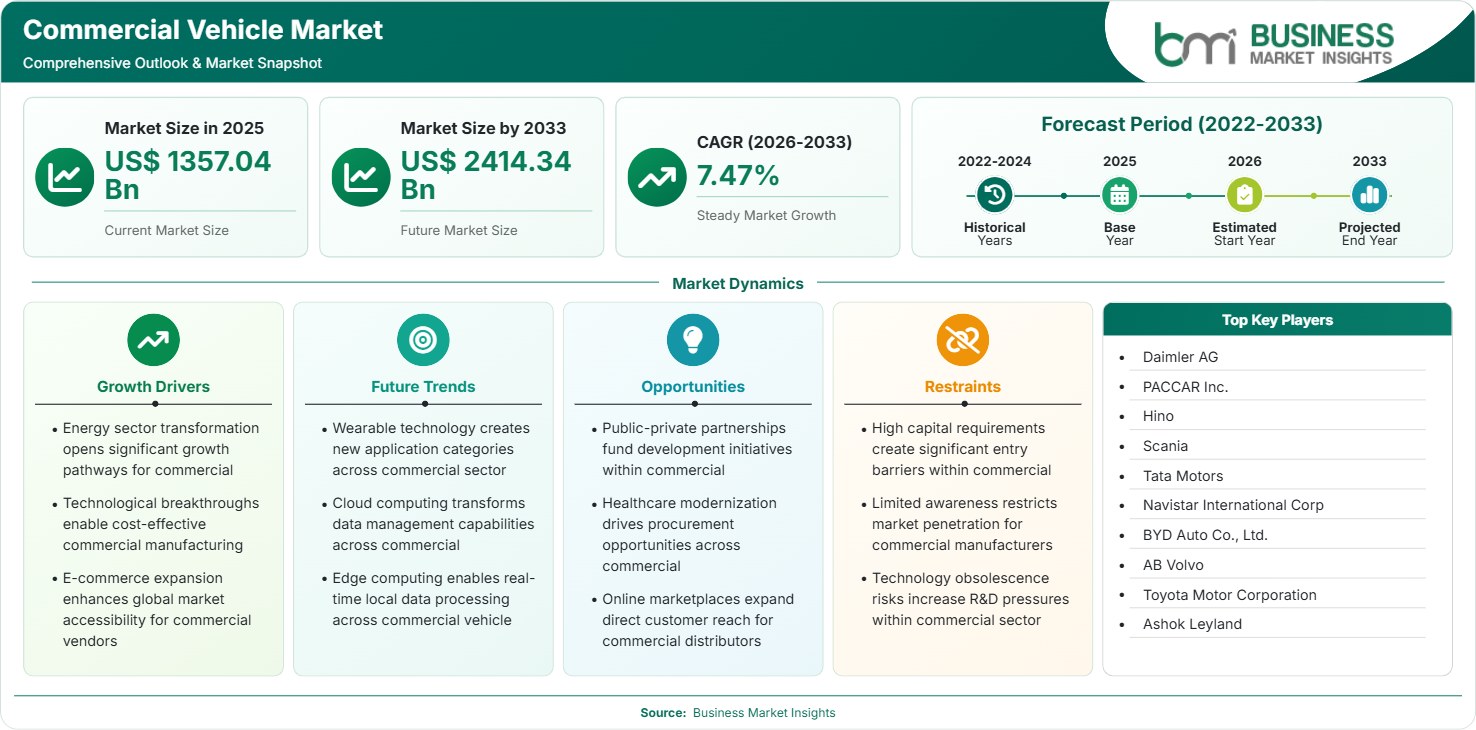
The Commercial Vehicle Market size was valued at US$ 1357.04 Billion in 2025 and is projected to reach US$ 2414.34 Billion by 2033, growing at a CAGR of 7.47% during 2026–2033, driven by fleet electrification, logistics expansion, infrastructure investments, and regulatory mandates accelerating low-emission vehicle adoption globally.

Report Coverage
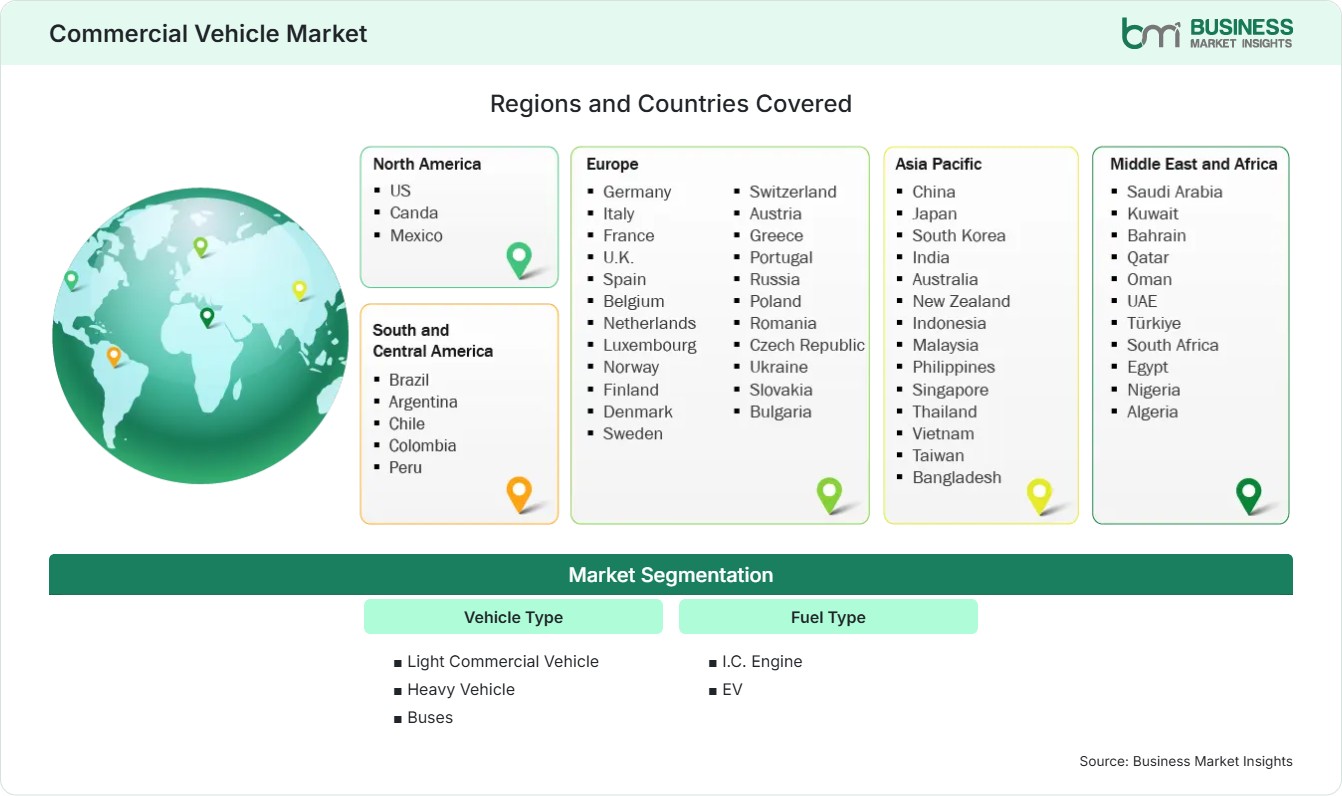
  • Vehicle Type: Light Commercial Vehicle, Heavy Vehicle, Buses
  • Fuel Type: I.C. Engine, EV
US$ 1357.04 Bn Market size in 2025
US$ 2414.34 Bn Market Size by 2033
7.47% CAGR, 2026 - 2033
2026-2033 Forecast Period

AI Overview

Commercial Vehicle Market Summary

  • North America Region: North America holds market share 32%–35% in 2025, growing with a CAGR of 6.5%–7.2% influenced by e-commerce logistics expansion, fleet modernization, and emission mandates. The US market is driven by replacement demand and electrification policies, expanding at a CAGR of 6.8%–7.4% supported by federal incentives and charging infrastructure expansion.
  • Fastest Growing Region: Asia Pacific holds market share 38%–42% in 2025, growing with a CAGR of 8.5%–9.5% influenced by industrial expansion, urban logistics demand, and government-led EV adoption programs across China, India, and Southeast Asia markets.
  • Leading Segment: Light Commercial Vehicles hold market share 48%–52% in 2025, growing with a CAGR of 7.2%–8.0% influenced by last-mile delivery demand, e-commerce penetration, and rising adoption of electric vans across urban logistics fleets globally.
  • High Growth Segment: Electric Vehicles hold market share 12%–16% in 2025, growing with a CAGR of 18.5%–20.5% influenced by emission regulations, battery cost reductions, and large-scale fleet electrification commitments from logistics and transportation companies globally.
  • Key Market Opportunity: Expansion of electric fleet ecosystems including charging infrastructure, battery leasing, and telematics integration is enabling cost optimization and operational efficiency for logistics providers, creating scalable opportunities across emerging and developed markets.
  • Major Market Players: Daimler Truck Holding AG, PACCAR Inc., Hino Motors, Ltd., Scania AB, Tata Motors Limited, Navistar, Inc., BYD Company Limited, AB Volvo, Toyota Motor Corporation, Ashok Leyland Limited
Strategic Insights

Commercial Vehicle Market: Strategic Insights

Commercial Vehicle Market Strategic Framework
FREE PDF
Request your free sample
Request free sample
Stakeholder View

Key Takeaways

  • The value chain is evolving toward integrated mobility solutions combining manufacturing, telematics, financing, and aftermarket services, enabling OEMs to capture recurring revenue streams and enhance customer lifecycle engagement.
  • Electric and light-duty segments present the highest growth potential, particularly in urban logistics and last-mile delivery applications driven by e-commerce and emission regulations.
  • Technological innovation is shifting toward electrification, hydrogen fuel cells, and autonomous driving systems, with OEMs increasing R&D spending to maintain competitive differentiation.
  • Asia Pacific offers the strongest investment potential due to industrialization, government subsidies, and rising transportation demand across emerging economies.
  • Strategic alliances, acquisitions, and joint ventures are increasing as companies seek to strengthen EV capabilities, battery supply chains, and digital service offerings.
  • Fleet digitization and predictive maintenance solutions are becoming critical for operational efficiency, influencing purchasing decisions among commercial fleet operators.
Geographic Outlook

Commercial Vehicle Market Regional Highlights

North America Commercial Vehicle Market

North America accounts for 32%–35% of the Commercial Vehicle Market share in 2025 with a CAGR of 6.5%–7.2%, driven by logistics demand and regulatory compliance. The share in this region is supported by strong replacement cycles and infrastructure development. Commercial Vehicle Market growth is influenced by electrification mandates and fleet modernization across transportation and construction sectors.

  • Expansion of e-commerce logistics networks is increasing demand for light and medium-duty vehicles, while regulatory mandates are pushing fleet operators toward low-emission alternatives and advanced telematics integration solutions.
  • Government incentives for zero-emission vehicles are accelerating the adoption of electric trucks and buses, supported by investments in charging infrastructure and public-private partnerships across major states.
  • Rising construction and infrastructure projects are boosting heavy-duty vehicle demand, particularly in the US and Canada, with increased investment in road, bridge, and urban development projects.
  • Fleet operators are adopting connected vehicle technologies to optimize route planning, reduce fuel consumption, and improve operational efficiency, contributing to sustained regional demand growth.

US Commercial Vehicle Market

The US represents 70%–75% share within North America in 2025 with a CAGR of 6.8%–7.4%, supported by strong logistics demand and electrification initiatives. Market expansion is driven by fleet replacement cycles, regulatory compliance, and increasing adoption of electric commercial vehicles across urban and regional transportation networks.

  • Federal and state-level incentives are promoting adoption of electric trucks and buses, supported by infrastructure investments and emission reduction targets aligned with environmental policies.
  • Strong presence of logistics and e-commerce companies is driving demand for light commercial vehicles, particularly for last-mile delivery and urban transportation applications.
  • Technological advancements in autonomous driving and telematics are enhancing fleet efficiency and reducing operational costs, influencing purchasing decisions among fleet operators.
  • Increasing focus on sustainability and carbon reduction is encouraging fleet electrification and adoption of alternative fuel technologies across various transportation sectors.

Europe Commercial Vehicle Market

Europe holds 22%–25% share in 2025 with a CAGR of 6.2%–7.0%, driven by stringent emission regulations and electrification initiatives. Leading countries include Germany and France, while the UK and Nordic countries exhibit higher growth with CAGR ranges of 7.0%–8.0% due to strong EV adoption.

  • Strict emission regulations such as Euro VI standards are pushing OEMs to develop low-emission vehicles, accelerating electrification across commercial fleets.
  • Investments in hydrogen fuel cell technology are supporting long-haul transportation solutions, particularly in Germany and the Netherlands.
  • Urban mobility initiatives and low-emission zones are driving adoption of electric buses and delivery vehicles across major European cities.
  • Strong government incentives and subsidies are encouraging fleet operators to transition toward sustainable transportation solutions.

Asia Pacific Commercial Vehicle Market

Asia Pacific dominates with 38%–42% share in 2025 and a CAGR of 8.5%–9.5%, supported by industrial growth and urbanization. China leads the region, while India and Southeast Asia are high-growth markets with CAGR ranges of 9.0%–10.5% driven by infrastructure expansion.

  • Rapid industrialization and urbanization are increasing demand for commercial vehicles across construction, logistics, and transportation sectors in China and India.
  • Government policies promoting electric mobility are accelerating adoption of electric buses and trucks, particularly in China.
  • Expansion of e-commerce platforms is driving demand for light commercial vehicles for last-mile delivery services.
  • Investments in infrastructure projects such as highways and urban transit systems are boosting demand for heavy commercial vehicles.

Rest of World Commercial Vehicle Market

Rest of World accounts for 10%–13% share in 2025 with a CAGR of 6.8%–7.6%. South America shows moderate growth driven by Brazil, while Middle East and Africa exhibit higher growth with CAGR ranges of 7.5%–8.5% supported by infrastructure and logistics expansion.

  • Increasing infrastructure investments in Middle East countries are driving demand for heavy commercial vehicles in construction and transportation sectors.
  • Growth in mining and oil industries in Africa is supporting demand for specialized commercial vehicles and heavy-duty trucks.
  • Expansion of logistics networks in Latin America is boosting demand for light and medium commercial vehicles.
  • Government initiatives to improve transportation infrastructure are supporting overall market growth across emerging economies.
Global Market Geography
FREE PDF
Request your free sample
Request free sample
Segment Analysis

Commercial Vehicle Market Segmentation

Vehicle Type

This segment accounts for 48%–52% share in 2025 with a CAGR of 7.2%–8.0%. The Commercial Vehicle Market scope within this segment is driven by logistics demand, urbanization, and industrial activity, supporting diversified adoption across light, heavy, and bus categories globally.

  • Light Commercial Vehicle: Dominates urban logistics and last-mile delivery applications, supported by e-commerce growth, rising demand for electric vans, and increasing fleet replacement cycles across developed and emerging markets.
  • Heavy Vehicle: Essential for construction, mining, and long-haul transportation, driven by infrastructure projects and industrial expansion, with increasing adoption of fuel-efficient and alternative powertrain technologies.
  • Buses: Growth supported by public transportation modernization and government initiatives promoting electric buses, particularly in urban areas to reduce emissions and improve mobility efficiency.

Fuel Type

This segment holds 100% market distribution with EVs gaining traction at a CAGR of 18.5%–20.5% while IC engines maintain dominance. Commercial Vehicle Market trends indicate gradual transition toward electrification driven by regulatory frameworks and sustainability goals.

  • I.C. Engine: Continues to dominate due to established infrastructure and cost advantages, particularly in developing regions, while incremental efficiency improvements support ongoing adoption across heavy-duty applications.
  • EV: Rapid growth driven by emission regulations, declining battery costs, and government incentives, with increasing adoption across logistics fleets and public transportation systems globally.
Market Forces

Commercial Vehicle Market Dynamics

Key Market Drivers

Electrification and Emission Regulations Driving Adoption

Stringent emission regulations across regions such as Europe and North America are compelling manufacturers to accelerate electrification strategies. The International Energy Agency indicates commercial vehicle electrification is expanding due to policy mandates and declining battery costs. Commercial Vehicle Market growth is increasingly dependent on the zero-emissions goals of logistics providers. Manufacturers spend a lot of money on electric drives and battery development. Also, urban low-emission areas are limiting access for regular cars, pushing companies to adopt electric cars into their line-up.

Expansion of E-commerce and Logistics Networks

Rapid growth in e-commerce is significantly increasing demand for efficient transportation solutions, particularly light commercial vehicles. The surge in last-mile delivery services is driving fleet expansion across urban and suburban areas. Commercial Vehicle Market trends reflect a growing need for logistics solutions that are flexible and efficient in terms of cost due to the help of digital technologies. Fleet management companies prefer to buy cars equipped with telematics and route optimization features in order to improve their efficiency. Also, it is driven by customer requirements for quicker delivery services.

Infrastructure Development and Industrial Growth

Investments in infrastructure on a global scale, especially in developing countries, are leading to the rise in demand for heavy trucks. The construction industry, mining, and energy sectors need a sturdy transportation solution. Governments are spending huge amounts of money on projects related to roads, railways, and urban development, which will lead to increased use of these vehicles. These factors collectively contribute to strong demand for heavy-duty trucks and specialized vehicles, reinforcing the importance of infrastructure development as a key driver of market expansion.

Key Market Opportunities

Expansion of Electric Fleet Ecosystems

The development of integrated electric vehicle ecosystems presents significant growth opportunities for industry participants. Commercial Vehicle Market Forecasts indicate strong demand for charging infrastructure, battery leasing, and fleet management solutions. Companies are exploring new business models such as subscription-based services and energy-as-a-service offerings. Investments in charging networks and renewable energy integration are further enhancing the viability of electric fleets. This ecosystem approach enables cost optimization and operational efficiency, making electric vehicles more attractive for fleet operators and accelerating adoption across various applications.

Adoption of Autonomous and Connected Technologies

Advancements in autonomous driving and connected vehicle technologies are creating new opportunities for innovation and efficiency. Fleet operators are increasingly adopting telematics and data analytics solutions to optimize operations and reduce costs. There are technologies that can help improve safety and minimize driver reliance, especially in long-distance transport. Collaboration between the OEMs and the technology companies will hasten the process of bringing such technologies into existence. As the regulatory environment changes, it is expected that such technologies will redefine the industry environment.

Growth in Emerging Markets and Urbanization

Rapid urbanization and economic growth in emerging markets are driving demand for commercial vehicles. Infrastructural development, along with increasing industrial activities, is meeting the growing needs of transportation in different industries. The governments are putting money into public transportation and logistics systems, which provide opportunities for the manufacturing companies. Increase in disposable income levels and population of the middle class are other reasons for growth in the need for goods and services, and thereby in transportation.

Market Restraints and Challenges

High Initial Cost of Electric Vehicles

Factor: Electric commercial vehicles have higher upfront costs compared to conventional vehicles due to expensive battery systems.

Impact: This limits adoption among small and medium fleet operators, particularly in cost-sensitive markets, slowing overall electrification progress despite long-term cost benefits and government incentives.

Supply Chain Disruptions and Component Shortages

Factor: Dependence on global supply chains for semiconductors and battery materials creates vulnerabilities.

Impact: Production delays and increased costs affect vehicle availability, disrupt manufacturing schedules, and constrain growth potential across various segments of the industry.

Company Analysis

Competitive Landscape

The Commercial Vehicle Market analysis highlights intense competition among global manufacturers focusing on electrification, innovation, and strategic partnerships.

Company Name

Overview

Products and Services relevant to this market

Daimler Truck Holding AG

Global leader in commercial vehicles with strong presence in trucks and buses, focusing on electrification and autonomous technologies.

Heavy-duty trucks, electric trucks, buses, fleet management solutions, and aftermarket services.

PACCAR Inc.

Manufacturer of premium trucks under brands like Kenworth and Peterbilt, emphasizing advanced technology and fuel efficiency.

Heavy-duty trucks, engines, financial services, and telematics solutions.

Hino Motors, Ltd.

Subsidiary of Toyota specializing in commercial vehicles, known for reliability and fuel-efficient engines.

Medium and heavy-duty trucks, buses, and hybrid vehicle technologies.

Scania AB

Swedish manufacturer focusing on sustainable transport solutions and modular vehicle systems.

Trucks, buses, engines, and digital fleet management solutions.

Tata Motors Limited

Indian multinational with strong presence in commercial vehicles across emerging markets.

Trucks, buses, electric commercial vehicles, and mobility solutions.

Navistar, Inc.

US-based manufacturer focusing on integrated vehicle solutions and advanced diesel engines.

Trucks, buses, engines, and connected vehicle technologies.

BYD Company Limited

Chinese leader in electric vehicles with strong focus on battery technology and electric buses.

Electric trucks, buses, batteries, and energy storage solutions.

AB Volvo

Global manufacturer known for trucks, buses, and construction equipment with strong sustainability focus.

Trucks, buses, electric vehicles, and autonomous solutions.

Toyota Motor Corporation

Global automotive leader expanding into commercial vehicles and hydrogen fuel technologies.

Light commercial vehicles, hydrogen fuel cell systems, and hybrid technologies.

Ashok Leyland Limited

Major commercial vehicle manufacturer in India focusing on cost-efficient and innovative solutions.

Trucks, buses, electric vehicles, and defense mobility solutions.

Trust & Transparency

Research Methodology

The market analysis combines proprietary research with secondary data from government agencies, company disclosures, regulatory filings, industry databases and expert interviews. Market estimates are validated through data triangulation, cross-market benchmarking and analyst review.

View Full Research Methodology

Questions Answered

Frequently Asked Questions

What does the Commercial Vehicle Market Report cover?

The report provides insights into market size, segmentation, regional analysis, competitive landscape, trends, and future growth opportunities for stakeholders.

How is electrification impacting the industry?

Electrification is transforming product portfolios, reducing emissions, and lowering operational costs over time, while requiring significant investments in infrastructure and battery technology.

What are the major technological trends?

Key trends include electrification, autonomous driving, connected vehicle technologies, and hydrogen fuel cell development, enhancing efficiency and sustainability across commercial fleets.

Which region dominates the global landscape?

Asia Pacific leads due to industrial growth, urbanization, and government support for electric mobility, particularly in China and India, followed by North America and Europe.

What factors are driving demand in the Commercial Vehicle Market?

Demand is driven by e-commerce expansion, infrastructure development, emission regulations, and electrification trends. Fleet modernization and technological advancements are also contributing to increased adoption across various transportation sectors.

Access the Full Commercial Vehicle Market Report

Get segment-level forecasts, regional estimates, competitive benchmarking, company profiles and downloadable Excel datasets.

Access the full Commercial Vehicle Market Report
350 pages PDF & Excel | 2026-08-18
Similar Research

Related Market Reports