
In-Vehicle AI Assistants Market Outlook: Size, Share, Trends, Growth Analysis, Competitive Landscape & Forecast, 2026-2033

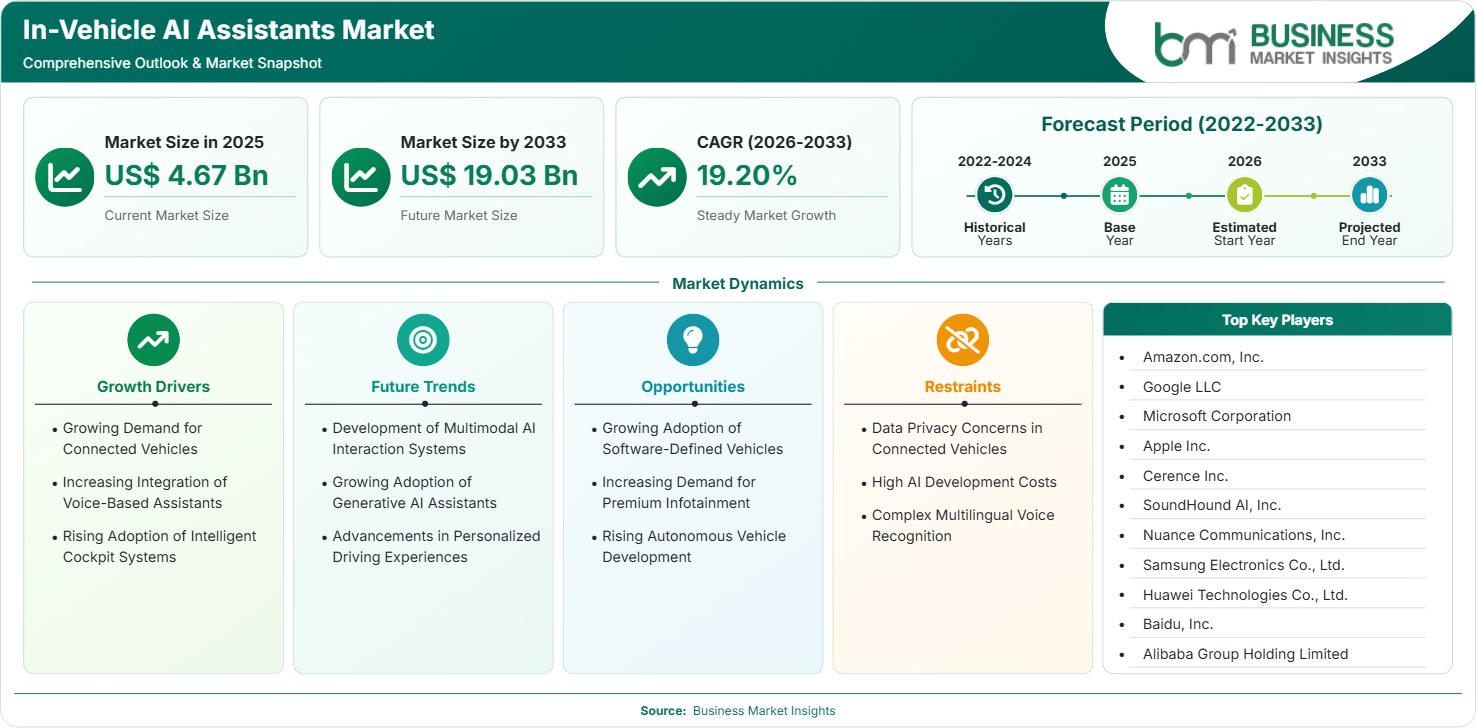
The In-Vehicle AI Assistants Market size was valued at US$ 4.67 Billion in 2025 and is projected to reach US$ 19.03 Billion by 2033, growing at a CAGR of 19.20% during 2026–2033. Rising connected vehicle adoption, intelligent cockpit innovation, and AI-powered voice technologies are accelerating industry expansion, while software-defined vehicles and autonomous mobility create significant long-term growth opportunities.

Report Coverage
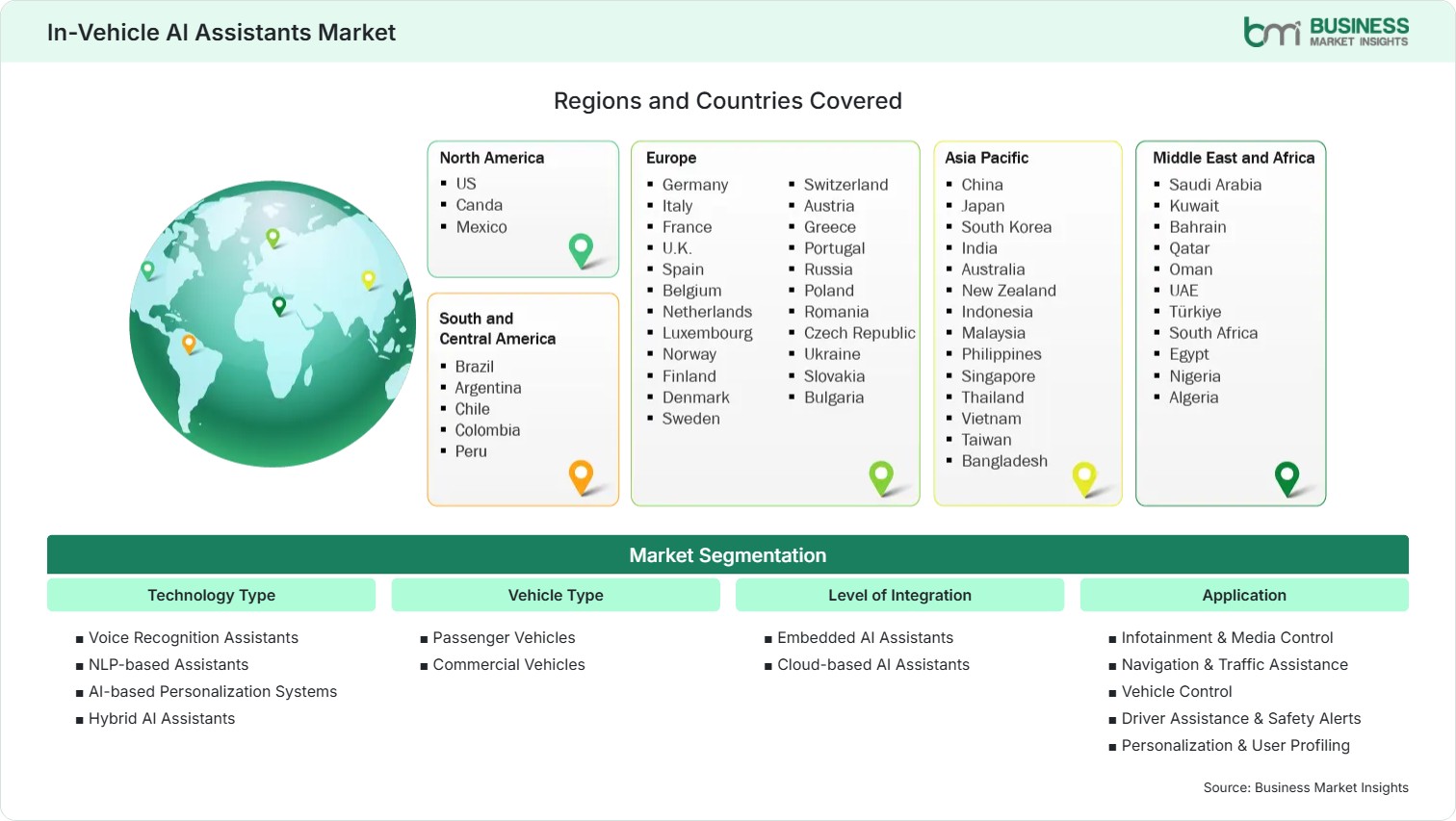
  • Technology Type: Voice Recognition Assistants, NLP-based Assistants, AI-based Personalization Systems, Hybrid AI Assistants
  • Vehicle Type: Passenger Vehicles, Commercial Vehicles
  • Level of Integration: Embedded AI Assistants, Cloud-based AI Assistants
  • Application: Infotainment & Media Control, Navigation & Traffic Assistance, Vehicle Control, Driver Assistance & Safety Alerts, Personalization & User Profiling
  • Sales Channel: OEM and Aftermarket
US$ 4.67 Bn Market size in 2025
US$ 19.03 Bn Market Size by 2033
19.20% CAGR, 2026 - 2033
2026-2033 Forecast Period

AI Overview

In-Vehicle AI Assistants Market Summary

  • North America Region: North America holds 36%–39% market share in 2025 and is projected to register a 17.8%–18.6% CAGR during 2026–2033. Strong connected vehicle penetration, mature cloud infrastructure, and strategic partnerships between automotive OEMs and AI technology providers continue supporting innovation and commercial deployment across premium and mass-market vehicles. The U.S. market benefits from extensive software innovation, premium vehicle demand, and advanced digital mobility ecosystems, expanding at an estimated 18.0%–18.8% CAGR through 2033.
  • Fastest Growing Region: Asia Pacific accounts for 28%–31% market share in 2025 and is anticipated to expand at a 21.3%–22.4% CAGR during 2026–2033. Rising electric vehicle production, expanding intelligent transportation infrastructure, supportive government digitalization initiatives, and increasing consumer preference for connected mobility are accelerating regional adoption of AI-enabled in-vehicle assistants.
  • Leading Segment: Passenger Vehicles represent 68%–71% of the market in 2025 and are forecast to grow at a 18.7%–19.5% CAGR through 2033. Increasing demand for premium infotainment, personalized digital experiences, advanced navigation, and voice-controlled vehicle functions continues strengthening adoption among global passenger vehicle manufacturers.
  • High Growth Segment: Embedded AI Assistants account for 54%–57% market share in 2025 while advancing at a 20.5%–21.6% CAGR during the forecast period. Lower latency, improved cybersecurity, offline functionality, and seamless integration with intelligent cockpit systems encourage OEMs to prioritize embedded solutions over conventional cloud-only deployments.
  • Key Market Opportunity: Growing deployment of software-defined vehicles enables continuous over-the-air upgrades, subscription-based digital services, multilingual conversational AI, predictive maintenance, and personalized mobility experiences, creating attractive revenue opportunities for automotive software and AI solution providers.
  • Major Market Players: Amazon.com, Inc., Google LLC, Microsoft Corporation, Apple Inc., Cerence Inc., SoundHound AI, Inc., Nuance Communications, Inc., Samsung Electronics Co., Ltd., Huawei Technologies Co., Ltd., Baidu, Inc., and Alibaba Group Holding Limited.
Strategic Insights

In-Vehicle AI Assistants Market: Strategic Insights

In-Vehicle AI Assistants Market Strategic Framework
FREE PDF
Request your free sample
Request free sample
Stakeholder View

Key Takeaways

  • The automotive value chain is evolving toward software-centric mobility, increasing collaboration among OEMs, cloud providers, semiconductor companies, and AI developers.
  • Passenger vehicles remain the leading revenue contributor, while embedded AI assistant platforms present the strongest long-term commercial opportunity.
  • Generative AI, natural language processing, and multimodal human-machine interfaces are transforming intelligent cockpit functionality and customer engagement.
  • Asia Pacific offers compelling investment opportunities through rapid electric vehicle production, expanding connected mobility infrastructure, and favorable government initiatives.
  • Strategic partnerships and software-driven business models are creating recurring revenue opportunities through digital subscriptions, over-the-air updates, and AI-enabled vehicle services.
Geographic Outlook

In-Vehicle AI Assistants Market Regional Highlights

North America In-Vehicle AI Assistants Market

North America accounts for 36%–39% of the market share in 2025 and is expected to grow at a 17.8%–18.6% CAGR during 2026–2033. Strong adoption of connected vehicles, widespread deployment of 5G infrastructure, and continuous investments in automotive software support regional leadership. The In-Vehicle AI Assistants Market share remains highest in this region due to collaborations between vehicle manufacturers and AI technology providers focused on intelligent cockpit development.

  • Automotive OEMs increasingly integrate AI assistants with cloud services to deliver real-time navigation, predictive maintenance, and personalized infotainment experiences.
  • High electric vehicle adoption supports demand for intelligent voice assistants capable of battery optimization, charging guidance, and connected mobility services.
  • Investments in software-defined vehicles and automotive cybersecurity strengthen deployment of embedded AI platforms across passenger and commercial vehicles.
  • Consumer preference for premium digital experiences encourages manufacturers to introduce advanced conversational AI and multimodal human-machine interfaces.

US In-Vehicle AI Assistants Market

The United States contributes approximately 79%–82% of North American revenue in 2025 and is forecast to expand at a 18.0%–18.8% CAGR through 2033. A strong innovation ecosystem, leading cloud providers, and extensive partnerships between automotive manufacturers and technology companies continue accelerating AI assistant deployment across connected vehicles.

  • Premium vehicle manufacturers increasingly deploy AI-powered cockpit platforms with voice recognition and contextual assistance.
  • Cloud-native automotive software supports continuous feature enhancement through secure over-the-air software updates.
  • Growing investment in autonomous driving technologies expands demand for intelligent conversational assistants.

Europe In-Vehicle AI Assistants Market

Europe captures 26%–29% of the market in 2025 and is projected to register a 18.5%–19.4% CAGR through 2033. Premium automotive production, strict vehicle safety regulations, and increasing software-defined vehicle adoption continue supporting regional expansion. Germany leads regional revenues, while the United Kingdom and France demonstrate strong technology adoption and digital mobility investments.

  • Germany remains the largest regional market due to premium automotive manufacturing and intelligent cockpit innovation.
  • The United Kingdom benefits from connected mobility initiatives and expanding cloud-based automotive services.
  • France experiences increasing deployment of AI-powered infotainment systems supported by electric vehicle adoption.
  • Automotive software partnerships continue accelerating multilingual AI assistant development across European OEMs.

Asia Pacific In-Vehicle AI Assistants Market

Asia Pacific represents 28%–31% market share in 2025 and is anticipated to achieve the fastest 21.3%–22.4% CAGR during 2026–2033. The In-Vehicle AI Assistants Market growth is driven by expanding electric vehicle production, increasing connected vehicle adoption, and supportive digital transformation policies. China dominates regional demand, while India emerges as the fastest-growing market owing to rising premium vehicle sales and smart mobility initiatives.

  • China leads AI-enabled automotive innovation through large-scale EV manufacturing and intelligent transportation investments.
  • India records rapid growth driven by connected vehicle adoption and increasing digital infrastructure.
  • Japan continues investing in intelligent mobility, advanced semiconductors, and autonomous driving technologies.
  • South Korea leverages strengths in consumer electronics and AI to advance connected cockpit platforms.

Rest of World In-Vehicle AI Assistants Market

The Rest of World region accounts for 8%–10% market share in 2025 and is projected to grow at a 18.8%–19.7% CAGR through 2033. South & Central America benefit from expanding automotive production, while the Middle East and Africa witness increasing demand for premium connected vehicles and investments in intelligent transportation infrastructure.

  • Brazil leads regional adoption through growing vehicle manufacturing and connected mobility investments.
  • Mexico strengthens demand through export-oriented automotive production and digital vehicle integration.
  • The UAE continues expanding premium connected mobility supported by smart city initiatives.
  • Saudi Arabia invests in intelligent transportation and digital infrastructure, creating opportunities for AI-enabled vehicle technologies.
Global Market Geography
FREE PDF
Request your free sample
Request free sample
Segment Analysis

In-Vehicle AI Assistants Market Segmentation

Technology Type

The Technology Type segment represents approximately 31%–34% of the market in 2025 and is expected to grow at a 20.2%–21.0% CAGR through 2033. Increasing demand for intelligent human-machine interaction, multilingual communication, and contextual assistance is driving adoption across modern connected vehicles. The In-Vehicle AI Assistants Market scope continues to expand as AI technologies become integral to digital cockpit platforms.

  • Voice Recognition Assistants: Enable hands-free control of navigation, infotainment, communication, and vehicle settings, improving driving safety while delivering seamless user interaction through advanced speech recognition.
  • NLP-based Assistants: Utilize natural language processing to interpret conversational commands, contextual requests, and multilingual communication, enhancing user convenience and interaction accuracy.
  • AI-based Personalization Systems: Analyze driving habits, entertainment preferences, and vehicle usage patterns to provide customized recommendations and adaptive in-cabin experiences.
  • Hybrid AI Assistants: Combine onboard processing with cloud intelligence to deliver low-latency responses, continuous learning, and reliable performance under varying network conditions.

Vehicle Type

Vehicle Type remains the dominant segment, accounting for 68%–71% market share in 2025 and expanding at a 18.7%–19.5% CAGR during the forecast period. Rising production of connected and electric vehicles, coupled with growing consumer demand for premium digital experiences, continues supporting widespread AI assistant deployment.

  • Passenger Vehicles: Lead adoption through increasing integration of intelligent infotainment, personalized navigation, voice-enabled controls, and connected digital ecosystems across premium and mid-range vehicle models.
  • Commercial Vehicles: Fleet operators adopt AI assistants to improve route optimization, driver communication, predictive maintenance, fuel efficiency, and operational productivity.

Level of Integration

The Level of Integration segment accounts for approximately 27%–30% market share in 2025 and is projected to register a 20.5%–21.6% CAGR through 2033. OEMs are increasingly balancing embedded processing and cloud connectivity to deliver secure, scalable, and intelligent mobility experiences.

  • Embedded AI Assistants: Provide faster response times, enhanced cybersecurity, offline functionality, and reliable performance through onboard computing integrated directly into vehicle systems.
  • Cloud-based AI Assistants: Deliver advanced conversational intelligence, real-time information retrieval, continuous software improvements, and personalized services through cloud infrastructure.

Application

Application-based deployment contributes around 33%–36% of market revenue in 2025 and is anticipated to grow at a 20.0%–20.9% CAGR through 2033. Increasing AI integration across multiple vehicle functions is strengthening In-Vehicle AI Assistants Market trends while improving safety, convenience, and customer engagement.

  • Infotainment & Media Control: Supports voice-enabled entertainment, music streaming, media recommendations, and smartphone synchronization for improved user convenience.
  • Navigation & Traffic Assistance: Provides intelligent route optimization, live traffic information, charging station guidance, and real-time travel recommendations.
  • Vehicle Control: Enables voice operation of climate systems, lighting, seating adjustments, windows, and other vehicle functions.
  • Driver Assistance & Safety Alerts: Delivers proactive notifications, collision warnings, lane guidance, driver monitoring, and emergency assistance through AI-enabled communication.
  • Personalization & User Profiling: Learns user behavior and preferences to deliver customized settings, adaptive recommendations, and personalized digital cockpit experiences.

Sales Channel

The Sales Channel segment holds 22%–25% market share in 2025 and is forecast to expand at a 19.1%–20.0% CAGR during 2026–2033. Increasing software-driven vehicle functionality and connected mobility services continue creating opportunities for both manufacturers and technology providers.

  • OEM: Automotive manufacturers integrate AI assistants during production, ensuring seamless compatibility with connected vehicle architectures, safety systems, and intelligent cockpit platforms.
  • Aftermarket: Technology providers offer software upgrades, voice assistant integration, infotainment enhancements, and connected digital services to extend intelligent capabilities across existing vehicle fleets.
Market Forces

In-Vehicle AI Assistants Market Dynamics

Key Market Drivers

Growing Demand for Connected Vehicles

The growing usage of connected cars is among the key factors behind the rise in in-car assistants powered by artificial intelligence. Auto manufacturers are incorporating technologies of cloud connectivity, vehicle-to-everything connectivity (V2X), and real-time analytics to boost safety, navigation, and infotainment functions. As per the estimates of the International Telecommunication Union (ITU) and trends in the automotive sector, growing 5G coverage is allowing for rapid data transfer and reduced latency for connected car solutions. Moreover, the In-Vehicle AI Assistants Market growth is also experiencing strong tailwinds from customer preference for seamless digital services, software updates, and intelligent features of the automobile.

Increasing Integration of Voice-Based Assistants

Improvements in voice recognition, natural language processing, and generative AI technologies are contributing to increased use of voice-operated assistants in the current automotive industry. Most drivers like using their hands to navigate, communicate, entertain themselves, and operate the vehicle. Voice assistants have the capability of recognizing context-sensitive commands, supporting various languages, and tailoring the responses to individual users based on their behavior. The automobile makers are working in partnership with tech firms to improve conversations in an effort to differentiate connected cars through an intelligent digital cockpit.

Rising Adoption of Intelligent Cockpit Systems

Intelligent cockpit solutions are revolutionizing vehicles into digital spaces comprising AI agents, superior display technologies, cloud connectivity, and predictive analysis capabilities. Intelligent cockpits offer customized infotainment, personalized advice, driver monitoring features, and navigation help through a singular interface. The rising manufacturing of electric vehicles and luxury vehicles is driving growth in the industry, while the software-defined architecture of vehicles allows ongoing improvements to features using over-the-air updates. Innovations in automotive semiconductor technology, edge computing of AI, and cybersecurity are further boosting the growth of intelligent cockpits.

Key Market Opportunities

Growing Adoption of Software-Defined Vehicles

Software Defined Vehicles are revolutionizing the automobile industry through the ability to continuously upgrade the software of the vehicle during its life cycle. The AI assistants can get updated with new functionalities, improved security, and personalization without any hardware changes. The In-Vehicle AI Assistants Market Forecasts are positive as automobile companies are focusing more on developing centralized computing platforms, automotive operating system, and software ecosystems. Such trends allow for the introduction of subscription-based digital services, predictive maintenance, and customer interaction.

Increasing Demand for Premium Infotainment

Consumer expectations for connected digital experiences are encouraging manufacturers to introduce premium infotainment systems supported by conversational AI. Intelligent assistants now manage entertainment, navigation, climate control, productivity applications, and smart device connectivity through natural voice interaction. Growing adoption of high-resolution displays, immersive audio systems, and personalized digital services creates opportunities for AI software developers, semiconductor companies, and cloud platform providers to expand automotive solutions across premium as well as mid-priced vehicle segments.

Rising Autonomous Vehicle Development

This evolution towards driverless mobility leads to new applications of AI assistants outside their conventional applications in driving. As more and more of the driving duties become the responsibility of automation, AI assistants will take charge of productivity, e-commerce, journey planning, personal health monitoring, and providing the passenger experience. Investment in AI technology, sensor fusion, processing capabilities, and driverless platforms will pave the way for the commercial success of conversational AI technologies in the future of mobility.

Market Restraints and Challenges

Data Privacy Concerns in Connected Vehicles

Factor: AI assistants continuously process voice commands, driving behavior, location information, and connected device data to deliver personalized services. Impact: Implementation in terms of regulatory compliance for data privacy necessitates good encryption, safe cloud computing facilities, and proper management of user consents along with continued cybersecurity. This poses challenges in the form of high cost of implementation and complexity in terms of development.

High AI Development Costs

Factor: Automotive-grade AI platforms require significant investment in algorithm development, semiconductor optimization, cloud infrastructure, multilingual language models, and software validation. Impact: Higher expenses involved in terms of research, integration, and maintenance pose challenges to smaller solution providers and increase commercialization periods. Companies have to weigh innovation and affordability, especially where advanced AI assistant technology is being employed.

Company Analysis

Competitive Landscape

The In-Vehicle AI Assistants Market analysis highlights competitive landscape is characterized by continuous investment in conversational AI, intelligent cockpit platforms, cloud-based automotive software, and embedded computing technologies. Leading companies are strengthening strategic alliances with automotive OEMs to enhance voice recognition, personalized user experiences, and software-defined vehicle capabilities. Continuous innovation in generative AI, multilingual interaction, and secure over-the-air software updates is intensifying competition while expanding intelligent mobility ecosystems.

Company Name

Overview

Products and Services Relevant to this Market

Amazon.com, Inc.

Develops cloud infrastructure and AI technologies that enable connected vehicle services and intelligent mobility applications.

Alexa Auto, AWS cloud services, generative AI solutions, connected vehicle platforms, and automotive software tools.

Google LLC

Provides AI software, digital mapping, and connected vehicle platforms for global automotive manufacturers.

Android Automotive OS, Google Assistant, Google Maps, Gemini AI, and Google Cloud automotive solutions.

Microsoft Corporation

Delivers enterprise cloud, AI, and connected mobility technologies supporting software-defined vehicles.

Microsoft Azure, Azure AI, connected vehicle platforms, cybersecurity, and automotive analytics.

Apple Inc.

Expands intelligent in-car experiences through ecosystem integration and voice-enabled digital services.

Apple CarPlay, Siri, Apple Maps, cloud connectivity, and digital mobility solutions.

Cerence Inc.

Specializes in conversational AI technologies designed exclusively for the automotive industry.

Cerence Assistant, voice recognition, natural language processing, automotive AI, and intelligent cockpit software.

SoundHound AI, Inc.

Develops conversational AI solutions supporting advanced voice interaction across connected vehicles.

SoundHound Chat AI, speech recognition, conversational AI, automotive voice assistants, and cloud AI services.

Nuance Communications, Inc.

Provides speech recognition and conversational AI technologies for intelligent automotive applications.

Dragon speech technologies, conversational AI, voice assistants, and language processing platforms.

Samsung Electronics Co., Ltd.

Supplies automotive semiconductors, connected electronics, and intelligent cockpit technologies.

Exynos Auto processors, Harman cockpit platforms, automotive displays, AI chips, and connectivity solutions.

Huawei Technologies Co., Ltd.

Invests in intelligent vehicle operating systems and connected mobility technologies.

HarmonyOS for vehicles, intelligent cockpit platforms, AI processors, ADS solutions, and cloud services.

Baidu, Inc.

Develops autonomous driving and AI technologies supporting intelligent transportation ecosystems.

Apollo autonomous driving platform, DuerOS, AI cloud services, navigation, and intelligent cockpit software.

Alibaba Group Holding Limited

Provides cloud computing and digital ecosystem technologies for connected vehicle platforms.

Alibaba Cloud, Banma smart cockpit, AI services, navigation technologies, and connected mobility software.

Trust & Transparency

Research Methodology

The market analysis combines proprietary research with secondary data from government agencies, company disclosures, regulatory filings, industry databases and expert interviews. Market estimates are validated through data triangulation, cross-market benchmarking and analyst review.

View Full Research Methodology

Questions Answered

Frequently Asked Questions

What does this In-Vehicle AI Assistants Market Report include?

The report covers market size, segmentation, regional analysis, competitive landscape, technology trends, growth opportunities, challenges, recent developments, and forecasts through 2033.

Which companies are shaping market competition?

Major participants include Amazon.com, Inc., Google LLC, Microsoft Corporation, Apple Inc., Cerence Inc., SoundHound AI, Inc., Samsung Electronics Co., Ltd., Huawei Technologies Co., Ltd., Baidu, Inc., and Alibaba Group Holding Limited.

Which segment is expected to grow the fastest?

Embedded AI assistants are projected to register the fastest growth because they offer lower latency, improved cybersecurity, offline functionality, and seamless vehicle integration.

Which region leads the market?

North America leads due to advanced connected vehicle infrastructure, high software adoption, strong technology partnerships, and increasing deployment of AI-enabled mobility solutions.

What is the primary growth driver for the In-Vehicle AI Assistants Market?

Growing adoption of connected vehicles, intelligent cockpit technologies, and AI-powered voice assistants is accelerating demand across passenger and commercial vehicles.

Access the Full In-Vehicle AI Assistants Market Report

Get segment-level forecasts, regional estimates, competitive benchmarking, company profiles and downloadable Excel datasets.

Access the full In-Vehicle AI Assistants Market Report
350 pages PDF & Excel | 2026-08-06
Similar Research

Related Market Reports