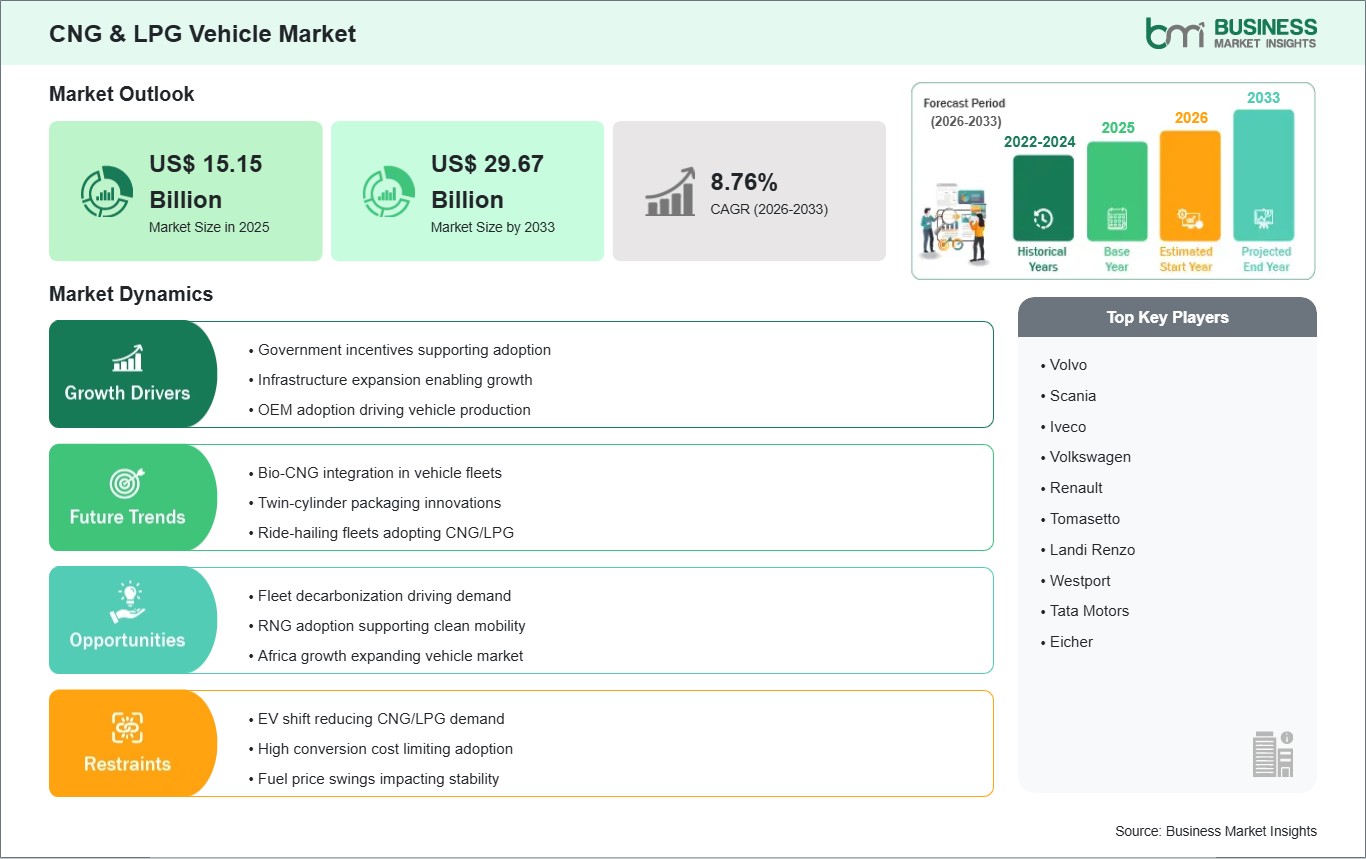
The CNG & LPG Vehicle Market size is expected to reach US$ 29.67 Billion by 2033 from US$ 15.15 Billion in 2025.The market is estimated to record a CAGR of 8.76% from 2026 to 2033.
The market for CNG and LPG vehicles relates to the ecosystem of internal combustion engines using vehicles that operate on compressed natural gas (CNG) and liquefied petroleum gas (LPG) wherein the fuel is stored in high-pressure cylinders in both dedicated and dual-fuel modes. Alternative fuel vehicles using CNG and LPG have become more common as a transition technology helping pave the way to less-polluting forms of transport utilizing current internal combustion engines in automobiles.
Around the world, the market is growing owing to higher costs of fuel, tougher environmental regulations, and the need for economical low emission alternatives for both passengers and freight. CNG-powered vehicles find wider use in densely packed urban environments because of their clean burning and economical operation, whereas LPG remains relevant where there are existing infrastructure facilities for re-fueling and transport from home use.
According to data published by Tata Motors Limited in June 2024, the company introduced additional CNG-powered commercial mobility solutions including buses and cargo vehicles aimed at lowering total cost of ownership for fleet operators while supporting cleaner urban freight and passenger transport systems. This trend is indicative of a wider global trend where automakers are now installing alternative fueling systems in the vehicle design itself, instead of opting for post-installation conversions, thus making the entire process more safe and efficient for the users.
The market growth will be highly dependent on decarbonization policies initiated by the government, increased availability of OEM CNG systems installed at the factory level, and higher usage in fleet-based services like taxis, buses, and logistics. Nevertheless, the market will experience several limitations due to underdeveloped refueling stations, lower driving range than liquid fuel vehicles, and strong competition from battery electric vehicles.

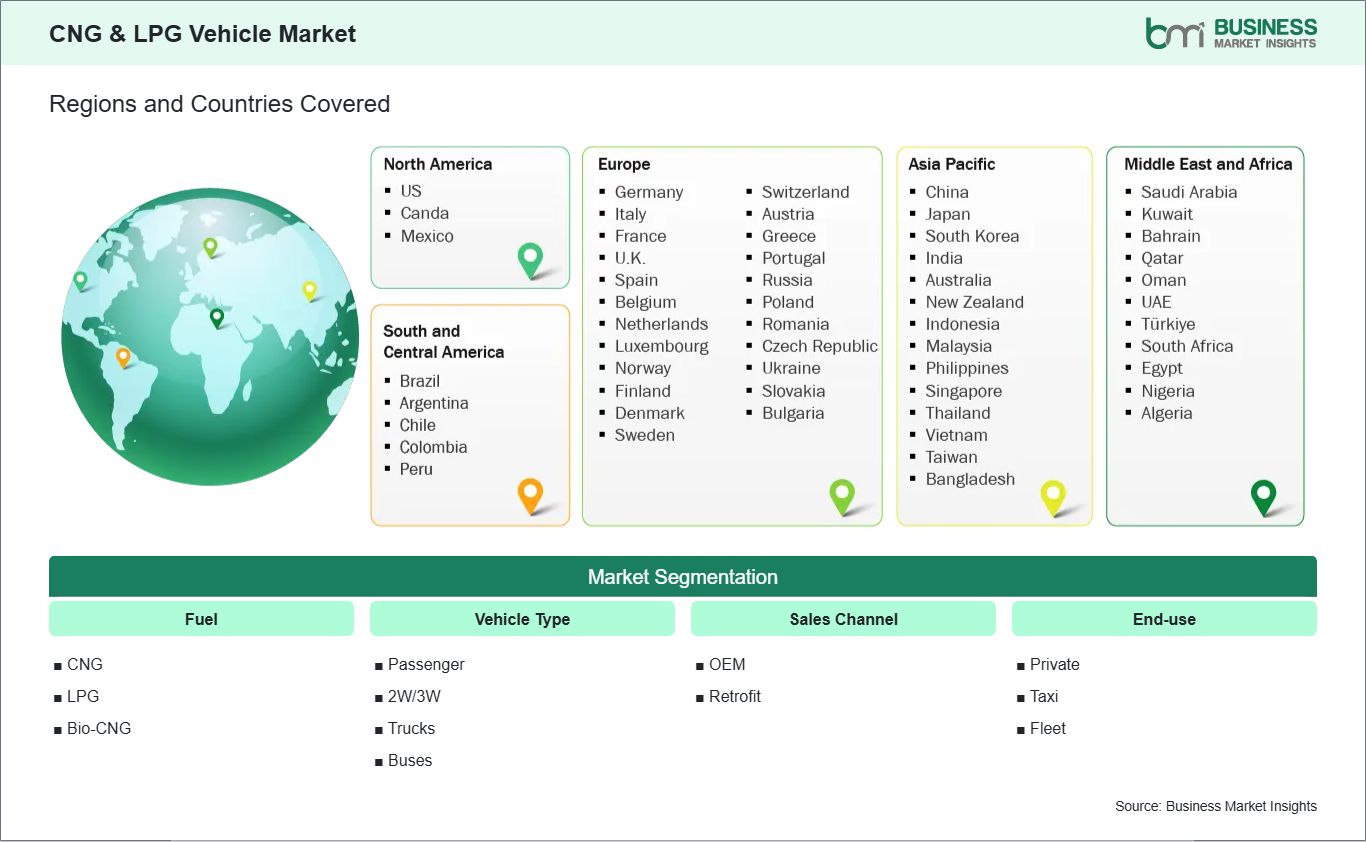
The CNG and LPG vehicle market is segmented based on fuel, vehicle type, sales channel, end-use, and cylinder type, reflecting the growing shift toward cleaner and more cost-effective mobility solutions across global transportation systems.
Government incentives have been a key driver of the expansion in the CNG and LPG cars market around the world. Countries around the globe are now focusing on using clean modes of transportation to cut down emissions and promote cleaner environments. The current trend among many governments is to develop policies that favor the use of cars running on gas than those which run on petrol or diesel.
For emerging economies, the pressure is particularly intense because of the high dependence on imported fuels and the cost-sensitivity of the consumers. There have been efforts towards expanding the city gas networks along with a policy initiative to encourage OEMs to produce factory fitted CNG versions of the cars and trucks. The public transport system, including taxis and buses, has also been targeted for such conversions to mitigate pollution caused by congestion in large cities.
In developed countries, there are no subsidies offered but rather the incentives take the form of regulatory requirements that seek to regulate highly emitting automobiles from entering certain zones within the city. Such low emission zones within cities like London, Paris, Amsterdam etc. are inadvertently encouraging the use of LPG and CNG vehicles, particularly in the logistics sector.
Renewable Natural Gas (RNG), also referred to as bio-CNG, appears to be an important technology for achieving sustainable development within the global CNG and LPG vehicles market. It enhances the environmental credentials of gas-powered vehicles through substitution of non-renewable natural gas by renewable energy, obtained from biological sources including agricultural wastes, landfills, and effluents of water purification processes.
Within the advanced markets, RNG is becoming increasingly incorporated into existing systems of delivery, enabling transport businesses to switch to the more environmentally friendly fuel without any alterations to the transport vehicles themselves. Consequently, renewable natural gas provides an opportunity to replace non-renewable natural gas within those sectors where switching to electricity is currently impossible due to high costs or technological constraints.
The development of RNG is highly associated with the strategies for waste disposal and rural energy in developing countries. The current trends show that governments are encouraging the construction of decentralized biogas plants that will not only ensure the generation of renewable fuels suitable for use in transportation but also improve waste disposal systems. This creates additional incentives for RNG development. Gradually, the rising availability of RNG is set to transform CNG and LPG cars into a means of sustainable transport.
The CNG & LPG Vehicle Market is projected to grow from US$ 15.15 Billion in 2025 to US$ 29.67 Billion by 2033 , registering a CAGR of 8.76% from 2026 to 2033.
By fuel, CNG dominates the market as it offers lower running costs, strong government support, and rapidly expanding city gas distribution infrastructure, while LPG remains limited in automotive use due to comparatively lower adoption and weaker OEM integration. Bio-CNG is an emerging segment supported by decarbonization goals and renewable fuel initiatives, but its penetration is still in the early stages due to limited production and infrastructure.
By vehicle type, passenger vehicles dominate the market as urban consumers increasingly adopt CNG-powered cars for affordability, fuel efficiency, and growing availability of OEM factory-fitted models. 2W/3W vehicles represent a significant and fast-growing segment, particularly in emerging economies where auto-rickshaws and small commercial mobility rely on low operating costs. Trucks and buses form a key commercial segment, driven by government initiatives to decarbonize heavy transport and reduce diesel dependency in urban and intercity operations.
By sales channel, OEM dominates the market as manufacturers increasingly integrate factory-fitted CNG systems that ensure better safety, performance, warranty coverage, and regulatory compliance compared to retrofit solutions, which remain a secondary option in price-sensitive or legacy vehicle segments.
By end-use, fleet operations dominate adoption due to high daily mileage and strong fuel savings, making CNG and LPG vehicles highly cost-effective for commercial operators as well as taxi. Private usage is also expanding steadily, supported by rising fuel prices and improved refueling infrastructure in urban centers.
By cylinder type, Type IV composite cylinders are increasingly dominating the market due to their lightweight structure, higher storage efficiency, improved corrosion resistance, and enhanced safety performance, making them the preferred choice in modern OEM vehicle platforms.
| Report Attribute | Details |
|---|---|
| Market size in 2025 | US$ 15.15 Billion |
| Market Size by 2033 | US$ 29.67 Billion |
| Global CAGR (2026 - 2033) | 8.76% |
| Historical Data | 2022-2024 |
| Forecast period | 2026-2033 |
| Segments Covered | By Fuel
|
|
Regions and Countries Covered
| |
| North America | US, Canada, Mexico |
| Europe | Germany, Italy, France, U.K., Spain, Belgium, Netherlands, Luxembourg, Norway, Finland, Denmark, Sweden, Switzerland, Austria, Greece, Portugal, Russia, Poland, Romania, Czech Republic, Ukraine, Slovakia, Bulgaria |
| Asia-Pacific | China, Japan, South Korea, India, Australia, New Zealand, Indonesia, Malaysia, Philippines, Singapore, Thailand, Vietnam, Taiwan, Bangladesh |
| South and Central America | Brazil, Argentina, Chile, Colombia, Peru |
| Middle East and Africa | Saudi Arabia, United Arab Emirates, Kuwait, Bahrain, Qatar, Oman, Turkiye, South Africa, Egypt, Nigeria, Algeria |
| Market leaders and key company profiles |
|
The "CNG and LPG Vehicle Market Size and Forecast (2022 and 2033)" report provides a detailed analysis of the market covering below areas:
The CNG and LPG vehicle market shows diverse regional adoption patterns influenced by increasing environmental concerns, rising fuel prices, supportive government policies, and growing demand for cleaner and cost-effective transportation solutions.
North America, which is an advanced technological region with an emphasis on reducing vehicle emissions, has seen the rise in the number of CNG and LPG cars. North America is composed of the United States and Canada, both of which are investing heavily in alternative energy infrastructure and natural gas distribution systems for vehicles. The key focus of this region is to reduce the consumption of fossil fuels and reduce greenhouse gas emissions by using new fuel sources. Established automobile and transportation industries in the region help in the adoption of new fuels in buses, trucks, taxis, and passenger cars.
The Asia-Pacific region is growing substantially due to its urbanization process, increased air pollution, higher prices of gasoline, and government policies that encourage the use of cleaner fuels in automobiles. The countries under the Asia-Pacific region include China, India, Japan, and South Korea among others, whereby the governments and the automotive sector are actively encouraging the use of CNG and LPG automobiles as an initiative to combat carbon emissions and enhance air quality. This region emphasizes the development of refueling facilities, ensuring energy security, and affordable transport solutions. Increasing adoption of CNG and LPG in public transportation, freight companies, and individual cars plays a major role in fostering market growth. Besides, increased production of automobiles and high demand for eco-friendly vehicles boost the expansion of the CNG and LPG vehicle market in the region.
Both regions are contributing significantly to the growth of the CNG and LPG vehicle market, focusing on sustainable transportation development, advancements in alternative fuel technologies, expansion of fueling infrastructure, and increasing adoption of low-emission vehicles across commercial and passenger transportation sectors.

The CNG and LPG vehicle market is evaluated by gathering qualitative and quantitative data post primary and secondary research, which includes important corporate publications, association data, and databases. A few of the key developments in the CNG and LPG vehicle market are:
The CNG & LPG Vehicle Market is valued at US$ 15.15 Billion in 2025, it is projected to reach US$ 29.67 Billion by 2033.
As per our report CNG & LPG Vehicle Market, the market size is valued at US$ 15.15 Billion in 2025, projecting it to reach US$ 29.67 Billion by 2033. This translates to a CAGR of approximately 8.76% during the forecast period.
The CNG & LPG Vehicle Market report typically cover these key segments-
The historic period, base year, and forecast period can vary slightly depending on the specific market research report. However, for the CNG & LPG Vehicle Market report:
The CNG & LPG Vehicle Market is populated by several key players, each contributing to its growth and innovation. Some of the major players include:
The CNG & LPG Vehicle Market report is valuable for diverse stakeholders, including:
Essentially, anyone involved in or considering involvement in the CNG & LPG Vehicle Market value chain can benefit from the information contained in a comprehensive market report.
Please tell us your area of interest
(Market Segments/ Regions and Countries/ Companies)