
Vehicle Electrification Market Outlook: Size, Share, Trends, Growth Analysis, Competitive Landscape & Forecast, 2026-2034

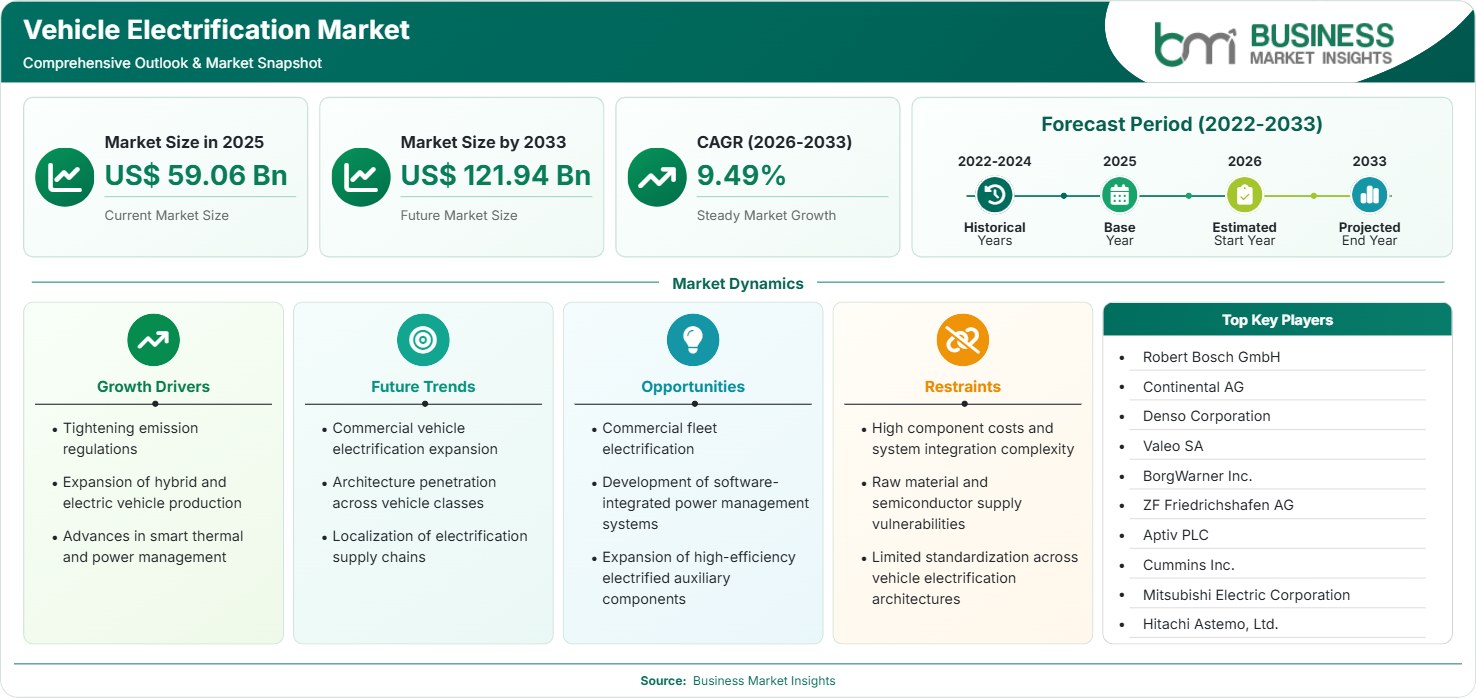
The Vehicle Electrification Market size was valued at US$ 59.06 Billion in 2025 and is projected to reach US$ 121.94 Billion by 2033, growing at a CAGR of 9.49% during 2026–2033. Key drivers include tightening emissions regulations, rising EV production, increasing electrified auxiliary systems adoption, and advances in thermal management, while opportunities emerge from commercial vehicle electrification and 48V architectures.

Report Coverage
  • Product Type: Start/Stop System, Electric Air Conditioner Compressor, PTC Heater, Electric Vacuum Pump, Electric Water Pump, Electric Oil Pump, Starter Motor & Alternator, Integrated Starter Generator, Actuators
  • Vehicle Type: Passenger Cars, Light Commercial Vehicles, Heavy Commercial Vehicles
US$ 59.06 Bn Market size in 2025
US$ 121.94 Bn Market Size by 2033
9.49% CAGR, 2026 - 2033
2026-2033 Forecast Period

AI Overview

Vehicle Electrification Market Summary

  • North America Region: Holds a market share of 34%–37% in 2025, growing with a CAGR of 8.4%–8.9% during 2026–2033. Growth is supported by expanding EV manufacturing, component localization initiatives, fleet electrification investments, advanced vehicle electronics integration, supportive federal incentives, charging infrastructure deployment, OEM electrification roadmaps, and commercial transport modernization programs. Brief U.S. analysis: Strong EV assembly expansion and supplier investments support demand, with CAGR estimated at 8.6%–9.0%.
  • Fastest Growing Region: Asia Pacific accounts for 29%–32% share in 2025 and advances at 10.8%–11.5% CAGR. Growth stems from large-scale EV manufacturing, battery investments, government incentives, expanding supplier ecosystems, rising vehicle sales, urbanization trends, technology adoption, localization programs, and increasing demand for energy-efficient transportation.
  • Leading Segment: Passenger Cars hold 52%–55% share in 2025 and expand at 9.2%–9.8% CAGR. Demand is driven by consumer EV adoption, stricter fuel economy norms, premium vehicle electrification, connected mobility technologies, advanced comfort systems, lightweight architectures, and automaker investment in electrified platforms.
  • High Growth Segment: Integrated Starter Generator accounts for 9%–12% share in 2025 and grows at 11.2%–11.9% CAGR. Adoption benefits from mild hybrid penetration, fuel-efficiency requirements, regenerative braking functionality, lower emissions targets, scalable 48V platforms, and increasing integration across passenger and commercial vehicles.
  • Key Market Opportunity: Commercial fleet electrification creates demand for electric pumps, compressors, heaters, and integrated power management systems, enabling suppliers to capture value from efficiency upgrades, operational savings, sustainability goals, and fleet modernization.
  • Major Market Players: Robert Bosch GmbH, Continental AG, Denso Corporation, Valeo SA, BorgWarner Inc., ZF Friedrichshafen AG, Aptiv PLC, Cummins Inc., Mitsubishi Electric Corporation, Hitachi Astemo, Ltd.
Strategic Insights

Vehicle Electrification Market: Strategic Insights

Vehicle Electrification Market Strategic Framework
FREE PDF
Request your free sample
Request free sample
Stakeholder View

Key Takeaways

  • Supply chains are shifting from mechanically driven systems toward electronically controlled components, increasing value creation opportunities for semiconductor providers, power electronics manufacturers, and integrated systems suppliers.
  • Integrated starter generators and electrified thermal management systems offer the strongest medium-term opportunity as automakers prioritize efficiency gains across hybrid and conventional vehicle platforms.
  • R&D activity increasingly focuses on smart actuators, predictive energy management, high-voltage auxiliaries, and software-controlled power distribution to improve overall vehicle efficiency.
  • India, China, and Southeast Asia present compelling investment cases due to manufacturing expansion, favorable policy support, growing automotive demand, and localization programs.
  • Strategic alliances between automotive suppliers, battery manufacturers, and vehicle OEMs are accelerating commercialization timelines and strengthening regional production resilience.
  • Electrification adoption in commercial fleets is creating new demand patterns for high-durability compressors, pumps, and energy-efficient component systems.
Geographic Outlook

Vehicle Electrification Market Regional Highlights

North America Vehicle Electrification Market

North America represents the largest regional market with a share of 34%–37% in 2025 and a forecast CAGR of 8.4%–8.9% through 2033. Strong OEM electrification commitments, domestic battery investments, and supportive industrial policies continue strengthening demand. Increasing electric light truck production and fleet modernization programs support advanced component adoption. Vehicle Electrification Market growth across the region also benefits from rising investments in thermal management systems and intelligent electronic architectures. Supplier localization and resilient sourcing strategies remain central competitive priorities.

  • U.S. and Canada continue expanding EV manufacturing ecosystems, increasing demand for integrated auxiliary systems and electrified components across passenger and commercial vehicle categories.
  • Federal incentives and industrial policy programs support domestic production capacity, reducing supply-chain dependence while encouraging long-term investment in electrification technologies.
  • Fleet operators increasingly adopt electrified commercial vehicles to reduce operating costs and support sustainability commitments.
  • Advanced software-enabled vehicle platforms create opportunities for smart actuarial systems, electric pumps, and energy-management technologies.

US Vehicle Electrification Market

The U.S. accounts for approximately 78%–82% of North American Vehicle Electrification Market share and records a CAGR of 8.6%–9.0%. Automotive manufacturers continue expanding EV and hybrid production capacity while strengthening local sourcing networks. Investments in battery plants and component manufacturing support demand for electrified auxiliaries. Large fleet operators are increasingly incorporating electric and hybrid vehicles into operational strategies, accelerating adoption of efficient electrical systems. Continued innovation in high-voltage architectures enhances demand prospects across multiple vehicle categories and applications.

  • Major automakers are scaling dedicated EV production facilities, generating sustained demand for electric thermal and power-management components.
  • Commercial fleet electrification programs increase deployment of advanced compressors, pumps, and integrated electrical systems.
  • Technology providers partner with OEMs to enhance vehicle efficiency through intelligent energy-management solutions.
  • Domestic battery manufacturing growth supports broader electrification ecosystem development.

Europe Vehicle Electrification Market

Europe captures 27%–30% Vehicle Electrification Market share in 2025 and expands at 8.8%–9.5% CAGR. The region benefits from aggressive decarbonization targets, widespread hybrid adoption, and established automotive manufacturing capabilities. Germany remains the leading market with CAGR around 8.7%–9.2%, while Eastern European manufacturing centers represent higher-growth production bases. Automakers increasingly deploy electrified auxiliaries to meet fleet efficiency requirements. Advanced regulatory frameworks and innovation-focused supplier networks continue supporting technology commercialization across vehicle segments.

  • Germany leads regional demand through strong OEM presence and intensive electrification investments.
  • Poland, Hungary, and Czechia attract manufacturing projects linked to battery and component production.
  • Carbon-emissions standards accelerate adoption of integrated efficiency-enhancing vehicle systems.
  • Smart thermal management solutions gain traction as automakers optimize energy consumption.
  • Partnerships between suppliers and OEMs strengthen innovation pipelines and product deployment.

Asia Pacific Vehicle Electrification Market

Asia Pacific holds 29%–32% share in 2025 and registers the fastest CAGR of 10.8%–11.5%. China leads regional demand with CAGR of 11.0%–11.6%, supported by substantial EV production capacity and mature battery supply chains. India emerges as a prominent high-growth market due to manufacturing incentives and expanding automotive demand. Strong government support, increasing consumer adoption, and extensive production ecosystems fuel sustained expansion. Regional suppliers continue investing in technologically advanced electrified subsystem manufacturing capabilities.

  • China dominates production and consumption of electrified vehicles, supporting large-scale component demand.
  • India records rapid adoption driven by localization initiatives and growing investment inflows.
  • Japan and South Korea contribute advanced engineering expertise for next-generation electrification solutions.
  • Battery ecosystem expansion strengthens procurement demand for auxiliary electrical components.
  • Urbanization and energy-efficiency priorities continue supporting long-term industry development.

Rest of World Vehicle Electrification Market

Rest of World accounts for 8%–10% share in 2025 and grows at 9.0%–9.7% CAGR. South & Central America benefit from gradual electrification adoption led by Brazil, while infrastructure expansion supports future opportunities. Middle East and Africa markets are developing through sustainability programs and fleet modernization initiatives.

Regional growth is supported by government-led transport initiatives and increasing interest in low-emission mobility solutions. Although adoption trails mature markets, improving investment environments and industrial diversification efforts create long-term opportunities.

  • Brazil remains a leading South American market with growing hybrid vehicle penetration.
  • UAE and Saudi Arabia support electrification through sustainable mobility programs and infrastructure investment.
  • Mining and commercial transport applications create demand for durable electrified systems.
  • Infrastructure development improves long-term adoption potential across emerging economies.
  • International OEMs increasingly target these regions through localized partnerships.
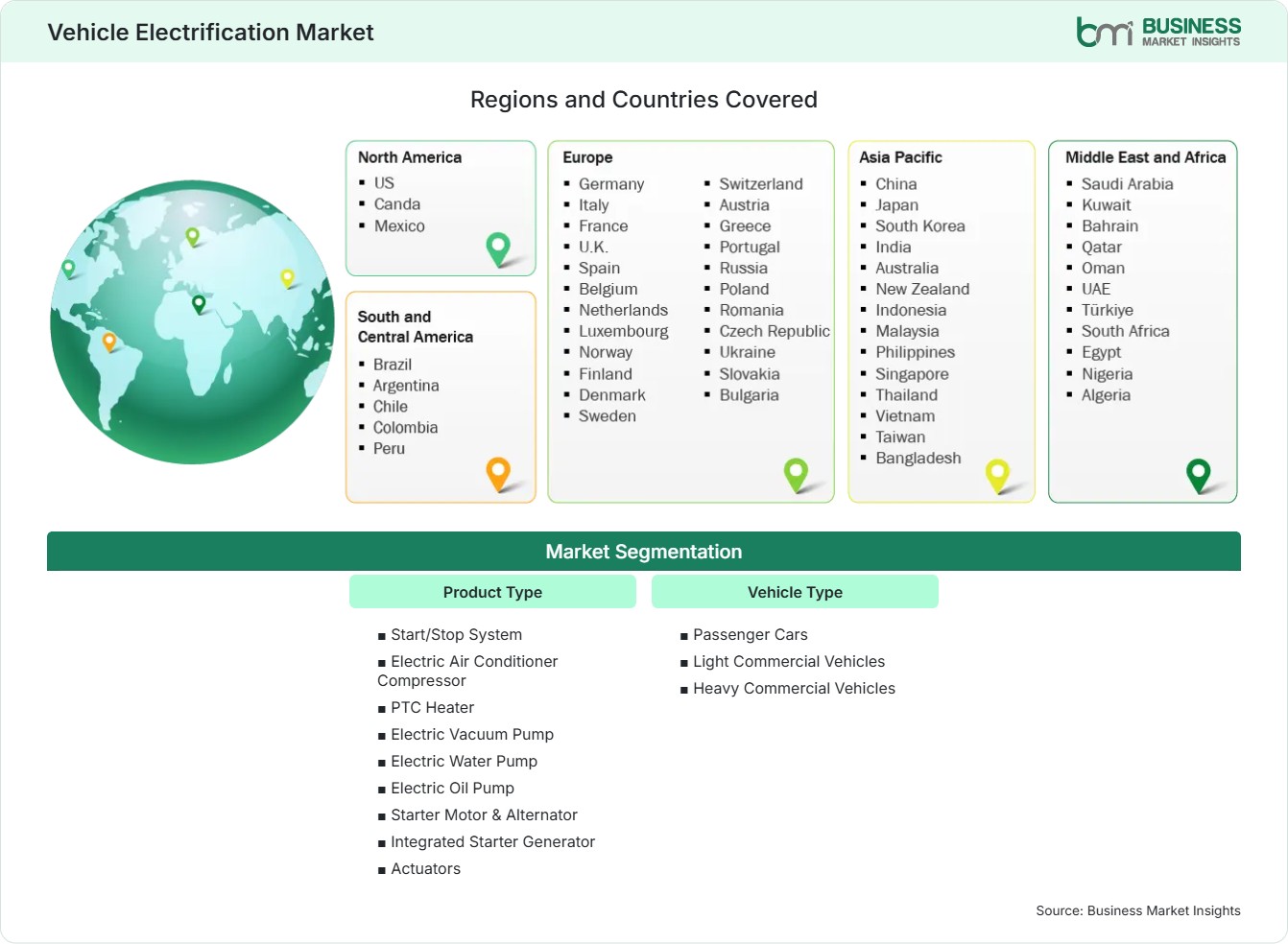
Global Market Geography
FREE PDF
Request your free sample
Request free sample
Segment Analysis

Vehicle Electrification Market Segmentation

Product Type

Product Type represents roughly 45%–48% market share in 2025 and advances at 9.5%–10.1% CAGR. Demand is influenced by efficiency mandates, electrified vehicle architectures, and increasing adoption of intelligent auxiliary systems. Vehicle Electrification Market scope within this segment expands through integration of pumps, compressors, heaters, and starter generators supporting energy optimization and improved vehicle performance.

  • Start/Stop System: Widely adopted in fuel-efficient passenger vehicles, reducing idle fuel consumption and emissions while supporting compliance with tightening regulatory requirements across developed and emerging automotive markets.
  • Electric Air Conditioner Compressor: Gains traction in EVs and hybrids by enabling independent climate control operation and improved passenger comfort without mechanically driven systems.
  • PTC Heater: Supports cabin heating efficiency in electric vehicles, particularly in colder regions where battery-energy optimization remains important.
  • Electric Vacuum Pump: Increasingly integrated into braking systems where mechanical vacuum sources are unavailable or less efficient.
  • Electric Water Pump: Improves thermal management performance through precise coolant flow control and energy-efficient operation.
  • Electric Oil Pump: Enables optimized lubrication independent of engine speed, improving efficiency and supporting hybrid architectures.
  • Starter Motor & Alternator: Remains relevant in conventional and hybrid vehicles through reliability enhancements and efficiency improvements.
  • Integrated Starter Generator: Fast-growing category benefiting from mild hybrid adoption and regenerative energy recovery capabilities.
  • Actuators: Support automated vehicle functions and intelligent control systems across increasingly electronic vehicle architectures.

Vehicle Type

Passenger and commercial vehicle electrification continues accelerating, accounting for 52%–55% market share in 2025 and expanding at 9.2%–9.8% CAGR. Vehicle Electrification Market trends indicate rising demand across consumer mobility and logistics applications as fleet operators pursue sustainability objectives and automakers introduce broader electrified model portfolios.

  • Passenger Cars: Largest category driven by consumer EV adoption, connectivity integration, and stringent efficiency mandates across major automotive markets.
  • Light Commercial Vehicles: Adoption increases as delivery fleets prioritize operating efficiency, emissions reduction, and urban mobility requirements.
  • Heavy Commercial Vehicles: Growth supported by electrified logistics solutions, regulatory pressures, and investment in sustainable freight transportation initiatives.
Market Forces

Vehicle Electrification Market Dynamics

Key Market Drivers

Stringent Emission Regulations Accelerating Electrification

Increasing automotive regulations around the globe are compelling companies to use more emission-reducing technology. The CO2 standards of Europe, fuel economy regulations in the United States, and the electrification regulations of Asia Pacific promote the use of electric pumps, compressors, actuators, and starter generators. Vehicle Electrification Market trends increasingly reflect regulatory-driven procurement decisions. Suppliers capable of delivering lightweight, energy-efficient systems benefit from growing OEM demand. Increasing the number of hybrid vehicles further helps to promote the use of components in areas that emphasize practical approaches to reducing carbon emissions from transport vehicles.

Expansion of Hybrid and Electric Vehicle Production

Rapid increases in EV and hybrid manufacturing volumes directly strengthen demand for electrified subsystems. Battery electric automobiles use highly advanced cooling and heating systems that depend on electronically managed systems. Hybrid powertrain technology is also heavily dependent on advanced electronic elements in order to efficiently use power. As automotive manufacturers ramp up their production programs worldwide, suppliers get the chance to benefit from them through original equipment and replacement channels. Investments made in battery and car assembly plants multiply the effects in the parts supply chain. Standardizing platforms will also encourage the electrification of auxiliary systems.

Advances in Smart Thermal and Power Management

Vehicle efficiency increasingly depends on intelligent management of thermal loads and electrical consumption. The use of advanced electrical water pumps, oil pumps, compressors, and actuators makes real-time operation possible depending on the current operating conditions. Such technology leads to better battery management, less energy loss, and vehicle reliability. The use of digital technology is made possible through the prediction of maintenance needs and energy allocation through the system. Companies that invest in the use of such technology have a strong competitive advantage and room to increase value.

Key Market Opportunities

Commercial Vehicle Electrification Expansion

Commercial transportation electrification remains at an earlier development stage than passenger vehicles, creating substantial opportunity. Maintenance efficiency, fuel independence, and sustainable operation performance are some of the attributes that fleet operators want. There is a need for thermal management systems as well as power distribution systems for heavy-duty and light commercial vehicle platforms. According to predictions, integrated electrical systems will become increasingly popular as logistics service providers upgrade their fleets. Component manufacturers providing rugged and high-performance components can benefit from promising growth opportunities.

48V Architecture Penetration Across Vehicle Classes

The broader adoption of 48V vehicle systems enables cost-effective efficiency improvements without fully transitioning to battery-electric configurations. The integrated starter generator, electric pump, and other auxiliary equipment offer considerable savings in fuel consumption, which makes 48V architectures desirable for use in traditional as well as hybrid cars. Automotive manufacturers use these architectures to meet environmental regulations while also addressing affordability concerns. Suppliers that can provide such scalable solutions for different types of automobiles would enjoy greater utilization.

Localization of Electrification Supply Chains

Regional manufacturing initiatives encourage localization of critical automotive components. There is an increasing trend towards governments providing more support for domestic production in terms of incentive schemes, industrial policies, and strategic investments. A local supply chain will create greater resilience, cut costs, and improve flexibility in response to vehicle production requirements. The setting up of facilities for component manufacture by international companies will open up more OEM sourcing possibilities. New centers for automotive manufacturing will have favorable cost structures as well as high domestic demand.

Market Restraints and Challenges

High Component Costs and System Integration Complexity

Factor: Advanced electrified components typically require sophisticated electronics, sensors, and software integration. Impact: High manufacturing costs will impede the deployment of new technologies, especially in cost-sensitive vehicles. It is necessary for OEMs to manage their efficiency improvements by balancing with cost and profitability expectations. Technical problems associated with integration add to complexity and necessitate testing for different car models. There is constant pressure from suppliers to minimize costs and sustain the high standards of reliability and performance. Compatibility of various electrical components becomes another hurdle in the development process.

Raw Material and Semiconductor Supply Vulnerabilities

Factor: Electrification technologies depend on stable access to semiconductors, specialty materials, and electronic components. Impact: Disruptions in supply could result in cost increases, production delays, and reduced availability of parts. Automakers have been working to improve their sourcing policies to minimize risks, but geopolitical uncertainty and fluctuating demand persist. Lack of supply may impact investment planning and stock management strategies. Diversified suppliers who can procure their raw materials from multiple sources posses.

Company Analysis

Competitive Landscape

Vehicle Electrification Market analysis highlights a competitive environment characterized by advanced engineering capabilities, global manufacturing footprints, and expanding collaboration between OEMs and technology suppliers.

Company Name

Overview

Products and Services relevant to this market

Robert Bosch GmbH

Global automotive technology leader focused on electrification, mobility systems, and advanced vehicle electronics.

Electric pumps, actuators, thermal management solutions, integrated starter generators, power electronics.

Continental AG

Major automotive supplier with strong expertise in electronic systems and electrified vehicle technologies.

Electrification components, control systems, actuators, power management solutions.

Denso Corporation

Japanese automotive technology company emphasizing efficiency, thermal systems, and electrification innovation.

Electric compressors, pumps, thermal management and electrified auxiliary systems.

Valeo SA

Global mobility supplier developing energy-efficient technologies for automotive manufacturers worldwide.

Start-stop systems, compressors, actuators, electrified powertrain technologies.

BorgWarner Inc.

Electrification-focused supplier serving global OEMs with advanced propulsion technologies.

Integrated starter generators, power electronics, electric drive technologies.

ZF Friedrichshafen AG

Automotive systems specialist supporting vehicle efficiency and intelligent mobility solutions.

Actuators, electrified auxiliaries, control systems and powertrain technologies.

Aptiv PLC

Technology company focused on software-defined vehicles and advanced electrical architecture.

Vehicle electrical systems, connectivity technologies, power distribution solutions.

Cummins Inc.

Diversified mobility company expanding its electrified transportation portfolio globally.

Electrified commercial vehicle systems and energy management technologies.

Mitsubishi Electric Corporation

Major electronics manufacturer serving automotive electrification applications.

Electric compressors, actuators, motor technologies and control systems.

Hitachi Astemo, Ltd.

Integrated mobility technology provider focused on electrified and intelligent vehicles.

Electric powertrain components, pumps, sensors, and vehicle control systems.

Trust & Transparency

Research Methodology

The market analysis combines proprietary research with secondary data from government agencies, company disclosures, regulatory filings, industry databases and expert interviews. Market estimates are validated through data triangulation, cross-market benchmarking and analyst review.

View Full Research Methodology

Questions Answered

Frequently Asked Questions

What insights does a Vehicle Electrification Market Report typically provide?

A Vehicle Electrification Market Report generally covers market size, competitive positioning, technology developments, regulatory impacts, segment performance, regional opportunities, and strategic growth outlooks.

Which region offers the strongest long-term expansion potential?

Asia Pacific presents the strongest long-term opportunity because of large-scale vehicle production, battery manufacturing leadership, supportive government policies, and expanding domestic vehicle demand.

How do integrated starter generators contribute to efficiency?

They support regenerative braking, enable smoother engine restart functionality, improve fuel efficiency, and help manufacturers comply with emissions requirements through mild hybrid architectures.

What factors most influence supplier competitiveness?

Technology capabilities, manufacturing scale, software integration expertise, regional production presence, and long-term OEM relationships are major competitive differentiators across the industry.

Which vehicle type generates the highest demand for electrification components?

Passenger cars represent the largest demand center due to high production volumes, increasing EV adoption, advanced comfort-system integration, and regulatory pressure for improved efficiency and lower emissions.

Access the Full Vehicle Electrification Market Report

Get segment-level forecasts, regional estimates, competitive benchmarking, company profiles and downloadable Excel datasets.

Access the full Vehicle Electrification Market Report
350 pages PDF & Excel | 2026-08-27