
In Vehicle Payment System Market Outlook: Size, Share, Trends, Growth Analysis, Competitive Landscape & Forecast, 2026-2033

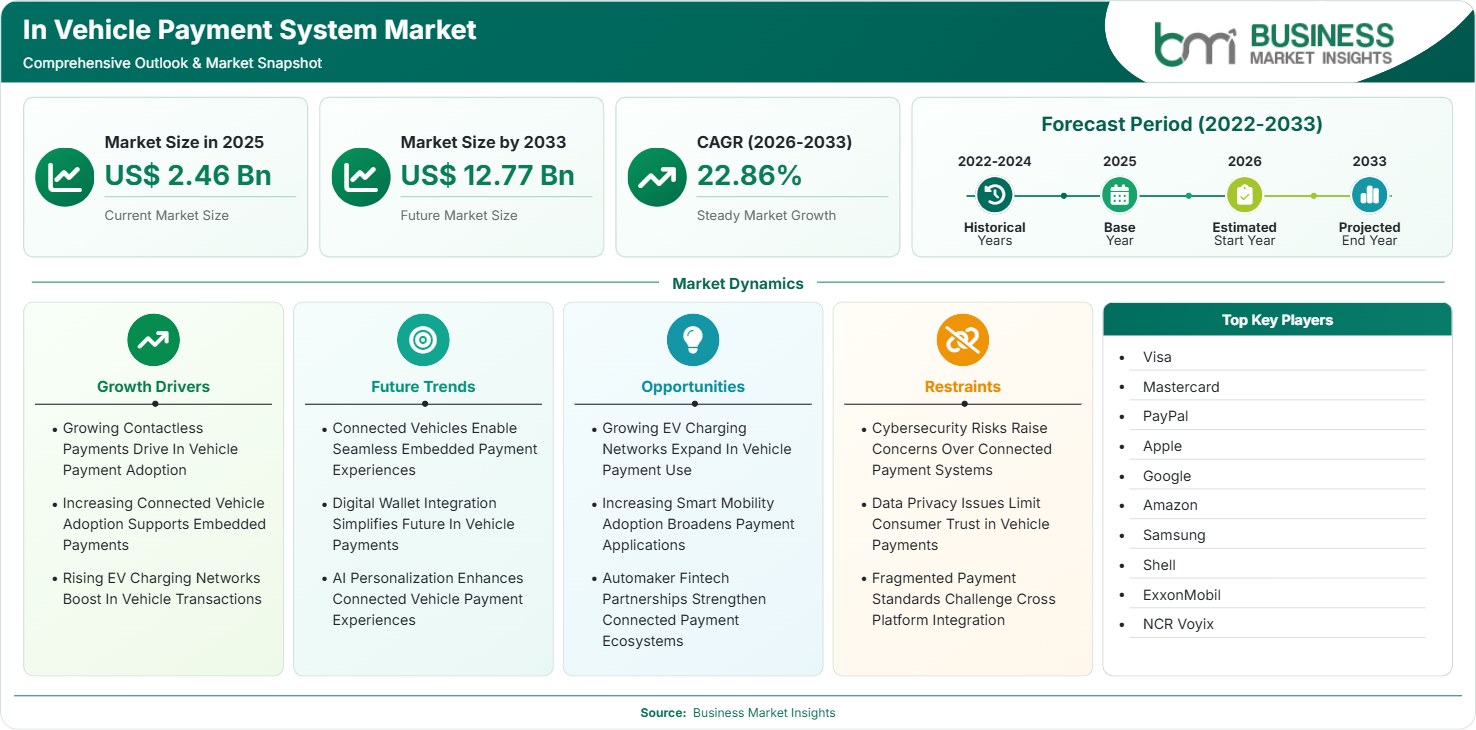
The In Vehicle Payment System Market size was valued at US$ 2.46 billion in 2025 and is projected to reach US$ 12.77 billion by 2033, growing at a CAGR of 22.86% during 2026–2033, driven by contactless payments, connected vehicles, EV charging expansion, smart mobility, and automaker-fintech partnerships.

Report Coverage
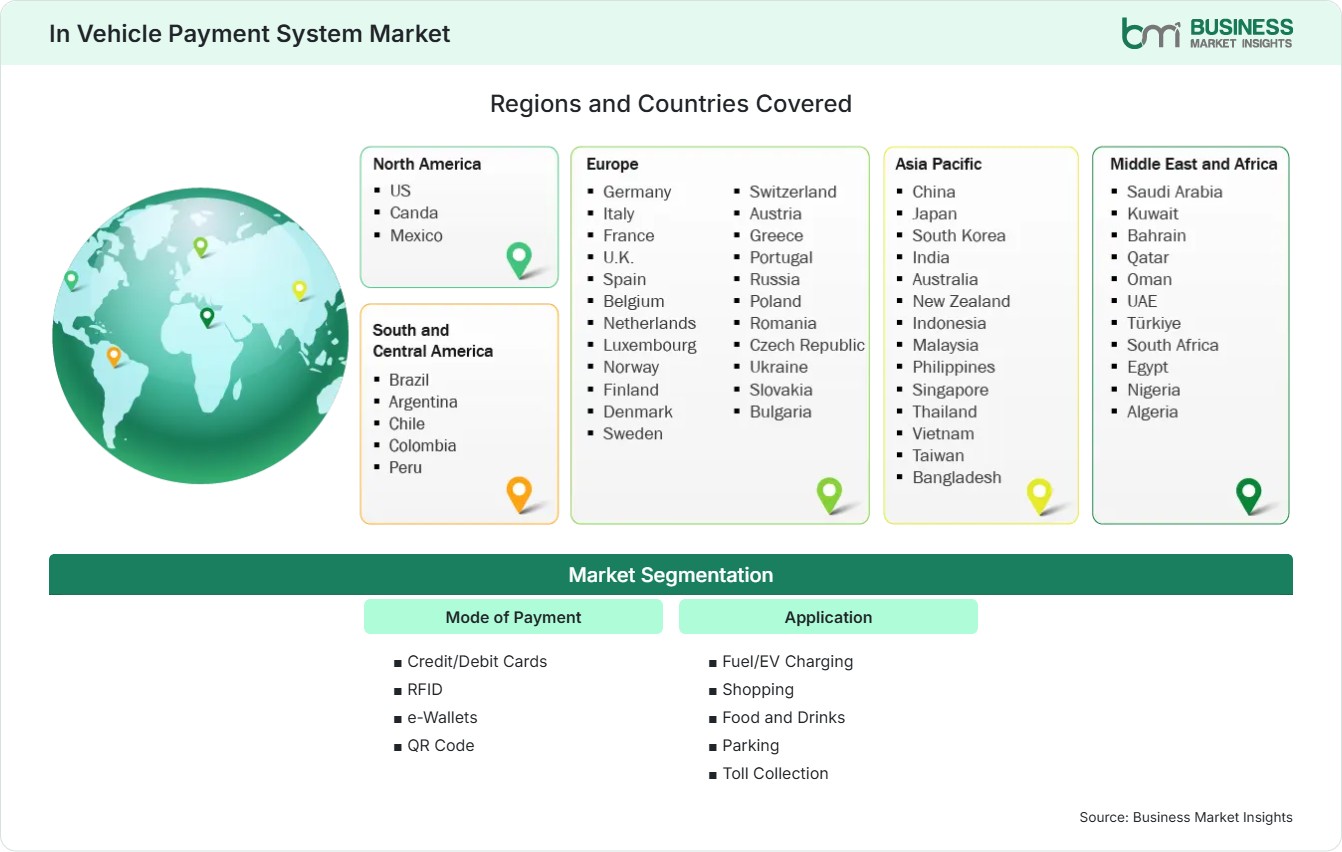
  • Mode of Payment: Credit/Debit Cards, RFID, e-Wallets, QR Code
  • Application: Fuel/EV Charging, Shopping, Food and Drinks, Parking, Toll Collection
US$ 2.46 Bn Market size in 2025
US$ 12.77 Bn Market Size by 2033
22.86% CAGR, 2026 - 2033
2026-2033 Forecast Period

01 AI Overview

In Vehicle Payment System Market Summary

  • North America Region: North America holds a 34%–39% share in 2025, growing at a CAGR of 20.5%–23.5% during 2026–2033, supported by connected vehicle penetration, digital payment infrastructure, EV charging expansion, and partnerships between automakers and payment providers. The US In Vehicle Payment System Market is projected to grow at a CAGR of 21.0%–24.0% during 2026–2033, supported by contactless payments, connected cars, EV adoption, and integrated mobility services.
  • Fastest Growing Region: Asia Pacific holds a 25%–30% share in 2025 and is projected to expand at a CAGR of 24.0%–27.0%, driven by connected vehicle adoption, mobile wallet penetration, expanding EV infrastructure, digital commerce, and increasing integration of payment capabilities into automotive ecosystems.
  • Leading Segment: Credit/Debit Cards represent a 35%–40% share in 2025 and are projected to grow at a CAGR of 20.5%–23.5%, supported by established payment acceptance, consumer familiarity, tokenization, contactless transactions, and integration with connected vehicle platforms.
  • High Growth Segment: RFID represents a 15%–20% share in 2025 and is projected to grow at a CAGR of 24.0%–27.0%, driven by automated tolling, fuel payments, parking access, faster authentication, and increasing deployment of vehicle-integrated identification technologies.
  • Key Market Opportunity: Expanding EV charging networks, smart mobility platforms, connected commerce, and automaker-fintech partnerships are creating opportunities for secure embedded payments across transportation and everyday vehicle services.
  • Major Market Players: Visa, Mastercard, PayPal, Apple, Google, Amazon, Samsung, Shell, ExxonMobil, and NCR Voyix.
02 Strategic Insights

In Vehicle Payment System Market: Strategic Insights

In Vehicle Payment System Market Strategic Framework
FREE PDF
Request your free sample
Request free sample
03 Stakeholder View

Key Takeaways

  • The ecosystem is shifting from standalone payment transactions toward integrated vehicle commerce, connecting automakers, payment networks, energy providers, merchants, and mobility platforms.
  • EV charging represents a major application opportunity because charging transactions can be integrated directly into connected vehicle interfaces and authenticated without repeated manual payment steps.
  • Tokenization, biometric authentication, secure digital identities, and vehicle-to-cloud connectivity are becoming important technology priorities as embedded payments expand.
  • Asia Pacific offers strong expansion potential because mobile payment adoption, connected vehicle deployment, digital commerce, and EV infrastructure are developing concurrently.
  • Strategic partnerships between automakers, payment networks, technology providers, energy companies, and retailers are likely to shape ecosystem development and transaction acceptance.
  • Providers that deliver interoperable platforms across fuel, charging, parking, tolling, food, and retail applications can strengthen customer engagement and increase transaction opportunities.
04 Geographic Outlook

In Vehicle Payment System Market Regional Highlights

North America In Vehicle Payment System Market

North America holds a 34%–39% share in 2025 and is projected to grow at a CAGR of 20.5%–23.5% during 2026–2033. The region benefits from mature card networks, connected vehicle adoption, widespread contactless payment acceptance, and expanding EV charging infrastructure. In Vehicle Payment System Market share is supported by established digital commerce and automotive technology ecosystems. Market growth is also encouraged by automaker partnerships, integrated tolling, parking services, and growing consumer acceptance of embedded payment experiences.

  • US automakers and technology companies are integrating connected services that can support payments across fuel, charging, parking, tolling, and retail environments.
  • Expanding EV charging networks are creating additional transaction points where vehicle-linked payment credentials can simplify authentication and billing.
  • Mature contactless infrastructure provides a strong foundation for integrating established payment networks into connected vehicle ecosystems.
  • Partnerships among payment providers, automakers, energy companies, and mobility operators are supporting broader ecosystem development.

US In Vehicle Payment System Market

The US represents a 30%–35% share of the global market in 2025 and is projected to grow at a CAGR of 21.0%–24.0% through 2033. Strong payment infrastructure, connected vehicle adoption, digital commerce, and EV charging expansion are supporting demand. Automotive platforms increasingly provide opportunities to connect payment credentials with vehicle identities. In Vehicle Payment System Market adoption is also supported by established tolling and parking systems, while retailers and energy providers explore integrated transaction experiences designed to reduce payment friction.

  • Connected vehicle platforms are creating new channels for embedded transactions across fuel, charging, parking, tolling, and commerce.
  • EV charging expansion is increasing demand for payment experiences that simplify authentication and reduce repeated manual interactions.
  • Payment tokenization and secure digital credentials are strengthening the potential for vehicle-linked transactions.

Europe In Vehicle Payment System Market

Europe accounts for a 25%–30% share in 2025 and is forecast to expand at a CAGR of 19.5%–22.5% during 2026–2033. Germany, the UK, France, Italy, and the Netherlands represent leading markets, while Nordic countries provide strong growth opportunities. Germany is projected to grow at a CAGR of 19.0%–22.0%, while the Netherlands could expand at 22.5%–25.5%. EV adoption, connected mobility, digital payments, and smart transportation infrastructure are supporting regional demand.

  • Germany benefits from a strong automotive ecosystem and increasing integration of connected digital services into vehicle platforms.
  • The UK and France offer opportunities through established contactless payment infrastructure and expanding digital mobility services.
  • Nordic markets are attractive for vehicle payment providers because of high digital payment adoption and advanced EV infrastructure.
  • European regulatory attention to cybersecurity and data protection is encouraging secure architecture for connected payment services.

Asia Pacific In Vehicle Payment System Market

Asia Pacific holds a 25%–30% share in 2025 and is projected to register a CAGR of 24.0%–27.0% during 2026–2033, making it the fastest-growing regional market. China, Japan, South Korea, India, and Australia represent important demand centers. India is projected to grow at a CAGR of 25.0%–28.0%, while China could expand at 24.0%–27.0%. Mobile payments, connected vehicles, EV adoption, and digital commerce are supporting rapid ecosystem development.

  • China provides significant opportunities through connected vehicle deployment, digital wallets, EV adoption, and advanced smart mobility infrastructure.
  • India offers strong potential as digital payments expand and automotive manufacturers increasingly introduce connected vehicle features.
  • Japan and South Korea benefit from advanced automotive technology ecosystems and established consumer acceptance of digital payment services.
  • Australia presents opportunities through EV charging development, connected mobility services, and increasing integration of digital transactions.

Rest of World In Vehicle Payment System Market

South and Central America account for a 7%–10% share in 2025 and are projected to expand at a CAGR of 19.0%–22.0% during 2026–2033. Brazil, Mexico, and Argentina lead regional demand as digital payments and connected mobility develop. The Middle East and Africa represent a 6%–9% share and are projected to grow at a CAGR of 20.0%–23.0%, supported by smart mobility investment and digital infrastructure expansion.

Brazil and Mexico offer opportunities through expanding digital payment ecosystems and growing connected vehicle adoption, while Gulf countries are investing in smart transportation infrastructure. The UAE and Saudi Arabia represent leading markets, whereas South Africa provides opportunities through digital commerce and mobility modernization. Growth depends on connectivity, payment infrastructure, EV charging development, cybersecurity readiness, and consumer trust.

  • Gulf countries are investing in smart mobility and connected transportation systems, creating opportunities for integrated vehicle payment services.
  • Brazil and Mexico provide growth potential through digital payment adoption and expanding connected mobility applications.
  • South Africa offers opportunities as digital commerce and automotive connectivity gradually increase across urban transportation networks.
  • Emerging markets can benefit from scalable payment platforms that connect fuel, parking, tolling, charging, and retail transactions.
Global Market Geography
FREE PDF
Request your free sample
Request free sample
05 Segment Analysis

In Vehicle Payment System Market Segmentation

Mode of Payment

The Mode of Payment segment is led by Credit/Debit Cards, representing a 35%–40% share in 2025 and growing at a CAGR of 20.5%–23.5% through 2034. Established acceptance, consumer familiarity, contactless capabilities, and tokenization support adoption. The In Vehicle Payment System Market scope is expanding as payment methods move into connected vehicle interfaces and automated mobility services.

  • Credit/Debit Cards: Card-based payments remain widely accepted and benefit from established networks, tokenization, contactless technology, and consumer familiarity across automotive transaction environments.
  • RFID: RFID enables automated identification and payment for tolls, fuel, parking, and access services, reducing manual interaction and supporting faster vehicle transactions.
  • e-Wallets: Digital wallets provide flexible payment credentials and benefit from smartphone ecosystems, mobile commerce, tokenization, and increasing integration with connected vehicle platforms.
  • QR Code: QR codes offer a low-cost payment mechanism that can connect vehicles and smartphones, supporting transactions where dedicated embedded payment infrastructure remains limited.

Application

The Application segment is led by Fuel/EV Charging, representing a 42%–47% share in 2025 and growing at a CAGR of 23.5%–26.5% through 2034. The expansion of EV charging networks and connected fuel services is creating frequent transaction opportunities. In Vehicle Payment System Market trends are increasingly influenced by the integration of payment credentials directly into vehicle and charging ecosystems.

  • Fuel/EV Charging: Fuel and charging represent major applications because drivers require frequent transactions and can benefit from automated vehicle-linked authentication and billing.
  • Shopping: Connected vehicle commerce can enable purchases through integrated interfaces, creating opportunities for retailers to engage drivers during journeys.
  • Food and Drinks: Vehicle-linked ordering and payment can simplify transactions at restaurants, drive-through locations, and roadside services.
  • Parking: Embedded payment capabilities can automate parking transactions, reduce manual payment steps, and support seamless entry and exit experiences.
  • Toll Collection: Vehicle-linked payments enable automated toll transactions and support faster movement through connected road infrastructure.
06 Market Forces

In Vehicle Payment System Market Dynamics

Key Market Drivers

Growing Contactless Payments Drive In Vehicle Payment Adoption

Contactless payment usage is building an excellent foundation for in-vehicle transactions by minimizing the need for physical cards or cash, as well as the constant need for authentication. Consumers are looking for easy, fast payments through digital channels across all areas of life, including transportation. Payment networks and technology providers are expanding the scope of contactless payments through tokenization and credential security. Through such practices, the users can make payments for fuel, parking, tolls, charging, and other services with minimal effort.

Increasing Connected Vehicle Adoption Supports Embedded Payments

The emergence of connected cars is creating a technological foundation that will enable embedded payments. Cars connected to the Internet can exchange information with payment gateways, service providers, charging stations, toll stations, and merchants. Connected cars enable transactions through in-car interfaces and authenticate users using their secure digital identities. More automakers are designing connected services not only for navigation and entertainment but also for commercial transactions. With the growth of connected cars, payment providers can develop services that eliminate friction in routine driving.

Rising EV Charging Networks Boost In Vehicle Transactions

EV charging is driving a rise in the number of places that frequently require drivers to use digital payment capabilities. Digital payments can include processes such as authentication, payment authorization, billing, and transaction logging, enabling integration with connected vehicle technology. An embedded payment solution would reduce reliance on multiple charging applications and the repetitive entry of card details, which is why companies are considering transaction methods that integrate these technologies. The Vehicle Payment System Market trends will increasingly be driven by the development of the EV ecosystem.

Key Market Opportunities

Growing EV Charging Networks Expand In Vehicle Payment Use

The growth in EV charging infrastructure is a great opportunity for vehicle payment providers, as charging generates continuous transaction flows at both public and private sites. With built-in payment functionality, there will be no need to repeatedly interact with third-party apps, as authentication can be made much easier. Car manufacturers can link charging payments to car account subscriptions, making the customer experience more uniform. Vehicle payment providers that establish business relationships with charging stations can achieve greater transaction coverage. This is just one aspect of the chance, since connected vehicles can use the same credentials for other mobility services, including parking and toll payments.

Increasing Smart Mobility Adoption Broadens Payment Applications

With smart mobility efforts, there will be greater opportunities to integrate mobility services through digital platforms. Payment systems for vehicles can facilitate transactions across toll road usage, parking, charging stations, fueling stations, and roadside services. With city investments in smart infrastructures, payment solutions can be integrated into mobility ecosystems to provide more streamlined user experiences. Tech vendors may also be able to offer their services in an interoperable format that enables payments for many different types of services and different payment methods. There will be opportunities for personalized experiences, loyalty programs, and subscriptions with smart mobility.

Automaker Fintech Partnerships Strengthen Connected Payment Ecosystems

Collaboration between car manufacturers and fintechs could accelerate the adoption of vehicle payments by leveraging vehicle connectivity technology alongside existing payment methods. While payment systems would offer secure processing and tokenization, car manufacturers would provide vehicle interfaces and customer relationships. Energy firms, retailers, and mobility services would be able to participate in the ecosystem by accepting vehicle-related payments. The Vehicle Payment System Market forecast sees greater integration within the ecosystem as industry players seek to reduce payment friction and create new payment channels.

Market Restraints and Challenges

Cybersecurity Risks Raise Concerns Over Connected Payment Systems

Factor: Linked payment platforms enable vehicles to connect to the cloud platform as well as to payment networks, merchants, and service providers, providing several digital entry points. Implications: Weaknesses in cybersecurity can result in the exposure of payment credentials, vehicle information, or transaction details, and can lower consumer confidence or increase compliance requirements. Service providers should ensure that they have encryption, tokenization, secure authentication, real-time monitoring, and regular software updates. Automakers and payment firms should also coordinate their cybersecurity policies, as vulnerabilities can arise in interconnected environments.

Data Privacy Issues Limit Consumer Trust in Vehicle Payments

Factor: Vehicle payment platforms can process transaction information alongside connected vehicle data, location information, and user preferences. Impact: Concerns about data collection, sharing, and usage can affect consumer trust and limit adoption. Customers may be reluctant to enable embedded payments if they are uncertain about how their information is stored or used. Companies must provide transparent privacy policies and strong controls over data access. Regulatory requirements can also increase implementation complexity. Building trust will require clear consent mechanisms, secure data handling, and responsible use of transaction and vehicle information.

07 Company Analysis

Competitive Landscape

The In Vehicle Payment System Market analysis indicates that competition is increasingly centered on ecosystem integration rather than payment processing alone. Payment networks, technology companies, automakers, energy providers, retailers, and mobility operators are building interconnected transaction environments. Competitive advantages include secure tokenization, broad merchant acceptance, connected vehicle compatibility, strong consumer trust, and the ability to support multiple applications through a single payment experience.

Company Name

Overview

Products and Services relevant to this market

Visa

Global digital payment network supporting electronic transactions across merchants, financial institutions, and connected commerce ecosystems.

Card payment networks, tokenization, digital credentials, contactless payments, and connected commerce infrastructure.

Mastercard

Global payments technology company providing secure transaction infrastructure and digital payment capabilities.

Tokenization, contactless payments, digital wallets, payment processing, and connected commerce solutions.

PayPal

Digital payments company providing online and mobile transaction services for consumers and businesses.

Digital wallets, payment processing, mobile payments, merchant services, and digital transaction infrastructure.

Apple

Technology company operating connected device ecosystems with integrated digital payment and wallet capabilities.

Apple Pay, digital wallets, contactless payments, tokenized credentials, and device-based payment authentication.

Google

Technology company providing digital payment services integrated with mobile and connected technology ecosystems.

Google Pay, digital wallets, payment credentials, contactless payments, and connected digital commerce services.

Amazon

Global technology and commerce company with extensive digital transaction capabilities and connected consumer services.

Digital payment services, merchant transactions, connected commerce, and customer account-based payment experiences.

Samsung

Technology company offering connected devices and digital payment services through its consumer electronics ecosystem.

Samsung Wallet, digital payments, tokenization, contactless transactions, and connected device payment capabilities.

Shell

Global energy company operating fuel stations and expanding mobility and EV charging services.

Fuel payments, EV charging transactions, digital mobility services, and connected energy payment experiences.

ExxonMobil

Global energy company operating fuel retail networks and developing digital customer experiences.

Fuel payment services, mobile transactions, loyalty-linked payments, and connected retail experiences.

NCR Voyix

Technology company providing digital commerce and payment solutions for businesses and consumer-facing environments.

Payment processing, commerce platforms, transaction systems, and digital solutions supporting retail and mobility payments.

10 Trust & Transparency

Research Methodology

The market analysis combines proprietary research with secondary data from government agencies, company disclosures, regulatory filings, industry databases and expert interviews. Market estimates are validated through data triangulation, cross-market benchmarking and analyst review.

View Full Research Methodology

11 Questions Answered

Frequently Asked Questions

What information is included in an In Vehicle Payment System Market Report?

The report covers market size, growth projections, segmentation, regional analysis, competitive landscape, payment technologies, applications, industry trends, drivers, opportunities, restraints, and strategic market dynamics.

Why are automaker-fintech partnerships important for market development?

Automaker-fintech partnerships combine vehicle connectivity, payment processing, tokenization, and customer ecosystems. These collaborations can improve transaction security, expand acceptance, and support seamless payments across charging, fuel, parking, tolling, and commerce.

How are EV charging networks influencing vehicle payment demand?

EV charging networks are creating frequent transaction points where integrated payment systems can simplify authentication, billing, and account management, encouraging automakers and payment providers to develop connected charging payment solutions.

Which payment mode leads the in vehicle payment system industry?

Credit/Debit Cards represent a leading payment mode due to established acceptance, consumer familiarity, contactless capabilities, secure tokenization, and compatibility with existing payment networks.

What factors are supporting In Vehicle Payment System Market growth?

Growing contactless payments, connected vehicle adoption, expanding EV charging networks, smart mobility development, digital commerce, and partnerships between automakers and financial technology companies are supporting market development.

Access the Full In Vehicle Payment System Market Report

Get segment-level forecasts, regional estimates, competitive benchmarking, company profiles and downloadable Excel datasets.

Access the full In Vehicle Payment System Market Report
350 pages PDF & Excel | 2026-08-06