
Autonomous Vehicle Market Outlook: Size, Share, Trends, Growth Analysis, Competitive Landscape & Forecast, 2026-2033

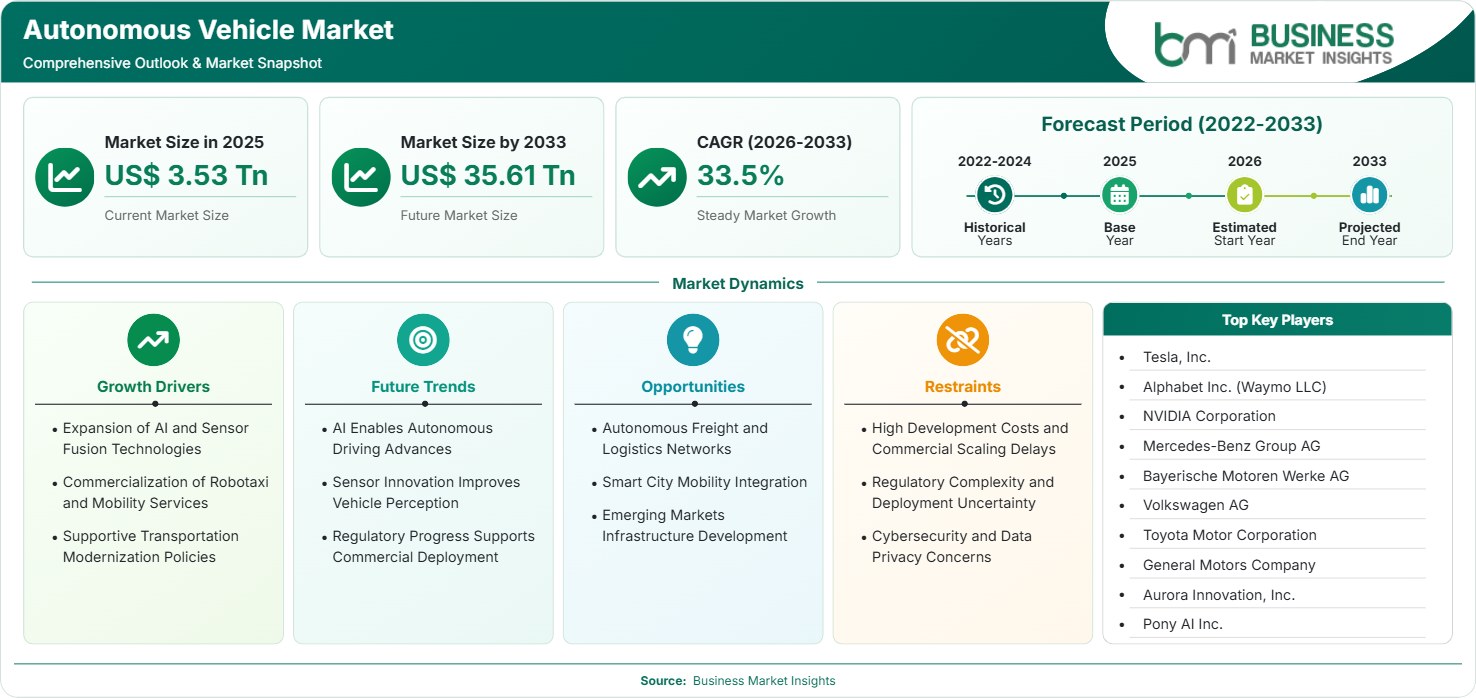
The Autonomous Vehicle Market size was valued at US$ 3.53 Trillion in 2025 and is projected to reach US$ 35.61 Trillion by 2033, growing at a CAGR of 33.5% during 2026–2033. Key drivers include AI-enabled driving systems, sensor cost optimization, regulatory pilots, connected mobility infrastructure, commercial fleet automation, and expanding robotaxi deployments. Opportunities stem from autonomous logistics, smart city integration, and software-defined mobility ecosystems.

Report Coverage
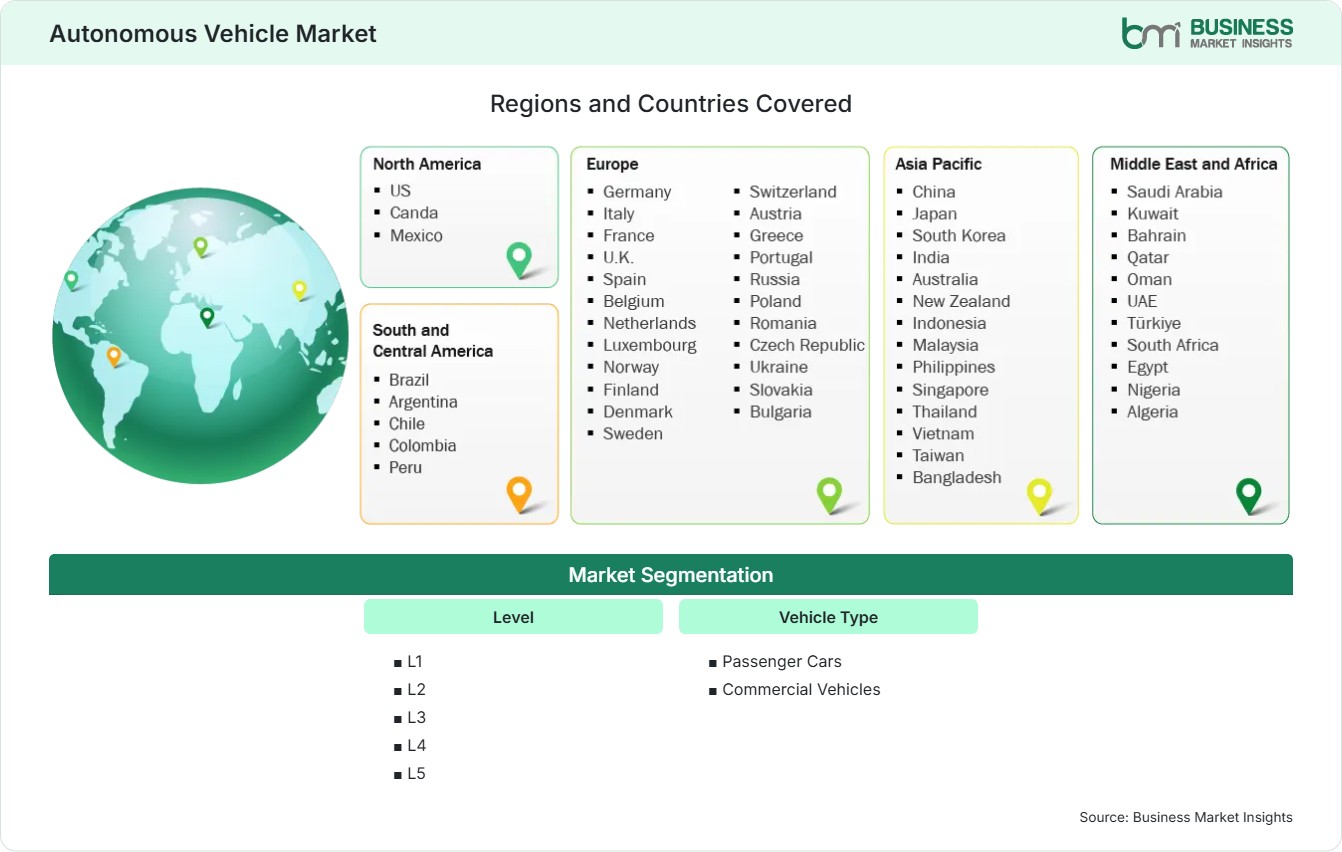
  • Level: L1, L2, L3, L4, L5
  • Vehicle Type: Passenger Cars, Commercial Vehicles
US$ 3.53 Tn Market size in 2025
US$ 35.61 Tn Market Size by 2033
33.5% CAGR, 2026 - 2033
2026-2033 Forecast Period

AI Overview

Autonomous Vehicle Market Summary

  • North America Region: Holds a market share of 34%–37% in 2025, growing at a CAGR of 31%–34% during 2026–2033. Growth is supported by robotaxi commercialization, advanced AI platforms, strong venture investment, federal testing programs, connected infrastructure upgrades, logistics automation initiatives, high consumer technology adoption, and semiconductor innovation. The U.S. remains the regional hub, advancing Level 4 deployments and commercial autonomous mobility services with a CAGR of 32%–35%.
  • Fastest Growing Region: Asia Pacific accounts for 28%–31% share in 2025 and expands at 35%–38% CAGR during 2026–2033. Government-backed intelligent transport programs, expanding EV ecosystems, large-scale urbanization, semiconductor capabilities, smart highway projects, and autonomous freight corridors continue strengthening regional deployment activity and technology commercialization.
  • Leading Segment: Passenger Cars represent 68%–71% share in 2025 and grow at 31%–34% CAGR during 2026–2033. Consumer demand for advanced driver assistance, expanding premium vehicle penetration, software-based vehicle architectures, connected vehicle ecosystems, and OEM investments in autonomy accelerate adoption across developed and emerging automotive markets.
  • High Growth Segment: Level L4 holds 16%–19% share in 2025 and records 37%–40% CAGR during 2026–2033. Commercial robotaxi operations, geo-fenced deployment models, logistics automation requirements, regulatory approvals, sensor fusion advances, and improving operational economics continue strengthening large-scale autonomous mobility implementation.
  • Key Market Opportunity: Expanding autonomous freight and logistics networks create attractive long-term opportunities through labor optimization, operational efficiency gains, continuous vehicle utilization, intelligent routing systems, and growing investment across industrial transportation ecosystems.
  • Major Market Players: Tesla, Inc.; Alphabet Inc. (Waymo LLC); NVIDIA Corporation; Mercedes-Benz Group AG; Bayerische Motoren Werke AG; Volkswagen AG; Toyota Motor Corporation; General Motors Company; Aurora Innovation, Inc.; Pony AI Inc.
Strategic Insights

Autonomous Vehicle Market: Strategic Insights

Autonomous Vehicle Market Strategic Framework
FREE PDF
Request your free sample
Request free sample
Stakeholder View

Key Takeaways

  • The value chain is increasingly shifting toward software platforms, AI processors, cloud infrastructure providers, sensor manufacturers, and mobility service operators rather than traditional vehicle manufacturing alone.
  • Commercial freight automation and Level L4 deployments present the strongest near-term revenue opportunities due to measurable efficiency gains and predictable operating environments.
  • R&D priorities are migrating from hardware-centric architectures toward AI training systems, digital twins, simulation environments, and real-time edge computing capabilities.
  • China, the United States, and the UAE offer attractive investment environments due to regulatory support, urban smart mobility initiatives, and technology ecosystem maturity.
  • Strategic partnerships between automakers, semiconductor companies, autonomous software vendors, and ride-hailing platforms are accelerating commercialization timelines.
  • Consolidation activity is expected to continue as technology scaling costs encourage mergers, acquisitions, and long-term development alliances.
Geographic Outlook

Autonomous Vehicle Market Regional Highlights

North America Autonomous Vehicle Market

North America accounts for approximately 34%–37% of revenue in 2025 and advances at a 31%–34% CAGR through 2033. The region benefits from mature digital infrastructure, strong venture funding, and commercial robotaxi deployments. Autonomous Vehicle Market share remains highest in this region due to extensive technology testing ecosystems, advanced semiconductor capabilities, and favorable regulatory pilot environments. Fleet automation, logistics digitization, and AI investment continue driving market expansion.

  • Waymo, Tesla, and multiple technology providers are expanding commercial deployment programs across major metropolitan corridors.
  • Strong cloud computing capabilities and AI development ecosystems accelerate autonomous software innovation.
  • Logistics operators increasingly deploy automated transportation solutions to reduce operating costs and address labor shortages.
  • Connected infrastructure initiatives support vehicle-to-everything communication and safer autonomous navigation.
  • Regulatory agencies continue evaluating deployment frameworks supporting broader commercialization.

US Autonomous Vehicle Market

The United States represents 76%–80% of regional revenue and grows at 32%–35% CAGR through 2033. Large-scale technology investment, advanced AI development, and expanding deployment pilots support rapid industry scaling. Autonomous mobility programs across California, Texas, Arizona, and Florida remain central to commercial implementation. Public-private collaboration continues strengthening operational testing and commercialization pathways.

  • Robotaxi services are expanding beyond pilot programs into commercial passenger transportation networks.
  • Autonomous trucking initiatives gain momentum along major freight routes.
  • Venture capital funding remains concentrated in perception systems, AI software, and mobility platforms.
  • Federal and state programs continue supporting innovation and safe deployment frameworks.

Europe Autonomous Vehicle Market

Europe captures 24%–27% market share in 2025 and expands at a 30%–33% CAGR through 2033. Strong automotive manufacturing capabilities, sustainability objectives, and vehicle safety regulations support adoption. Germany leads regional deployment activity, while the United Kingdom demonstrates one of the fastest growth trajectories. Collaborative research programs and intelligent mobility investments strengthen technological competitiveness.

  • Germany leads commercialization efforts through premium automotive manufacturers and technology partnerships.
  • The United Kingdom records one of the fastest regional growth rates driven by regulatory support.
  • Vehicle safety regulations encourage integration of advanced automated driving functions.
  • Urban mobility projects stimulate autonomous shuttle and passenger transport deployments.
  • Cross-border research initiatives accelerate technology validation activities.

Asia Pacific Autonomous Vehicle Market

Asia-Pacific accounts for 28% to 31% of market share in 2025 and shows the highest growth rate, with a 35% to 38% CAGR through 2033. China leads the regional market in terms of deployment activities; however, India and Southeast Asia show potential as emerging markets. There is governmental backing, a large urban population, and smart investments that promote deployment in the region.

  • China leads deployment through aggressive smart mobility strategies and technology investments.
  • Japan strengthens adoption through advanced automotive engineering capabilities.
  • India emerges as a long-term opportunity linked to smart-city development initiatives.
  • Autonomous freight and industrial transport applications expand across manufacturing hubs.
  • Large-scale digital infrastructure investments improve deployment readiness.

Rest of World Autonomous Vehicle Market

Rest of World has a share between 9%-12% and is growing at a CAGR of 32%-35%. The Middle East is experiencing a growth boom driven by smart city initiatives and digital infrastructure development projects. South and Central America are witnessing an increase in test deployments. UAE dominates in the region, while Brazil is a good growth prospect owing to improved mobility solutions.

  • UAE autonomous mobility programs are supported by advanced smart-city investments.
  • Saudi Arabia integrates autonomous transportation into large-scale urban development projects.
  • Brazil is emerging as a leading Latin American market for intelligent mobility.
  • Infrastructure modernization supports future deployment opportunities.
  • Public transportation automation programs gain increasing policy attention.
Global Market Geography
FREE PDF
Request your free sample
Request free sample
Segment Analysis

Autonomous Vehicle Market Segmentation

Level

This section constitutes a 58% to 62% market share in 2025 and grows at 34% to 37% CAGR. The Autonomous Vehicle market scope continues to widen as automation evolves from driver assistance to full autonomy. Regulations, advancements in AI, the affordability of sensors, and investments by OEMs remain essential for adoption across all automation stages.

  • L1: Entry-level automation supports lane assistance and adaptive cruise functions, improving safety while familiarizing consumers with automated driving technologies.
  • L2: Widely deployed in premium and mid-range vehicles, combining steering and acceleration support with active driver supervision requirements.
  • L3: Conditional automation gains traction through regulatory approvals and increasing manufacturer investment in highway driving applications.
  • L4: Commercial robotaxi and logistics deployments accelerate adoption through geo-fenced operational environments and measurable efficiency benefits.
  • L5: Full automation remains developmental but continues attracting substantial AI, simulation, and autonomous systems investment.

Vehicle Type

Vehicle Type is the first pillar, including Passenger Cars, which generate the highest income. The Autonomous Vehicle Market trends indicate increasing penetration across both consumer and commercial mobility applications. The segment accounts for around 68%-71% market share in 2025 and is growing at a CAGR of 31%-34% through the forecast period.

  • Passenger Cars: Lead adoption through premium vehicle offerings, connected technologies, enhanced safety features, and consumer demand for autonomous driving convenience.
  • Commercial Vehicles: Adoption is driven by logistics optimization, freight efficiency improvements, labor shortages, and increasing investment in autonomous transport operations.
Market Forces

Autonomous Vehicle Market Dynamics

Key Market Drivers

Expansion of AI and Sensor Fusion Technologies

Artificial intelligence is advancing in perception, object detection, and real-time decision-making. The emergence of advanced sensor fusion systems that integrate lidar, radar, cameras, and powerful computing processors is driving the development of dependable operating systems. Industry investments in AI learning platforms and simulation technology are driving faster commercialization. The Autonomous Vehicles market growth is being driven by falling sensor costs and improved computing efficiency. Leading automobile manufacturers worldwide are adding more automation to their vehicles, enabling widespread implementation in both passenger and commercial transport while improving safety and efficiency.

Commercialization of Robotaxi and Mobility Services

The growing commercial deployment of autonomous ride-hailing services is creating directly monetizable use cases. Urban transportation operators increasingly view autonomous fleets as opportunities to improve vehicle utilization and reduce operational expenses. Various technology companies are working on providing commercial services in the most prominent cities. Increased usage of automated mobility services by users facilitates further adoption. A scalable software platform is one factor that fleet providers can benefit from. Business models such as mobility-as-a-service, AI-enabled driving, and digital infrastructure investment further boost demand for autonomous transportation.

Supportive Transportation Modernization Policies

Transportation digitalization is being embraced by governments through policies such as smart mobility programs, infrastructure connectivity programs, and policies enabling controlled tests. Transportation strategies by various nations include road safety, emissions control, and efficiency-of-movement goals. 5G network development, vehicle-to-everything, and digital highways will facilitate preparedness for its deployment. The trends in the Autonomous Vehicles sector will be characterized by cooperation between regulators, automakers, technology players, and infrastructure firms. This guarantees that there are no obstacles on the road to commercialization and that the development paths are predictable. It is particularly significant for regulatory clarity in securing investment in autonomous transport solutions.

Key Market Opportunities

Autonomous Freight and Logistics Networks

Investment in freight transport is considered the most viable option because of the process's predictability and the ability to measure operational benefits. Logistics firms are looking to improve asset efficiency, reduce fuel consumption, and shorten delivery times. The introduction of autonomous trucks will increase efficiency and address the driver shortage. Autonomous vehicle market forecasts for the self-driving car industry highlight logistics use cases as a key driver of growth. Transport corridors and logistics hubs serve as an excellent foundation for real-life commercialization of autonomous technology. Providers that can offer scalable fleet management solutions and autonomous driving platforms will be able to capitalize on logistics automation projects.

Smart City Mobility Integration

There is a development of mobility ecosystems in which autonomous cars are integrated into the public transport system by urban governments. Connected infrastructure, digital traffic management, and real-time data analytics will help to enhance movement within the smart city platform. The autonomous shuttles and on-demand transportation services will increase accessibility while alleviating congestion. Integrating the autonomous car system with the electric mobility network enhances the overall setup from a sustainability perspective. It is expected that technology providers will generate sustained revenue streams as the transformation of urban mobility accelerates.

Emerging Markets Infrastructure Development

The emerging economies understand the potential role of autonomous vehicles in their overall economic development strategies. Smart city projects, intelligent highways, logistics corridors, and digital infrastructure programs present an ideal environment. Technology companies will have a chance to establish their position in the market before the competition accelerates. Investments in connected transportation solutions are on the rise in Asia, the Middle East, and selected countries in Latin America. The solutions for scalability and diverse operating environments could generate significant value as these economies accelerate infrastructure modernization and transportation digitalization efforts.

Market Restraints and Challenges

High Development Costs and Commercial Scaling Delays

Creating autonomous vehicles that are safe entails heavy investments in sensors, AI training, simulation software, validation processes, and regulatory compliance, among other things. This makes it very stiff competition for new companies trying to operate in emerging markets and lengthens the time it takes them to achieve commercialization. It is essential that large autonomous vehicles are tested extensively across different environments. This is why most companies in the industry prefer partnerships and external funding to further develop themselves. It is necessary for companies to strike a balance between technology and economics.

Regulatory Complexity and Deployment Uncertainty

There is huge diversity in autonomous mobility regulations at the country, state, and municipality levels. The consequences include compliance issues with safety certification, liability, cybersecurity, and testing, which complicate deployment. This leads to a delayed commercialization process and inconsistent access to the markets. Organizations often modify technologies and deployment approaches due to varying regulatory conditions. Regulatory fragmentation may lead to higher costs of development and deployment. Coordination among regulators, industry players, and technology vendors will be crucial to building a consistent regulatory framework that supports safe and scalable market expansion.

Company Analysis

Competitive Landscape

Autonomous Vehicle Market analysis indicates that competition is driven by AI capabilities, sensor technology, software platforms, mobility partnerships, and commercialization scale.

Company Name

Overview

Products and Services relevant to this market

Tesla, Inc.

Global EV manufacturer pursuing autonomous mobility through software-centric vehicle platforms and AI capabilities.

Full Self Driving platform, AI training infrastructure, connected vehicle systems, autonomous mobility technologies.

Alphabet Inc. (Waymo LLC)

Pioneer in commercial robotaxi services with extensive real-world autonomous driving deployment experience.

Waymo Driver technology, robotaxi platforms, autonomous fleet management solutions.

NVIDIA Corporation

Leading provider of autonomous computing architectures and AI processing platforms.

DRIVE platform, AI chips, simulation software, autonomous vehicle computing systems.

Mercedes-Benz Group AG

Premium automotive manufacturer advancing conditional and higher-level autonomous driving technologies.

DRIVE PILOT systems, intelligent mobility solutions, advanced vehicle automation technologies.

Bayerische Motoren Werke AG

Luxury vehicle producer investing heavily in automated driving capabilities and software-defined vehicles.

Automated driving systems, connected vehicle technologies, advanced driver assistance platforms.

Volkswagen AG

Major global automaker developing scalable autonomous mobility architectures.

Autonomous software platforms, mobility services, intelligent transportation technologies.

Toyota Motor Corporation

Automotive leader expanding autonomous mobility through partnerships and advanced R&D programs.

Automated driving systems, autonomous shuttles, intelligent mobility platforms.

General Motors Company

Mobility-focused manufacturer with established autonomous technology investments.

Autonomous vehicle platforms, connected mobility services, vehicle automation systems.

Aurora Innovation, Inc.

Specialized autonomous driving technology developer focused on freight and logistics markets.

Aurora Driver platform, autonomous trucking technologies, fleet automation solutions.

Pony AI Inc.

Autonomous mobility company active in passenger transportation and logistics automation.

Robotaxi systems, autonomous driving software, commercial mobility technologies.

Trust & Transparency

Research Methodology

The market analysis combines proprietary research with secondary data from government agencies, company disclosures, regulatory filings, industry databases and expert interviews. Market estimates are validated through data triangulation, cross-market benchmarking and analyst review.

View Full Research Methodology

Questions Answered

Frequently Asked Questions

What information does an Autonomous Vehicle Market Report typically provide?

It generally includes market sizing, technology assessment, competitive benchmarking, regulatory evaluation, segmentation insights, investment trends, and long-term commercialization outlooks.

What makes Asia Pacific the fastest-growing regional market?

Government mobility initiatives, rapid urbanization, smart infrastructure projects, semiconductor capabilities, extensive EV adoption, and proactive technology investments support accelerated expansion.

How does autonomous mobility affect commercial transportation?

Autonomous transportation improves asset utilization, optimizes routing efficiency, reduces labor dependency, and supports continuous operations across freight, delivery, and logistics networks.

What technologies are most critical for autonomous vehicle performance?

Artificial intelligence, sensor fusion, high-definition mapping, edge computing, vehicle-to-everything connectivity, and cloud-based simulation platforms collectively enable reliable autonomous operation.

Which automation level is expected to generate the strongest future investment activity?

Level L4 remains the most commercially attractive due to robotaxi deployment, logistics automation, geo-fenced operations, and measurable return-on-investment potential relative to fully autonomous Level L5 systems.

Access the Full Autonomous Vehicle Market Report

Get segment-level forecasts, regional estimates, competitive benchmarking, company profiles and downloadable Excel datasets.

Access the full Autonomous Vehicle Market Report
350 pages PDF & Excel | 2026-09-22
Similar Research

Related Market Reports