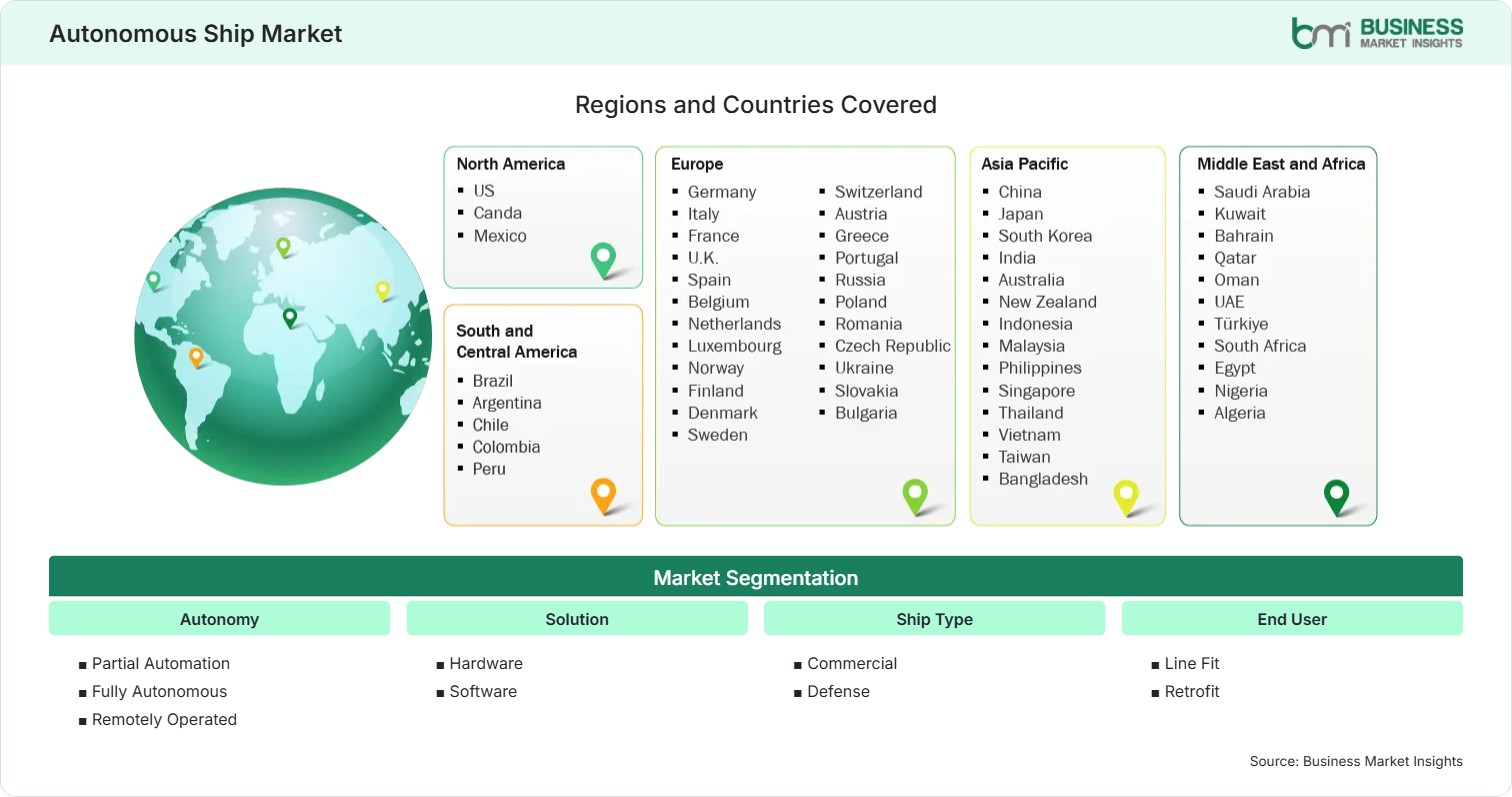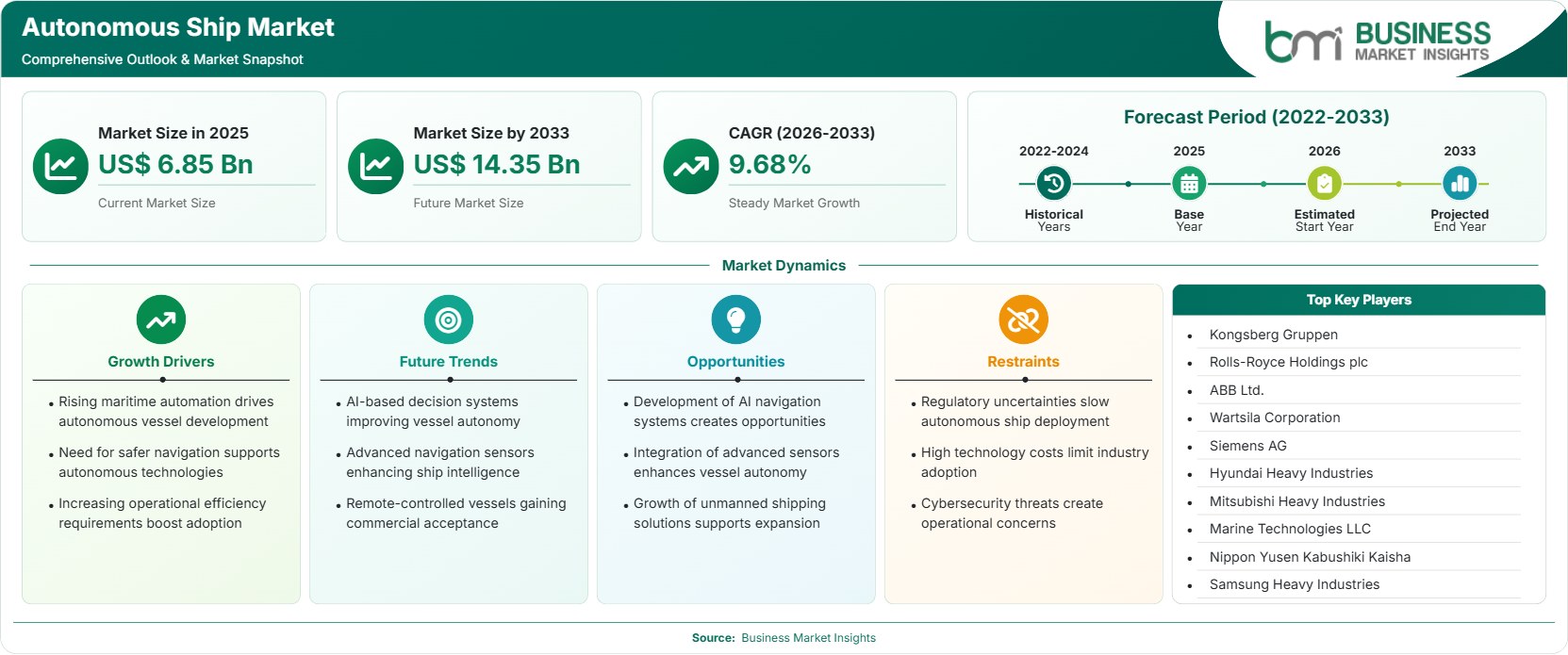
Autonomous Ship Market Regional Highlights
North America Autonomous Ship Market
North America held 24%–27% market share in 2025 and is expected to expand at a CAGR of 8.9%–9.5% during 2026–2033. The region benefits from advanced maritime research, defense spending, digital infrastructure, and established technology suppliers. Commercial operators are testing remote monitoring and autonomous navigation, while naval organizations are evaluating unmanned platforms for surveillance and maritime security. Investments in intelligent ports and coastal shipping systems are also creating supporting infrastructure for autonomous operations.
- U.S. defense programs continue encouraging development of unmanned maritime platforms, advanced sensors, secure communications, and autonomous mission systems for surveillance and maritime security.
- Commercial operators are increasingly evaluating autonomous assistance technologies for route planning, vessel monitoring, collision avoidance, and operational optimization on coastal and controlled shipping routes.
- Canadian maritime organizations provide opportunities for autonomous vessel trials in ports, coastal transportation, environmental monitoring, and specialized operations requiring reduced onboard personnel.
- North American technology suppliers benefit from established software, cybersecurity, artificial intelligence, and communications capabilities that can be integrated into maritime automation platforms.
US Autonomous Ship Market
The U.S. accounted for 78%–82% of North American market share in 2025 and is projected to grow at a CAGR of 9.1%–9.7% during 2026–2033. The country has strong capabilities in naval technology, autonomous systems, artificial intelligence, and maritime research. Commercial and defense organizations are developing unmanned platforms while technology companies provide navigation, sensing, connectivity, and control capabilities.
- Defense applications remain an important technology development area, with unmanned surface systems supporting surveillance, reconnaissance, security, and mission-specific maritime operations.
- Research programs continue improving autonomous navigation, sensor fusion, communications resilience, and remote vessel control for increasingly complex operating environments.
- Commercial operators are evaluating autonomous technologies where route predictability, operating efficiency, and remote supervision can provide measurable economic benefits.
Europe Autonomous Ship Market
Europe represented 27%–30% market share in 2025 and is projected to grow at a CAGR of 9.0%–9.6% during 2026–2033. The region has a strong maritime technology ecosystem spanning shipbuilders, navigation companies, ports, research institutions, and classification organizations. Norway remains a leading market for autonomous vessel development, while Finland and Denmark are emerging high-growth markets because of active smart shipping projects and maritime technology investment.
- Norway remains a leading autonomous shipping hub, supported by advanced maritime technology companies, short-sea shipping projects, and established vessel testing capabilities.
- Finland continues developing smart vessel technologies through cooperation among shipbuilders, technology companies, research institutions, and maritime operators.
- Denmark provides opportunities for autonomous and digitally managed ferries, short-sea vessels, and port operations supported by strong maritime infrastructure.
- European shipowners are increasingly linking automation with fuel efficiency, emissions reduction, predictive maintenance, and broader vessel lifecycle optimization.
Asia Pacific Autonomous Ship Market
Asia Pacific held 39%–42% autonomous ship market share in 2025 and is expected to register the fastest CAGR of 10.4%–11.0% during 2026–2033. The region benefits from extensive shipbuilding capacity, large commercial fleets, strong electronics manufacturing, and expanding smart port infrastructure. China remains a leading market, while South Korea and Japan are important high-growth countries because of advanced shipbuilding and active autonomous vessel programs. Singapore also provides an important testing environment because of its strategic position as a major maritime hub.
- South Korea is advancing autonomous navigation through major shipbuilders that are integrating artificial intelligence, digital ship systems, and remote monitoring into commercial vessel programs.
- Japan's shipping companies and technology suppliers are investing in autonomous vessel demonstrations focused on coastal transportation, navigation safety, and operating efficiency.
- China benefits from extensive shipbuilding capacity and growing investment in intelligent vessels, digital ports, navigation systems, and maritime automation.
- Singapore continues supporting maritime technology development through port digitalization, autonomous vessel testing, research partnerships, and regulatory initiatives.
Rest of World Autonomous Ship Market
The Rest of World region represented 5%–8% autonomous ship market share in 2025 and is projected to expand at a CAGR of 8.1%–8.7% during 2026–2033. South and Central America are developing opportunities through port modernization, offshore operations, coastal shipping, and maritime surveillance. Brazil represents a leading market because of its extensive coastline and offshore industrial activity. Mexico and Chile provide additional opportunities as maritime logistics and port infrastructure become more digitalized.
The Middle East and Africa region is also moving towards automation at sea for various activities such as energy at sea, defense, port management, and special vessels. Among some of the leading markets in this region are the United Arab Emirates and Saudi Arabia, while South Africa represents opportunities connected to port development and maritime security.
- Brazil's offshore and maritime industries provide opportunities for remotely monitored vessels, autonomous navigation systems, and specialized maritime technologies.
- Gulf countries are investing in smart ports, maritime logistics infrastructure, offshore operations, and digital technologies that can support autonomous vessel deployment.
- South Africa's port modernization initiatives can create demand for automated vessel monitoring, navigation assistance, and maritime control systems.
- Mexico's extensive coastline and commercial port network provide potential applications for remote vessel supervision and intelligent navigation technologies.