
Ship Building Market Outlook: Size, Share, Trends, Growth Analysis, Competitive Landscape & Forecast, 2026-2033

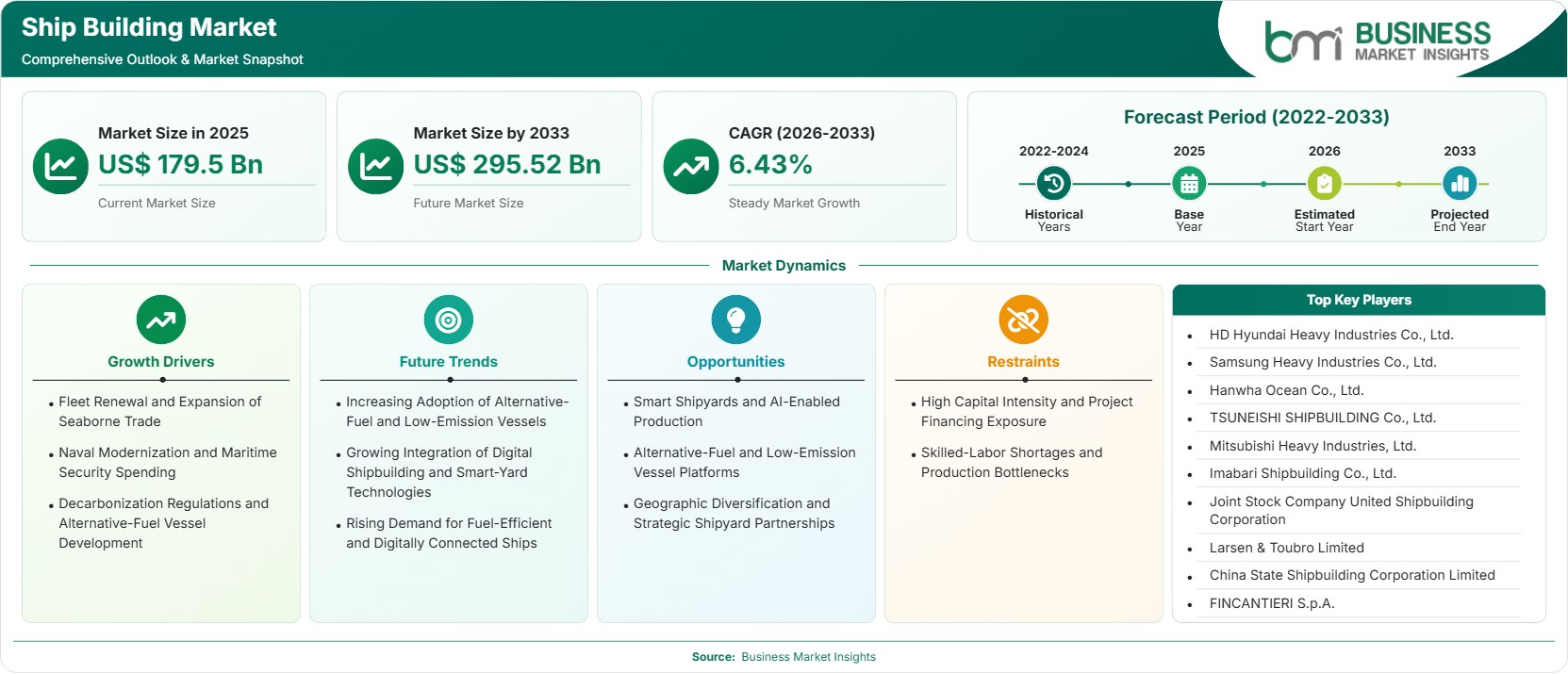
The Ship Building Market size was valued at US$ 179.5 Billion in 2025 and is projected to reach US$ 295.52 Billion by 2033, growing at a CAGR of 6.43% during 2026–2033, driven by fleet renewal, maritime trade expansion, naval modernization, decarbonization investments, and demand for fuel-efficient vessels.

Report Coverage
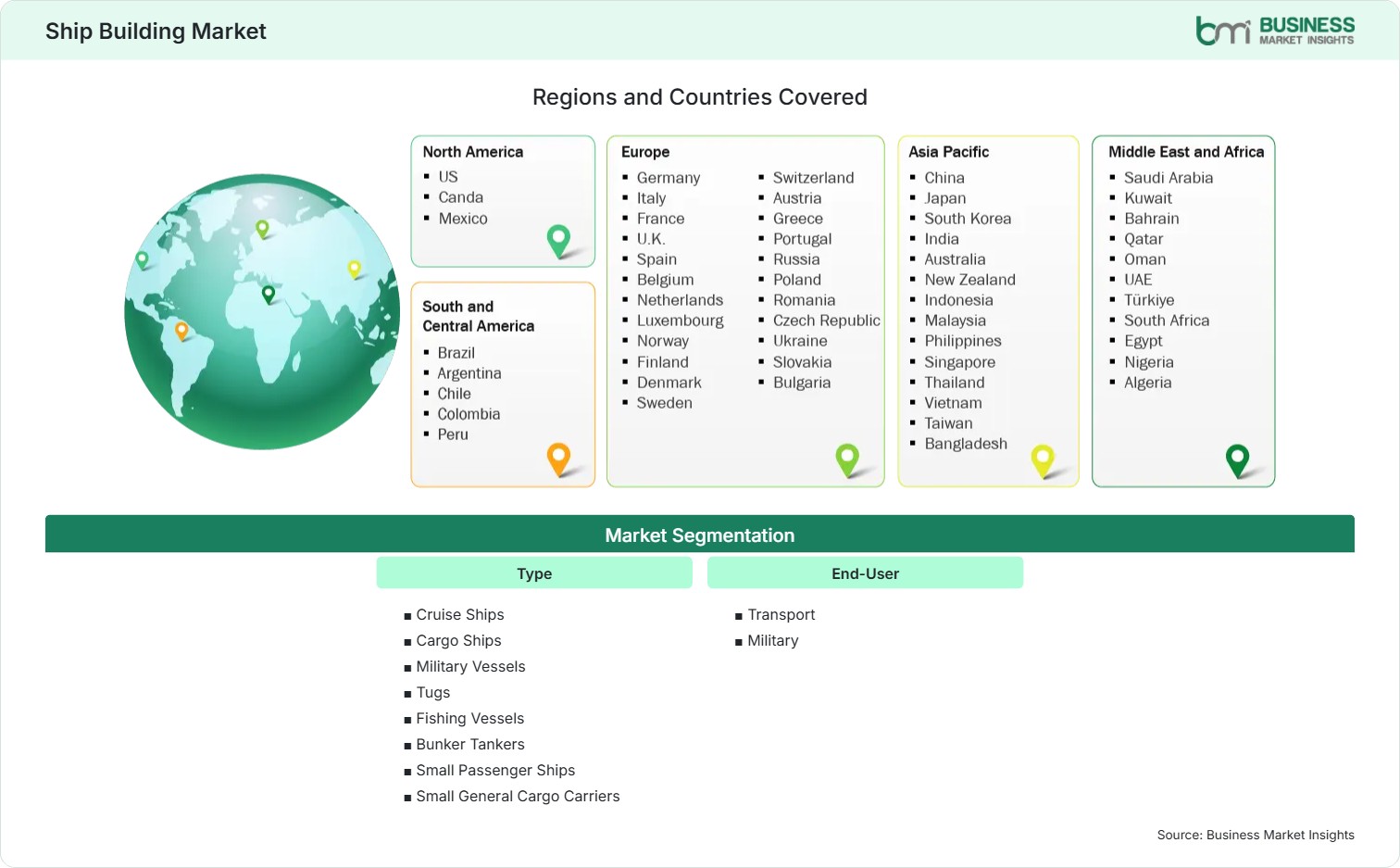
  • Type: Cruise Ships, Cargo Ships, Military Vessels, Tugs, Fishing Vessels, Bunker Tankers, Small Passenger Ships, Small General Cargo Carriers
  • End-User: Transport, Military
US$ 179.5 Bn Market size in 2025
US$ 295.52 Bn Market Size by 2033
6.43% CAGR, 2026 - 2033
2026-2033 Forecast Period

AI Overview

Ship Building Market Summary

  • North America Region: North America holds a 9%–12% share in 2025, growing at a 4.8%–6.0% CAGR during 2026–2033, supported by naval procurement, commercial fleet renewal, offshore infrastructure, domestic manufacturing incentives, and resilient maritime supply chains. US shipbuilding remains strategically important, with commercial and naval modernization supporting approximately 5.0%–6.2% CAGR through 2033.
  • Fastest Growing Region: Asia Pacific commands a 68%–72% share in 2025, expanding at a 7.0%–8.2% CAGR through 2033, supported by concentrated shipyard capacity, competitive production economics, extensive orderbooks, export demand, fleet renewal, alternative-fuel vessel development, and government-backed maritime industrial strategies.
  • Leading Segment: Cargo Ships account for a 39%–43% share in 2025, advancing at a 6.0%–7.0% CAGR through 2033, supported by seaborne trade, fleet replacement, containerization, energy-efficient propulsion, larger vessel deployment, and shipowner investment in fuel-flexible commercial tonnage.
  • High Growth Segment: Military Vessels represent a 13%–17% share in 2025 and are projected to register a 7.2%–8.5% CAGR through 2033, driven by naval modernization, maritime security requirements, autonomous systems, geopolitical competition, submarine programs, and expanded domestic defense manufacturing.
  • Key Market Opportunity: Shipbuilders can capture value through alternative-fuel vessels, autonomous navigation, digital shipyards, modular construction, lifecycle services, and specialized vessels serving offshore energy, defense, and emerging low-carbon maritime logistics.
  • Major Market Players: HD Hyundai Heavy Industries Co., Ltd.; Samsung Heavy Industries Co., Ltd.; Hanwha Ocean Co., Ltd.; TSUNEISHI SHIPBUILDING Co., Ltd.; Mitsubishi Heavy Industries, Ltd.; Northstar Shipbuilding Private Limited; Imabari Shipbuilding Co., Ltd.; United Shipbuilding Corporation; Larsen & Toubro Limited; China State Shipbuilding Corporation; and Fincantieri S.p.A.
Strategic Insights

Ship Building Market: Strategic Insights

Ship Building Market Strategic Framework
FREE PDF
Request your free sample
Request free sample
Stakeholder View

Key Takeaways

  • Value chain integration is occurring in relation to shipyards, manufacturers of marine equipment, steel producers, propulsion firms, classification societies, and shipowners, enhancing supply chain integration and dependence on procurement.
  • Bulk carriers continue to be the largest Ship Building Market, driven by factors such as fleet replacement, new shipping lanes, containerization, and energy transportation.
  • Shipping innovation has taken the path of utilizing alternative fuels, energy-saving propulsion, optimized hull design, automation, and monitoring systems.
  • Asia Pacific offers the strongest investment case because shipyard scale, supplier density, skilled marine engineering, and export-oriented production support vessel replacement and alternative-fuel demand.
  • Investment strategies increasingly connect shipbuilding with industrial policy, national security, and supply-chain resilience, creating opportunities for joint ventures, technology partnerships, capacity expansion, and strategic acquisitions.
Geographic Outlook

Ship Building Market Regional Highlights

North America Ship Building Market

North America represents a 9%–12% share in 2025 and is projected to expand at a 4.8%–6.0% CAGR through 2033. The Ship Building Market share reflects substantial naval procurement alongside smaller commercial construction capacity. US demand is supported by fleet modernization, maritime security, and domestic industrial policy. Canada contributes through naval and coast guard programs, while Mexico provides lower-cost fabrication opportunities.

  • Naval modernization remains a primary demand anchor, with procurement programs supporting surface combatants, submarines, auxiliary vessels, and specialized platforms while strengthening domestic production.
  • US shipyards are prioritizing automation, modular fabrication, workforce training, and supply-chain resilience to address labor shortages, aging infrastructure, and production constraints.
  • Canada offers opportunities through fleet renewal, coast guard requirements, and specialized vessels, supporting demand for engineering services, marine systems, maintenance, and shipyard capacity.
  • North American yards can improve competitiveness through digital production, advanced materials, robotics, and standardized modules that reduce labor intensity and improve construction precision.

US Ship Building Market

The US Ship Building Market accounts for a 7%–10% share of global shipbuilding value in 2025 and is estimated to grow at a 4.7%–5.9% CAGR through 2033. Commercial output remains comparatively limited, but specialized construction generates attractive value pools. Shipyard modernization, skilled-worker shortages, supplier localization, and digital engineering will determine future competitiveness.

  • Defense procurement provides relatively predictable demand for destroyers, submarines, amphibious platforms, logistics vessels, and support ships, reducing exposure to commercial shipbuilding cycles.
  • Domestic commercial requirements create opportunities for coastwise vessels, ferries, offshore support ships, and specialized craft, particularly where regulations favor domestic construction.
  • Workforce constraints remain critical because shipbuilding requires skilled welders, electricians, pipefitters, engineers, and technicians, increasing demand for apprenticeships, automation, digital training, and productivity improvements.

Europe Ship Building Market

Europe holds a 12%–15% share in 2025 and is expected to register a 4.9%–6.1% CAGR through 2033. The regional share is concentrated in specialized, high-value vessels rather than mass commercial production. Italy, France, Finland, and Germany maintain capabilities spanning cruise ships, naval platforms, ferries, and specialized vessels. Italy is expected to remain a leading Ship Building Market, while Finland and France benefit from cruise and advanced-vessel expertise.

  • Italy remains a major European shipbuilding center, particularly for cruise and complex passenger vessels, supported by established design capabilities and specialized suppliers.
  • France benefits from naval construction, cruise ship expertise, and advanced marine engineering, while defense priorities support demand for sophisticated platforms and support vessels.
  • Finland maintains a strong position in cruise ship construction, where complex hotel systems, energy efficiency, passenger safety, and integrated engineering create entry barriers.
  • Germany combines commercial engineering, naval capabilities, and marine equipment expertise, with automation and supplier optimization supporting competitiveness amid higher production costs.
  • Europe’s decarbonization agenda favors shipyards integrating methanol, LNG, batteries, hybrid systems, energy-saving technologies, and digital energy-management solutions into vessel designs.

Asia Pacific Ship Building Market

Asia Pacific commands a 68%–72% Ship Building Market share in 2025 and is forecast to expand at a 7.0%–8.2% CAGR through 2033. It remains the dominant production center because China, South Korea, and Japan combine extensive yard capacity, skilled labor, supplier ecosystems, and export-oriented manufacturing. China leads regional scale, while South Korea remains strong in high-value vessels and Japan retains specialized engineering capabilities.

  • China remains the regional production leader, supported by extensive yard capacity, competitive pricing, industrial support, and strong export demand across major vessel categories.
  • South Korea emphasizes higher-value shipbuilding, including LNG carriers, large commercial vessels, and advanced propulsion platforms, while labor constraints encourage production partnerships.
  • Japan maintains competitiveness through engineering quality, fuel-efficient vessels, automation, and specialized commercial ships, although workforce aging influences capacity and investment.
  • India offers strong growth potential through maritime industrial policy, domestic fleet ambitions, shipbuilding finance, and efforts to expand repair and construction capacity.
  • Southeast Asian countries, including Vietnam and the Philippines, are gaining relevance through lower-cost production, outsourcing, repair capabilities, and partnerships with established shipbuilders.

Rest of World Ship Building Market

Rest of World represents a 7%–10% Ship Building Market share in 2025 and is projected to grow at a 5.2%–6.4% CAGR through 2033. South and Central America benefit from regional transport, offshore energy, fishing, and specialized vessel demand, while Brazil provides the largest industrial base. Middle Eastern and African demand is increasingly linked to offshore energy, port development, naval security, and fleet renewal.

  • Brazil offers opportunities through offshore energy and maritime logistics, supporting demand for specialized vessels with advanced propulsion, safety systems, and operational capabilities.
  • Türkiye benefits from competitive specialized shipbuilding, repair infrastructure, and proximity to European owners, supporting ferries, workboats, tankers, offshore vessels, and other differentiated platforms.
  • Gulf markets are developing shipbuilding ecosystems alongside ports, logistics, offshore energy, and naval capabilities, creating opportunities for joint ventures, local manufacturing, and maintenance services.
  • African demand centers on fishing, patrol, passenger, offshore, and support vessels, with local-content initiatives creating opportunities for international shipbuilders and marine equipment suppliers.
  • Regional diversification can reduce dependence on established East Asian yards, while financing, workforce availability, infrastructure, supplier depth, and execution capability remain critical investment considerations.
Global Market Geography
FREE PDF
Request your free sample
Request free sample
Segment Analysis

Ship Building Market Segmentation

Type

The Type segment reflects differentiated vessel economics, fleet replacement cycles, regulatory requirements, and end-use specifications in Ship Building Market scope. Cargo Ships lead with a 39%–43% share in 2025 and a 6.0%–7.0% CAGR through 2033, supported by trade volumes, replacement demand, and fleet efficiency investments.

  • Cruise Ships: Cruise vessels require complex hotel systems, advanced propulsion, passenger safety technologies, and energy-efficient designs. Premium tourism demand supports specialized construction, while emissions requirements encourage cleaner propulsion architectures.
  • Cargo Ships: Cargo vessels remain central to maritime trade, supported by containerized commerce, fleet renewal, route optimization, and demand for larger, fuel-efficient ships with alternative-fuel readiness.
  • Military Vessels: Naval platforms combine sophisticated propulsion, communications, surveillance, weapons integration, and survivability systems. Defense modernization programs support construction activity while geopolitical risks reinforce long-term procurement priorities.
  • Tugs: Tugs serve ports, terminals, offshore facilities, and marine construction projects. Replacement of aging fleets and adoption of hybrid-electric propulsion create opportunities for efficient, maneuverable vessel designs.
  • Fishing Vessels: Fishing vessels require specialized hulls, refrigeration, processing, navigation, and storage systems. Fleet modernization, safety requirements, and sustainable fishing practices influence replacement and equipment investment decisions.
  • Bunker Tankers: Bunker tankers support marine fuel distribution and are evolving toward LNG, methanol, and other alternative-fuel logistics. Expanding bunkering infrastructure creates demand for specialized storage and transfer capabilities.
  • Small Passenger Ships: Ferries, commuter vessels, excursion boats, and regional passenger ships benefit from urban mobility requirements. Battery-electric, hybrid, and low-emission propulsion technologies increasingly influence newbuilding specifications.
  • Small general Cargo Carriers: Small cargo carriers serve regional trade routes and short-sea shipping networks. Their flexibility supports replacement demand, while efficiency improvements and alternative propulsion can strengthen operating economics.

End-User

The End-User segment is divided between Transport and Military, with Transport representing the larger demand pool in 2025 and a 5.8%–6.8% CAGR through 2033, supported by commercial fleet renewal, maritime trade, and logistics infrastructure.

  • Transport: Transport applications encompass commercial vessels serving cargo, passengers, fuel distribution, and regional logistics. Fleet expansion, replacement requirements, trade-route restructuring, and efficiency regulations support sustained investment in new vessels.
  • Military: Military demand is shaped by naval modernization, maritime surveillance, deterrence requirements, fleet readiness, and sovereign industrial strategies. Advanced combat systems and autonomous technologies increase the value of specialized defense shipbuilding.
Market Forces

Ship Building Market Dynamics

Key Market Drivers

Fleet Renewal and Expansion of Seaborne Trade

Fleet renewal is a central demand driver as shipowners replace aging tonnage with larger, safer, and more efficient vessels. Changing trade routes, cargo patterns, vessel utilization, and operational requirements continue to influence newbuilding decisions. The Ship Building Market growth will therefore be driven not only by renewal cycles but also by incremental fleet needs. Increasingly ship owners have started taking into account not only fuel efficiency, but also their emission characteristics, cargo capacity, ease of maintenance, and resale value. The need for high efficiency ships is strengthening and helping drive trends in the market. The shipyards which can deliver flexibility in design, optimal hull shape, efficient propulsion and digital operations will derive more value out of this trend.

Naval Modernization and Maritime Security Spending

Military procurement is strengthening shipbuilding demand as governments prioritize naval readiness, maritime surveillance, logistics support, and sovereign defense capabilities. Modern naval forces need destroyers, frigates, submarines, patrol vessels, auxiliary ships, and special purpose vessels fitted with sensors, communications, and autonomy technologies. Modern warships include advanced digital command architecture, advanced propulsion, unmanned vehicles, and surveillance networking. Ship Building Market trends with defense accreditation, systems integration capabilities, and secure logistics will find themselves strategically advantaged. Military procurement offers naval shipbuilders an incentive to invest in advanced facilities, engineering capabilities, and technical manpower within both mature and new naval markets.

Decarbonization Regulations and Alternative-Fuel Vessel Development

Environmental regulation is changing vessel specifications, propulsion choices, and shipyard engineering requirements. Owners are considering the usage of methanol, ammonia, LNG, batteries, hybrid engines, wind assistance systems, and energy-efficient systems depending on vessel type and route. More often, shipyards are requesting integrated capabilities for fuel handling and storage, emissions reduction, digital monitoring along with traditional capabilities in hull construction. The adoption of alternative fuels leads to investments in compatible architecture of propulsion systems, energy management systems, and emissions reduction. Depending on changing regulation, more flexible engineering capacity in shipyards may assist in the adaptation of vessels for redesign and retrofitting.

Key Market Opportunities

Smart Shipyards and AI-Enabled Production

Digital shipyards represent a major productivity opportunity because construction requires coordination across design, procurement, fabrication, welding, outfitting, testing, and commissioning. AI-enabled planning, robots, digital twins, automatic inspections, computerized manufacturing, and integration of data systems can help in minimizing the need for reworks as well as increase schedule visibility. Ship builders can benefit even more by integrating the construction process of ships with the renovation process of their shipyards, especially in those marketplaces where they are looking for greater domestic production capabilities. The Ship Building Market Forecasts contain many opportunities for engineering companies, automation companies, software vendors, and already existing shipyards with smart yard business models.

Alternative-Fuel and Low-Emission Vessel Platforms

Alternative-fuel vessel construction offers a growing premium-value opportunity as owners seek to reduce emissions while maintaining commercial performance, safety, and route flexibility. The use of methanol, ammonia, LNG, battery solutions, hybrid vessels, and on-board carbon management systems will necessitate the design of appropriate storage tanks, fuel handling systems, control systems, ventilation, safety systems, and propulsion systems. Standardization of low-emission vessel design by shipyard builders would make engineering simpler and customization unnecessary. The drive for compliance is prompting investments in appropriate propulsion systems, emission control systems, energy management systems, and the design of vessels for changing fuels availability.

Geographic Diversification and Strategic Shipyard Partnerships

Production diversification creates investment opportunities as shipowners, governments, and shipbuilders seek greater capacity flexibility and reduced dependence on concentrated production networks. Partnerships may bring engineering competencies and competitive construction sites along with purchasing and labor development as well as favorable industrial policies. There are chances in Southeast Asia, India, Middle East and North America in relation to commercial ships, repairs, offshore facilities, military vessels and specialist crafts. Such partnerships can spread out engineering, purchasing, fabrication and assembling tasks at various sites while enhancing production flexibility. Local partnerships bring about more scope for local suppliers, technology licensing, digital manufacturing systems and training.

Market Restraints and Challenges

High Capital Intensity and Project Financing Exposure

Factor: Shipbuilding requires substantial upfront investment in dry docks, cranes, fabrication facilities, specialized machinery, engineering systems, working capital, and skilled labor.

Impact: Higher capital requirements can restrict new entrants, delay capacity modernization, and weaken smaller yards during downturns. The financing environment will also have an impact on the shipowners ordering plans since ships are usually bought using a mixture of different types of funding including equity, business loaning, export credits, leases, and long charters. As interest rates or risk premiums go up, the shipowners can postpone their investments despite any replacement requirements. Shipyard companies that maintain a healthy balance sheet and orderbook can handle such a situation better than others.

Skilled-Labor Shortages and Production Bottlenecks

Factor: Modern shipbuilding depends on welders, pipefitters, electricians, marine engineers, naval architects, automation specialists, quality inspectors, and project managers, while experienced workers are retiring across several established shipbuilding countries.

Impact: Labor shortages may restrict the efficiency of yard operations, delay construction deadlines, incur high overtime charges, and limit the capacity to take more orders. This issue becomes especially critical when shipyards are presented with huge backlogs which cannot be fulfilled by expanding production capability within the desired timeframe. Robotics, digital instructions, simulation techniques, modular construction, and apprentice programs are among measures adopted by shipyards to increase output per worker.

Company Analysis

Competitive Landscape

The Ship Building Market analysis indicates a competitive structure dominated by large Asian yards, supported by specialized European and emerging regional players. Competition increasingly depends on vessel complexity, delivery reliability, alternative-fuel capabilities, digital manufacturing, defense certification, financing access, and global production partnerships.

Company Name

Overview

Products and Services relevant to this market

HD Hyundai Heavy Industries Co., Ltd.

Major South Korean shipbuilder with extensive commercial and naval construction capabilities and integrated engineering resources across the maritime value chain.

Large commercial vessels, naval ships, offshore structures, propulsion-related solutions, shipyard engineering, digital shipbuilding, and lifecycle marine services.

Samsung Heavy Industries Co., Ltd.

South Korean shipbuilder recognized for complex commercial vessels, offshore facilities, LNG-related projects, and advanced shipyard technologies.

LNG carriers, container ships, tankers, FLNG facilities, offshore structures, smart shipyard systems, automation, and digital engineering solutions.

Hanwha Ocean Co., Ltd.

South Korean shipbuilder focused on commercial vessels, naval platforms, offshore facilities, and advanced maritime technologies following its corporate transformation.

LNG carriers, container ships, tankers, submarines, surface combatants, offshore platforms, ship repair, and specialized marine engineering.

TSUNEISHI SHIPBUILDING Co., Ltd.

Japanese shipbuilder with established capabilities in commercial vessels and a strong international manufacturing footprint serving global shipowners.

Bulk carriers, multipurpose vessels, tankers, container-related vessels, engineering services, ship repair, and international shipyard operations.

Mitsubishi Heavy Industries, Ltd.

Diversified Japanese industrial group with specialized maritime engineering and shipbuilding capabilities through its shipbuilding businesses.

Commercial ships, training vessels, ferries, patrol vessels, marine machinery, alternative-fuel systems, emissions technologies, and maritime engineering.

Northstar Shipbuilding Private Limited

Indian shipbuilding participant supporting the country’s expanding maritime manufacturing ecosystem and specialized vessel requirements.

Commercial and specialized vessel construction, marine fabrication, ship repair, engineering services, and related maritime infrastructure capabilities.

Imabari Shipbuilding Co., Ltd.

Major Japanese shipbuilding group with extensive commercial construction experience and a broad domestic maritime supplier network.

Bulk carriers, containerships, tankers, gas carriers, general cargo vessels, marine engineering, ship repair, and vessel lifecycle support.

United Shipbuilding Corporation

Russian shipbuilding group operating across military and civilian maritime construction, with capabilities spanning multiple shipyard and engineering facilities.

Naval vessels, submarines, ice-class vessels, tankers, passenger ships, offshore platforms, specialized vessels, repair, and marine engineering.

Larsen & Toubro Limited

Indian engineering and defense company with shipbuilding capabilities focused strongly on naval and specialized maritime platforms.

Naval ships, patrol vessels, coast guard platforms, defense vessels, ship repair, marine engineering, and integrated defense systems.

China State Shipbuilding Corporation

China’s largest state-owned shipbuilding group, integrating major yards and marine engineering capabilities across commercial and defense construction.

Container ships, bulk carriers, tankers, LNG carriers, naval vessels, offshore engineering, marine equipment, ship repair, and advanced maritime systems.

Trust & Transparency

Research Methodology

The market analysis combines proprietary research with secondary data from government agencies, company disclosures, regulatory filings, industry databases and expert interviews. Market estimates are validated through data triangulation, cross-market benchmarking and analyst review.

View Full Research Methodology

Questions Answered

Frequently Asked Questions

What factors should investors evaluate before entering shipbuilding?

Investors should assess orderbook quality, yard utilization, financing, workforce availability, supplier depth, dry-dock capacity, regulations, vessel specialization, government support, and alternative-fuel capabilities.

What makes Asia Pacific the dominant production region?

Asia Pacific combines large shipyards, dense supplier networks, skilled labor, competitive production economics, government support, and strong relationships with global shipowners, supporting extensive commercial, specialized, and naval vessel capacity.

How are alternative fuels changing ship design?

Alternative fuels require modifications to tanks, piping, ventilation, safety systems, engines, controls, and crew procedures. This increases engineering complexity while creating opportunities for integrated low-emission vessel solutions.

Why is smart-yard technology becoming strategically important?

Smart-yard technology can improve scheduling, automate fabrication, reduce rework, and increase visibility across engineering and procurement. It also enables shipbuilders to transfer manufacturing expertise to developing Ship Building Market.

Which vessel type provides the strongest commercial opportunity?

Cargo ships offer broad opportunities because they support global merchandise movement and require recurring replacement. Additional value comes from fuel-efficient propulsion, greater cargo capacity, alternative-fuel readiness, and digital fleet-management systems, supporting the Ship Building Market Report outlook.

Access the Full Ship Building Market Report

Get segment-level forecasts, regional estimates, competitive benchmarking, company profiles and downloadable Excel datasets.

Access the full Ship Building Market Report
350 pages PDF & Excel | 2026-09-01