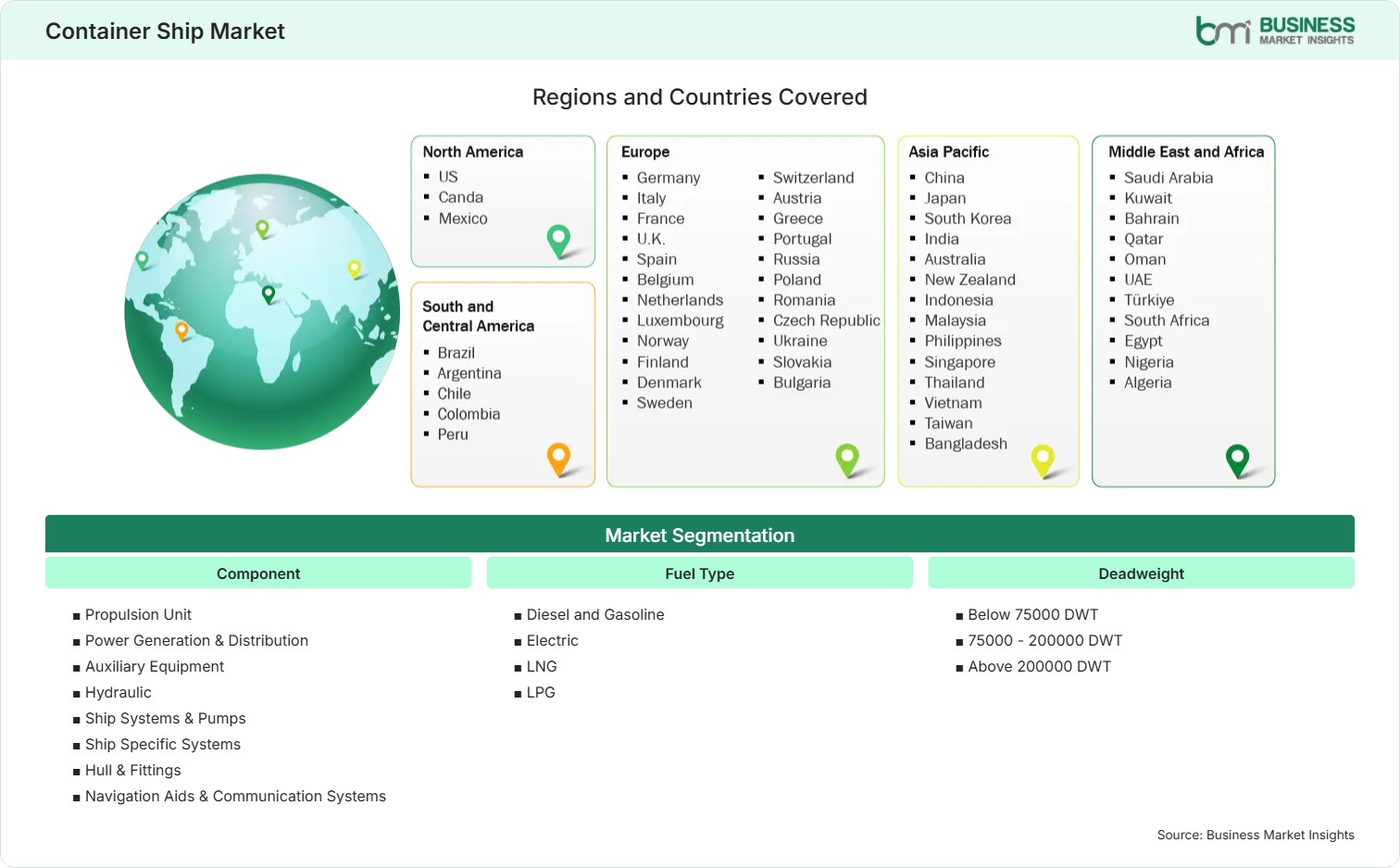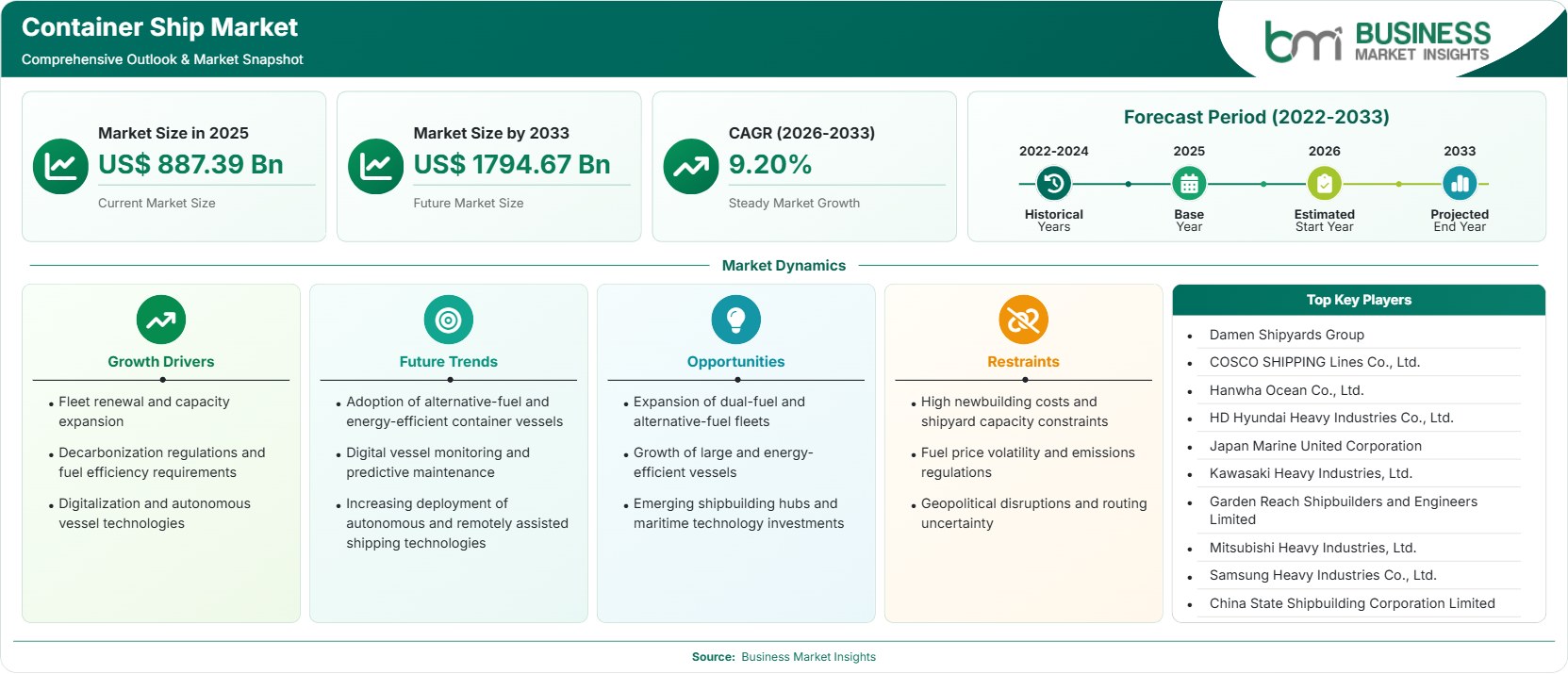
Container Ship Market Regional Highlights
North America Container Ship Market
The North American market holds a 12%–15% share in 2025 and is forecast to grow at a CAGR of 8.20%–9.00% through 2033. Container Ship Market share is driven by high levels of transpacific connectivity, investments in port development, fleet renewal, and demand for ship compliance. Trade policy of the USA, nearshoring, and investments contribute to replacement demand, while trade corridors in Canada and Mexico enhance opportunities for regional feeding and shortsea operations. Advanced logistics software, automated terminals, and availability of finance for efficient shipping are among the other advantages of the region.
- Port modernization is increasing demand for vessels compatible with deeper berths, automated terminals, shore-power systems, and high-throughput cargo handling across major gateways.
- Transpacific trade remains a core demand driver, while rerouting risks and tariff changes encourage operators to maintain flexible fleets capable of serving alternative routes.
- Cleaner propulsion is gaining commercial importance as owners prepare for tighter carbon requirements and rising scrutiny of fuel consumption across international voyages.
- Mexico and Canada provide additional feeder and regional cargo opportunities as manufacturing networks diversify and North American supply chains become more geographically distributed.
US Container Ship Market
The US accounts for about 8% to 11% of the world’s demand in the North America opportunity, and is expected to experience an 8.30% to 9.10% CAGR. The factors fuelling the Container Ship Market growth include robust import figures, investments in port facilities, diversification of supply chain logistics, and a keen interest in indigenous maritime capabilities. The ports of Los Angeles, Long Beach, New York-New Jersey, Savannah, and Houston remain key freight gateways. Government initiatives to build ships and enhance maritime security have facilitated cooperation with Asian shipbuilders and technologists, even as domestic construction facilities are limited.
- US shipbuilding policy is creating opportunities for international partnerships, technology transfer, repair capacity, and long-term maritime industrial investment.
- West Coast and Gulf Coast infrastructure upgrades support larger vessel calls while requiring compatible cranes, berth depth, intermodal links, and terminal automation.
- Import diversification and nearshoring are strengthening demand for flexible services connecting Asian manufacturing centers with North American distribution networks.
Europe Container Ship Market
Europe has a market share of 15%–18% in 2025, and it is projected to grow at a CAGR of 8.00%–8.80%. Germany, Denmark, the Netherlands, France, and Italy are the key maritime nations of Europe, whereas Spain and Greece are the other significant contributors to the maritime industry in terms of shipping and ownership. The Container Ship Market share has gained momentum due to a well-organized European logistics network, gateway ports, robust liner services, and environmental regulations. The EU's FuelEU Maritime initiative places greater focus on measuring fuel-based emissions.
- Germany and the Netherlands benefit from advanced maritime engineering, logistics infrastructure, and established relationships among shipowners, shipyards, equipment suppliers, and ports.
- Greece remains strategically important through its large shipowning base, creating replacement and charter opportunities even when construction occurs outside Europe.
- France and Denmark benefit from major shipping companies and marine technology capabilities, strengthening demand for low-emission vessels and advanced onboard systems.
- Spain and Italy offer growth through short-sea shipping, Mediterranean trade, feeder services, and modernization of vessels operating on regional routes.
Asia Pacific Container Ship Market
The Asia Pacific region holds a market share of 58%–62% in 2025 and will record the highest regional CAGR of 9.80%–10.60%. China, South Korea, and Japan dominate in production capabilities, whereas Singapore, India, and the Southeast Asia region excel in maritime services. The Container Ship Market growth drivers include export manufacturing facilities, transshipment centers, shipbuilding facilities, marine engines, and the expansion of alternative fuel facilities. According to UNCTAD, China, South Korea, and Japan accounted for 91% of global ship completions by gross tonnage in 2025.
- China combines extensive shipyard capacity with large domestic shipping demand, enabling competitive production of conventional, large-scale, and increasingly fuel-flexible container vessels.
- South Korea remains strong in high-value shipbuilding, including large dual-fuel vessels, sophisticated propulsion systems, automation, and energy-efficiency technologies.
- Japan retains expertise in hydrodynamic optimization, efficient hull design, marine machinery, and high-reliability merchant vessels, supporting premium engineering applications.
- India is emerging as a complementary shipbuilding location as government policy encourages commercial vessel construction, export orders, maritime infrastructure, and domestic component development.
Rest of World Container Ship Market
Rest of World accounts for 8% to 12% of the market in 2025, with a CAGR of 7.00% to 7.80%. The South and Central America regions are driven by agricultural exports, minerals, feeder trade, and port capacity expansion. Brazil, Chile, Panama, and Colombia provide important shipping routes. While Panama holds importance due to the canal trade, Brazil has export business in its favor. The Middle East and Africa have needs due to transshipment, Gulf operations, Red Sea route changes, and port investments. The Container Ship Market study reveals that route resilience will remain a key factor.
- Brazil offers long-term demand from commodity-linked containerized exports, industrial logistics, and investment in modern port infrastructure supporting larger vessels.
- Panama benefits from its strategic canal position and transshipment ecosystem, although water availability and routing constraints influence fleet economics.
- Gulf economies are investing in logistics hubs and port capacity, creating demand for regional feeder vessels and large ships serving intercontinental networks.
- Africa presents selective growth opportunities around major gateways where port modernization, regional trade integration, and industrialization improve containerized cargo flows.