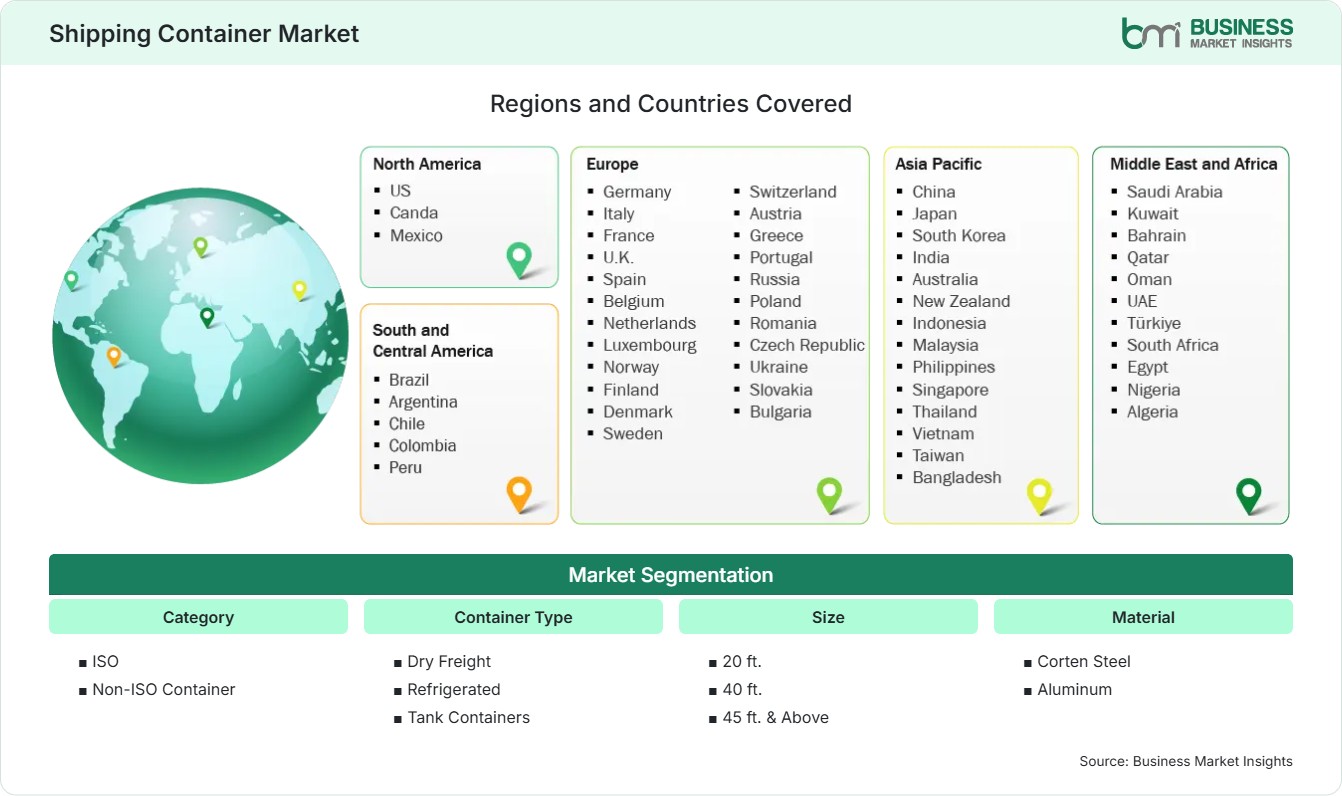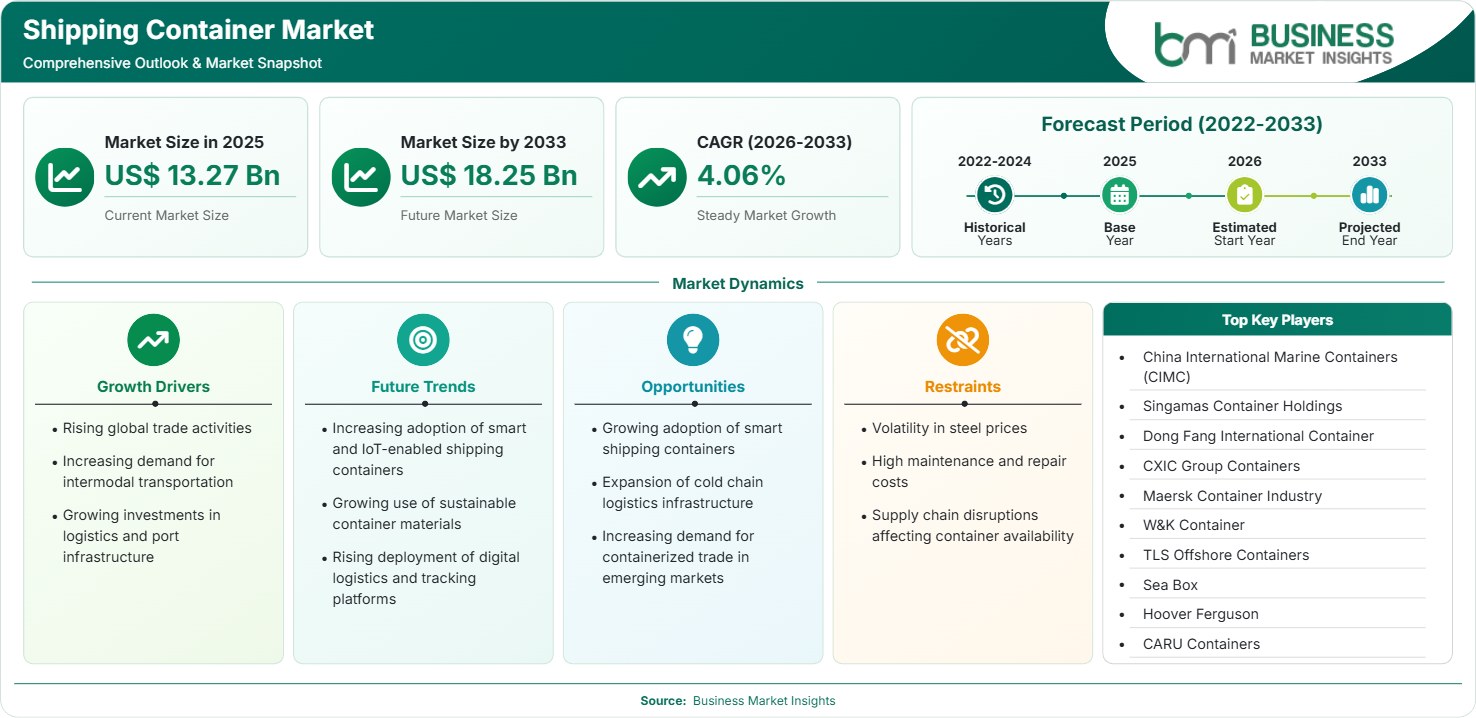
Shipping Container Market Regional Highlights
North America Shipping Container Market
North America accounted for 22%–25% of the market share in 2025 and is projected to grow at a 3.8%–4.4% CAGR during 2026–2033. The region benefits from established maritime infrastructure, strong intermodal transportation networks, and increasing logistics modernization. The United States remains the primary contributor due to extensive port operations, cross-border trade activities, and demand from retail, automotive, and industrial sectors. The Shipping Container Market share in North America is influenced by supply chain resilience initiatives and digital freight management adoption.
- Port modernization projects across the US and Canada are improving container handling efficiency, supporting higher freight capacity, and strengthening regional logistics infrastructure capabilities.
- Growing e-commerce fulfillment networks are increasing demand for reliable container transportation solutions across retail supply chains and distribution channels.
- Automotive and industrial manufacturers are utilizing containerized transportation to improve global sourcing efficiency and optimize international freight operations.
- Increasing adoption of tracking technologies is enhancing container visibility, asset management, and operational control across logistics networks.
US Shipping Container Market
The United States represented 18%–21% of the Shipping Container Market in 2025 and is expected to expand at a 3.9%–4.5% CAGR between 2026–2033. The country benefits from extensive port infrastructure, large consumer markets, and established trade relationships supporting container demand. Rising investments in logistics automation, supply chain diversification, and intermodal transportation systems are strengthening market opportunities. The growth in the US is supported by demand from retail, food logistics, manufacturing, and international trade operations.
- US ports are investing in automation technologies and infrastructure upgrades to improve container processing speed and reduce operational bottlenecks.
- Growth in cross-border trade with Mexico and Canada is supporting container movement across integrated North American supply chains.
- Increasing demand for refrigerated transportation is supporting container adoption across food, pharmaceutical, and temperature-sensitive cargo applications
Europe Shipping Container Market
Europe accounted for 20%–23% of the Shipping Container Market in 2025 and is forecast to grow at a 3.5%–4.2% CAGR through 2033. Germany, the Netherlands, and Belgium remain leading markets due to advanced logistics infrastructure and major maritime hubs. The region is emphasizing sustainable transportation, port digitalization, and efficient freight networks. Germany is projected to grow at 3.6%–4.1% CAGR, while the Netherlands demonstrates strong adoption through port modernization and logistics technology investments.
- Major European ports are implementing digital platforms to improve container tracking, cargo handling efficiency, and supply chain coordination.
- Sustainability regulations are encouraging logistics companies to adopt efficient container utilization and environmentally responsible transportation practices.
- Automotive manufacturers are increasing containerized freight usage to support international component sourcing and vehicle supply chains.
- Cold chain expansion across Europe is increasing demand for refrigerated containers in food and pharmaceutical transportation.
Asia Pacific Shipping Container Market
Asia Pacific held the largest 42%–45% share of the Shipping Container Market in 2025 and is expected to expand at the fastest pace with a 4.5%–5.2% CAGR during 2026–2033. China, India, Japan, and Southeast Asian economies are driving regional demand through manufacturing expansion, export activities, and infrastructure development. China remains the dominant market, while India represents a high-growth opportunity due to industrial growth and logistics modernization. The growth across Asia Pacific is supported by rising international trade volumes and port investments.
- China maintains leadership through large-scale manufacturing output, export activities, and extensive container production capabilities.
- India is increasing container demand through infrastructure development, manufacturing expansion, and improving multimodal transportation networks.
- Southeast Asian countries are attracting manufacturing investments, creating demand for efficient containerized freight solutions.
- Smart port initiatives are accelerating adoption of technology-enabled containers across regional logistics ecosystems.
- Cold chain infrastructure development is supporting refrigerated container demand across food and pharmaceutical sectors.
Rest of World Shipping Container Market
The Rest of World region accounted for 10%–13% of the Shipping Container Market share in 2025 and is projected to grow at a 3.7%–4.5% CAGR during 2026–2033. Latin America, the Middle East, and Africa are expanding through trade diversification, infrastructure investment, and increasing logistics connectivity. Brazil, Mexico, Saudi Arabia, and the UAE represent important markets due to industrial development and port expansion initiatives. The growth in these regions is supported by increasing commodity exports and emerging trade corridors.
- Latin American economies are improving logistics infrastructure to support agricultural exports, industrial shipments, and international trade expansion.
- Middle Eastern countries are investing in ports and logistics hubs to strengthen regional trade connectivity and economic diversification.
- African markets are developing transportation infrastructure to improve regional trade networks and containerized cargo movement.
- Energy sector investments are supporting container demand for industrial equipment transportation and specialized cargo applications.
- Emerging trade routes are creating opportunities for container manufacturers and logistics providers across developing economies.