
Food Container Market Outlook: Size, Share, Trends, Growth Analysis, Competitive Landscape & Forecast, 2026-2033

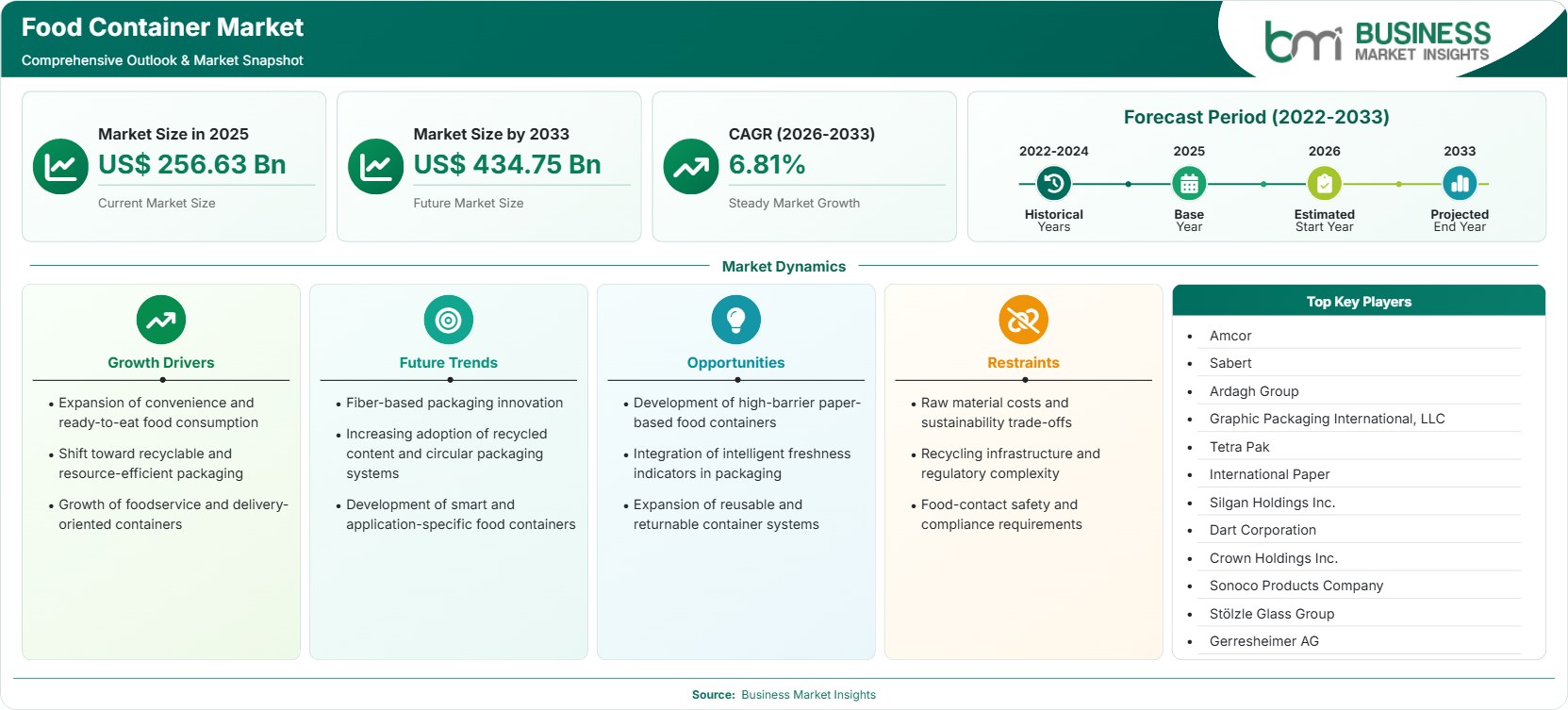
The Food Container Market size was valued at US$ 256.63 Billion in 2025 and is projected to reach US$ 434.75 Billion by 2033, growing at a CAGR of 6.81% during 2026–2033, driven by convenience foods, foodservice expansion, shelf-life requirements, sustainability, e-commerce, and recyclable packaging innovation.

Report Coverage
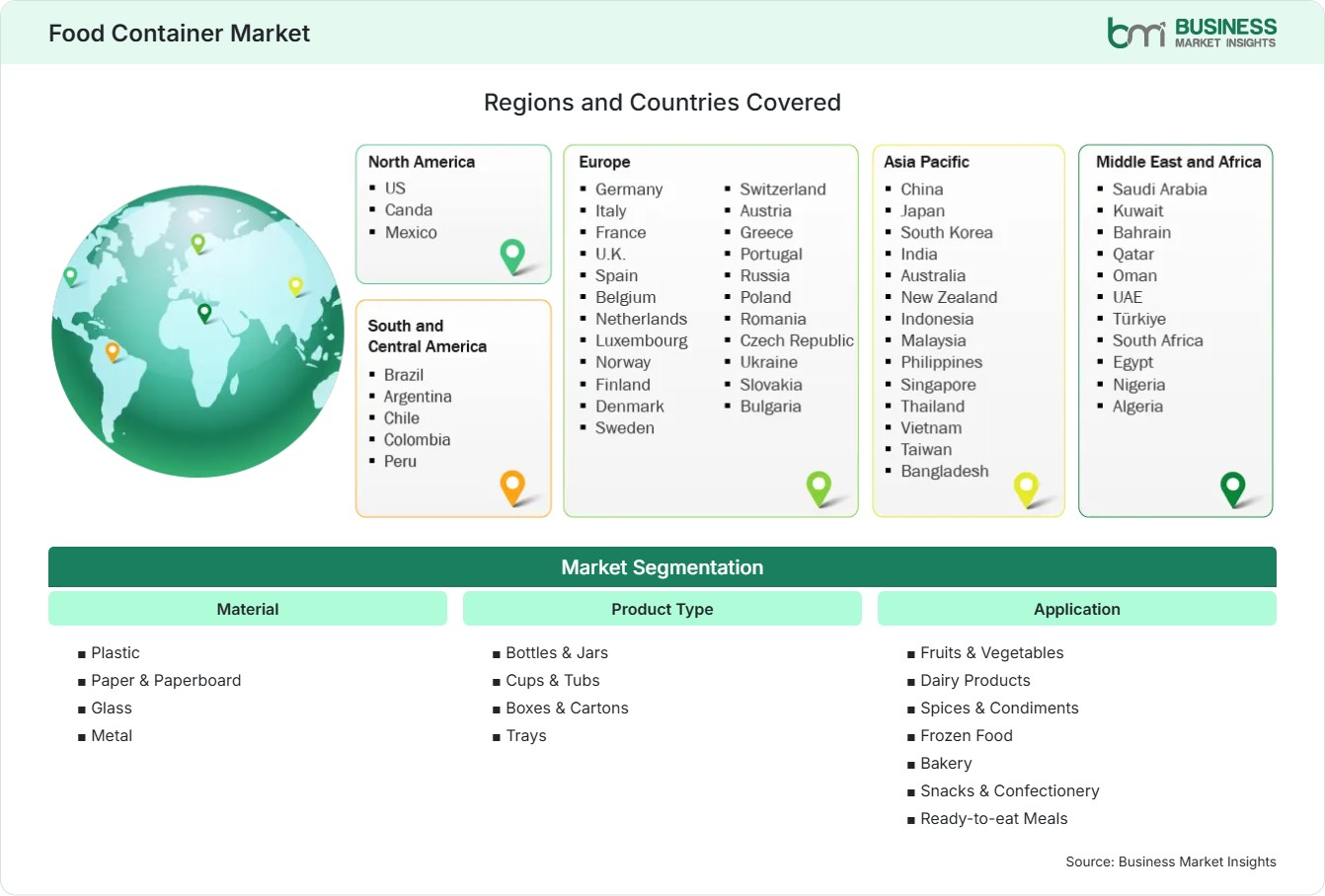
  • Material: Plastic, Paper & Paperboard, Glass, Metal
  • Product Type: Bottles & Jars, Cups & Tubs, Boxes & Cartons, Trays
  • Application: Fruits & Vegetables, Dairy Products, Spices & Condiments, Frozen Food, Bakery, Snacks & Confectionery, Ready-to-eat Meals
US$ 256.63 Bn Market size in 2025
US$ 434.75 Bn Market Size by 2033
6.81% CAGR, 2026 - 2033
2026-2033 Forecast Period

AI Overview

Food Container Market Summary

  • North America Region: North America holds a 33%–34% share of the Food Container market in 2025, with a modeled 5.9%–6.3% CAGR during 2026–2033, supported by foodservice demand, convenience meals, retail prepared foods, sustainability initiatives, and advanced container formats. The U.S. represents approximately 84%–85% of North American demand, with a modeled 5.8%–6.2% CAGR, supported by ready-to-eat meals, food delivery, retail food, and packaging innovation.
  • Fastest Growing Region: Asia Pacific holds a 29%–30% share of the Food Container market in 2025, with a modeled 7.1%–7.6% CAGR during 2026–2033, supported by urbanization, organized food retail, packaged foods, expanding foodservice networks, e-commerce, and rising demand for convenient portion-controlled containers.
  • Leading Segment: Plastic holds a 43%–45% share in 2025, with a modeled 6.7%–7.1% CAGR during 2026–2033, supported by lightweight construction, barrier performance, low transportation costs, flexible design, microwave compatibility, and high-volume food manufacturing requirements.
  • High Growth Segment: Ready-to-eat Meals holds an estimated 10%–12% share in 2025, with a modeled 7.4%–7.8% CAGR during 2026–2033, supported by convenience consumption, meal delivery, urban lifestyles, portion control, microwaveable packaging, and chilled and frozen prepared-food distribution.
  • Key Market Opportunity: Recyclable mono-materials, molded fiber, high-barrier paperboard, recycled polymers, lightweight containers, smart packaging, and application-specific designs can improve sustainability while preserving food safety and shelf-life performance.
  • Major Market Players: Amcor, Sabert, Ardagh Group, Graphic Packaging International, LLC, Tetra Pak, International Paper, Silgan Holdings Inc., Dart Corporation, Crown Holdings Inc., Sonoco Products Company, Stölzle Glass Group, Gerresheimer AG, Huhtamaki, Genpak LLC, and PRINTPACK.
Strategic Insights

Food Container Market: Strategic Insights

Food Container Market Strategic Framework
FREE PDF
Request your free sample
Request free sample
Stakeholder View

Key Takeaways

  • The value chain increasingly extends beyond container manufacturing into material science, barrier technologies, closures, printing, recycling compatibility, and packaging equipment integration.
  • Plastic remains structurally important because of its lightweight and versatile characteristics, but paperboard, molded fiber, recycled polymers, glass, and metal are gaining application-specific opportunities.
  • Ready-to-eat meals, food delivery, frozen foods, bakery products, snacks, and convenience formats offer attractive growth because containers must support portability, heating, sealing, and shelf-life protection.
  • Asia Pacific provides the strongest investment case through expanding packaged-food production, urban consumption, organized retail, foodservice infrastructure, and manufacturing capacity.
  • Strategic activity is increasingly centered on material substitution, recycled content, fiber-based packaging, lightweighting, and production technologies that reduce material consumption without compromising performance.
  • Packaging suppliers must manage a three-way commercial balance between cost, food protection, and sustainability because customers increasingly demand environmental improvements without accepting shorter shelf life or weaker functionality.
Geographic Outlook

Food Container Market Regional Highlights

North America Food Container Market

North America had a Food Container market share of 33%-34% in 2025 and will grow at a CAGR of 5.9%-6.3% from 2026 to 2033. An estimate of the industry's current state in 2025 indicates that North America’s market share is 33.25%. The area enjoys an established food service, retail, frozen food, prepared meal, and convenience food distribution system.

  • Foodservice operators increasingly require containers combining leak resistance, stackability, heat tolerance, and efficient transportation, supporting demand for engineered plastic, paperboard, molded fiber, and hybrid structures.
  • Retail prepared foods require containers that provide product visibility, sealing integrity, microwave compatibility, and attractive presentation, encouraging suppliers to develop application-specific trays, tubs, bowls, and cartons.
  • Sustainability initiatives are increasing demand for recycled polymers, fiber-based structures, lightweighting, and recyclable formats while maintaining barrier properties required for moisture, grease, oxygen, and heat protection.
  • U.S. and Canadian manufacturers increasingly evaluate total packaging cost rather than material price alone, considering transportation efficiency, filling-line productivity, shelf life, damage rates, and end-of-life requirements.

US Food Container Market

The U.S. Food Container market accounted for around 84% to 85% of North American demand in 2025 and is projected to grow at a CAGR of 5.8% to 6.2% from 2026 to 2033. The demand is driven by the widespread production of packaged foods, food service, grocery retail, food delivery, frozen foods, and baked goods, as well as convenience consumption.

  • Prepared meals and food delivery are strengthening demand for containers designed for thermal resistance, secure closures, stacking, transport stability, and microwave or oven compatibility.
  • Food manufacturers increasingly seek lightweight packaging that reduces material consumption and freight costs while preserving protection against moisture, oxygen, grease, impact, and temperature changes.
  • Regulatory and retailer sustainability expectations are accelerating experimentation with fiber-based containers, recycled polymers, and recyclable structures, creating opportunities for suppliers with scalable manufacturing and strong testing capabilities.

Europe Food Container Market

Europe accounted for about 27%-28% in 2025 and is projected to grow at a 5.6%-6.1% CAGR from 2026 to 2033 in the Food Container market. Germany and the U.K. are the key markets, whereas France, Italy, and Spain serve the food-processing and service sectors. Packaging innovation in Europe has focused on recyclability, less material consumption, and recycling content.

  • Germany combines a large food-processing base with advanced manufacturing capabilities, supporting demand for high-performance containers serving dairy, bakery, frozen foods, prepared meals, and retail applications.
  • The U.K. provides opportunities through convenience foods, meal delivery, foodservice, supermarket private labels, and growing interest in recyclable and fiber-based packaging solutions.
  • France, Italy, and Spain provide additional demand through processed foods, dairy, bakery, fresh produce, and foodservice channels requiring specialized container formats and barrier performance.
  • European producers increasingly optimize packaging for circularity, encouraging material simplification, recycled content, fiber substitution, and designs that preserve food safety while improving recyclability.

Asia Pacific Food Container Market

Asia Pacific held approximately 29%–30% share in 2025 and is modeled to grow at 7.1%–7.6% CAGR during 2026–2033, making it the fastest-growing region. China, India, Japan, South Korea, and Southeast Asian economies combine large food-processing industries with expanding urban populations. The Food Container market region's growth is driven by packaged food consumption, food delivery, modern retail, and e-commerce.

  • China has substantial demand for packaged food, beverages, foodservice, convenience items, and online retail, driving the mass production of plastic, paperboard, glass, and metal containers.
  • India has the potential for cost-effective, lightweight, recyclable, and portion-controlled containers due to the development of food processing, retail stores, dairy, snack products, and ready meals.
  • Japan and South Korea offer premium demand for containers due to the presence of sophisticated prepared foods, convenience retail, fresh food, and strict packaging standards.
  • Southeast Asia offers strong upside as urbanization, modern grocery retail, quick-service restaurants, food delivery, and packaged-food consumption increase across Indonesia, Vietnam, Thailand, Malaysia, and the Philippines.

Rest of World Food Container Market

Rest of World represented approximately a 9%–10% share in 2025 and is modeled at 6.0%–6.6% CAGR during 2026–2033. South and Central America Food Container market benefits from expanding processed-food and beverage production, while the Middle East and Africa are supported by urbanization, modern retail, tourism, and foodservice investment.

Brazil and Mexico are leading opportunities in Latin America, while the UAE, Saudi Arabia, and South Africa provide attractive demand centers across premium foodservice, retail, hospitality, and packaged-food applications.

  • * Brazil has a large food processing industry that provides support for containers used for dairy, bakery, snacks, frozen foods, sauces, fresh food, and ready-to-eat meals in both domestic and export markets.
  • Mexico has advantages due to food processing, convenient retail, foodservice growth, and proximity to North American supply chains.
  • The UAE offers opportunities in hospitality, tourism, premium foodservice, food imports, and modern retail, thereby encouraging demand for visually attractive, durable, and high-performance containers.
  • Saudi Arabia's food-processing and retail diversification is creating opportunities for containers serving prepared foods, bakery, dairy, frozen products, snacks, and foodservice applications.
Global Market Geography
FREE PDF
Request your free sample
Request free sample
Segment Analysis

Food Container Market Segmentation

Material

The Material category includes Plastic, Paper & Paperboard, Glass, Metal, and Others. The market share of plastic in the Food Container Market in 2025 is expected to be 43%- 45%, growing at a CAGR of 6.7%–7.1% between 2026 and 2033. This is due to factors such as lightweight, design, barrier properties, and the production of foods in large quantities, while fiber, glass, and metal gain application-specific demand.

  • Plastic: Plastic containers provide lightweight construction, design flexibility, impact resistance, sealing compatibility, and cost efficiency across dairy, frozen food, snacks, ready meals, sauces, and foodservice applications.
  • Paper & Paperboard: Paper and paperboard benefit from renewable-resource positioning, printability, lightweight construction, and substitution opportunities where barrier coatings can provide moisture, grease, and heat resistance.
  • Glass: Glass containers remain important for premium foods, sauces, beverages, dairy, preserves, and specialty products where inertness, transparency, premium appearance, and strong barrier performance justify higher weight.
  • Metal: Metal containers support long shelf life, mechanical strength, hermetic sealing, and thermal processing, making them valuable for canned foods, vegetables, fruits, sauces, and other shelf-stable products.

Product Type

The Product Type segment consists of Bottles & Jars, Cups & Tubs, Boxes & Cartons, Trays, and Others. The demand for packaging is increasingly influenced by convenience, portability, shelf appeal, ease of filling, and product-specific protection needs. Prepared food and foodservice uses are advantageous for boxes, cartons, trays, cups, and tubs, which benefit from expanding prepared-food and foodservice applications.

  • Bottles & Jars: Bottles and jars serve sauces, condiments, dairy products, preserves, beverages, and specialty foods where sealing, visibility, dispensing, and barrier properties influence consumer and manufacturer selection.
  • Cups & Tubs: Cups and tubs support dairy, desserts, snacks, sauces, and prepared foods, benefiting from portion control, stackability, easy filling, resealability, and convenient consumption formats.
  • Boxes & Cartons: Boxes and cartons provide efficient storage, transport, branding, and material optimization across bakery, frozen food, snacks, prepared meals, and dry-food applications.
  • Trays: Trays support fresh produce, meat alternatives, bakery, prepared meals, frozen foods, and foodservice, with demand increasingly focused on lightweight structures, sealing, heating performance, and recyclability.

Application

The Application segment comprises Fruits & Vegetables, Dairy Products, Spices & Condiments, Frozen Food, Bakery, Snacks & Confectionery, and Ready-to-eat Meals. Ready-to-eat meals are one such application that has witnessed considerable growth due to the increasing need for convenience consumption and packaging.

  • Fruits & Vegetables: Containers protect fresh produce against physical damage, moisture loss, contamination, and handling pressure while supporting visibility and efficient retail merchandising.
  • Dairy Products: Dairy containers require strong sealing, food safety, temperature resistance, and barrier performance across yogurt, desserts, cream, spreads, and related refrigerated products.
  • Spices & Condiments: Spices and condiments require containers that preserve aroma, prevent leakage, provide accurate dispensing, and protect products from moisture, oxygen, and contamination.
  • Frozen Food: Frozen-food containers require temperature resistance, structural integrity, moisture protection, and reliable sealing during cold storage, transportation, retail display, and consumer preparation.
  • Bakery: Bakery containers preserve product shape, freshness, appearance, and handling quality while supporting attractive retail presentation and convenient transportation for breads, cakes, pastries, and desserts.
  • Snacks & Confectionery: Snack and confectionery containers emphasize product protection, barrier performance, portion control, shelf presentation, and convenience across chocolates, biscuits, chips, candies, and premium treats.
  • Ready-to-eat Meals: Ready-to-eat meals require microwave compatibility, leak resistance, compartmentalization, sealing, stackability, and thermal performance, supporting strong demand from retail, foodservice, delivery, and convenience channels.
Market Forces

Food Container Market Dynamics

Key Market Drivers

Expansion of Convenience and Ready-to-eat Food Consumption

Urban living styles, food deliveries, organized retail, and the consumption of ready-to-eat meals are driving demand for packaging that is portable, sealable, heat-resistant, and protective. Meals that are ready-to-eat need packaging that can be distributed, cooled, frozen, heated, and handled by consumers. The demands created by these trends contribute to the Food Container Market growth by increasing demand for application-specific trays, tubs, bowls, cartons, and sealable packaging. Providers of packaging solutions for food services are also optimizing designs to keep temperature and food structure intact during distribution. Sabert's Twist & Crispy container, recognized in 2025, illustrates how specialized structural design can address takeout quality challenges.

Shift Toward Recyclable and Resource-efficient Packaging

Regulatory push and sustainability targets from customers are contributing to faster adoption of material substitution and lightweighting. In February 2025, Tetra Pak rolled out packaging in India containing 5% certified recycled polymers in the carton. In addition, Amcor and Metsä Group announced plans to develop molded fiber food packaging by combining fiber construction with barrier technology. The above illustrates how Food Container Market trends are shifting towards packaging that minimizes reliance on fossil resources without compromising barrier and food-protection properties.

Growth of Foodservice and Delivery-oriented Containers

Food delivery and foodservice require containers engineered around transport stability, leakage prevention, heat retention, stacking, and consumer convenience. Hence, the expansion of quick-service restaurants, online food orders, ready-made food, and convenience formats will create greater demand for specialty containers than for packaging solutions. The award received by Graphic Packaging in 2025 for their two-cell drink insert is an indication of innovation centered on improving food-service transportation and convenience. Suppliers are also increasing their use of paperboard and molded fiber to meet sustainability requirements. This combination of functionality and material innovation strengthens demand for differentiated containers that protect food quality throughout delivery and consumption.

Key Market Opportunities

Fiber-based Containers With Advanced Barrier Technology

There is an opportunity in fiber-based packaging for brands seeking replacement products for conventional plastics while maintaining barrier properties against grease, water vapor, oxygen, and heat, and preserving strength. This is illustrated by the partnership between Amcor and Metsä Group, which combines molded fiber technology with high-barrier film liners and lidding systems. Graphic Packaging has also developed paperboard products as an alternative to plastic containers in select retail applications. The Food Container Market Forecasts clearly indicate that the advantage will go to suppliers who can design fiber structures for food-contact applications.

Recycled Content and Circular Packaging Systems

Recycled plastics, recyclable paperboard, reusable systems, and enhanced compatibility with collection systems present opportunities for suppliers capable of incorporating circularity into their packaging design. Considering Tetra Pak's launch of recycled polymer-based packs in India, it can be said that the use of recycled materials in packaging is not limited to special items. It also becomes simpler for the supplier to market itself on the grounds of recycled material use, material efficiency, recyclability, and environmental details. This would be particularly easy where the packaging buyer seeks to improve sustainability without compromising fill-line compatibility or consumer convenience.

Smart and Application-specific Container Development

Design specific to a particular application can generate added value by enhancing freshness, portion control, thermal performance, traceability, and consumer engagement. Digital printing, QR codes, enhanced closures, tamper-proofing, active packaging, and freshness-sensing technology can help increase differentiation. The study conducted in 2024 found that smart packaging technology, which is battery-free and uses sensing, wireless energy harvesting, and controlled release, is now capable of checking the freshness of food products. However, the technology is still evolving and could be applied in the future to premium food items, cold-chain items, prepared foods, and high-value applications where monitoring and shelf-life optimization can justify additional packaging functionality.

Market Restraints and Challenges

Raw Material Costs and Sustainability Trade-offs

Factor: Resin, paperboard, aluminum, steel, glass, energy, transportation, and recycled-content costs can fluctuate, while sustainable materials may require specialized processing or higher-quality inputs. Impact: Packaging producers can face margin pressure when customers resist price increases despite rising input costs. Substituting materials also involves technical trade-offs because thinner structures or alternative substrates may affect barrier performance, sealing, durability, or shelf life. Suppliers must therefore optimize material consumption rather than simply replacing one substrate with another. Integrated procurement, lightweighting, manufacturing efficiency, recycled-content sourcing, and material engineering can reduce exposure while preserving the performance standards required by food manufacturers.

Recycling Infrastructure and Regulatory Complexity

Factor: Recycling systems, collection infrastructure, labeling requirements, recycled-content mandates, and packaging rules differ across countries and jurisdictions. Impact: Manufacturers serving multinational food companies may need multiple container specifications, certification processes, and end-of-life assessments, increasing development and compliance costs. Fiber-based and multilayer structures can also require careful engineering to balance barrier properties with recycling compatibility. Tetra Pak's certified recycled-polymer initiative illustrates how regulatory requirements can directly influence packaging composition. Suppliers with strong regulatory teams, material testing capabilities, and region-specific design platforms can reduce compliance risk and accelerate customer approvals.

Company Analysis

Competitive Landscape

Competitive positioning depends on material breadth, manufacturing scale, barrier technology, food-contact expertise, sustainability credentials, geographic coverage, and customer integration. The Food Container Market analysis indicates that competition spans flexible and rigid packaging producers, paperboard specialists, glass and metal manufacturers, foodservice suppliers, and integrated packaging companies.

Company Name

Overview

Products and Services relevant to this market

Amcor

Global packaging company with broad food, beverage, and consumer packaging capabilities.

Plastic containers, rigid packaging, flexible structures, barrier solutions, closures, and recyclable packaging technologies.

Sabert

Global food-packaging specialist focused on sustainable foodservice and retail solutions.

Food containers, molded fiber products, paper packaging, trays, tubs, lids, and takeout solutions.

Ardagh Group

Global packaging producer with significant metal and glass packaging capabilities.

Glass containers, metal food packaging, jars, cans, closures, and protective packaging formats.

Graphic Packaging International, LLC

Paperboard packaging specialist serving food, beverage, and foodservice applications.

Paperboard cartons, trays, cups, containers, foodservice packaging, and fiber-based alternatives.

Tetra Pak

Global food-processing and packaging company specializing in carton-based food and beverage systems.

Carton packages, aseptic containers, paperboard structures, closures, and integrated packaging systems.

International Paper

Global fiber-based packaging producer with extensive paper and foodservice packaging capabilities.

Paperboard, foodservice packaging, cartons, containers, and fiber-based packaging materials.

Silgan Holdings Inc.

North American packaging producer serving food and consumer-product markets.

Metal containers, closures, plastic containers, dispensing systems, and food packaging formats.

Dart Corporation

Packaging company with extensive foodservice and disposable-container capabilities.

Foam and plastic food containers, cups, trays, lids, and foodservice packaging systems.

Crown Holdings Inc.

Global metal packaging producer with strong food-can capabilities.

Steel food cans, closures, metal containers, specialty tins, and protective food packaging.

Sonoco Products Company

Diversified packaging company offering metal and rigid paper packaging globally.

Metal food cans, rigid paper containers, composite packaging, and consumer food packaging.

Stölzle Glass Group

European glass packaging specialist serving food and beverage customers.

Glass jars, containers, specialty glass packaging, and customized food packaging formats.

Gerresheimer AG

Global packaging and containment company with strong glass and polymer capabilities.

Glass and polymer containers, specialty packaging, and engineered containment solutions.

Huhtamaki

Global foodservice and flexible packaging company with paperboard and molded-fiber capabilities.

Food containers, cups, trays, molded fiber packaging, paperboard solutions, and foodservice formats.

Genpak LLC

Foodservice packaging supplier serving restaurants, retailers, and prepared-food businesses.

Trays, containers, hinged packaging, foam and plastic foodservice formats, and related accessories.

PRINTPACK

Packaging manufacturer providing printed and converted packaging solutions for food applications.

Printed flexible packaging, pouches, films, laminates, and food packaging conversion services.

Trust & Transparency

Research Methodology

The market analysis combines proprietary research with secondary data from government agencies, company disclosures, regulatory filings, industry databases and expert interviews. Market estimates are validated through data triangulation, cross-market benchmarking and analyst review.

View Full Research Methodology

Questions Answered

Frequently Asked Questions

What makes ready-to-eat meals attractive for container suppliers?

Ready-to-eat meals require packaging capable of supporting preparation, heating, transportation, portioning, sealing, stacking, and consumer convenience. Expansion of supermarket prepared foods, meal delivery, convenience retail, and foodservice makes this application commercially attractive for specialized container manufacturers.

Why are fiber-based containers gaining attention?

Fiber-based containers can support renewable-resource positioning and plastic reduction while providing strong printing and structural characteristics. Advanced coatings and liners are increasingly being developed to address moisture, grease, heat, and barrier requirements that traditionally favored plastic.

How can food-container manufacturers increase product differentiation?

Manufacturers can differentiate through improved barrier performance, light weighting, recycled content, molded fiber structures, resealable closures, microwave compatibility, smart labeling, tamper evidence, and application-specific designs that improve food quality or operational efficiency.

Which material faces the strongest sustainability pressure?

Conventional plastic faces the strongest substitution pressure because policymakers, retailers, and consumers increasingly focus on recyclability, recycled content, and material reduction. However, plastic remains commercially important where light weighting, barrier performance, durability, and cost efficiency are difficult to replicate.

What is driving demand for the food containers market across emerging markets?

Urbanization, packaged-food consumption, food delivery, modern retail, organized foodservice, and increasing demand for convenience are expanding container requirements. Emerging markets also offer opportunities for locally manufactured packaging that reduces transportation costs and supports regional food-processing industries.

Access the Full Food Container Market Report

Get segment-level forecasts, regional estimates, competitive benchmarking, company profiles and downloadable Excel datasets.

Access the full Food Container Market Report
350 pages PDF & Excel | 2026-08-27