Market Summary
Executive Summary and Global Market Analysis
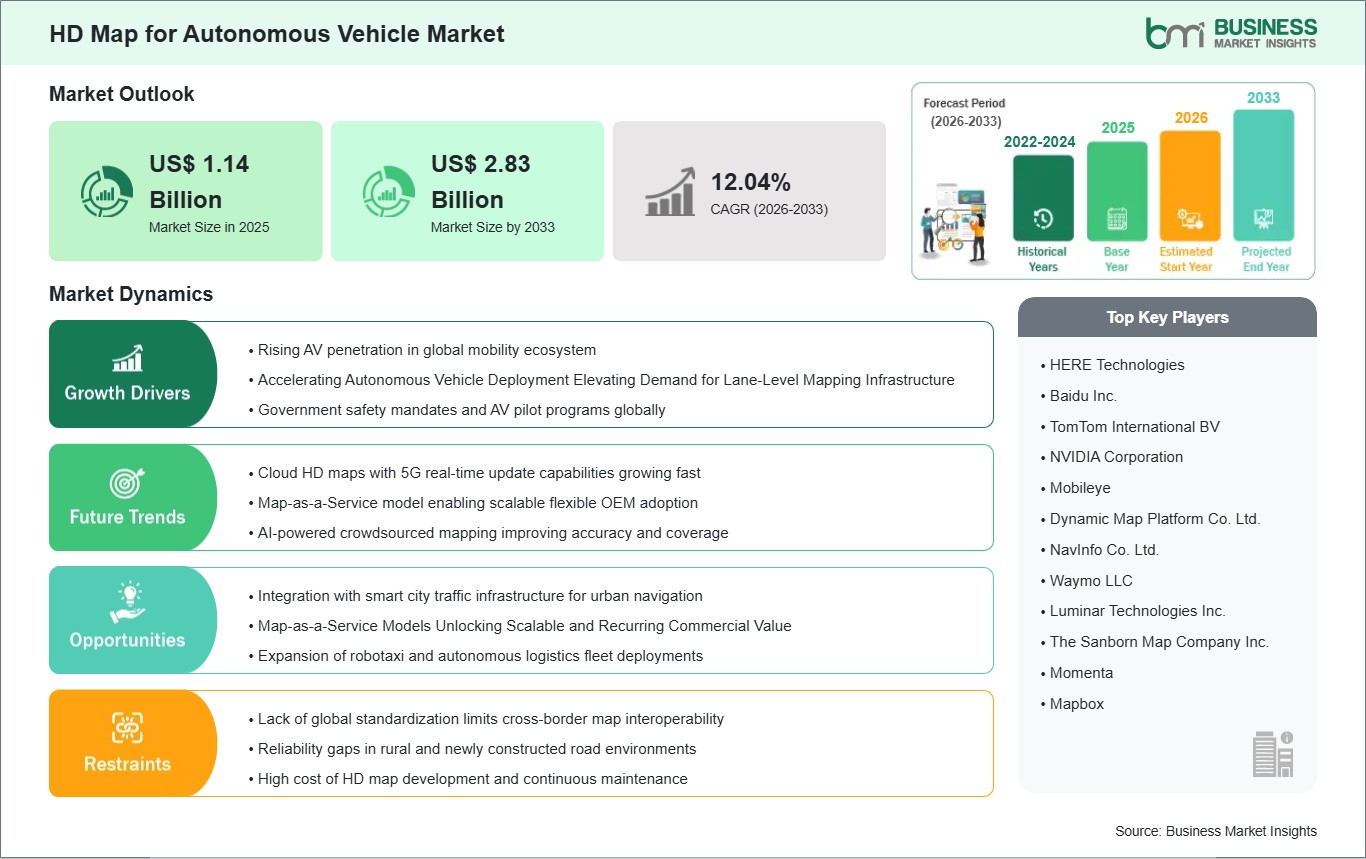
The HD Maps for Autonomous Vehicle Market focuses on advanced digital mapping systems designed for autonomous and connected vehicle operations. These maps contain highly detailed roadway information, including lane markings, road geometry, traffic signals, and surrounding infrastructure. Autonomous driving platforms rely on HD maps to improve navigation accuracy, localization precision, and real-time driving decisions across complex transportation environments. Automotive manufacturers and mobility technology providers are strengthening investment in autonomous driving ecosystems. Demand for safer navigation systems and improved vehicle intelligence has encouraged broader integration of mapping technologies into connected mobility platforms. Government interest in intelligent transportation infrastructure and smart city development also supports industry progression across public and private transportation networks.
The market structure covers multiple solution categories, vehicle platforms, service functions, and mobility applications. Passenger cars represent a major implementation area because of increasing incorporation of advanced driver assistance systems. Commercial mobility applications are also gaining industry attention as logistics operators and fleet managers seek navigation systems capable of supporting route optimization and operational efficiency. Technology development within the industry continues shifting toward cloud-enabled mapping platforms, continuous map updates, and enhanced localization capabilities. Mapping systems increasingly integrate sensor fusion technologies combining cameras, radar, lidar, and satellite positioning inputs. These developments improve map reliability while supporting autonomous functionality under changing road and traffic conditions across urban and highway environments.
Segment Analysis
HD Map for Autonomous Vehicle Market Segmentation
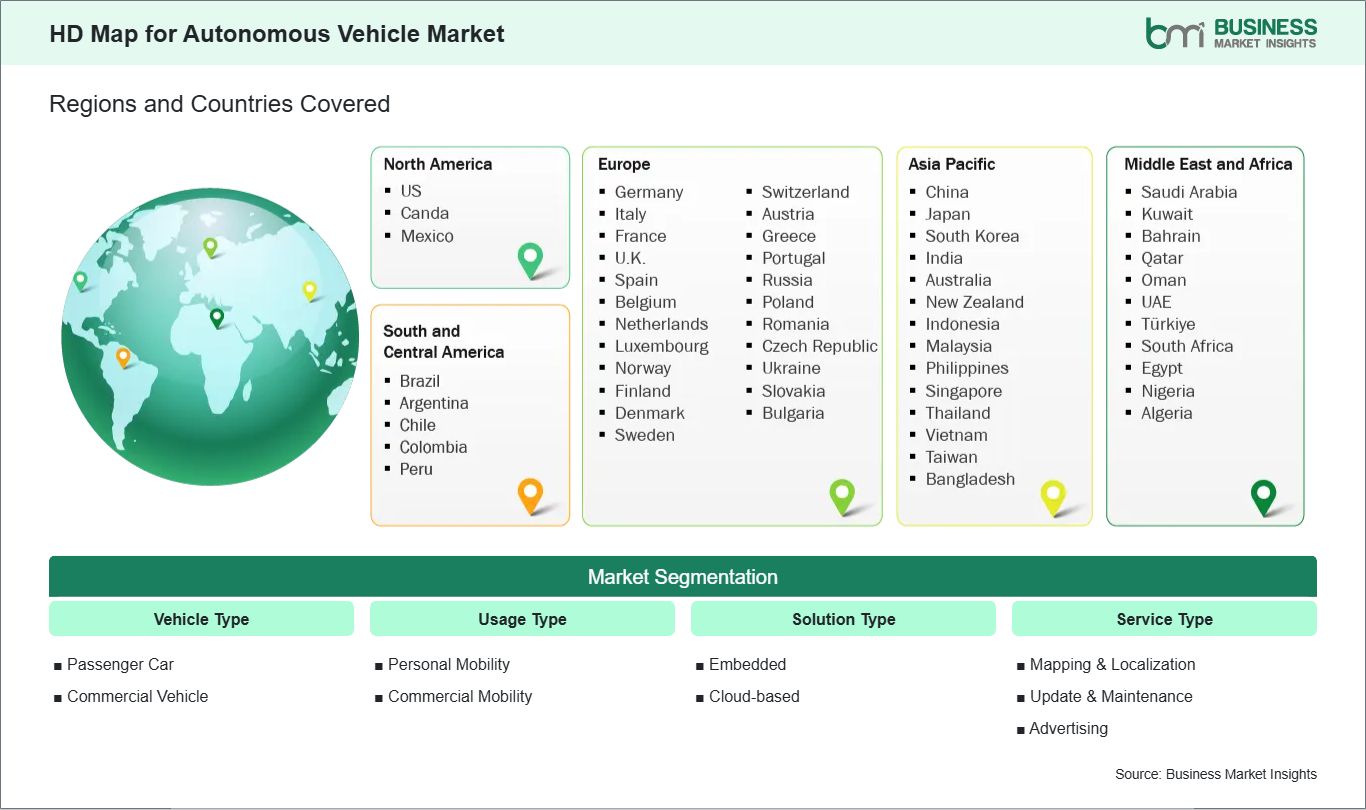
Key segments that contributed to the derivation of the Green Tires market analysis are vehicle type, usage type, solution type and service type.
By Vehicle Type
- Passenger Vehicles: The Passenger Vehicles segment dominated the market in 2025, driven by rising adoption of autonomous driving technologies and increasing demand for connected and electrified personal mobility solutions. • Commercial Vehicles: The Commercial Vehicles segment is expanding due to growing deployment of autonomous logistics, freight optimization systems, and fleet automation across transportation networks.
By Usage Type
- Personal Mobility: The Personal Mobility segment held the largest market share in 2025 owing to rising penetration of autonomous and connected passenger cars and increasing consumer preference for advanced driving assistance systems. • Commercial Mobility: The Commercial Mobility segment is growing due to increasing adoption of autonomous trucks, delivery vehicles, and smart mobility solutions in logistics and transportation services.
By Solution Type
- Embedded: The Embedded segment accounted for the largest market share in 2025 as automotive OEMs increasingly integrate HD mapping systems directly into vehicles for real-time navigation and autonomous driving support. • Cloud-Based: The Cloud-Based segment is gaining traction due to its ability to provide continuous map updates, real-time data synchronization, and scalable processing capabilities for autonomous vehicle ecosystems.
By Service Type
- Mapping & Localization: Held the largest share in 2025 as it forms the core foundation of autonomous driving systems by enabling lane-level accuracy and precise vehicle positioning for safe navigation. • Update & Maintenance: Growing due to continuous requirement for real-time map updates, road condition changes, and system accuracy enhancements. • Advertising: Emerging segment driven by location-based advertising opportunities and in-vehicle digital monetization models integrated with HD mapping platforms.
Market Forces
HD Map for Autonomous Vehicle Market Drivers and Opportunities
Accelerating Autonomous Vehicle Deployment Elevating Demand for Lane-Level Mapping Infrastructure
The expansion of AV testing programs and limited commercial deployments across North America, Europe, and Asia has created a direct and immediate requirement for high-definition mapping coverage in those corridors. Vehicle systems operating at Level 3 automation and above cannot rely solely on onboard sensor fusion for safe operation — they require pre-validated map data to cross-reference perception outputs and resolve ambiguity in complex road scenarios. This structural dependency between AV functionality and HD map availability has shifted mapping from a supporting service to a prerequisite technology layer embedded in platform certification processes.
Regulatory frameworks governing autonomous vehicle deployment increasingly specify operational design domains, within which map data quality is an implicit safety condition. As governments in the United States, European Union, China, and Japan codify AV approval pathways, the documentation of map accuracy and update frequency is becoming a compliance input rather than a commercial differentiator alone. This regulatory dimension reinforces the baseline demand for HD maps across all AV categories, extending the addressable market well beyond early technology adopters into mainstream automotive supply chains.
Map-as-a-Service Models Unlocking Scalable and Recurring Commercial Value
The transition from one-time map licensing to subscription-based Map-as-a-Service delivery structures has restructured the commercial economics of the HD mapping industry. Cloud-connected map platforms allow providers to distribute coverage expansions, accuracy updates, and new feature layers across existing subscriber bases without proportional increases in delivery cost. This model aligns provider revenue with the growing installed base of connected AV-capable vehicles, creating a compounding revenue structure that strengthens with each new platform integration.
Over the longer horizon, the advertising-linked service layer presents a differentiated opportunity that extends the commercial logic of HD maps beyond pure navigation utility. Precise location context, combined with real-time occupant presence data from autonomous vehicles, creates a new medium for proximity-sensitive commercial messaging in mobility environments. As autonomous vehicle interiors evolve from driver-focused cockpits to passenger experience spaces, the value of location intelligence as an advertising substrate will expand in parallel with AV adoption across urban markets.
Size and Share Analysis
HD Map for Autonomous Vehicle Market Size and Share Analysis
The HD Map for Autonomous Vehicle Market is projected to grow from US$ 1.14 Billion in 2025 to US$ 2.83 Billion by 2033 , registering a CAGR of 12.04% from 2026 to 2033.
By vehicle type, the HD Maps for Autonomous Vehicle market is divided into Passenger Vehicles, Commercial Vehicles. The Passenger Vehicles segment dominated the market in 2025, driven by personal mobility electrification trends.
By Usage Type, the market is divided into Personal Mobility, Commercial Mobility. The personal mobility segment held the largest market share in 2025 owing to the rising penetration of autonomous and connected passenger cars.
By Solution Type, the market is segmented into Embedded and Cloud-based. The embedded segment accounted for the largest market share in 2025 as automotive manufacturers increasingly integrate HD mapping systems directly into vehicles.
By Service Type, the market is divided into Mapping & Localization, Update & Maintenance, and Advertising. Mapping and localization held the largest market share in 2025 because they form the core foundation of autonomous driving systems. HD maps provide lane-level accuracy and real-time positioning, enabling vehicles to navigate safely and efficiently.
Report Coverage
HD Map for Autonomous Vehicle Market Report Coverage and Deliverables
The "HD Map for Autonomous Vehicle Market Size and Forecast (2022–2033)" report provides a detailed analysis of the market covering:
- HD Map for Autonomous Vehicle market size and forecast at global, regional, and country levels for all the key market segments covered under the scope
- Market trends, dynamics such as drivers, restraints, and key opportunities
- Industry landscape and competition analysis covering market concentration, heat map analysis, prominent players, and recent developments
- Detailed company profiles, including SWOT analysis
Geographic Insights
HD Map for Autonomous Vehicle Market Geographic Insights
The HD Maps for Autonomous Vehicle market is divided into geographic segments, which include North America, Asia Pacific, Europe, Middle East & Africa, and South & Central America. The Asia Pacific market is anticipated to be the leading region for such substantial growth throughout the forecast period because of its regulatory maturity, vehicle electrification pace, and raw material availability.
North America holds a prominent position in this market, with the United States leading through a combination of active AV deployment programs, federal and state-level regulatory engagement, and a dense concentration of technology and automotive development activity. Canada has contributed through cross-border freight corridor mapping initiatives, while California, Arizona, and Texas have emerged as primary coverage priority zones for both consumer and commercial AV platforms. The United States regulatory environment, though still evolving, has provided sufficient operational clarity to support sustained investment in high-definition map infrastructure at commercial scale.
Asia-Pacific represents the most production-intensive regional environment, with China anchoring demand through its scale in both AV development investment and connected vehicle manufacturing output. Japan and South Korea contribute through the AV roadmap commitments of their globally active automotive OEMs, with mapping requirements embedded in next-generation platform specifications. India presents an emerging opportunity as smart mobility initiatives and urban traffic management programs begin incorporating digital road asset development into national infrastructure planning frameworks.
Industry Activity
Recent Developments
The HD Maps for Autonomous Vehicle market is evaluated by gathering qualitative and quantitative data post primary and secondary research, which includes important corporate publications, association data, and databases. A few of the key developments in the HD Maps for Autonomous Vehicle market are:
- In April 2026, HERE Technologies, the leading mapping and location data company, and Baidu Maps, one of China’s most widely used digital mapping and navigation platforms, today announced the signing of a Memorandum of Understanding (MoU) to jointly deliver advanced map, navigation and intelligent driving solutions for automakers worldwide.
- In March 2026, Mobileye (Nasdaq: MBLY) announced that a leading U.S. automaker will integrate the Mobileye Driver Monitoring System (Mobileye DMS) into future vehicles equipped with Mobileye's EyeQ6L system-on-chip, with start of production targeted for 2027. The newly awarded win expands the scope and feature set of an existing ADAS program and is expected to span millions of vehicles across multiple models and model years.
Trust & Transparency
Research Methodology
The market analysis combines proprietary research with secondary data from government agencies, company disclosures, regulatory filings, industry databases and expert interviews. Market estimates are validated through data triangulation, cross-market benchmarking and analyst
review.
View Full Research Methodology
Key Sources Referred:
National Highway Traffic Safety Administration (NHTSA) Government transportation and environmental policy publications European Commission Directorate-General for Mobility and Transport Company annual reports and sustainability disclosures Academic studies on bio-based polymers and recycled materials International automotive production and mobility assessments Research publications covering tire material innovation and efficiency trends Company website Company annual reports Company investor presentations