
Vehicle Telematics Market Outlook: Size, Share, Trends, Growth Analysis, Competitive Landscape & Forecast, 2026-2033

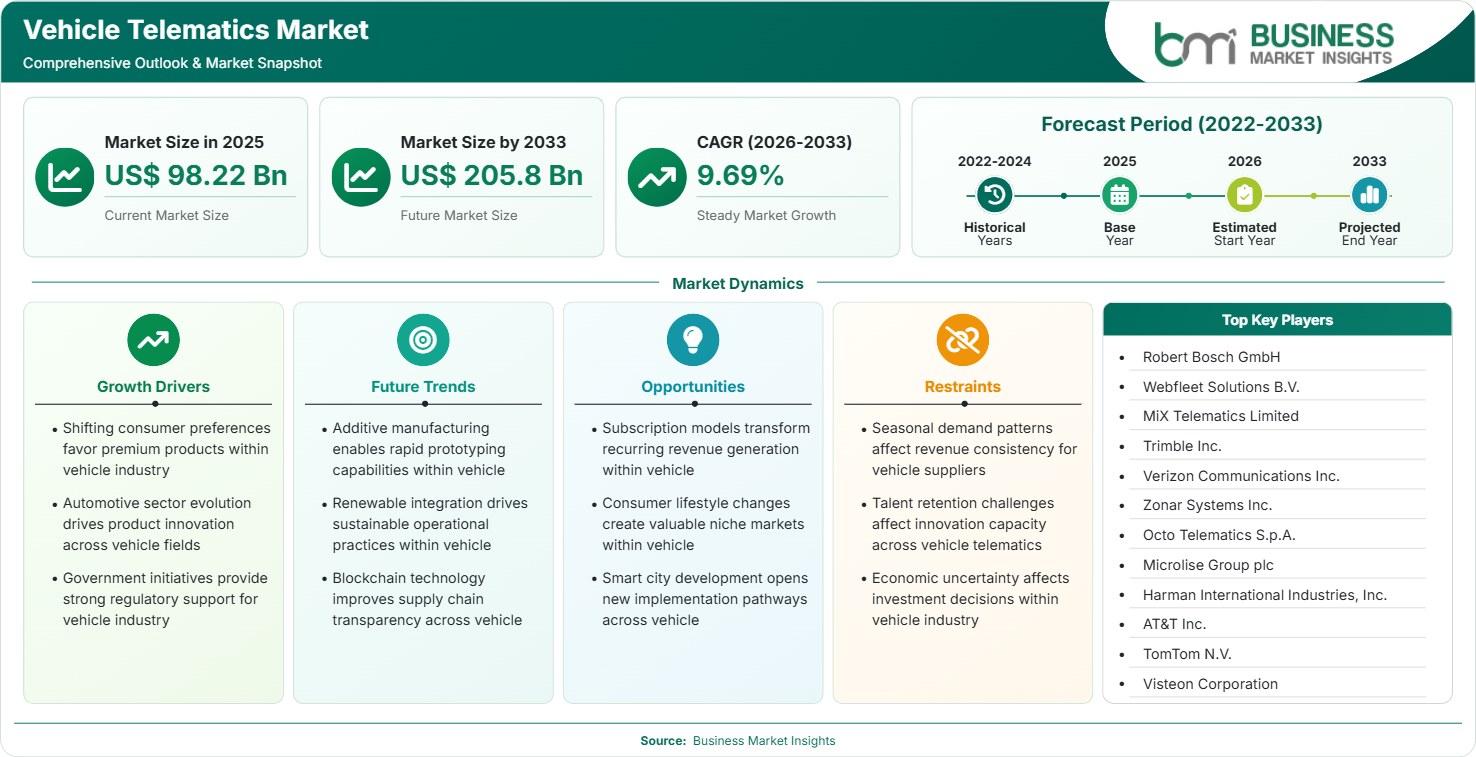
The Vehicle Telematics Market size was valued at US$ 98.22 Billion in 2025 and is projected to reach US$ 205.8 Billion by 2033, growing at a CAGR of 9.69% during 2026–2033. Rising connected vehicle adoption, fleet digitization, safety regulations, predictive maintenance demand, and expansion of usage-based mobility services continue creating significant growth opportunities across global transportation ecosystems.

Report Coverage
  • Application: Information and Navigation, Safety and Security, Fleet/Asset Management, Insurance Telematics, Infotainment System, Others
  • Technology: Embedded, Tethered, Integrated
  • Sales Channel: OEM, Aftermarket
  • Vehicle Type: Passenger Cars, Commercial Vehicles
US$ 98.22 Bn Market size in 2025
US$ 205.8 Bn Market Size by 2033
9.69% CAGR, 2026 - 2033
2026-2033 Forecast Period

AI Overview

Vehicle Telematics Market Summary

  • North America Region: North America holds a market share of 34%–37% in 2025, growing with a CAGR of 8.5%–9.5% during 2026–2033. Strong fleet digitalization, commercial vehicle monitoring, insurance telematics adoption, connected mobility investments, and regulatory focus on driver safety create sustained opportunities across transportation networks. Brief U.S. market analysis: The U.S. remains the regional leader, supported by enterprise fleet modernization and connected vehicle investments, advancing at a CAGR of 8.8%–9.8%.
  • Fastest Growing Region: Asia Pacific holds a market share of 25%–28% in 2025, growing with a CAGR of 11.0%–12.5% during 2026–2033. Expanding vehicle production, smart transportation initiatives, growing logistics sectors, connected car penetration, digital infrastructure upgrades, and increasing demand for fleet optimization accelerate adoption across emerging economies.
  • Leading Segment: Fleet/Asset Management accounts for 29%–32% share in 2025 and expands at a CAGR of 10.0%–11.0% during 2026–2033. Enterprises prioritize fuel efficiency, route optimization, asset visibility, maintenance planning, and compliance monitoring, strengthening deployment across commercial transportation and logistics operations.
  • High Growth Segment: Insurance Telematics represents 12%–15% share in 2025 and grows at a CAGR of 12.5%–14.0% during 2026–2033. Rising adoption of usage-based insurance, driver behavior analytics, risk profiling technologies, digital claims processing, and personalized premium structures support accelerated market expansion.
  • Key Market Opportunity: Growing integration of artificial intelligence, edge analytics, vehicle-to-everything communication, and cloud-connected mobility platforms enables predictive fleet intelligence, enhanced safety monitoring, operational automation, and data-driven transportation decision-making worldwide.
  • Major Market Players: Robert Bosch GmbH, Webfleet Solutions B.V., MiX Telematics Limited, Trimble Inc., Verizon Communications Inc., Zonar Systems Inc., Octo Telematics S.p.A., Microlise Group plc, Harman International Industries, Inc., AT&T Inc., TomTom N.V., Visteon Corporation, Telefónica, S.A., Aptiv PLC, and Geotab Inc.
Strategic Insights

Vehicle Telematics Market: Strategic Insights

Vehicle Telematics Market Strategic Framework
FREE PDF
Request your free sample
Request free sample
Stakeholder View

Key Takeaways

  • The industry value chain is increasingly centered on data generation, connectivity infrastructure, cloud analytics, software platforms, and fleet management services, creating recurring revenue opportunities beyond traditional hardware deployments.
  • Fleet management and insurance telematics applications offer the strongest commercial upside as enterprises seek measurable reductions in fuel consumption, maintenance expenses, accident rates, and operational inefficiencies.
  • Artificial intelligence, machine learning, predictive diagnostics, and edge computing are becoming critical innovation areas, enabling more accurate operational forecasting and proactive vehicle performance management.
  • Asia Pacific presents one of the most compelling investment environments due to expanding logistics networks, rising vehicle ownership, supportive digital infrastructure policies, and increasing connected vehicle adoption.
  • Strategic acquisitions and partnerships between automotive technology providers, telecommunications companies, software vendors, and mobility platform developers are accelerating ecosystem consolidation and solution integration.
  • The growing convergence of connected vehicles, smart cities, autonomous driving technologies, and vehicle-to-everything communications is creating new revenue streams across transportation and mobility services.
Geographic Outlook

Vehicle Telematics Market Regional Highlights

North America Vehicle Telematics Market

North America accounts for 34%–37% of global demand in 2025 and is projected to expand at a CAGR of 8.5%–9.5% during 2026–2033. The region benefits from mature telecommunications infrastructure, widespread adoption of fleet digitization platforms, and strong demand for connected vehicle services. Large commercial transportation networks continue investing in predictive maintenance, route optimization, and driver safety solutions. The Vehicle Telematics Market share remains concentrated among enterprise fleet operators, logistics providers, and insurance companies leveraging real-time operational intelligence to improve efficiency and compliance outcomes.

  • Commercial fleet operators increasingly deploy AI-enabled monitoring platforms to reduce fuel costs, improve asset utilization, strengthen regulatory compliance, and enhance operational visibility across regional and long-haul transportation networks.
  • Usage-based insurance programs continue gaining traction as insurers adopt driver behavior analytics, real-time risk assessment tools, and connected vehicle data to improve underwriting accuracy and customer engagement.
  • Telecommunications providers are expanding 5G-enabled connectivity services, enabling faster vehicle data transmission, enhanced remote diagnostics capabilities, and more sophisticated fleet management applications across industries.
  • Growing e-commerce fulfillment requirements are encouraging logistics companies to invest in integrated tracking solutions that improve delivery efficiency, reduce downtime, and support predictive maintenance planning.
  • Regulatory focus on transportation safety, emissions management, and electronic logging compliance continues encouraging investments in connected vehicle technologies throughout commercial fleet ecosystems.

US Vehicle Telematics Market

The United States represents approximately 74%–78% of the regional Vehicle Telematics Market revenue in 2025 and is forecast to grow at a CAGR of 8.8%–9.8% through 2033. Strong technology adoption, a large commercial vehicle population, and advanced cloud infrastructure support sustained demand. Fleet operators continue prioritizing operational efficiency and compliance management through connected mobility platforms. Increasing investments in intelligent transportation systems, vehicle analytics, and digital logistics networks further strengthen market expansion across freight, construction, utilities, and last-mile delivery sectors nationwide.

  • Enterprise transportation companies increasingly integrate telematics with fleet management software, creating unified operational ecosystems that improve planning accuracy, vehicle utilization, and maintenance scheduling effectiveness.
  • Strong adoption of advanced driver assistance technologies is generating demand for connected safety monitoring platforms capable of supporting accident prevention and driver performance optimization initiatives.
  • Large-scale logistics providers continue investing in data-driven transportation management systems that support route efficiency, fuel savings, and customer service improvements.
  • Insurance companies are expanding connected mobility offerings, encouraging broader implementation of driver analytics solutions and usage-based pricing models across commercial and personal vehicle segments.

Europe Vehicle Telematics Market

Europe holds 27%–30% of global revenue in 2025 and is anticipated to register a CAGR of 8.8%–9.8% during 2026–2033. The region benefits from stringent vehicle safety regulations, advanced automotive manufacturing capabilities, and widespread deployment of connected mobility solutions. Germany remains the leading market, while Eastern European countries demonstrate faster adoption supported by logistics modernization initiatives. The Vehicle Telematics Market share is further strengthened by regulatory requirements promoting digital fleet monitoring, emissions management, and transportation efficiency improvements across commercial vehicle operations.

  • Germany leads regional adoption with strong automotive technology development, extensive logistics infrastructure, and growing demand for intelligent fleet management solutions supporting industrial transportation activities.
  • Poland and Romania are among the faster-growing markets, benefiting from transportation sector modernization, expanding logistics investments, and increasing deployment of connected vehicle technologies.
  • European fleet operators increasingly utilize predictive maintenance platforms to minimize downtime, improve vehicle lifespan, and optimize maintenance expenditure across transportation networks.
  • Sustainability initiatives encourage implementation of connected mobility systems that help reduce fuel consumption, emissions output, and inefficient vehicle utilization patterns.
  • Collaboration between automotive manufacturers, software developers, and telecommunications providers is accelerating innovation in connected transportation ecosystems throughout the region.

Asia Pacific Vehicle Telematics Market

Asia Pacific accounts for 25%–28% of global Vehicle Telematics Market revenue in 2025 and is projected to achieve the highest CAGR of 11.0%–12.5% through 2033. Rapid urbanization, expanding vehicle production, growing logistics activity, and supportive smart transportation initiatives continue driving adoption. China leads regional demand, while India exhibits the strongest growth trajectory due to increasing commercial fleet digitization and connected mobility investments. The region is becoming a focal point for technology deployments aimed at improving transportation efficiency, vehicle safety, and operational intelligence.

  • China maintains leadership through extensive connected vehicle deployment, strong automotive manufacturing capacity, and significant investments in intelligent transportation infrastructure projects.
  • India is among the fastest-growing markets, supported by expanding logistics networks, government digitalization initiatives, and rising demand for fleet optimization technologies.
  • Growing e-commerce activity is encouraging transportation companies to deploy advanced tracking, monitoring, and route optimization solutions throughout supply chain operations.
  • Increasing smartphone penetration and cloud connectivity availability are supporting adoption of integrated mobility platforms across commercial transportation ecosystems.
  • Regional automotive manufacturers are embedding connected technologies into new vehicle platforms, strengthening demand for integrated telematics solutions.

Rest of World Vehicle Telematics Market

Rest of World represents 9%–11% of global Vehicle Telematics Market revenue in 2025 and is expected to expand at a CAGR of 9.5%–10.5% during 2026–2033. South and Central America are experiencing increasing deployment of fleet management systems driven by logistics modernization and fuel efficiency objectives.

The Middle East and Africa are benefiting from investments in smart mobility infrastructure, transportation digitization programs, and commercial fleet modernization initiatives. Brazil leads adoption across South and Central America, while the United Arab Emirates demonstrates the strongest growth momentum within the Middle East and Africa due to smart city investments and connected transportation development programs.

  • Brazil remains the leading regional market, supported by expanding logistics operations, rising fleet optimization requirements, and growing awareness of connected transportation technologies.
  • The United Arab Emirates is emerging as a high-growth market due to smart city development programs, advanced mobility initiatives, and increasing transportation infrastructure investments.
  • Fleet operators throughout the region are adopting vehicle monitoring solutions to improve fuel efficiency, enhance safety performance, and strengthen operational visibility.
  • Rising cross-border trade activities are encouraging transportation companies to deploy connected technologies that support asset tracking and route management capabilities.
  • Governments are increasingly promoting intelligent transportation initiatives, creating favorable conditions for adoption of digital mobility and fleet management platforms.
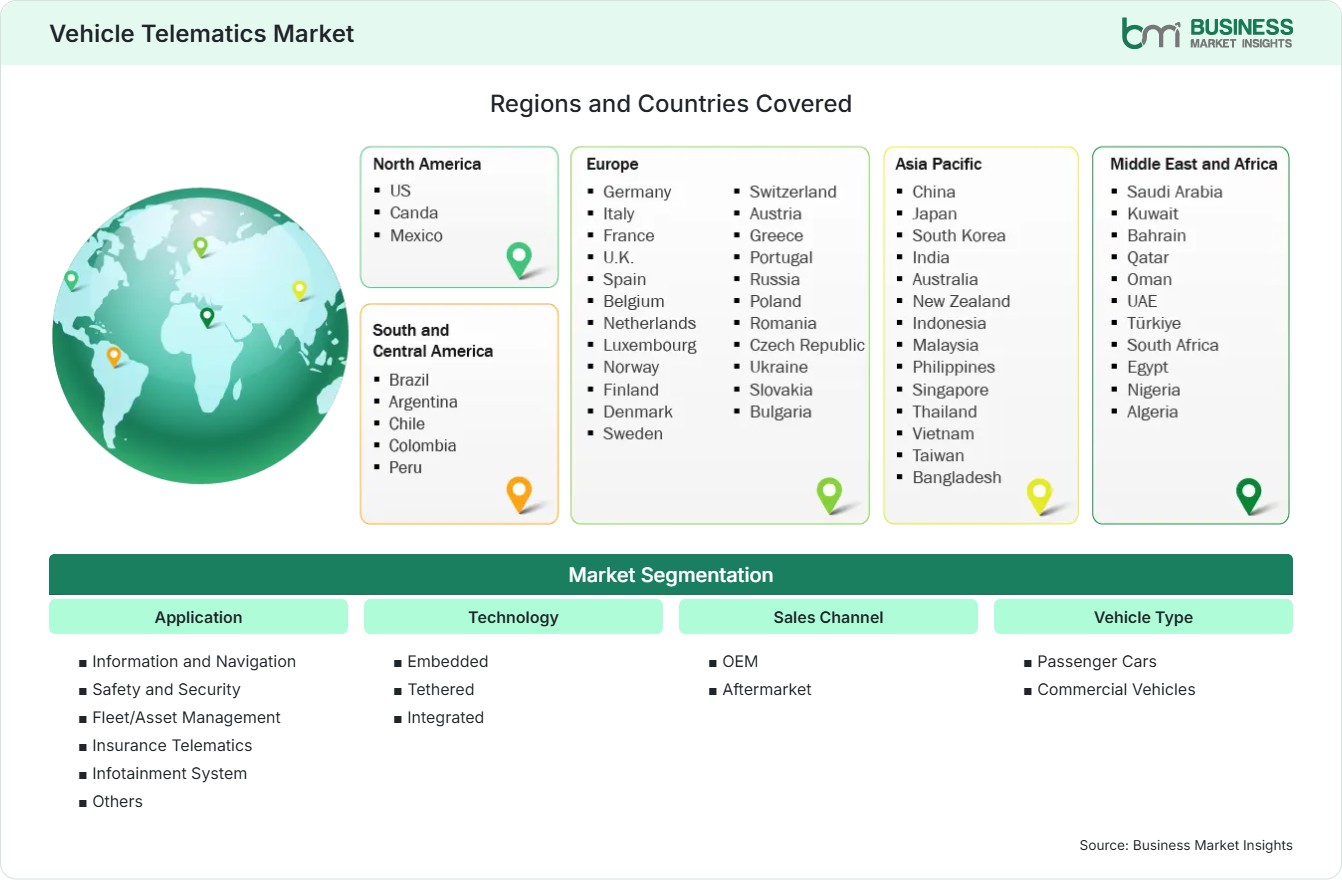
Global Market Geography
FREE PDF
Request your free sample
Request free sample
Segment Analysis

Vehicle Telematics Market Segmentation

Application

Application-based deployments account for the largest revenue contribution, with Fleet/Asset Management holding 29%–32% share in 2025 and expanding at a CAGR of 10.0%–11.0% through 2033. Growing requirements for operational visibility, vehicle utilization optimization, safety compliance, and predictive maintenance continue supporting adoption. The Vehicle Telematics Market scope is expanding as organizations increasingly integrate connected mobility solutions into broader digital transportation strategies.

  • Information and Navigation: Real-time routing, traffic intelligence, and location-based services improve transportation efficiency while supporting commercial fleet productivity and enhanced driver decision-making across complex operating environments.
  • Safety and Security: Connected safety platforms enable driver behavior monitoring, emergency assistance, vehicle recovery, and accident prevention capabilities, supporting regulatory compliance and risk reduction objectives.
  • Fleet/Asset Management: Enterprises utilize advanced monitoring tools to improve vehicle utilization, fuel management, maintenance planning, and route optimization while enhancing operational efficiency across transportation networks.
  • Insurance Telematics: Usage-based insurance models leverage connected vehicle data to improve underwriting accuracy, personalize premiums, and strengthen customer engagement through behavior-driven risk assessment.
  • Infotainment System: Integrated infotainment platforms support connectivity, navigation, communication, and entertainment features that enhance user experience and support connected vehicle ecosystems.

Technology

Technology segmentation remains influenced by connectivity requirements, data transmission capabilities, and vehicle integration preferences. Embedded solutions account for 44%–47% Vehicle Telematics Market share in 2025 and are projected to grow at a CAGR of 9.8%–10.8% through 2033. Automotive manufacturers increasingly integrate factory-installed systems to support seamless connectivity, improved reliability, and enhanced data management capabilities across vehicle platforms.

  • Embedded: Factory-installed connectivity modules provide continuous communication capabilities, supporting advanced diagnostics, safety monitoring, and intelligent mobility services without dependence on external devices.
  • Tethered: Solutions utilizing smartphones or external communication devices offer cost-effective connectivity options while enabling navigation, tracking, and operational monitoring functionalities.
  • Integrated: Integrated architectures combine embedded hardware and external connectivity resources, providing flexible deployment models for advanced fleet management and connected mobility applications.

Sales Channel

OEM channels maintain a dominant position with 58%–61% share in 2025 and a CAGR of 9.5%–10.5% through 2033. Growing integration of connected technologies during vehicle manufacturing supports broader adoption. Automotive manufacturers increasingly incorporate advanced connectivity features to meet consumer expectations, regulatory requirements, and evolving transportation ecosystem demands.

  • OEM: Vehicle manufacturers integrate telematics systems directly into new vehicles, improving functionality, reliability, and compatibility while supporting long-term connected mobility strategies.
  • Aftermarket: Aftermarket deployments remain important for existing fleets seeking cost-effective connectivity upgrades, monitoring capabilities, and operational efficiency improvements without vehicle replacement.

Vehicle Type

Commercial vehicles represent the leading category, accounting for 52%–55% share in 2025 while registering a CAGR of 10.2%–11.2% through 2033. Rising logistics activity, regulatory compliance requirements, and operational efficiency initiatives continue supporting deployment. The Vehicle Telematics Market trends increasingly reflect growing investment in connected commercial transportation solutions across global supply chains.

  • Passenger Cars: Consumers increasingly adopt connected vehicle technologies that support navigation, safety services, infotainment capabilities, and enhanced driving experiences across personal transportation applications.
  • Commercial Vehicles: Fleet operators prioritize connected mobility platforms for asset monitoring, compliance management, route optimization, predictive maintenance, and driver performance improvement initiatives.
Market Forces

Vehicle Telematics Market Dynamics

Key Market Drivers

Expansion of Connected Fleet Management Ecosystems

Commercial transport companies are turning to connected fleets to increase efficiency, safety, and asset usage. Based on evaluations made by the transportation sector, one third of fleet operation costs is made up of fuel consumption costs, necessitating investment in technologies such as route optimization and driving behavior analysis. Fleets have access to cloud-based monitoring systems that offer live insight into the operations of the vehicles. Vehicle Telematics Market growth is being facilitated through increased demand for systems that provide predictive maintenance, which reduces downtime and increases vehicle lifespans. The integration of AI, geospatial technologies, and sophisticated communication technologies keeps aiding intelligent transportation decision-making within logistics, construction, utility, and public transportation industries around the world.

Rising Regulatory Emphasis on Road Safety and Compliance

Safety regulations, electronic logging provisions, emission monitoring systems, and compliance with commercial vehicle standards are being enhanced by governments and transportation agencies throughout the world. Connected vehicle technology can facilitate compliance with these regulations without increasing administration and risk. Organizations involved in road safety are still encouraging digital monitoring to increase driver responsibility and minimize accidents. Real-time alerting, vehicle diagnostics, and behavior analytics are becoming essential in compliance management. Vehicle Telematics Market trends have played a role in influencing the market due to requirements aimed at adopting smart transportation systems. Firms that use connected monitoring systems have an easier time meeting safety goals and improving reporting accuracy.

Growth of E-Commerce and Logistics Digitization

Global e-commerce expansion continues increasing demand for efficient transportation and delivery services. Logistics providers require advanced visibility tools to manage vehicle fleets, optimize routes, and improve delivery performance across increasingly complex supply chains. The use of the connected mobility platform helps to track the status of the assets, vehicle condition management, and better customer service due to the accurate prediction of deliveries. The digital logistics revolution results in the use of the smart transport solution that can manage multiple deliveries and operations. The growing importance of the last mile delivery network, regional distribution center, and cross-border transport creates the need for the connected fleet and vehicle analytics.

Key Market Opportunities

Artificial Intelligence-Powered Predictive Mobility Platforms

The development of artificial intelligence technology opens up the possibility for transportation firms to make a shift from reactive to predictive modes of operations. Modern advanced analytics solutions allow for processing high volumes of connected vehicles data in order to establish maintenance needs, streamline routing processes and maximize the efficiency of the entire fleet. Investors and technology providers are increasingly focusing on AI-enabled transportation ecosystems that deliver measurable productivity improvements. Vehicle Telematics Market Forecasts increasingly reflect growing adoption of predictive mobility platforms capable of supporting autonomous decision-making, advanced diagnostics, and intelligent fleet optimization across diverse transportation environments.

Expansion of Usage-Based Insurance Programs

Insurance providers are increasingly leveraging connected vehicle data to develop personalized pricing models based on driving behavior, mileage patterns, and risk profiles. Usage-based insurance offers another opportunity for developing new revenue streams for technology providers, insurers, and mobility companies while engaging their customers. The use of real-time behavioral analytics improves the accuracy of the underwriting process and claims management. Acceptance of digital insurance and connectivity products by the consumers has led to an increase in the uptake of these services. Due to the importance of telematics in risk assessment, there will be greater engagement by insurers with connectivity providers and automobile manufacturers.

Integration with Smart Cities and V2X Infrastructure

Governments are investing heavily in intelligent transportation systems, smart city initiatives, and vehicle-to-everything communication frameworks. The technologies of connected mobility will be vital in helping optimize traffic, monitor infrastructure, and enhance transportation efficiency. The future city mobility ecosystem will increasingly rely on real-time data interactions among vehicles, infrastructure components, and management hubs. Technology companies that can help implement compatible communication protocols and advanced analytics will greatly benefit from this trend. Investments in digital infrastructure, connected transport corridors, and intelligent traffic management systems represent long-term opportunities for telematics solutions providers in both mature and emerging markets.

Market Restraints and Challenges

Data Privacy and Cybersecurity Concerns

Factor: The connected vehicle platforms create a lot of operational, behavioral, and locational data, thus raising questions of privacy and cybersecurity for businesses, regulators, and consumers.

Impact: Such issues as security threats, access without permission, and regulatory compliance problems may cause distrust and prevent the system deployment. Organizations need to spend money on encrypting technologies, safe communication channels, and regulatory compliance programs in order to ensure their security and privacy. Moreover, new data protection needs in different jurisdictions complicate the process of implementing this technology. With the development of connected mobility ecosystems, strong cybersecurity becomes necessary.

High Integration Complexity Across Diverse Vehicle Fleets

Factor: Transportation companies often operate heterogeneous fleets of vehicles, which may involve a range of manufacturers and technology standards.

Impact: Integration issues lead to higher costs in terms of implementation and time spent, as well as make data management more difficult. The successful realization of the integration of the various types of equipment, networks, and software requires many resources and knowledge in this sphere. Small operators of fleets can be faced with certain limitations and not adopt such innovations. Differences in terms of connectivity and regulatory requirements add to the difficulty of implementation.

Company Analysis

Competitive Landscape

Vehicle Telematics Market analysis indicates a highly competitive environment characterized by connected mobility innovation, strategic partnerships, cloud-based analytics development, and increasing integration of artificial intelligence capabilities.

Company Name

Overview

Products and Services relevant to this market

Robert Bosch GmbH

Global mobility technology provider focused on connected transportation, safety systems, and intelligent vehicle electronics.

Telematics control units, fleet connectivity solutions, vehicle diagnostics, predictive maintenance, and connected mobility platforms.

Webfleet Solutions B.V.

Fleet management specialist serving commercial transportation operators across multiple regions.

Fleet tracking, route optimization, driver management, vehicle monitoring, and operational analytics solutions.

MiX Telematics Limited

Provider of fleet intelligence and driver safety solutions for enterprise transportation operations.

Fleet management software, asset tracking, safety analytics, compliance monitoring, and performance management platforms.

Trimble Inc.

Technology company delivering transportation, logistics, and asset management solutions worldwide.

Fleet telematics, routing systems, transportation analytics, asset visibility, and mobility management software.

Verizon Communications Inc.

Telecommunications leader supporting connected mobility and enterprise transportation ecosystems.

Vehicle tracking, fleet analytics, connectivity services, driver monitoring, and cloud-based management platforms.

Zonar Systems Inc.

Fleet technology company specializing in operational visibility and compliance solutions.

Electronic inspections, GPS tracking, compliance management, driver performance monitoring, and fleet analytics.

Octo Telematics S.p.A.

Connected insurance and mobility technology provider serving automotive and insurance sectors.

Insurance telematics, risk analytics, driver behavior monitoring, and connected vehicle intelligence solutions.

Microlise Group plc

Transportation technology provider supporting logistics optimization and fleet efficiency initiatives.

Fleet performance management, route planning, telematics hardware, tracking systems, and analytics platforms.

Harman International Industries, Inc.

Connected vehicle technology provider focused on automotive digital transformation initiatives.

Connected car systems, telematics modules, infotainment integration, cybersecurity, and vehicle connectivity services.

AT&T Inc.

Telecommunications company enabling large-scale connected transportation deployments globally.

IoT connectivity, fleet communication services, vehicle tracking, data management, and mobility platforms.

TomTom N.V.

Location technology specialist providing mapping and navigation intelligence solutions.

Digital mapping, navigation systems, traffic intelligence, routing optimization, and connected mobility services.

Visteon Corporation

Automotive technology company delivering advanced cockpit and connectivity solutions.

Connected vehicle platforms, digital cockpit systems, telematics integration, and vehicle communication technologies.

Telefónica, S.A.

Telecommunications operator supporting IoT and connected transportation initiatives.

IoT connectivity, fleet communications, mobility services, analytics solutions, and telematics infrastructure.

Aptiv PLC

Global mobility technology company focused on intelligent and connected transportation systems.

Connected vehicle architectures, telematics hardware, software platforms, and advanced mobility technologies.

Geotab Inc.

Fleet management technology leader serving commercial transportation and logistics operators.

Fleet tracking, telematics analytics, compliance tools, sustainability monitoring, and vehicle intelligence platforms.

Trust & Transparency

Research Methodology

The market analysis combines proprietary research with secondary data from government agencies, company disclosures, regulatory filings, industry databases and expert interviews. Market estimates are validated through data triangulation, cross-market benchmarking and analyst review.

View Full Research Methodology

Questions Answered

Frequently Asked Questions

What insights can be obtained from a Vehicle Telematics Market Report?

A Vehicle Telematics Market Report provides analysis of industry trends, technology developments, competitive positioning, investment opportunities, regional performance, segmentation dynamics, and future growth prospects.

How are insurers benefiting from telematics technologies?

Insurers use connected vehicle data to assess risk profiles, develop usage-based insurance models, improve claims processing, and enhance customer engagement through personalized pricing structures.

Which vehicle category generates the highest demand for telematics solutions?

Commercial vehicles represent the largest deployment category due to extensive requirements for asset tracking, compliance management, fleet optimization, and operational visibility across transportation networks.

What role does artificial intelligence play in modern telematics platforms?

Artificial intelligence enables predictive maintenance, driver behavior analysis, route optimization, operational forecasting, and automated decision support, improving transportation efficiency and reducing operating costs.

What factors are accelerating adoption of connected vehicle technologies?

Growing demand for fleet efficiency, safety compliance, predictive maintenance, route optimization, and digital transportation management solutions is encouraging organizations to invest in connected mobility technologies.

Access the Full Vehicle Telematics Market Report

Get segment-level forecasts, regional estimates, competitive benchmarking, company profiles and downloadable Excel datasets.

Access the full Vehicle Telematics Market Report
350 pages PDF & Excel | 2026-08-31