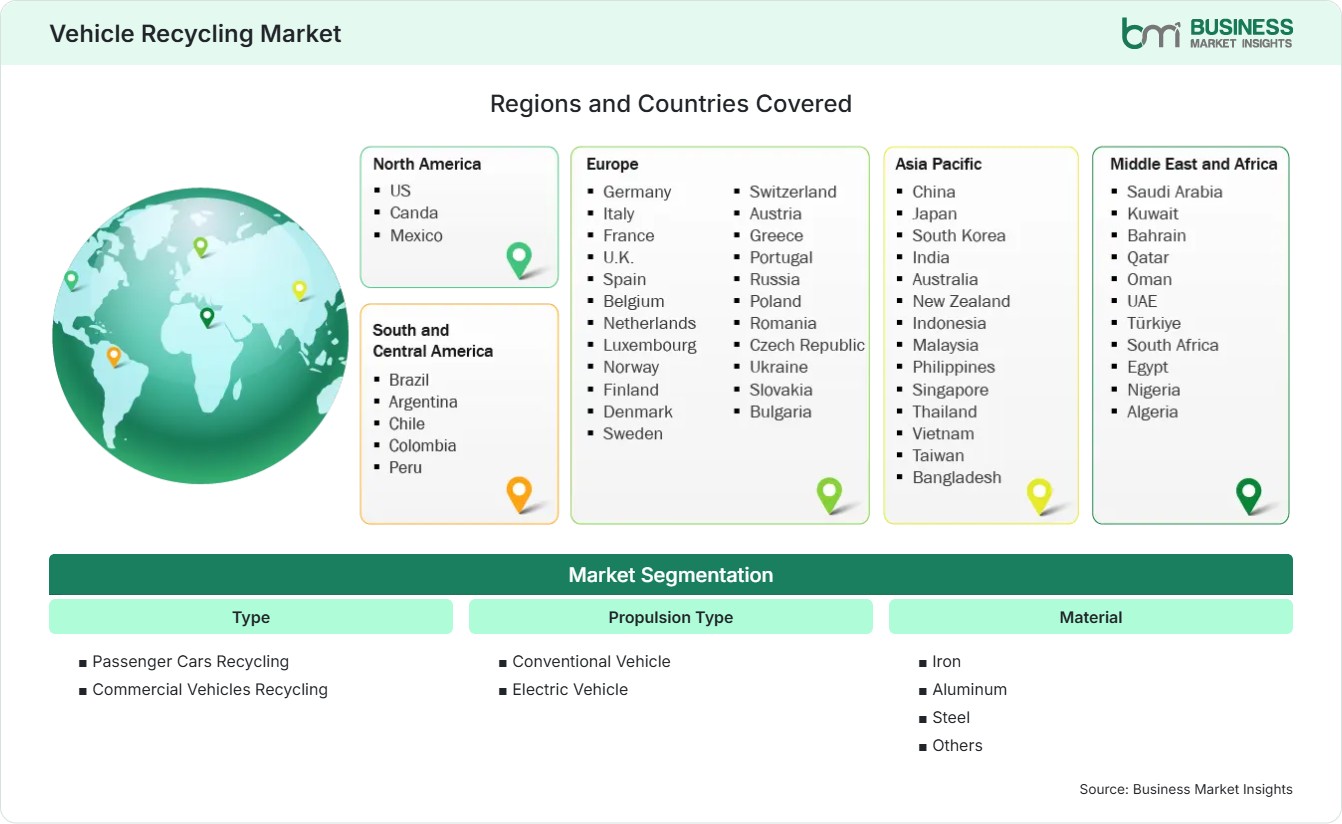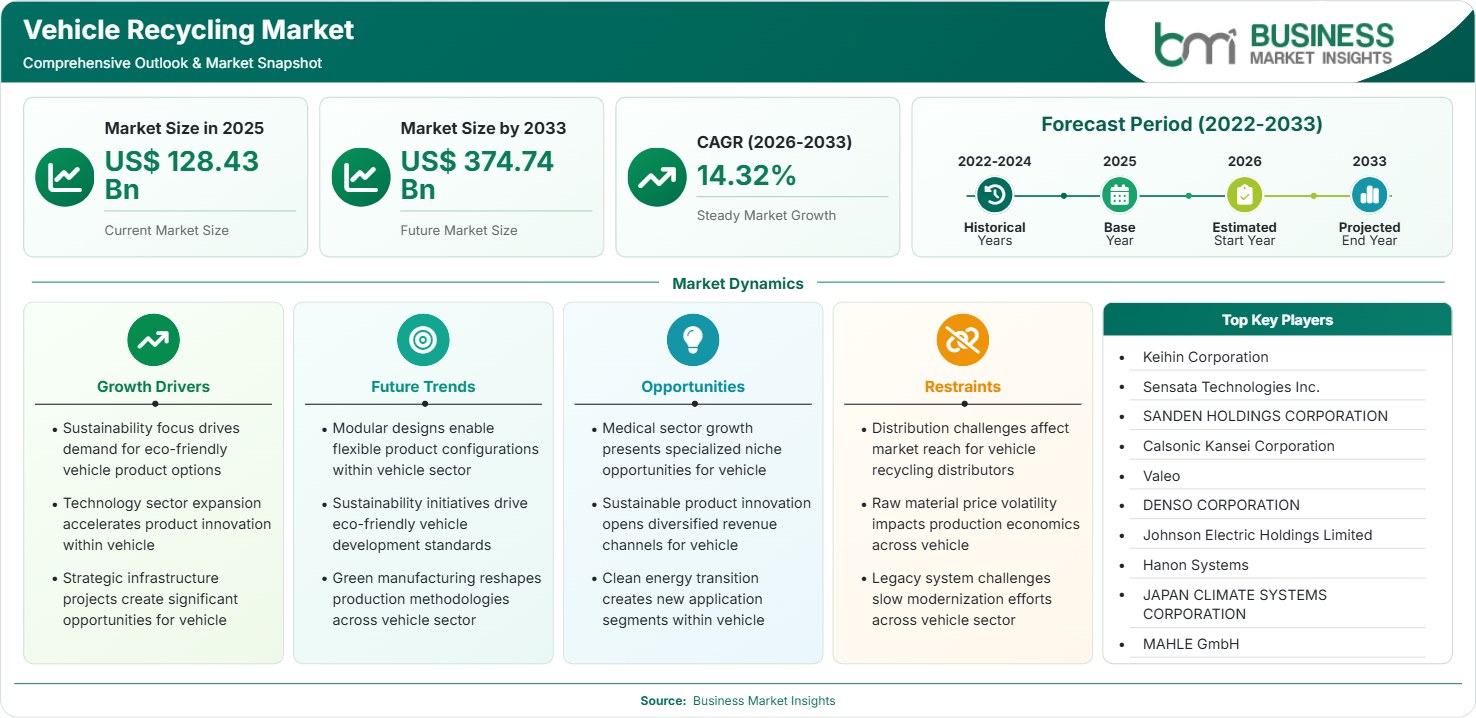
Vehicle Recycling Market Regional Highlights
North America Vehicle Recycling Market
North America accounted for 34%–37% of the Vehicle Recycling Market share in 2025 and is projected to register a 13.4%–14.1% CAGR during 2026–2033. The region benefits from well-established end-of-life vehicle (ELV) collection systems, advanced shredding technologies, and strong demand for recycled steel and aluminum from automotive and construction industries. Regulatory initiatives supporting circular economy practices and increasing investments in battery recycling infrastructure continue strengthening organized recycling networks across the U.S. and Canada while enhancing recovery efficiency for high-value automotive materials.
- Advanced dismantling and automated sorting facilities improve material recovery rates while reducing operational costs, allowing recyclers to maximize profitability through efficient extraction of ferrous metals, non-ferrous metals, plastics, and reusable automotive components.
- Growing electric vehicle adoption encourages investments in lithium-ion battery recycling technologies, enabling recovery of lithium, nickel, cobalt, and graphite to support domestic critical mineral supply chains and manufacturing resilience.
- Automotive manufacturers increasingly collaborate with recycling companies to establish circular supply chains, reducing dependence on virgin raw materials while meeting sustainability commitments and regulatory compliance objectives across North America.
- Rising infrastructure modernization and industrial manufacturing activities sustain strong demand for recycled steel and aluminum, supporting continuous expansion of organized vehicle dismantling and processing facilities throughout the region.
- Digital inventory management, AI-enabled material identification, and robotics improve dismantling accuracy, increasing operational productivity while minimizing waste generation and environmental impacts across recycling facilities.
US Vehicle Recycling Market
The United States represented 76%–79% of the North American market in 2025 and is forecast to expand at a 13.6%–14.3% CAGR through 2033. Extensive automotive ownership, mature scrap metal infrastructure, stringent environmental regulations, and growing investments in electric vehicle battery recycling strengthen industry competitiveness. Increasing adoption of sustainable manufacturing practices further supports long-term expansion of organized end-of-life vehicle processing across multiple industrial sectors.
- Federal sustainability initiatives and state-level recycling regulations encourage higher vehicle recovery rates while promoting investments in modern dismantling equipment, battery processing technologies, and advanced metal separation facilities.
- Strong domestic steel production and expanding aluminum recycling demand improve commercial viability for recyclers by creating consistent secondary material demand from manufacturing, infrastructure, and automotive industries.
- Growing partnerships between automotive OEMs and specialized recyclers enhance closed-loop material recovery, supporting circular manufacturing strategies and improved resource utilization across the transportation sector.
- Investments in battery recycling facilities accelerate domestic recovery of strategic minerals, reducing import dependence while supporting long-term electric vehicle supply chain resilience and environmental sustainability.
Europe Vehicle Recycling Market
Europe captured 28%–31% Vehicle Recycling Market share during 2025 and is expected to grow at a 13.1%–13.8% CAGR through 2033. Comprehensive ELV regulations, ambitious carbon neutrality targets, and widespread adoption of sustainable manufacturing practices continue driving recycling activities across the region. Germany remains the leading national market, while Poland demonstrates one of the fastest growth trajectories supported by expanding dismantling infrastructure and increasing investments in secondary raw material recovery.
- Germany leads regional recycling capacity through advanced dismantling facilities, strong automotive manufacturing presence, and continuous technological investments supporting efficient recovery of metals and reusable vehicle components.
- Poland records one of Europe's strongest expansion rates due to increasing vehicle retirement volumes, infrastructure investments, and supportive recycling regulations encouraging organized ELV processing.
- European Union circular economy initiatives stimulate higher recycling efficiency, improved traceability, and broader utilization of recycled automotive materials across manufacturing industries.
- Increasing battery recycling investments support strategic recovery of lithium, cobalt, nickel, and manganese as Europe strengthens domestic critical mineral security.
- Cross-border collaboration among recyclers, OEMs, and technology providers accelerates innovation in automated dismantling and environmentally responsible vehicle disposal.
Asia Pacific Vehicle Recycling Market
Asia Pacific accounted for 27%–30% of the Vehicle Recycling Market in 2025 and is projected to achieve the fastest 15.8%–16.6% CAGR during the forecast period. Rapid vehicle ownership growth, expanding automotive manufacturing, increasing scrappage volumes, and government initiatives promoting resource efficiency continue supporting regional development. China leads regional revenue generation, while India records the fastest growth owing to formal vehicle scrappage policies and expanding recycling infrastructure.
- China dominates regional recycling activities through extensive automotive production, rising end-of-life vehicle volumes, and substantial investments in automated recycling technologies and battery material recovery.
- India demonstrates exceptional growth supported by organized vehicle scrappage programs, increasing formal recycling capacity, and government policies promoting circular economy development across automotive industries.
- Japan and South Korea continue investing in high-value component recovery, advanced dismantling automation, and battery recycling technologies supporting sustainable industrial production.
- Rising electric vehicle production significantly increases future demand for battery recycling facilities capable of recovering critical minerals required for next-generation battery manufacturing.
- Expanding industrialization and infrastructure investments strengthen demand for recycled metals, encouraging modernization of regional recycling ecosystems and material processing capabilities.
Rest of World Vehicle Recycling Market
The Rest of World region contributed 8%–10% of global Vehicle Recycling Market revenue in 2025 and is anticipated to expand at a 12.2%–12.9% CAGR through 2033.
South and Central America continue strengthening organized recycling activities through increasing vehicle ownership, supportive environmental policies, and modernization of scrap processing facilities. Brazil remains the leading market, while Mexico demonstrates accelerating growth through automotive manufacturing expansion and improved material recovery infrastructure. In the Middle East and Africa, the UAE leads organized recycling investments, whereas South Africa records notable growth driven by industrial recycling initiatives and rising sustainability awareness.
- Brazil benefits from expanding automotive production, improving recycling regulations, and increasing investments in formal dismantling operations that enhance recovery efficiency across valuable automotive materials.
- Mexico experiences accelerating development due to automotive manufacturing expansion, export-oriented production, and increasing adoption of environmentally responsible recycling technologies.
- The UAE strengthens regional leadership through investments in circular economy infrastructure, advanced waste management systems, and sustainable industrial development supporting organized vehicle recycling.
- South Africa expands recycling capacity through industrial modernization, rising metal recovery demand, and government initiatives promoting resource conservation and environmental sustainability.
- International partnerships and technology transfer programs continue improving dismantling efficiency, workforce capabilities, and environmentally compliant recycling practices across emerging economies.