Market Summary
Executive Summary and Global Market Analysis
In-vehicle infotainment systems integrate audio, visual, communication, and navigation functions within the cabin environment to support information access, media control, and connected user experiences during travel. These platforms have shifted from standalone entertainment modules to software-led interfaces that coordinate displays, voice interaction, smartphone connectivity, and route guidance across vehicle architectures.
Automakers are expanding deployment of infotainment platforms as buyers place greater value on connected driving, intuitive interfaces, and seamless access to digital services. Cabin design priorities now extend beyond mechanical performance, with user experience, device integration, and software responsiveness influencing purchasing decisions across both personal and fleet mobility categories.
Segmentation patterns indicate broad relevance across component, vehicle type, and installation categories. Display units remain central to interface design, while communication and navigation units support connected functions and trip management. Passenger cars represent the widest deployment base, whereas SUVs and MPVs increasingly incorporate larger screens and multi-zone content access. In-dash systems continue as the standard format, while rear-seat infotainment retains importance in comfort-oriented vehicle configurations.
Technology evolution within this sector reflects a move toward integrated cockpit computing, sharper display formats, voice-enabled control layers, and software platforms that support over-the-air upgrades. Interface design increasingly emphasizes reduced driver distraction, faster menu logic, and compatibility with advanced vehicle electronics, allowing infotainment functions to align more closely with safety systems and digital services.
Competitive conditions are shaped by platform integration capabilities, software expertise, display engineering, and alignment with evolving automotive design cycles. Market participants compete through modular architectures, interface refinement, and collaboration across hardware and software layers. As infotainment becomes more embedded in overall cockpit strategy, product differentiation increasingly depends on system reliability, update flexibility, and quality of user interaction.
Segment Analysis
In-Vehicle Infotainment Market Segmentation
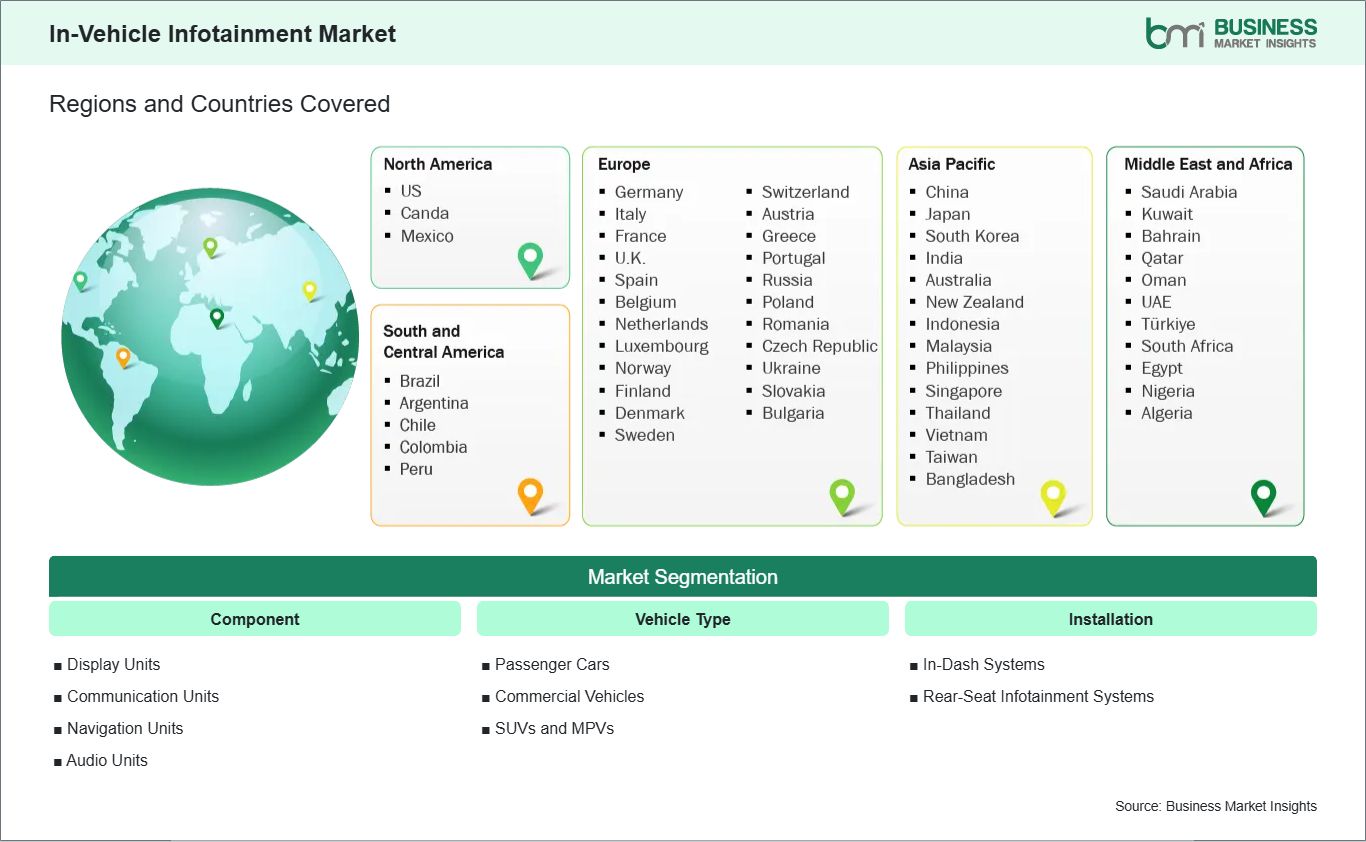
The market is segmented by component, vehicle type, and installation. Each category reflects distinct interface priorities, content access models, and cabin integration needs.
By Component
- Display Units : Anchor interface visibility and centralize driver-passenger interaction.
- Communication Units : Enable connectivity, telematics exchange, and external service access.
- Navigation Units : Support route intelligence and trip-focused decision assistance.
- Audio Units : Deliver media output and enhance in-cabin acoustic experience.
By Vehicle Type
- Passenger Cars : Lead interface standardization and mass-market feature integration.
- Commercial Vehicles : Prioritize communication, routing, and operational continuity.
- SUVs and MPVs : Favor larger displays and richer multi-occupant content delivery.
By Installation
- In-Dash Systems : Remain the default architecture for integrated cockpit control.
- Rear-Seat Infotainment Systems : Extend media access for passenger-focused travel settings.
Market Forces
In-Vehicle Infotainment Market Drivers and Opportunities
Connected Cabin Expectations Across Vehicle Platforms
Consumer preference has shifted toward vehicles that deliver familiar digital experiences through embedded screens, voice control, and device synchronization. This change has created a clear need for infotainment platforms that combine communication, media access, and navigation within a unified cabin interface. Automakers are responding by integrating broader software functionality into mainstream and premium vehicles, expanding deployment across multiple body styles and installation formats.
The effect of this shift extends beyond entertainment, shaping cockpit design, interface hierarchy, and brand differentiation. Infotainment quality now influences perceived vehicle sophistication and everyday usability. In this context, manufacturers and suppliers are refining display clarity, interface speed, and content accessibility to align with evolving user expectations. The driver remains highly relevant because infotainment increasingly serves as a visible expression of digital value within the cabin.
Software-Defined Cockpit Expansion
A broader shift toward software-defined vehicles is opening new opportunities for infotainment platforms that support updates, personalization, and function layering over time. This trend encourages innovation in interface frameworks, cloud-connected services, and centralized cockpit computing. Use cases now include profile-based media settings, contextual navigation prompts, and synchronized display environments that adapt to vehicle modes, occupant needs, and connected ecosystems.
Future scope is widening as infotainment becomes a flexible software layer rather than a fixed hardware feature. This creates room for service expansion, interface upgrades, and closer integration with advanced cockpit electronics. As automakers pursue scalable digital architectures, infotainment systems can influence long-term revenue models and user retention. The opportunity matters because it links cabin experience with ongoing feature evolution and post-sale differentiation.
Size and Share Analysis
In-Vehicle Infotainment Market Size and Share Analysis
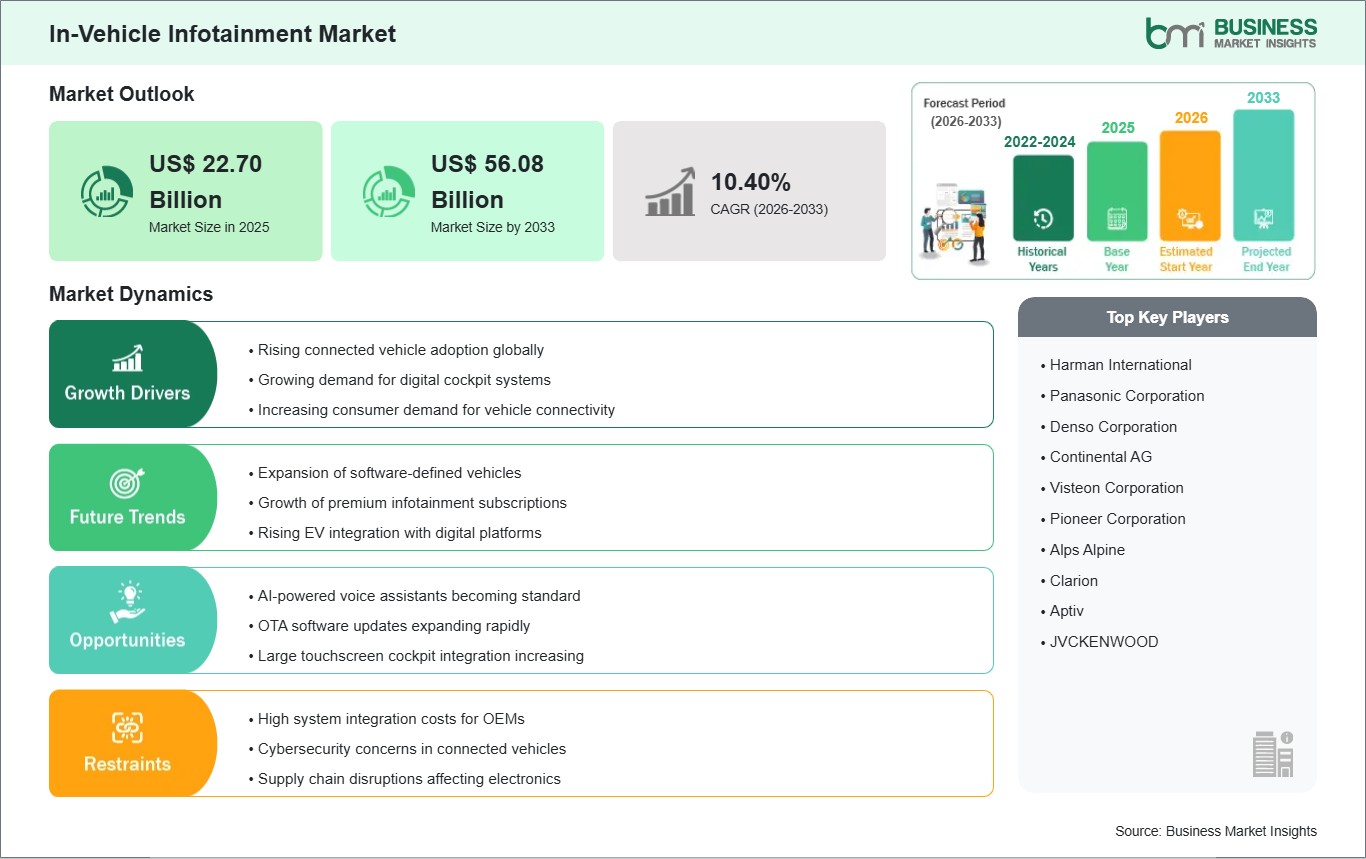
The In-Vehicle Infotainment market size is expected to reach US$ 56.08 billion by 2033 from US$ 22.70 billion in 2025. The market is estimated to record a CAGR of 10.40% from 2026 to 2033.
This trajectory reflects the rising strategic importance of digital cabin systems within vehicle design, where software functionality, interface quality, and connected services increasingly shape product positioning and user value perception.
Among segments, display units hold a leading position because they define the primary interaction layer for media, navigation, and vehicle information access. Passenger cars represent the broadest deployment base due to higher production volumes and wide feature standardization. In-dash systems maintain segment prominence as they remain the most established format for integrating core infotainment functions within the dashboard architecture.
Application leadership remains centered on everyday cabin functions that combine route guidance, communication access, media control, and user interface management within a single operating environment. These use patterns favor systems that can support frequent interaction without disrupting vehicle use. Rear-seat infotainment retains relevance in passenger-oriented vehicle formats, yet integrated front-cabin applications continue to account for the most consistent share of demand.
Report Coverage
In-Vehicle Infotainment Market Report Coverage and Deliverables
The report provides a detailed analysis of the market covering the below areas:
- Market size and forecast at global, regional, and country levels for all the key market segments covered under the scope
- Market trends, as well as market dynamics such as drivers, restraints, and key opportunities
- Market analysis covering key market trends, global and regional framework, major players, regulations, and recent market developments
- Industry landscape and competition analysis covering market concentration, heat map analysis, prominent players, and recent developments for the market
- Detailed company profiles, including SWOT analysis
Geographic Insights
In-Vehicle Infotainment Market Geographic Insights
The In-Vehicle Infotainment market shows diverse regional adoption patterns influenced by automotive production strategies, digital feature preferences, connectivity ecosystems, and regulatory attention to in-cabin interface design. At the global level, the industry is moving toward larger displays, software-centric cockpit platforms, and tighter integration between navigation, communication, and media functions. Demand also reflects the broader transition toward connected mobility, where vehicle interiors are increasingly designed as digital interaction environments rather than purely mechanical spaces.
North America demonstrates strong market maturity, supported by consumer preference for feature-rich vehicles and early acceptance of connected cabin services. Automakers in the region place considerable emphasis on interface responsiveness, smartphone compatibility, and subscription-enabled digital functions. Demand is also shaped by attention to driver distraction and usability, encouraging infotainment designs that balance broad functionality with simpler interaction pathways across passenger cars, utility vehicles, and fleet-oriented platforms.
Asia Pacific represents the most dynamic regional landscape, supported by large vehicle production volumes, expanding middle-class mobility demand, and intense competition around cabin technology differentiation. Manufacturers across the region are incorporating wider display formats, connected navigation features, and integrated communication functions to strengthen vehicle appeal. Local innovation in electronics and software ecosystems further reinforces this direction, allowing infotainment offerings to evolve quickly across both entry-level and premium vehicle segments.
Europe maintains a strong position through its focus on interface quality, design coherence, and alignment with safety-oriented cabin development. The region favors infotainment systems that integrate clean visual architecture with advanced communication and route guidance functions. Emerging markets in the Middle East and Africa and South and Central America are developing more gradually, with adoption linked to vehicle mix, affordability, and localization priorities. Even so, infotainment remains an increasingly visible differentiator as connected vehicle expectations extend across broader geographies.
Industry Activity
Recent Developments
Recent developments reflect a clear shift toward software-led cockpit experiences and more intuitive display environments. Product announcements continue to emphasize interface refinement, personalization, and tighter integration of connected in-cabin functions.
- In May 2026, LG Electronics (LG) showcased its latest suite of in-vehicle infotainment (IVI) and software-defined vehicle (SDV) solutions, which earned strong recognition from Google and global automakers. A new range of solutions is built on Android Automotive OS (AAOS) and AAOS SDV technologies. While AAOS SDV enables software to define and control core vehicle functions from driving performance and convenience features to safety systems, AAOS serves as the foundation for delivering infotainment experiences to passengers.
- In March 2026, Panasonic Automotive Systems Co., Ltd. announced that the companys in-vehicle infotainment (IVI) system has debuted in Toyota Motor Corporation's (Toyota) 2026 RAV4 vehicle. This cutting-edge platform is designed to keep drivers connected, informed and entertained with speed, personalization and future-ready technology.
Trust & Transparency
Research Methodology
The market analysis combines proprietary research with secondary data from government agencies, company disclosures, regulatory filings, industry databases and expert interviews. Market estimates are validated through data triangulation, cross-market benchmarking and analyst
review.
View Full Research Methodology
Key Sources Referred:
World Bank -Global Trade Indicators World Trade Organization (WTO) International Monetary Fund (IMF) International Trade Administration (ITA) Company Websites Company Annual Reports Company Investor Presentations