
Autonomous Truck Market Outlook: Size, Share, Trends, Growth Analysis, Competitive Landscape & Forecast, 2026-2033

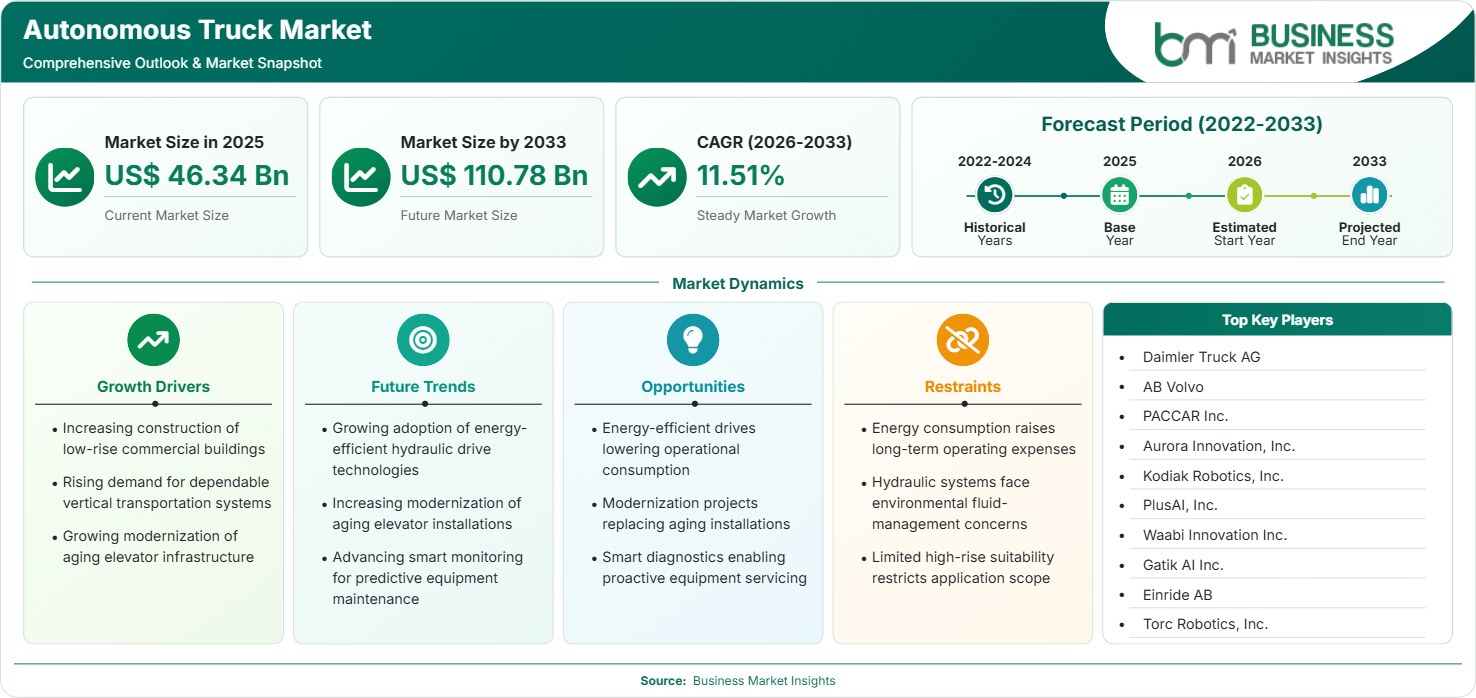
The Autonomous Truck Market size was valued at US$ 46.34 Billion in 2025 and is projected to reach US$ 110.78 Billion by 2033, growing at a CAGR of 11.51% during 2026–2033. Key drivers include freight automation, persistent driver shortages, AI-enabled fleet optimization, and logistics efficiency demands, while opportunities emerge from electric autonomous fleets, mining applications, dedicated freight corridors, and expanding regulatory support.

Report Coverage
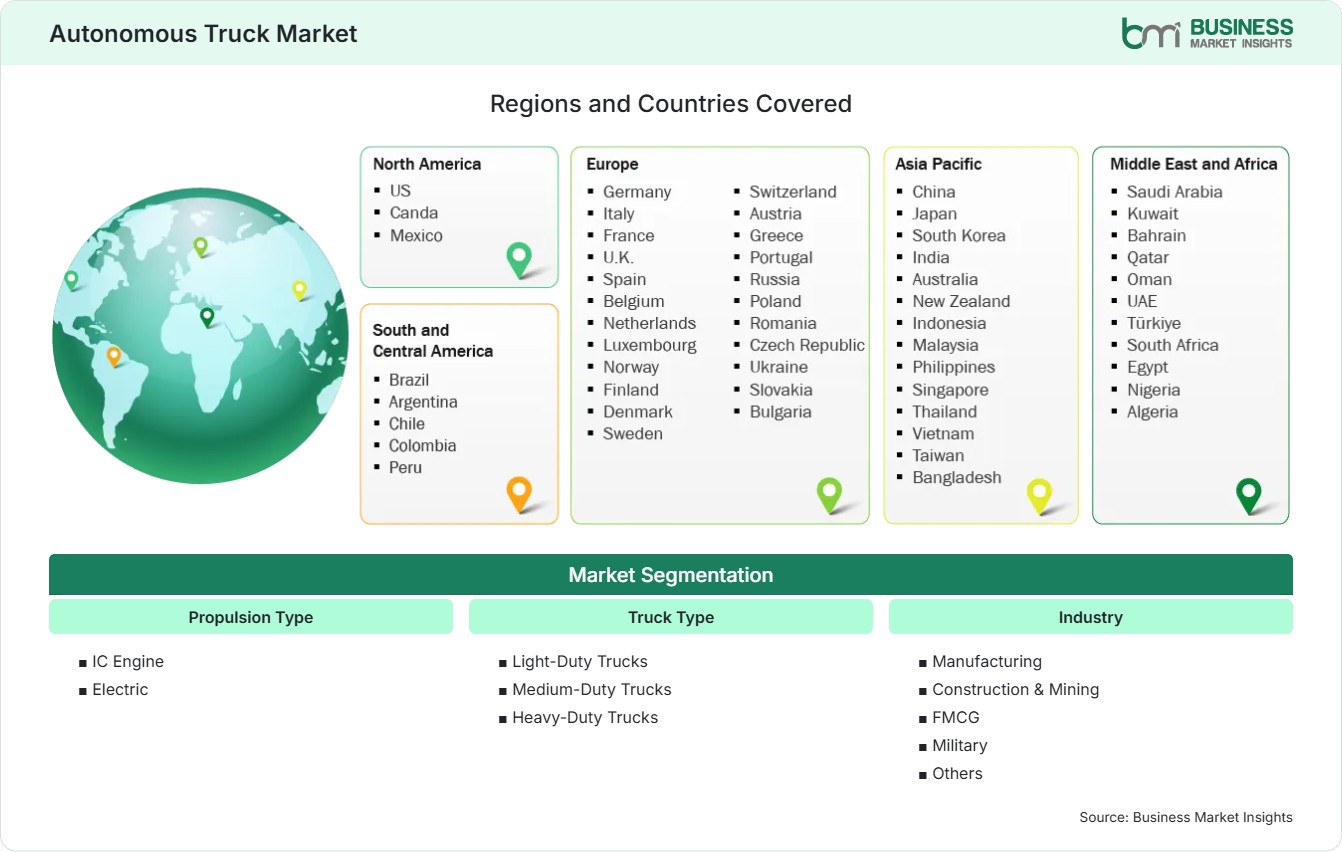
  • Propulsion Type: IC Engine, Electric
  • Truck Type: Light-Duty Trucks, Medium-Duty Trucks, Heavy-Duty Trucks
  • Industry: Manufacturing, Construction & Mining, FMCG, Military, Others
US$ 46.34 Bn Market size in 2025
US$ 110.78 Bn Market Size by 2033
11.51% CAGR, 2026 - 2033
2026-2033 Forecast Period

AI Overview

Autonomous Truck Market Summary

  • North America Region: North America holds a market share of 36%–39% in 2025, growing at a CAGR of 10.5%–11.5% during 2026–2033, supported by commercial pilot deployments, freight corridor digitization, logistics automation, safety improvements, fleet modernization, and increasing partnerships between truck OEMs and autonomous software developers. The U.S. maintains leadership through large-scale freight networks and testing programs, advancing at approximately 10.8%–11.8% CAGR.
  • Fastest Growing Region: Asia Pacific holds a market share of 25%–28% in 2025, growing at a CAGR of 12.8%–13.8% during 2026–2033, driven by logistics expansion, industrial automation, smart transportation investment, electric vehicle production strength, cross-border trade growth, and government-backed intelligent mobility initiatives.
  • Leading Segment: Level 2 holds a market share of 38%–42% in 2025, growing at a CAGR of 10.5%–11.5% during 2026–2033, supported by immediate fleet applicability, regulatory acceptance, lower deployment costs, ADAS integration, fuel optimization capabilities, and scalable commercial adoption pathways.
  • High Growth Segment: Level 4 holds a market share of 12%–16% in 2025, growing at a CAGR of 17.0%–19.0% during 2026–2033, supported by unmanned freight operations, rapid AI improvements, sensor cost reductions, dedicated logistics corridors, mining applications, and increasing autonomous freight network investments.
  • Key Market Opportunity: Dedicated autonomous freight corridors connecting logistics hubs, ports, distribution centers, and industrial zones can improve route efficiency, reduce operating costs, support electric fleets, and accelerate large-scale commercialization globally.
  • Major Market Players: Daimler Truck AG, AB Volvo, PACCAR Inc., Aurora Innovation, Inc., Kodiak Robotics, Inc., PlusAI, Inc., Waabi Innovation Inc., Gatik AI Inc., Einride AB, and Torc Robotics, Inc.
Strategic Insights

Autonomous Truck Market: Strategic Insights

Autonomous Truck Market Strategic Framework
FREE PDF
Request your free sample
Request free sample
Stakeholder View

Key Takeaways

  • The value chains in the field of autonomous trucking are becoming increasingly integrated, bringing together truck manufacturers, AI developers, sensor makers, cloud service providers, fleet operators, and logistics companies into collaborative deployment ecosystems.
  • Commercial viability is greatest for long-haul freight transport and mining activities, since the use of defined routes enhances operational predictability and the economics of deployment.
  • Innovation is now moving in the direction of Level 4 autonomy, sensor fusion systems, digital twins, predictive fleet intelligence, and AI-powered route optimization platforms.
  • China, India, and Southeast Asia offer compelling investment opportunities due to logistics infrastructure expansion, industrial activity growth, and smart mobility programs.
  • Strategic partnerships and funding activity increasingly focus on autonomy software integration, commercial pilot expansion, and autonomous freight corridor development.
  • Electric autonomous trucks are becoming a highly valuable convergence opportunity that fits with sustainability goals, emissions reduction targets, and the aim of optimizing total cost of ownership.
Geographic Outlook

Autonomous Truck Market Regional Highlights

North America Autonomous Truck Market

North America accounts for 36%–39% share in 2025 and is projected to expand at 10.5%–11.5% CAGR through 2033. The region benefits from advanced logistics infrastructure, extensive interstate freight networks, commercial testing programs, and strong participation from autonomy technology developers. The Autonomous Truck Market share remains highest in North America because operators actively pursue cost reduction and asset utilization improvements. Freight corridor deployment models across the United States and Canada continue supporting commercial scaling initiatives.

  • Autonomous freight pilots are now becoming more involved in commercial operations on the major logistics corridors.
  • Large fleet operators are investing in automation platforms to address workforce shortages and productivity requirements.
  • Technology partnerships help to speed up the deployment of AI sensors, mapping systems, and remote fleet management tools.
  • The growth of distribution centres and e-commerce increases the demand for autonomous middle-mile freight movements.

US Autonomous Truck Market

The United States represents approximately 78%–82% of North American demand in 2025 and grows at 10.8%–11.8% CAGR. Supportive state-level testing frameworks, extensive highway infrastructure, and strong investment activity position the country as the global commercialization center for autonomous freight transportation. Strong Autonomous Truck Market growth is supported by scalable freight routes and adoption among logistics providers.

  • Texas and Arizona are still important for autonomous freight testing and for the deployment of such technology.
  • Partnerships with OEMs and software developers help speed up the process of commercialization.
  • The greater the volume of freight the more important it becomes to improve operational efficiency.
  • The use of AI in fleet monitoring improves performance and safety results.

Europe Autonomous Truck Market

Europe holds 27%–30% share in 2025 and advances at 10.0%–11.0% CAGR. Sustainability goals, intelligent transportation investments, and advanced truck manufacturing capabilities support regional adoption. Germany leads demand, while Nordic countries demonstrate strong growth potential, supported by digital freight initiatives and electrification programs.

  • The fact that regulators are focusing on transportation efficiency helps to promote the development of autonomous vehicles.
  • Germany has the leading position among commercial pilots in terms of advanced industrial logistics networks.
  • Sweden and Norway are showing strong growth as a result of their mobility innovation programs.
  • The automation of cross-border freight is still a major objective for long-term deployment.

Asia Pacific Autonomous Truck Market

Asia Pacific captures 25%–28% Autonomous Truck Market share in 2025 and records the fastest expansion at 12.8%–13.8% CAGR. Rapid industrialization, manufacturing activity, logistics modernization, and supportive government initiatives drive adoption. China leads regional demand while India demonstrates substantial growth potential as supply chain infrastructure expands.

  • China gains as a result of its investments in intelligent transportation and its research into autonomous vehicles.
  • There is an increasing demand in India for the automation of its logistics across various industrial sectors.
  • The expansion of e-commerce places greater pressure on freight operations to be efficient.
  • The ecosystems of domestic technology promote innovation and help with localization.

Rest of World Autonomous Truck Market

Rest of World accounts for 8%–11% Autonomous Truck Market share in 2025 and grows at 11.5%–12.5% CAGR. The Middle East increasingly invests in smart logistics infrastructure, while South America explores mining and industrial transportation applications. Brazil leads regional demand, while the UAE demonstrates strong growth potential through intelligent mobility initiatives.

  • Mining operations provide real-world chances for autonomous deployment.
  • Investments in smart cities lead to the adoption of intelligent freight transportation.
  • Upgrading port infrastructure helps autonomous logistics systems.
  • Programs aimed at achieving economic diversification lead to greater investment in technology.
Global Market Geography
FREE PDF
Request your free sample
Request free sample
Segment Analysis

Autonomous Truck Market Segmentation

Level of Autonomy

This segment accounted for the largest revenue contribution, with Level 2 systems representing 38%–42% market share in 2025 and the overall category growing at 11.0%–12.0% CAGR. The Autonomous Truck Market scope within autonomy levels continues expanding as operators progress from driver assistance toward supervised and eventually driverless transportation models.

  • Level 1: Early automation features improve safety, fuel efficiency, and driver support through adaptive cruise control and lane management technologies.
  • Level 2: Combines multiple automated functions, offering the strongest commercial deployment potential across logistics and freight transportation.
  • Level 3: Enables conditional automation, supporting advanced highway operations where drivers intervene only under specified scenarios.
  • Level 4: Supports highly autonomous operation within defined environments, including logistics hubs, freight corridors, and mining locations.

Propulsion Type

IC engine vehicles maintain the largest installed base, while electrified autonomous trucks experience accelerating adoption. The segment records 10.8%–11.8% CAGR as fleet operators balance infrastructure readiness, operating economics, emissions reduction goals, and long-haul transportation requirements.

  • IC Engine: Dominates current deployments due to established fueling infrastructure and long-distance freight suitability.
  • Electric: Benefits from sustainability targets, lower maintenance requirements, and increasing battery technology improvements.

Truck Type

Heavy-duty platforms dominate revenue generation, supported by long-haul freight applications and logistics efficiency requirements. The segment expands at 11.2%–12.2% CAGR, reflecting growing investments in commercial freight automation and network optimization.

  • Light-Duty Trucks: Increasingly adopted in urban logistics, distribution services, and last-mile delivery operations.
  • Medium-Duty Trucks: Support regional transportation and industrial logistics activities requiring route flexibility.
  • Heavy-Duty Trucks: Lead adoption due to substantial labor savings and operational efficiency benefits across long-haul transportation.

Industry

Manufacturing and logistics-intensive sectors remain primary adopters, with segment expansion supported by automation priorities and supply chain efficiency initiatives. Autonomous Truck Market trends increasingly reflect industry-specific deployment strategies aligned with operational requirements and safety objectives.

  • Manufacturing: Uses autonomous trucks for predictable freight movements between facilities and distribution centers.
  • Construction & Mining: Benefits from controlled operating environments and continuous transportation requirements.
  • FMCG: Supports rapid inventory replenishment and time-sensitive supply chain operations.
  • Military: Explores autonomous logistics solutions for mission support, resupply, and operational efficiency.
Market Forces

Autonomous Truck Market Dynamics

Key Market Drivers

Persistent Global Driver Shortages

Freight operators across North America, Europe, and Asia continue to face driver shortages, creating challenges for logistics companies that need to maintain reliable transportation capacity. The aging workforce and difficulties in attracting new drivers are particularly noticeable in long-haul trucking, where working conditions and extended time away from home can make recruitment more difficult. These labor constraints can increase transportation costs and limit the ability of fleets to respond to growing freight demand. Autonomous driving systems offer a potential way to reduce dependence on a limited labor pool while keeping freight moving. Fleet operators are therefore evaluating supervised and highly automated driving technologies to improve vehicle utilization, increase route availability, and manage operating costs. These workforce pressures remain an important factor supporting Autonomous Truck Market growth as companies look for scalable transportation solutions.

Expansion of E-Commerce Freight Networks

The constant rise in e-commerce is leading to higher freight volumes in distribution centers, fulfillment facilities, warehouses, and the regional logistics networks. Since customers expect quicker, more reliable deliveries, logistics companies face increasing pressure to handle greater shipment volumes without lowering their service standards. Autonomous transportation technologies can help meet these demands by improving route consistency, fleet scheduling, and the use of vehicles. AI-powered routing systems are able to find efficient routes, cut down on unnecessary empty miles, and enable operators to respond more effectively to changes in freight demand. The increasing number of online orders is placing especially heavy pressure on middle-mile transportation, which involves the movement of goods between fulfilment centres and distribution sites. Autonomous trucks can contribute to more consistent freight transport and improved operational efficiency, which is why they are becoming more appealing to logistics providers seeking greater competitiveness and resilience in rapidly growing digital commerce networks.

Advances in AI, Sensors, and Connectivity

The capabilities of autonomous trucks are being greatly enhanced and are becoming more suitable for commercial use due to rapid advances in artificial intelligence, sensors, computing power, and vehicle connectivity. Due to high-resolution cameras, radar, lidar systems, and AI-based perception software, vehicles are now able to identify and react to the road conditions around them with greater accuracy. The use of edge computing means that vehicles can process important information nearer to where it is generated, which in turn allows for quicker decision-making. Connectivity technologies also enable trucks to communicate with one another, with infrastructure, with fleet management systems, and with logistics networks. Moreover, the falling costs of sensors and the improved performance of processing systems are helping to lower some of the financial obstacles linked to autonomous technology. Ongoing research and development by technology providers and vehicle manufacturers is also contributing to the validation of safety and to the readiness for deployment. The integration of AI, autonomous driving, and connected transportation infrastructure is therefore increasing confidence in the large-scale automation of freight and is helping to facilitate its long-term commercialization.

Key Market Opportunities

Dedicated Autonomous Freight Corridors

Purpose-built autonomous freight corridors provide significant commercialization opportunities. These routes offer controlled operating environments, predictable traffic conditions, and infrastructure optimized for connected transportation systems. Logistics providers can maximize efficiency through hub-to-hub operations while reducing operational complexity. Governments increasingly support corridor development as part of digital transportation strategies. Autonomous Truck Market Forecasts indicate that dedicated freight routes can accelerate commercial deployment timelines and improve fleet economics. Companies investing early in corridor infrastructure, fleet integration, and software ecosystems are positioned to capture substantial value as autonomous transportation scales globally.

Electric and Autonomous Fleet Convergence

The fact that vehicles are becoming electric and capable of operating autonomously makes a strong case for investment. Electric autonomous trucks can reduce fuel costs, cut emissions, and simplify maintenance. More fleet operators are setting sustainability goals that match their countries' decarbonization strategies. Autonomous energy management systems also help to optimize vehicle performance throughout freight networks. As battery technology improves and charging infrastructure expands, electric autonomous fleets are expected to become more commercially viable. This combination will help to bring about long-term change in the transport sector and, at the same time, offer opportunities for original equipment manufacturers, software companies, utilities, and infrastructure developers.

Industrial and Mining Applications

Autonomous vehicles can be readily deployed in mining operations, construction work, at ports, and in industrial facilities since the routes involved are repetitive and the operating conditions are more regulated than those on public roads. By maintaining continuous transportation operations and lowering the level of safety risks, companies are able to achieve tangible improvements in productivity. Nowadays, autonomous material transport systems are increasingly integrated with digital industrial platforms. Investment is still growing in the mining areas of Australia, in Latin America, and in the Middle East. The specific applications involved show great commercial potential and offer a realistic way to move towards wider autonomous deployment strategies.

Market Restraints and Challenges

Regulatory Fragmentation and Slower Commercial Deployment

Autonomous vehicle regulations remain inconsistent across jurisdictions, creating challenges for cross-border and interstate commercial operations. Different testing, certification, safety reporting, and operational approval requirements increase deployment complexity. Developers must adapt software and compliance frameworks to diverse regulatory environments, increasing implementation costs and delaying commercialization. Logistics providers face uncertainty regarding operational scalability across multiple regions. Although governments continue developing transportation policies, fragmented regulatory structures remain a significant barrier to widespread deployment. Greater international coordination and harmonized standards will be necessary to support efficient market expansion and improve investment confidence.

High System Costs and Adoption Barriers for Fleets

The development of advanced autonomous systems entails substantial investment in sensors, computing platforms, software, connectivity infrastructure, and operational validation programs. Fleet operators with smaller fleets will find it difficult to demonstrate that deployment is economically viable in the early stages of commercialization. Additional costs for maintenance, cybersecurity, remote monitoring, and workforce training also contribute to the total implementation expenses. Because of these financial factors, procurement decisions can be delayed, slowing the rate at which the technology is adopted. Even though the cost of the technology is still falling, the high level of capital required for autonomous deployments remains a major obstacle. Greater commercialization and the benefits of larger production scales are expected to make the systems more affordable, but short-term barriers to adoption will still exist.

Company Analysis

Competitive Landscape

Autonomous Truck Market analysis indicates competition is increasingly shaped by OEM-software partnerships, autonomous driving platforms, freight ecosystem integration, and commercial deployment capabilities.

Company Name

Overview

Products and Services relevant to this market

Daimler Truck AG

Global commercial vehicle manufacturer advancing Level 4 autonomous freight programs through strategic technology collaborations.

Freightliner platforms, autonomous truck development, fleet solutions, connectivity technologies.

AB Volvo

Major truck manufacturer investing in autonomous transport and integrated freight operations.

Autonomous transport systems, Volvo trucks, fleet management technologies.

PACCAR Inc.

Commercial vehicle producer supporting autonomous trucking innovation and connected logistics.

Kenworth and Peterbilt trucks, connected vehicle services, autonomy integration.

Aurora Innovation, Inc.

Autonomous driving technology company focused on driverless freight transportation.

Aurora Driver platform, perception software, autonomy stack integration.

Kodiak Robotics, Inc.

Developer of autonomous trucking systems for freight and industrial applications.

Autonomous driving software, fleet automation, logistics deployment services.

PlusAI, Inc.

AI-powered autonomous driving specialist focused on commercial vehicles.

Autonomous driving platforms, advanced driver assistance technologies.

Waabi Innovation Inc.

AI-first autonomous vehicle developer emphasizing virtual validation and trucking automation.

Autonomous driving software, simulation technology, freight automation systems.

Gatik AI Inc.

Focused on middle-mile logistics automation and commercial deployment programs.

Autonomous delivery platforms, fleet management technologies.

Einride AB

Freight technology company combining autonomous and electric transportation solutions.

Electric autonomous trucks, digital freight platforms, logistics services.

Torc Robotics, Inc.

Autonomous vehicle company developing scalable self-driving trucking technology.

Level 4 autonomous software, freight automation systems, safety technologies.

Trust & Transparency

Research Methodology

The market analysis combines proprietary research with secondary data from government agencies, company disclosures, regulatory filings, industry databases and expert interviews. Market estimates are validated through data triangulation, cross-market benchmarking and analyst review.

View Full Research Methodology

Questions Answered

Frequently Asked Questions

What does an Autonomous Truck Market Report typically evaluate?

An Autonomous Truck Market Report generally assesses technology adoption, competitive positioning, regional demand, regulatory developments, market dynamics, investment trends, and forecast opportunities across major industry segments.

How are autonomous trucks impacting sustainability goals?

Autonomous systems improve route efficiency, reduce idle time, optimize fuel use, and support integration with electric truck platforms, contributing to transportation decarbonization strategies.

Which region offers the strongest growth potential through 2033?

Asia Pacific presents the strongest growth outlook due to industrial expansion, logistics infrastructure investment, smart transportation initiatives, and increasing autonomous vehicle innovation activity.

Which autonomy level currently generates the largest revenue contribution?

Level 2 systems generate the highest revenue because they provide practical commercial benefits while remaining compatible with current regulatory and operational requirements.

What is driving adoption of autonomous trucks in commercial logistics?

Labor shortages, rising freight demand, operational efficiency requirements, and AI-powered fleet optimization are encouraging logistics providers to evaluate autonomous transportation solutions across long-haul and middle-mile applications.

Access the Full Autonomous Truck Market Report

Get segment-level forecasts, regional estimates, competitive benchmarking, company profiles and downloadable Excel datasets.

Access the full Autonomous Truck Market Report
350 pages PDF & Excel | 2026-09-10
Similar Research

Related Market Reports