
Utility Truck Market Outlook: Size, Share, Trends, Growth Analysis, Competitive Landscape & Forecast, 2026-2033

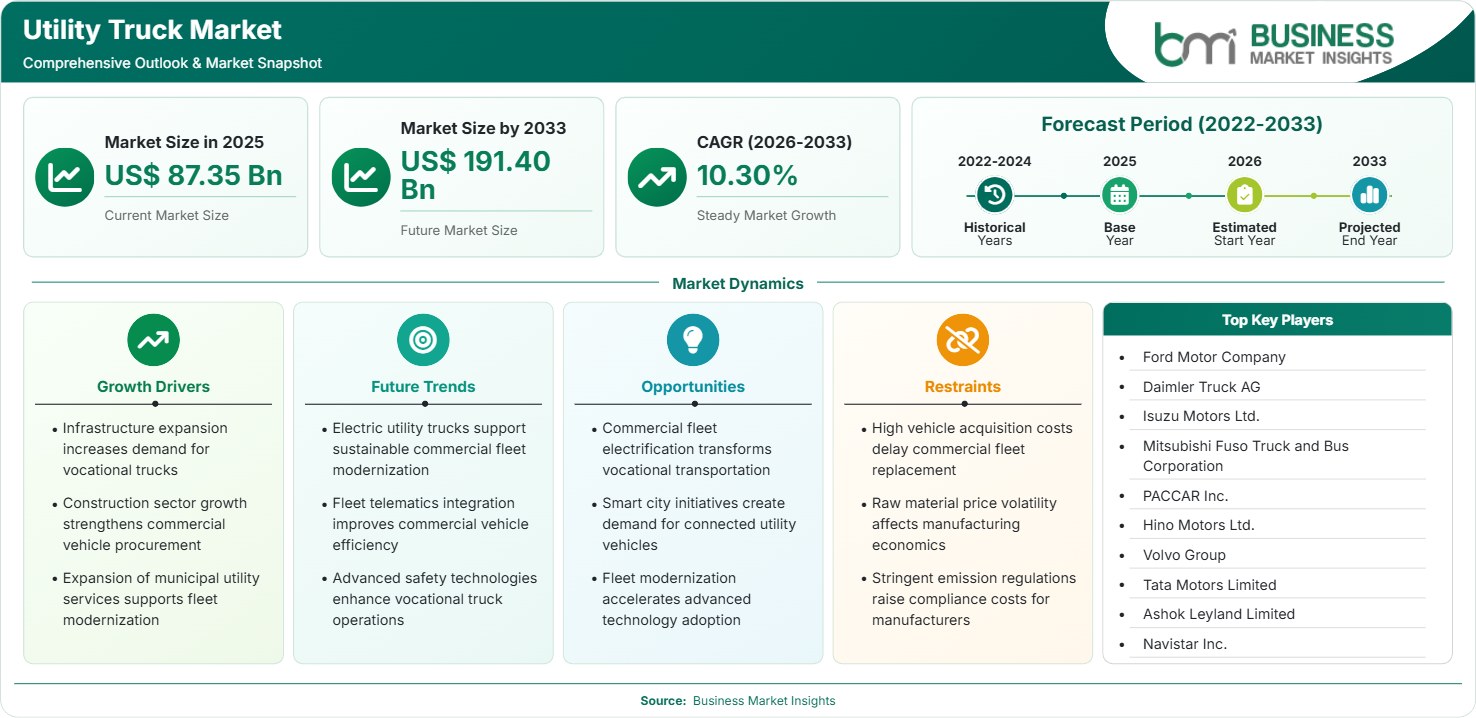
The Utility Truck Market size was valued at US$ 87.35 billion in 2025 and is projected to reach US$ 191.4 billion by 2033, growing at a CAGR of 10.30% during 2026–2033. Rising investments in transportation infrastructure, increasing construction activities, and expanding municipal utility services are accelerating fleet demand, while commercial vehicle electrification and smart fleet technologies continue creating long-term growth opportunities for manufacturers and technology providers.

Report Coverage
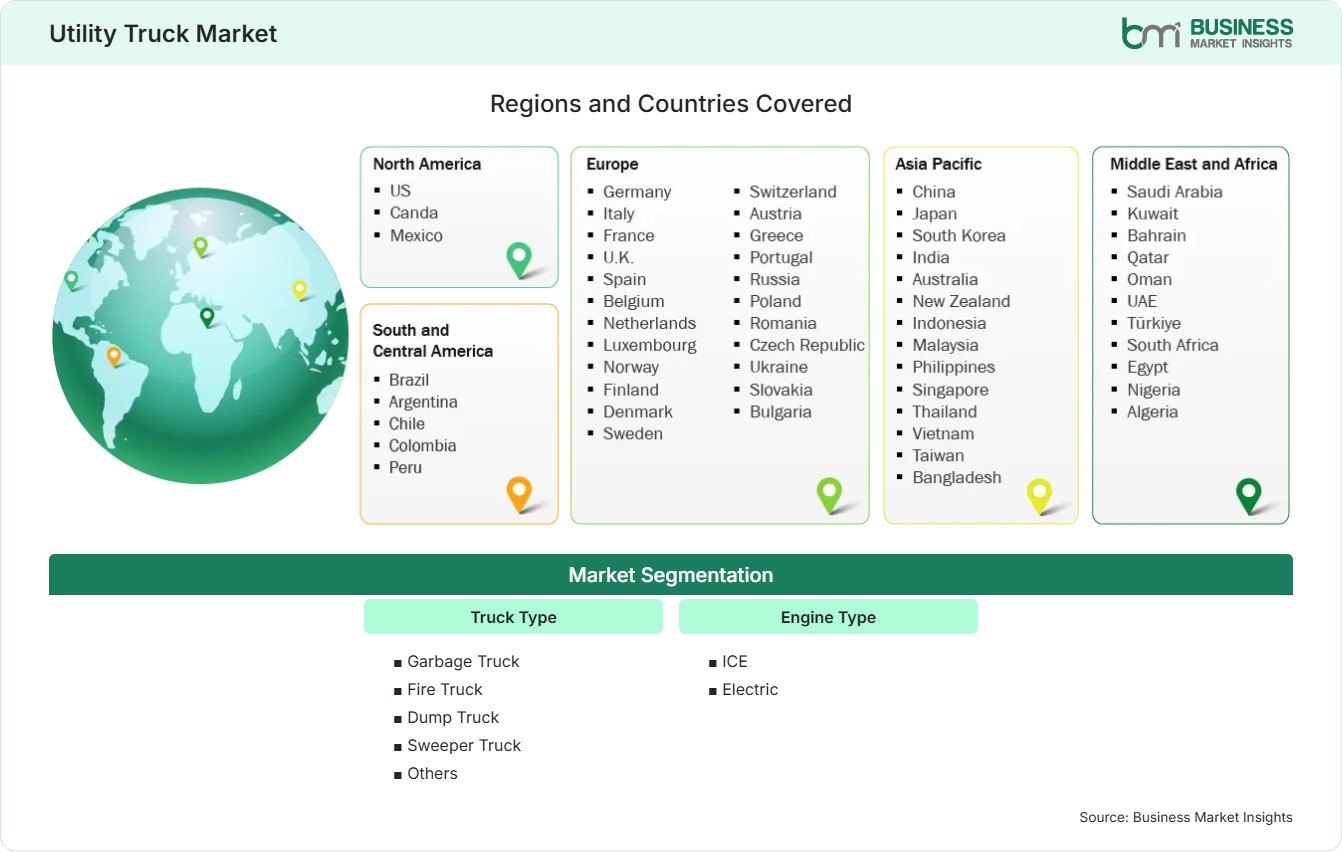
  • Truck Type: Garbage Truck, Fire Truck, Dump Truck, Sweeper Truck, Others
  • Engine Type: ICE, Electric
US$ 87.35 Bn Market size in 2025
US$ 191.40 Bn Market Size by 2033
10.30% CAGR, 2026 - 2033
2026-2033 Forecast Period

01 AI Overview

Utility Truck Market Summary

  • North America Region: North America accounts for 34%–37% of revenue in 2025 and is expected to expand at a CAGR of 9.6%–10.0% during 2026–2033. Large municipal replacement programs, extensive infrastructure rehabilitation, and increasing adoption of connected fleet technologies continue supporting demand. The United States contributes nearly 81%–84% of regional revenue and is anticipated to grow at a CAGR of 9.7%–10.1% owing to sustained public infrastructure spending and utility fleet modernization.
  • Fastest Growing Region: Asia Pacific represents 27%–30% of global revenue in 2025 and is projected to register a CAGR of 11.6%–12.2% through expanding urbanization, large-scale transportation projects, increasing municipal investments, and accelerating adoption of electric commercial vehicles across developing economies.
  • Leading Segment: Dump Truck holds 30%–33% of the market in 2025 and is forecast to grow at a CAGR of 10.0%–10.5% because of rising mining activities, road construction projects, and continuous investment in heavy infrastructure development.
  • High Growth Segment: Electric accounts for 18%–21% of market revenue in 2025 while advancing at a CAGR of 15.2%–16.0%, supported by emission reduction policies, battery technology improvements, and increasing procurement of zero-emission municipal utility vehicles.
  • Key Market Opportunity: Fleet electrification, autonomous driving assistance, predictive maintenance platforms, and smart municipal infrastructure are creating long-term opportunities for manufacturers supplying connected, energy-efficient, and digitally managed utility vehicles.
  • Major Market Players: Ford Motor Company, Daimler Truck AG, Isuzu Motors Ltd., Mitsubishi Fuso Truck and Bus Corporation, PACCAR Inc., Hino Motors Ltd., Volvo Group, Tata Motors Limited, Ashok Leyland Limited, and Navistar Inc.
02 Strategic Insights

Utility Truck Market: Strategic Insights

utility-truck-market-market-strategic-framework
FREE PDF
Request your free sample
Request free sample
03 Stakeholder View

Key Takeaways

  • Infrastructure developers, municipal authorities, body builders, component suppliers, and fleet operators are increasingly collaborating to create integrated commercial vehicle ecosystems focused on efficiency, durability, and lower lifecycle operating costs.
  • Electric utility vehicles present the strongest long-term investment opportunity in utility truck market as governments introduce stricter emission standards and municipalities accelerate replacement of aging diesel-powered service fleets.
  • Advanced telematics, predictive maintenance, over-the-air software updates, and driver assistance technologies are becoming essential competitive differentiators that improve fleet utilization, reduce downtime, and enhance operational safety.
  • Asia Pacific offers the most attractive expansion opportunities because of rapid urbanization, large infrastructure investments, growing construction equipment demand, and increasing domestic commercial vehicle manufacturing capacity.
  • Strategic partnerships between vehicle manufacturers, battery suppliers, charging infrastructure providers, and digital fleet software companies are accelerating commercialization of next-generation electric utility trucks across multiple end-use sectors.
  • Continued investment in modular chassis platforms, lightweight materials, and intelligent fleet management solutions is expected to improve profitability while enabling manufacturers to address increasingly diverse municipal and industrial application requirements.
04 Geographic Outlook

Utility Truck Market Regional Highlights

North America Utility Truck Market

North America accounted for 34%–37% of global revenue in 2025 and is projected to expand at a CAGR of 9.6%–10.0% during 2026–2033. Strong public infrastructure spending, continuous replacement of aging municipal fleets, and increasing adoption of connected commercial vehicles continue supporting regional demand. The Utility Truck Market share remains the largest globally because of established construction industries, advanced fleet management practices, and extensive investments in utility, sanitation, emergency response, and road maintenance operations.

  • The United States remains the dominant contributor owing to sustained federal and state infrastructure investments, modernization of municipal service vehicles, and strong procurement from construction contractors supporting transportation, water, and energy projects.
  • Canada continues investing in utility fleet replacement programs, expanding renewable energy infrastructure, and smart municipal services, creating stable demand for specialized trucks equipped with advanced safety and telematics technologies.
  • Fleet operators are increasingly integrating predictive maintenance, GPS tracking, and digital diagnostics to improve vehicle utilization, reduce downtime, and optimize operating costs across large commercial vehicle fleets.
  • Electrification initiatives are gradually transforming municipal procurement strategies, particularly for sanitation, road maintenance, and utility service fleets operating in urban environments with stringent emission regulations.
  • Continuous upgrades in vocational truck chassis, hydraulic equipment, and operator safety systems are strengthening replacement demand throughout construction, mining, and public utility applications.

US Utility Truck Market

The United States represented approximately 81%–84% of North American revenue in 2025 and is anticipated to grow at a CAGR of 9.7%–10.1% through 2033. Federal infrastructure funding, increasing investments in water utilities, expanding energy transmission networks, and modernization of emergency response fleets continue driving commercial vehicle demand across diverse industrial sectors, aligning with utility truck market forecasts.

  • Infrastructure rehabilitation programs continue supporting procurement of dump trucks, fire trucks, sweepers, and specialized municipal service vehicles for transportation, utilities, and public works departments.
  • Strong construction activity across residential, commercial, and industrial sectors sustains demand for durable vocational trucks capable of operating under challenging environmental and operational conditions.
  • Growing deployment of connected fleet platforms enables real-time monitoring, fuel optimization, predictive maintenance, and enhanced driver safety across municipal and commercial transportation operations.
  • Commercial fleet operators increasingly evaluate battery-electric and hybrid utility trucks to comply with evolving emission regulations while reducing long-term operating expenses.

Europe Utility Truck Market

Europe held 25%–28% of global revenue in 2025 and is expected to register a CAGR of 9.8%–10.3% during the forecast period. Environmental regulations encouraging fleet electrification, advanced commercial vehicle engineering, and sustained infrastructure maintenance continue supporting regional growth. Germany leads the regional market, while the United Kingdom records the fastest expansion with an estimated 10.4%–10.9% CAGR through increasing municipal investments and zero-emission commercial vehicle adoption.

  • Germany benefits from a strong commercial vehicle manufacturing ecosystem, advanced engineering capabilities, and continuous investments in intelligent transportation and utility fleet modernization in utility truck market.
  • The United Kingdom continues accelerating procurement of electric municipal vehicles through low-emission transportation policies, urban sustainability initiatives, and modernization of public service fleets.
  • France maintains healthy demand through investments in sanitation services, emergency response infrastructure, and public transportation maintenance supporting specialized vocational vehicle deployment.
  • Nordic countries increasingly adopt electric utility trucks equipped with connected fleet technologies to support climate objectives while improving municipal operational efficiency.
  • European manufacturers continue strengthening product portfolios through lightweight materials, alternative powertrains, and digital fleet management technologies designed for lower emissions and improved productivity.

Asia Pacific Utility Truck Market

Asia Pacific represented 27%–30% of global revenue in 2025 and is forecast to achieve the highest CAGR of 11.6%–12.2% through 2033. Large-scale urbanization, expanding industrial production, rising government infrastructure expenditure, and increasing domestic commercial vehicle manufacturing continue supporting long-term market expansion. China remains the largest regional market, while India demonstrates the fastest growth with an estimated 12.2%–12.8% CAGR.

  • China continues investing in transportation corridors, municipal infrastructure, renewable energy projects, and industrial development, sustaining robust demand for vocational trucks across multiple industries.
  • India experiences rapid fleet expansion driven by highway construction, smart city initiatives, mining activities, and increasing investment in sanitation and utility infrastructure in in utility truck market.
  • Japan focuses on technologically advanced commercial vehicles incorporating automation, fuel efficiency improvements, and intelligent driver assistance systems for municipal and industrial applications.
  • South Korea strengthens demand through industrial automation, smart logistics development, and increasing adoption of environmentally sustainable commercial transportation solutions.
  • Regional manufacturers continue expanding production capacity while introducing electric utility trucks tailored to local operating conditions and regulatory requirements.

Rest of World Utility Truck Market

The Rest of World region accounted for 8%–10% of global revenue in 2025 and is projected to grow at a CAGR of 10.3%–10.8% during 2026–2033. South & Central America benefits from expanding mining and infrastructure projects, while the Middle East & Africa continues investing in urban development, energy infrastructure, and municipal modernization programs supporting vocational truck demand.

Growing industrial diversification, improving transportation infrastructure, and increasing public investment in utility services continue strengthening commercial vehicle procurement despite economic volatility across selected developing economies.

  • Brazil remains the leading South & Central American market through ongoing investments in mining, agriculture, road construction, and municipal infrastructure requiring specialized heavy-duty utility vehicles.
  • The United Arab Emirates records the fastest regional growth with a projected 11.2%–11.8% CAGR, supported by smart city developments, logistics expansion, and continuous investment in advanced municipal services.
  • Saudi Arabia continues expanding demand through Vision 2030 infrastructure projects, industrial diversification, and modernization of construction and utility vehicle fleets in utility truck market.
  • South Africa maintains stable demand through mining operations, municipal fleet replacement, and continued investment in transportation and public infrastructure development.
  • International manufacturers increasingly establish regional partnerships, localized assembly operations, and after-sales service networks to improve competitiveness and strengthen long-term market penetration.
global-market-geography
FREE PDF
Request your free sample
Request free sample
05 Segment Analysis

Utility Truck Market Segmentation

Truck Type

Truck Type accounted for the largest portion of industry revenue, with this segment representing 64%–67% of the market in 2025 and projected to expand at a CAGR of 10.1%–10.6% during 2026–2033. Rising investments in transportation infrastructure, mining, municipal sanitation, emergency response, and construction continue driving demand for specialized vocational trucks. The Utility Truck Market scope is expanding as fleet operators increasingly adopt application-specific vehicles that improve operational efficiency, payload capacity, and lifecycle performance.

  • Garbage Truck: Garbage trucks continue experiencing stable demand as municipalities modernize waste collection services through automated loading systems, route optimization technologies, and cleaner propulsion solutions that improve operational efficiency and environmental performance.
  • Fire Truck: Fire trucks benefit from increasing public investment in emergency response infrastructure, disaster preparedness programs, and urban firefighting capabilities requiring technologically advanced rescue vehicles equipped with integrated communication and safety systems.
  • Dump Truck: Dump trucks remain the largest product category because of extensive deployment across mining, road construction, infrastructure development, quarrying, and heavy earthmoving projects requiring high payload capacity and reliable operating performance.
  • Sweeper Truck: Sweeper trucks experience growing adoption as municipalities strengthen urban cleanliness initiatives, airport maintenance programs, and highway maintenance activities through mechanized road cleaning solutions that improve efficiency and reduce labor requirements.

Engine Type

Engine Type remains a critical purchasing consideration, accounting for 33%–36% of total market value in 2025 while registering a CAGR of 10.8%–11.3% through the forecast period. Fleet operators increasingly evaluate propulsion technologies based on fuel efficiency, operating costs, regulatory compliance, and sustainability objectives. The Utility Truck Market trends indicate an accelerating transition toward low-emission powertrains supported by advances in battery technologies, charging infrastructure, and government incentive programs.

  • ICE: Internal combustion engine trucks continue dominating installed fleets because of proven reliability, established refueling infrastructure, high payload capability, and operational suitability for demanding construction, mining, and long-distance utility applications.
  • Electric: Electric utility trucks are witnessing rapid adoption across municipal sanitation, road maintenance, airport operations, and urban utility services due to lower emissions, reduced maintenance requirements, quieter operation, and improving battery performance.
06 Market Forces

Utility Truck Market Dynamics

Key Market Drivers

Infrastructure expansion increases demand for vocational trucks

Globally, there is an escalating trend towards the expansion of investment in roads, bridges, water distribution networks, public transport, and power infrastructure, resulting in continuous demand for vocational trucks. In the view of multilateral development organizations, spending on infrastructure development is considered an essential strategy to sustain economic growth and urban development in both developed and developing countries. The need to move construction material, maintain infrastructure, and perform under difficult conditions necessitates the use of customized trucks that have capabilities for such operations.

Construction sector growth strengthens commercial vehicle procurement

The continuous growth in activities such as building homes, businesses, and industries is creating an increased need for dump trucks and utility service vehicles. Urbanization, industrialization, and investment in new manufacturing plants are prompting contractors to grow their fleet to cater to these needs. The current trend in construction works emphasizes equipment efficiency, safety, and fleet management, promoting the use of telematics and predictive maintenance technologies. This leads to better utilization of the fleet along with decreased operating expenses.

Expansion of municipal utility services supports fleet modernization

Rapid population growth in urban areas poses challenges for municipal governments in enhancing waste management, fire-fighting operations, road maintenance, and public utility systems by modernizing specialized trucks. The development of sanitation networks, emergency preparedness programs, and public works departments facilitates the purchase of advanced vocational trucks. In addition, digital tracking of truck movements, efficient route planning, and maintenance scheduling enhance the performance of these services while cutting down downtime. Modern municipal governments are more concerned about durable and eco-friendly vehicles that can ensure efficient delivery of services over long periods of time.

Key Market Opportunities

Commercial fleet electrification transforms vocational transportation

Electrification is offering tremendous opportunities to manufacturers, battery providers, chargers, and fleet technology suppliers. Better batteries, extended range of vehicles, and improved charging systems are making it possible to deploy electric utility vehicles in urban operation areas. Municipal fleet management agencies are now considering zero-emission vehicles as part of their compliance to environmental regulations as well as reduced costs of fuel and maintenance. Collaborations between commercial vehicle manufacturers and energy infrastructures firms are likely to speed up the process of development and adoption of the products during the forecast period.

Smart city initiatives create demand for connected utility vehicles

Smart city programs in urban settings are promoting the usage of inter-connected commercial vehicles that can aid in developing smart transport systems, automation of fleet management, and smart city operations. The use of IoT sensors and telematics platforms is contributing to better routing, fuel efficiency, maintenance scheduling, and transparency. Municipal governments are increasingly using inter-connected utility vehicles as part of their smart city programs to enhance services at lower costs and less pollution. Such efforts present opportunities for software vendors, fleet managers, and vehicle manufacturers.

Fleet modernization accelerates advanced technology adoption

Many public sector organizations and private fleets are upgrading their old vocational vehicles with new, advanced versions that ensure enhanced safety features, longevity, fuel economy, and connectivity. Modern day fleet management tends to focus on minimizing lifecycle costs as opposed to purchase costs, which promotes the adoption of predictive diagnostic tools, braking technology, driving aids, and lightweight vehicle construction. Companies with capabilities in providing a modular vehicle design and digital solutions will have an advantage in this space.

Market Restraints and Challenges

High vehicle acquisition costs delay commercial fleet replacement

Factor: Specialized utility truck bodies are quite costly to buy due to the special chassis, hydraulic components, safety technology, emission technology, and body design for different applications.

Impact: Purchase price is a factor that results in delayed buying decisions on behalf of municipalities, contractors, and companies that have little capital budget. Increased cost of financing further increases the cycle time to replace older trucks, which raises maintenance costs. Companies end up reconditioning their fleets rather than buying new equipment despite higher demands.

Raw material price volatility affects manufacturing economics

Factor: The prices of steel, aluminum, copper, rubber, batteries, and electronics fluctuate from time to time due to supply chain disturbances, geopolitical instability, and shifts in global demand.

Impact: Price volatility of materials leads to increased costs of production as well as tight margins for manufacturers as they become unsure about their pricing policy for fleet buyers. It becomes difficult for procurement plans to be made, especially when it comes to projects that have a budgeted amount of money.

07 Company Analysis

Competitive Landscape

The competitive environment is marked by continuous investment in electrified drivetrains, intelligent fleet connectivity, lightweight vehicle platforms, and vocational truck solutions tailored for specific applications. The Utility Truck Market analysis highlights that manufacturers are solidifying their positions via strategic partnering, regional manufacturing, digital fleet management, and innovative products designed for the construction, municipal, mining, and emergency services markets.

Company Name

Overview

Products and Services Relevant to this Market

Ford Motor Company

Global automotive manufacturer with a strong commercial vehicle portfolio serving municipal, utility, logistics, and construction customers worldwide.

Utility trucks, chassis cabs, fleet management solutions, connected commercial vehicles, telematics services, and vocational truck platforms.

Daimler Truck AG

Leading global commercial vehicle manufacturer focused on heavy-duty trucks, vocational vehicles, and advanced transportation technologies.

Heavy-duty utility trucks, electric commercial trucks, fleet connectivity, vocational chassis, aftersales services, and mobility solutions.

Isuzu Motors Ltd.

Japanese manufacturer specializing in medium and heavy-duty commercial vehicles with strong presence in utility and municipal applications.

Utility trucks, dump trucks, municipal vehicles, diesel engines, connected fleet technologies, and commercial vehicle solutions.

Mitsubishi Fuso Truck and Bus Corporation

Commercial vehicle manufacturer delivering light, medium, and heavy-duty trucks for industrial and public utility applications.

Utility trucks, electric trucks, vocational chassis, fleet management technologies, maintenance services, and transportation solutions.

PACCAR Inc.

Global producer of premium commercial vehicles operating through multiple truck brands with advanced engineering capabilities.

Heavy-duty vocational trucks, connected vehicle technologies, fleet services, financing solutions, and aftermarket support.

Hino Motors Ltd.

Commercial vehicle manufacturer providing durable trucks and integrated fleet services for industrial and municipal operations.

Utility trucks, vocational vehicles, diesel engines, telematics platforms, maintenance services, and fleet management solutions.

Volvo Group

International commercial vehicle manufacturer emphasizing safety, sustainability, digital services, and zero-emission transportation technologies.

Electric utility trucks, heavy-duty commercial vehicles, connected fleet solutions, autonomous technologies, and aftermarket services.

Tata Motors Limited

Indian commercial vehicle manufacturer supplying diversified vocational truck solutions for infrastructure, mining, and municipal sectors.

Dump trucks, utility vehicles, construction trucks, electric commercial vehicles, fleet management systems, and service support.

Ashok Leyland Limited

Leading commercial vehicle manufacturer offering medium and heavy-duty trucks across construction, logistics, and municipal applications.

Utility trucks, tipper trucks, municipal vehicles, alternative fuel trucks, connected fleet technologies, and maintenance solutions.

Navistar Inc.

North American commercial vehicle manufacturer delivering advanced vocational trucks and integrated transportation services.

Vocational trucks, connected vehicle technologies, fleet diagnostics, heavy-duty chassis, aftermarket services, and maintenance programs.


10 Trust & Transparency

Research Methodology

The market analysis combines proprietary research with secondary data from government agencies, company disclosures, regulatory filings, industry databases and expert interviews. Market estimates are validated through data triangulation, cross-market benchmarking and analyst review.

View Full Research Methodology

11 Questions Answered

Frequently Asked Questions

What does market Report typically include?

A comprehensive Utility Truck Market Report covers market size, technology developments, competitive landscape, regional outlook, segment analysis, regulatory environment, investment opportunities, and future growth strategies influencing industry evolution.

Which truck type generates the largest revenue?

Dump trucks account for the largest revenue contribution because of extensive utilization across construction, mining, quarrying, road development, and heavy infrastructure projects requiring high-capacity material transportation.

Which region currently leads the global industry?

North America maintains the leading position owing to extensive infrastructure investment, established commercial vehicle manufacturing, large municipal fleet replacement programs, and widespread deployment of advanced fleet management technologies.

Which engine technology is expected to grow the fastest?

In utility truck market, electric utility trucks are expected to record the highest growth because of tightening emission regulations, improving battery performance, lower operating costs, and increasing government support for zero-emission commercial vehicle adoption.

What is driving long-term demand in the utility truck industry?

Infrastructure modernization, expanding construction activities, municipal fleet replacement, mining investments, and increasing adoption of connected commercial vehicles continue supporting long-term industry expansion across developed and emerging economies.

Access the Full Utility Truck Market Report

Get segment-level forecasts, regional estimates, competitive benchmarking, company profiles and downloadable Excel datasets.

Access the full Utility Truck Market Report
350 pages PDF & Excel | 2026-08-04