
Class 7 Trucks Market Outlook: Size, Share, Trends, Growth Analysis, Competitive Landscape & Forecast, 2026-2033

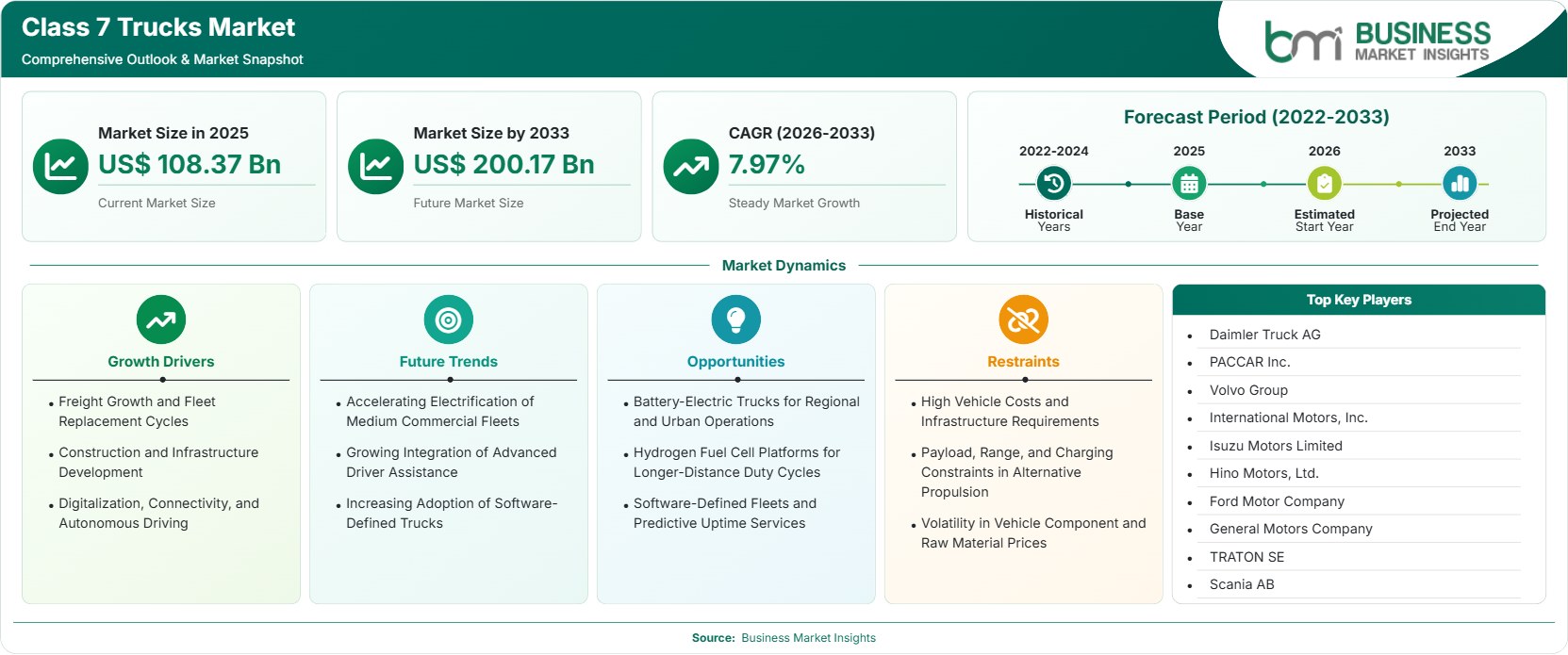
The Class 7 Trucks Market size was valued at US$ 108.37 Billion in 2025 and is projected to reach US$ 200.17 Billion by 2033, growing at a CAGR of 7.97% during 2026–2033, driven by freight demand, infrastructure investment, fleet replacement, connected technology, emission regulations, electrification, and specialized vocational requirements.

Report Coverage
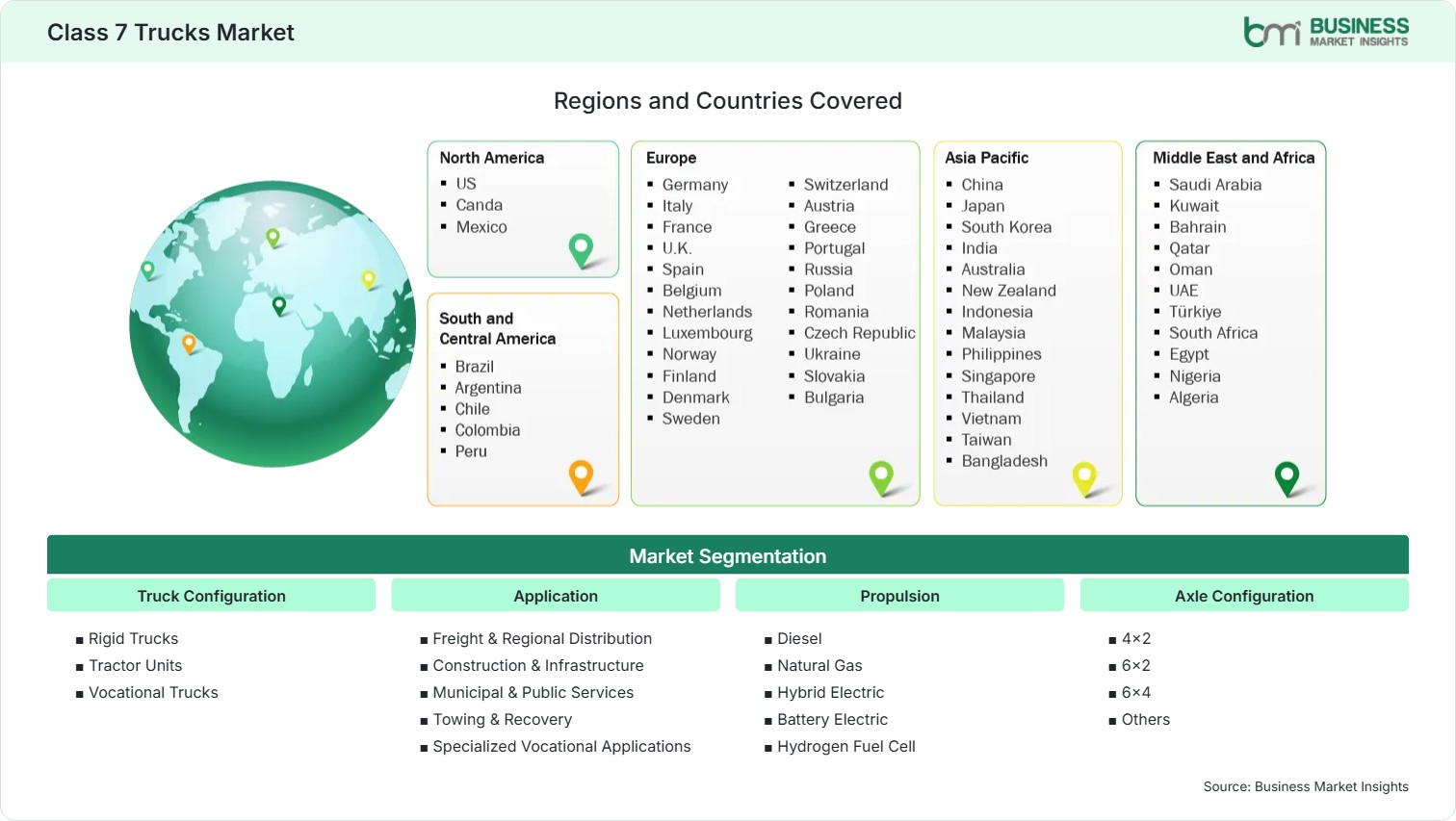
  • Truck Configuration: Rigid Trucks, Tractor Units, Vocational Trucks
  • Application: Freight & Regional Distribution, Construction & Infrastructure, Municipal & Public Services, Towing & Recovery, Specialized Vocational Applications
  • Propulsion: Diesel, Natural Gas, Hybrid Electric, Battery Electric, Hydrogen Fuel Cell
  • Axle Configuration: 4x2, 6x2, 6x4, Others
US$ 108.37 Bn Market size in 2025
US$ 200.17 Bn Market Size by 2033
7.97% CAGR, 2026 - 2033
2026-2033 Forecast Period

AI Overview

Class 7 Trucks Market Summary

  • North America Region: The North American market accounts for 29%-32% share in 2025 and is projected to grow at a CAGR of 7.5%-8.2% between 2026 and 2033. Growth drivers in the region include fleet replacement, construction, freight movement, stringent emission norms, telematics solutions, driver assistance solutions, and commercial vehicle finance solutions. The United States continues to lead and is growing at a CAGR of 7.6%-8.3% through 2033.
  • Fastest Growing Region: The Asia-Pacific has a 35% to 39% share in 2025 and exhibits a CAGR of 8.7% to 9.5% between 2026 and 2033. Factors that boost the sales of heavy trucks include industrialization, urbanization, logistics of ecommerce, spending on infrastructure, construction, urbanization, local manufacturing, and fleet expansion.
  • Leading Segment: Rigid Trucks holds a 52%–56% share in 2025 and records a 7.5%–8.1% CAGR during 2026–2033. Regional distribution, construction, municipal services, food logistics, utility operations, and fleet standardization support sustained demand for rigid platforms.
  • High Growth Segment: Battery Electric (BEV) holds a 6%–10% share in 2025 and records a 20.0%–24.0% CAGR during 2026–2033. Zero-emission regulations, improving batteries, depot charging, urban logistics, predictable routes, lower noise, and falling operating costs accelerate adoption.
  • Key Market Opportunity: Fleet electrification, autonomous-driving systems, connected fleet management, predictive maintenance, alternative fuels, high-efficiency diesel platforms, and specialized vocational configurations offer substantial opportunities across regional freight and infrastructure operations.
  • Major Market Players: Daimler Truck AG, PACCAR Inc., Volvo Group, International Motors, Inc., Isuzu Motors Limited, Hino Motors, Ltd., Ford Motor Company, General Motors Company, TRATON SE, Scania AB
Strategic Insights

Class 7 Trucks Market: Strategic Insights

Class 7 Trucks Market Strategic Framework
FREE PDF
Request your free sample
Request free sample
Stakeholder View

Key Takeaways

  • The commercial-vehicle value chain is expanding beyond vehicle manufacturing into connected services, financing, fleet management, charging, maintenance, software updates, predictive diagnostics, energy management, insurance, and autonomous-driving support.
  • Rigid trucks retain strong commercial relevance because they serve multiple high-utilization applications, while BEV platforms provide the strongest long-term growth potential where route predictability and charging infrastructure support electrification.
  • Vehicle innovation is increasingly software-led, with manufacturers developing unified electronic architectures, over-the-air updates, advanced driver assistance, predictive maintenance, automated route management, and centralized fleet-data ecosystems.
  • Asia Pacific offers the strongest investment case because construction, logistics, manufacturing, urban development, and ecommerce are increasing commercial-vehicle utilization across large and rapidly developing economies.
  • Strategic partnerships are becoming important in autonomous and software-defined trucking. TRATON expanded its partnership with PlusAI in January 2026 and committed dedicated R&D funding toward scalable autonomous highway operations.
  • Fleet economics increasingly determine powertrain adoption. Buyers compare purchase price, residual value, charging or fueling requirements, payload impact, utilization, maintenance, uptime, energy costs, and regulatory exposure rather than selecting technologies solely on emissions performance.
Geographic Outlook

Class 7 Trucks Market Regional Highlights

North America Class 7 Trucks Market

North America holds a 29%–32% share in 2025 and records a 7.5%–8.2% CAGR during 2026–2033. The region benefits from mature freight infrastructure, strong fleet financing, high commercial-vehicle utilization, construction activity, and established aftermarket networks. The United States remains the primary market, while Canada contributes through transportation, infrastructure, mining, forestry, and municipal applications. Class 7 Trucks Market share is concentrated across regional freight, vocational construction, public services, towing, utility fleets, and specialized applications requiring high uptime.

  • Fleet operators are increasingly replacing aging vehicles with newer models offering better fuel economy, safety systems, telematics, aerodynamic performance, and driver comfort.
  • Construction activity supports demand for vocational configurations, including dump, mixer, utility, recovery, crane, and service-body applications requiring customized chassis specifications.
  • Connected fleet platforms are becoming increasingly important because operators use real-time location, fuel data, maintenance alerts, driver behavior, and vehicle-health analytics to manage costs.
  • Electric truck adoption is strongest in predictable regional routes where charging infrastructure can be concentrated at depots and vehicle utilization can be planned around charging schedules.

US Class 7 Trucks Market

The U.S. represents 82%–86% of North American demand in 2025 and records a 7.6%–8.3% CAGR during 2026–2033. Freight distribution, construction, municipal fleets, utility services, food delivery, and regional transportation provide the strongest demand base. Fleet replacement remains important as operators seek higher uptime and lower fuel consumption.

  • Regional freight operators increasingly prioritize aerodynamic efficiency, driver safety, automated transmissions, connectivity, and optimized service intervals when replacing older units.
  • Municipal and vocational customers demand customized wheelbases, bodies, axles, PTO compatibility, and specialized equipment integration, creating high-margin configuration opportunities for manufacturers.
  • Alternative powertrains are gaining interest in urban delivery, refuse, utility, and government applications where route predictability and environmental requirements align with vehicle capabilities.

Europe Class 7 Trucks Market

Europe holds a 24%–27% share in 2025 and records a 6.8%–7.5% CAGR during 2026–2033. Germany, France, the United Kingdom, Italy, Spain, Sweden, and the Netherlands represent major demand centers. European operators face strong pressure to reduce emissions while preserving payload, driving range, uptime, and freight productivity. Battery-electric trucks are expanding in regional and urban applications, while hydrogen remains under development for longer-distance use cases.

  • Germany remains a major heavy-truck market because logistics, manufacturing, construction, and industrial freight demand substantial regional and long-distance fleet capacity.
  • Sweden and the Nordic region provide strong opportunities for electric heavy-duty vehicles because of public incentives, renewable electricity, fleet sustainability targets, and advanced charging deployment.
  • The United Kingdom and France support demand across distribution, construction, municipal operations, logistics, and waste services, creating opportunities for both conventional and alternative propulsion.
  • European fleets are increasingly evaluating total cost of ownership, charging infrastructure, residual value, toll structures, and regulatory compliance when selecting powertrain technologies.

Asia Pacific Class 7 Trucks Market

Asia Pacific holds a 35%–39% share in 2025 and records an 8.7%–9.5% CAGR during 2026–2033, making it the fastest-growing region. China, India, Japan, South Korea, Australia, and Southeast Asia represent major markets. Manufacturing expansion, construction, ecommerce, infrastructure projects, regional freight, municipal services, and urban delivery are strengthening demand.

  • China provides extensive demand through logistics, construction, infrastructure, industrial production, municipal services, and rapidly expanding new-energy commercial-vehicle programs.
  • India is increasing heavy-truck adoption through highway development, manufacturing growth, ecommerce logistics, construction, mining, and regional freight expansion.
  • Japan and South Korea provide sophisticated demand for fuel-efficient, connected, safe, and increasingly electrified commercial vehicles, alongside strong interest in hydrogen technology.
  • Southeast Asia is expanding logistics and infrastructure capacity, creating opportunities for vocational trucks, rigid freight vehicles, natural-gas platforms, and selected electric applications.

Rest of World Class 7 Trucks Market

Rest of World holds a 13%–16% share in 2025 and records a 6.1%–7.0% CAGR during 2026–2033. Latin America benefits from agricultural logistics, mining, construction, regional freight, and infrastructure investment, while the Middle East supports heavy transportation through construction, energy, logistics, and industrial development. Africa provides emerging demand through mining, municipal fleets, infrastructure projects, and regional freight in Class 7 Trucks Market.

  • Brazil and Mexico provide strong demand across freight, construction, industrial logistics, agriculture, utilities, and specialized vocational applications.
  • Gulf economies require heavy trucks for infrastructure projects, construction, municipal services, logistics, and energy-sector operations, supporting premium vehicles with high utilization and advanced safety.
  • South Africa remains important for mining, freight distribution, construction, municipal services, and regional transportation requiring robust heavy-duty platforms.
  • Emerging African markets can create long-term fleet opportunities as infrastructure, logistics networks, mining investment, and urbanization increase, although vehicle financing and after-sales support remain important constraints.
Global Market Geography
FREE PDF
Request your free sample
Request free sample
Segment Analysis

Class 7 Trucks Market Segmentation

Truck Configuration

Rigid Trucks holds a 52%–56% share in 2025 and records a 7.5%–8.1% CAGR during 2026–2033. Rigid architectures serve broad applications because chassis configurations can accommodate freight bodies, construction equipment, municipal systems, towing equipment, and specialized machinery. Tractor Units remain critical for high-capacity freight, while vocational trucks provide specialized functionality. Class 7 Trucks Market scope increasingly favors modular platforms capable of supporting multiple body and propulsion configurations.

  • Rigid Trucks: Used for freight, construction, municipal, utility, recovery, and specialized applications with flexible body configurations.
  • Tractor Units: Designed for regional and long-distance hauling, focusing on power, fuel efficiency, aerodynamics, comfort, and trailer compatibility.
  • Vocational Trucks: Built for specialized work, offering strong chassis, PTO and hydraulic systems, and customized body integration.

Application

Freight & Regional Distribution holds a 42%–46% share in 2025 and records a 7.7%–8.3% CAGR during 2026–2033. Ecommerce, manufacturing, food distribution, retail replenishment, parcel logistics, and regional freight continue driving utilization in Class 7 Trucks Market. Construction & Infrastructure provides the strongest expansion outside freight because infrastructure spending increases demand for dump, mixer, crane, and utility trucks. Municipal, towing, and specialized applications remain stable niche categories.

  • Freight & Regional Distribution: Used for cargo transport, retail supply, food logistics, parcels, and manufacturing distribution.
  • Construction & Infrastructure: Support aggregates, concrete, equipment transport, roadwork, utilities, and infrastructure projects.
  • Municipal & Public Services: Used for waste collection, street maintenance, utilities, emergency services, and public works.
  • Towing & Recovery: Equipped with specialized chassis, PTO systems, winches, and reinforced drivetrains for recovery operations.
  • Specialized Vocational Applications: Customized for mining, forestry, firefighting, oilfield services, mobile workshops, and military logistics.

Propulsion

Diesel remains the dominant propulsion category with a 77%–81% share in 2025 and records a 6.8%–7.4% CAGR during 2026–2033 in Class 7 Trucks Market. Established fueling infrastructure, range, payload capability, manufacturing scale, and strong residual-value markets support continued use. Battery Electric (BEV) represents the fastest-growing category as emissions regulations and fleet sustainability programs expand. Natural Gas remains relevant for selected regional and municipal routes, while hydrogen development focuses on longer-range zero-emission applications.

  • Diesel: Remains dominant in long-haul freight, construction, vocational work, and high-use fleets due to established fueling and service networks.
  • Natural Gas (CNG/LNG): Used in selected regional freight, municipal, and waste operations where suitable fueling infrastructure is available.
  • Hybrid Electric: Combines engine power with electric assistance to improve efficiency in urban, stop-start, and vocational applications.
  • Battery Electric (BEV): Growing in distribution, municipal, and regional operations where routes, payload, charging, and infrastructure support electrification.
  • Hydrogen Fuel Cell (FCEV): Offers a potential zero-emission option for long-range, high-use operations where fast refueling is important.

Axle Configuration

The 6×4 configuration holds a 31%–35% share in 2025 and records a 7.4%–8.0% CAGR during 2026–2033 because it supports demanding vocational and heavy-load applications. The 4×2 configuration remains important for regional freight where lower tare weight and efficiency are priorities. The 6×2 configuration offers payload and efficiency advantages across distribution and long-haul applications.

  • 4×2: Lightweight and fuel-efficient, suited to regional freight and distribution.
  • 6×2: Balances payload, fuel economy, and axle capacity for regional and long-distance freight.
  • 6×4: Provides greater traction and durability for construction, heavy hauling, towing, and demanding applications.
Market Forces

Class 7 Trucks Market Dynamics

Key Market Drivers

Freight Growth and Fleet Replacement Cycles

The demand for Class 7 trucks can be explained by freight operations, e-commerce, manufacturing, infrastructure construction, and replacement. The heavy-duty trucks are extensively utilized, which leads customers to consider reliability, fuel consumption, and maintenance costs. As older trucks require more repair works, consume more fuel, and lack safety and technological features, there is an ongoing replacement need. PACCAR has identified the aging truck fleet in North America and the possibility to replace it with new trucks that consume less fuel. Buyers consider powertrain, telematics, driver assistance, aerodynamic features, services, and financing when replacing.

Construction and Infrastructure Development

Construction and infrastructure projects create steady demand for Class 7 trucks used to transport equipment, aggregates, concrete, materials, and tools. Highway projects, urban development, renewable energy, utilities, and rail construction require trucks with different body and chassis configurations. Buyers often look for features such as hydraulic systems, reinforced frames, PTO systems, and high-traction axles based on the job requirements. Electric trucks are also gaining interest in urban construction because they can reduce noise and local emissions. Overall, the Class 7 trucks market is moving toward vehicles designed around specific applications and operating conditions rather than standard configurations.

Digitalization, Connectivity, and Autonomous Driving

Digital technologies are changing how Class 7 trucks are managed and operated. Connected systems help fleets with vehicle monitoring, predictive maintenance, remote diagnostics, route planning, driver performance, and safety. Manufacturers are also moving toward software-based vehicle platforms that can support future updates and automation. Autonomous driving is developing alongside these systems, particularly for long-haul and controlled-route applications. As a result, software and connectivity are becoming important parts of truck design and fleet management, alongside traditional factors such as engines, axles, and chassis. Class 7 trucks market trends are increasingly shaped by data-driven fleet management, improved uptime, and automation readiness.

Key Market Opportunities

Battery-Electric Trucks for Regional and Urban Operations

Battery-electric trucks are well suited to predictable routes where charging is available at fleet depots or other regular locations. Regional distribution, municipal services, waste collection, urban construction, and dedicated logistics are suitable applications because vehicles often follow fixed routes and return to the same facilities. Manufacturers are improving battery systems, charging technology, vehicle layouts, and payload management to meet fleet needs. Charging infrastructure and energy management are also becoming important parts of electric truck deployment. As adoption grows, the Class 7 Trucks Market will depend not only on truck sales but also on depot charging, energy services, and related software.

Hydrogen Fuel Cell Platforms for Longer-Distance Duty Cycles

Hydrogen fuel cell trucks can support applications that require long driving ranges, high vehicle use, quick refueling, or consistent payload capacity. They may be useful for long-distance freight and routes where battery-electric trucks are less practical. However, limited hydrogen infrastructure remains a key challenge. Fleet operators may initially adopt hydrogen through dedicated projects supported by refueling networks and energy suppliers. This creates opportunities across hydrogen production, refueling, maintenance, and fleet management. Class 7 trucks market growth are likely to include multiple powertrain options, with operators choosing diesel, battery-electric, or hydrogen based on route requirements and operating costs.

Software-Defined Fleets and Predictive Uptime Services

Software-defined trucks have created new possibilities for manufacturers offering digital services. The connection system may offer functions such as diagnostics, software updates, security, performance tracking, and fleet management. Predictive maintenance can also help identify potential problems in advance, allowing operators to save time and plan maintenance efficiently. Manufacturers are developing common software platforms that link vehicle information to the fleets and the upcoming automation functions. This development creates an opportunity for manufacturers to make use of the software in truck owning. The advantages for operators are primarily high uptime, maintenance planning, and increased efficiency.

Market Restraints and Challenges

Factor: Advanced Class 7 trucks use complex engines, transmissions, sensors, batteries, charging systems, and specialized equipment, increasing vehicle costs.

Impact: The high cost of entry may also be a barrier to replacing fleets, especially for smaller fleets. Electric and hydrogen-powered vehicles will need additional investment in infrastructure like depot charging, electricity distribution network, hydrogen storage, and special maintenance services. Lack of clarity regarding the resale value may further complicate funding. Consequently, fleets might use diesel-powered trucks even if they would save money by shifting to other energy sources in the long run. There are ways to overcome all these obstacles.

Payload, Range, and Charging Constraints in Alternative Propulsion

Factor: Battery-electric and hydrogen trucks face challenges related to battery weight, driving range, charging time, infrastructure, hydrogen supply, payload, and operating conditions.

Impact: The following constraints could limit the deployment of these technologies for such applications. The electric truck would have larger batteries and might require a charging station, thus limiting its payload and operational range. The hydrogen trucks would be limited by production, storage, transportation, and refueling infrastructure. The powertrain would be adopted based on applications and routes.

Company Analysis

Competitive Landscape

The Class 7 Trucks Market analysis reflects competition among global commercial-vehicle manufacturers, regional truck specialists, powertrain developers, software providers, and fleet-service ecosystems. Differentiation increasingly depends on fuel efficiency, uptime, cabin ergonomics, safety, connectivity, alternative propulsion, autonomous readiness, financing, after-sales coverage, and body-configurable platforms.

Company Name

Overview

Products and Services relevant to this market

Daimler Truck AG

Global commercial-vehicle manufacturer with heavy-duty, electric, hydrogen, vocational, and connected capabilities.

Mercedes-Benz Trucks, eActros, NextGenH2, vocational trucks, diesel engines, charging, fleet services, and ADAS.

PACCAR Inc.

Major North American truck manufacturer operating Kenworth, Peterbilt, and DAF brands.

Class 7/8 trucks, powertrains, PACCAR Parts, financing, telematics, vocational models, electric trucks, and fleet services.

Volvo Group

Global commercial-vehicle manufacturer with heavy-truck, electric, autonomous, and connected transport capabilities.

Volvo FH, FM, VNL, VNR, electric trucks, fleet management, charging solutions, and autonomous technologies.

International Motors, Inc.

North American commercial-vehicle manufacturer serving freight, vocational, and fleet markets.

International trucks, vocational vehicles, diesel engines, connected services, fleet management, parts, financing, and aftermarket support.

Isuzu Motors Limited

Japanese commercial-vehicle manufacturer with light, medium, and heavy-duty truck capabilities.

Trucks, diesel engines, vocational models, fleet services, connected technologies, and specialty vehicles.

Hino Motors, Ltd.

Japanese truck manufacturer with strong commercial-vehicle and powertrain expertise.

Heavy-duty trucks, vocational vehicles, diesel and alternative powertrains, telematics, fleet services, and aftermarket support.

Ford Motor Company

Global automotive manufacturer with commercial-vehicle capabilities through Ford Pro.

Super Duty trucks, vocational platforms, fleet management, telematics, charging services, connected solutions, and financing.

General Motors Company

Global automotive manufacturer developing commercial vehicles, electric platforms, and fleet solutions.

Commercial trucks, electric platforms, connectivity, fleet technology, battery systems, and mobility solutions.

TRATON SE

Commercial-vehicle group operating Scania, MAN, International, and Volkswagen Truck & Bus brands.

Heavy trucks, electric trucks, autonomous systems, software-defined vehicles, fleet services, financing, and connected platforms.

Scania AB

Swedish heavy-truck manufacturer focused on efficiency, electrification, and connectivity.

Scania trucks, electric trucks, hybrid systems, charging, fleet optimization, powertrains, vocational vehicles, and services.

Trust & Transparency

Research Methodology

The market analysis combines proprietary research with secondary data from government agencies, company disclosures, regulatory filings, industry databases and expert interviews. Market estimates are validated through data triangulation, cross-market benchmarking and analyst review.

View Full Research Methodology

Questions Answered

Frequently Asked Questions

How should investors use a Class 7 Trucks Market Report?

A Report should be assessed through vehicle configuration, regional freight demand, vocational applications, fleet age, propulsion mix, regulatory requirements, infrastructure readiness, software adoption, manufacturing capacity, and aftermarket revenue.

How are software technologies changing heavy trucks?

Software is enabling predictive maintenance, over-the-air updates, telematics, fleet optimization, cybersecurity, advanced driver assistance, automated diagnostics, and autonomous-driving development.

Which powertrain has the strongest growth opportunity in Class 7 Trucks Market forecasts?

Battery-electric trucks have the strongest growth potential because regulatory pressure, battery development, charging infrastructure, and fleet sustainability programs are accelerating adoption.

Why are rigid trucks still important?

Rigid trucks provide flexible chassis configurations that can carry numerous body types without relying on a separate tractor and trailer combination.

What defines a Class 7 truck?

Class 7 generally refers to heavy commercial trucks within a defined gross vehicle weight range, commonly used for regional freight, vocational, construction, municipal, towing, and specialized applications.

Access the Full Class 7 Trucks Market Report

Get segment-level forecasts, regional estimates, competitive benchmarking, company profiles and downloadable Excel datasets.

Access the full Class 7 Trucks Market Report
350 pages PDF & Excel | 2026-09-01