
Hydrogen Truck Market Outlook: Size, Share, Trends, Growth Analysis, Competitive Landscape & Forecast, 2022-2033

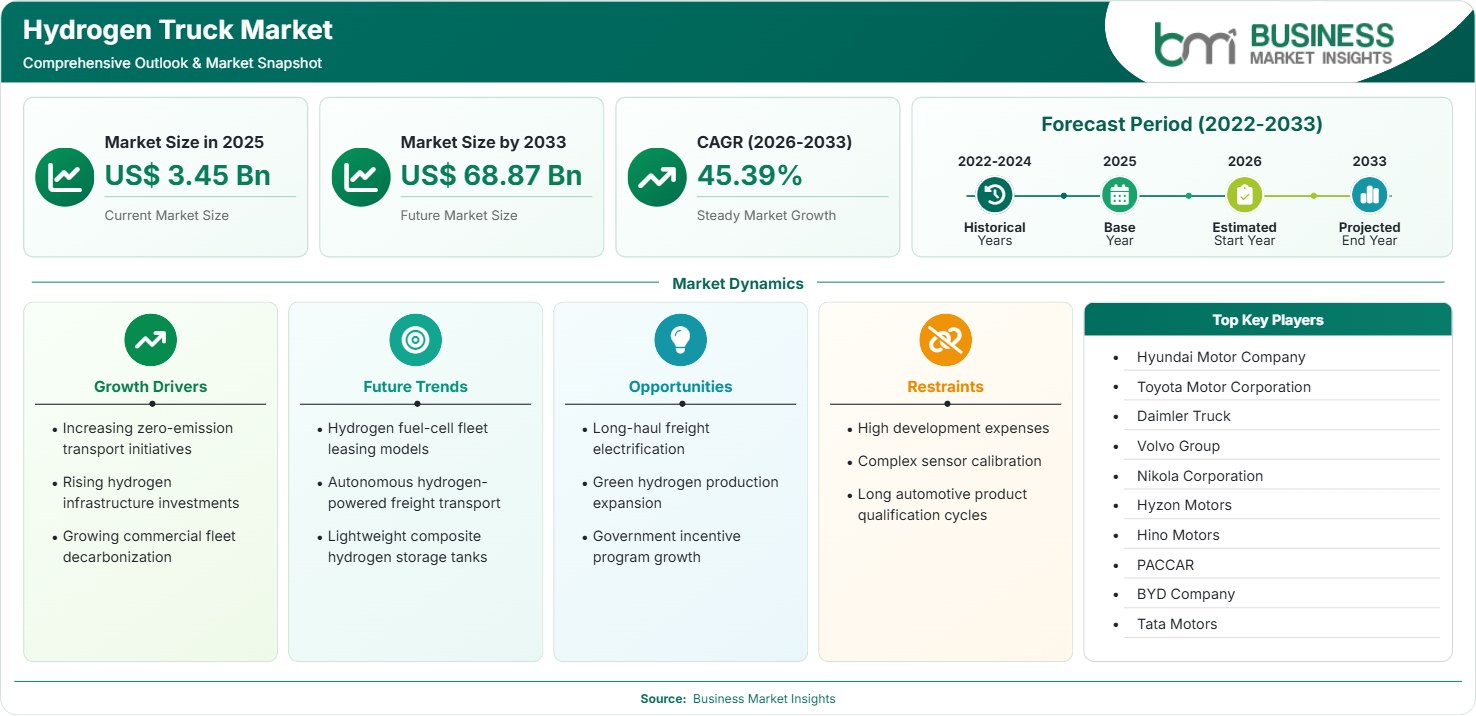
The Hydrogen Truck Market size was valued at US$ 3.45 billion in 2025 and is projected to reach US$ 68.87 billion by 2033, growing at a CAGR of 45.39% during 2026–2033. An increase in zero-emission transport projects, higher spending on hydrogen fueling stations, and greater decarbonization of commercial fleets are contributing to market growth, along with green hydrogen generation, freight electrification, and government incentives.

Report Coverage
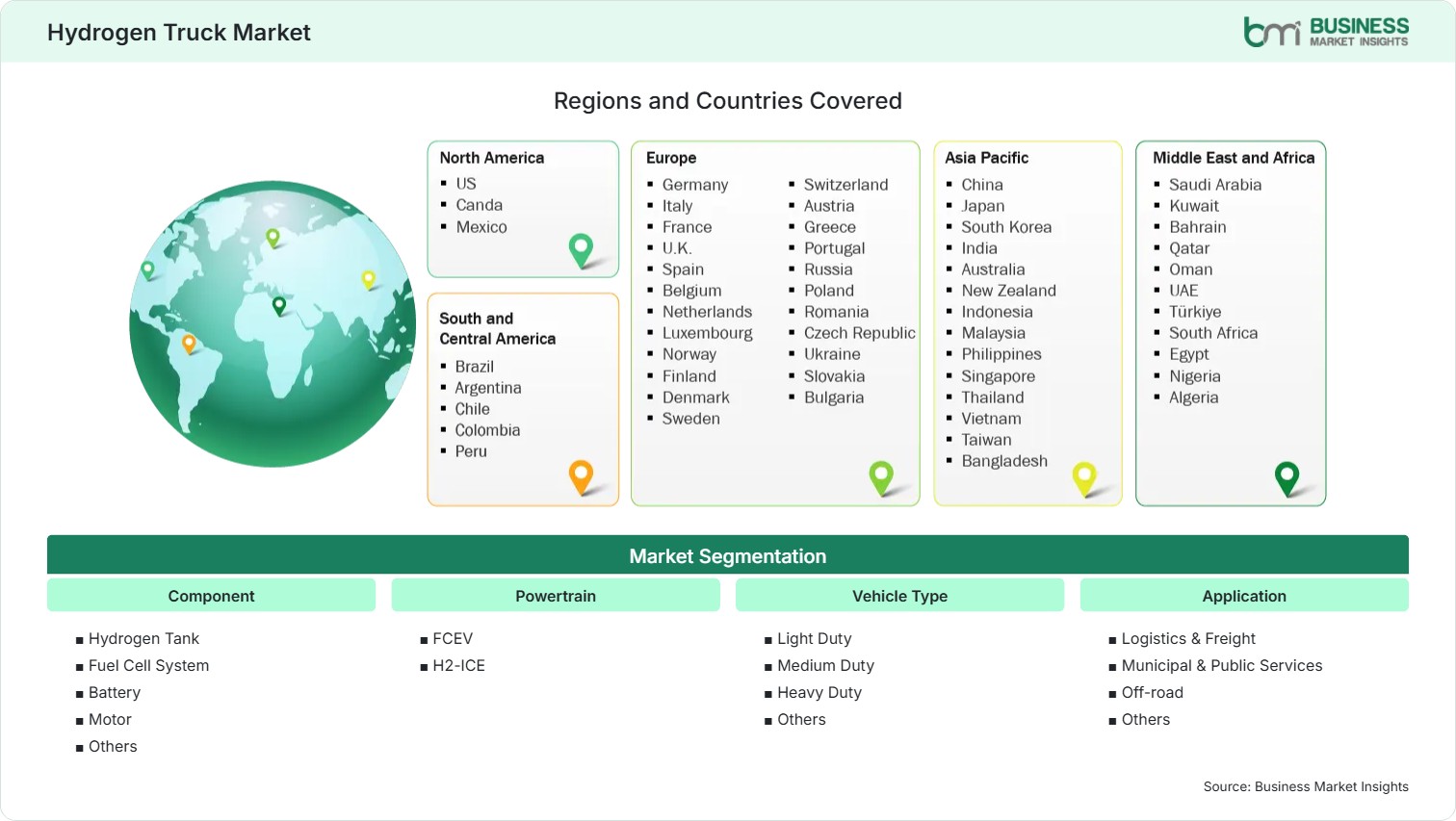
  • Component: Hydrogen Tank, Fuel Cell System, Battery, Motor, Others
  • Powertrain: FCEV, H2-ICE
  • Vehicle Type: Light Duty, Medium Duty, Heavy Duty, Others
  • Application: Logistics & Freight, Municipal & Public Services, Off-road, Others
US$ 3.45 Bn Market size in 2025
US$ 68.87 Bn Market Size by 2033
45.39% CAGR, 2026 - 2033
2026-2033 Forecast Period

01 AI Overview

Hydrogen Truck Market Summary

  • North America Region: North America holds a market share of 34%–37% in 2025 and is projected to expand at a CAGR of 43.5%–44.5% during 2026–2033. Favorable government policies, increasing hydrogen infrastructure investments, and strong participation from commercial fleet operators continue driving regional leadership. The U.S. market is anticipated to grow at a CAGR of 44.0%–45.0% throughout the forecast period.
  • Fastest Growing Region: Asia Pacific accounts for 30%–33% of the market in 2025 and is expected to register the fastest CAGR of 47.5%–48.5% during 2026–2033. Rapid hydrogen ecosystem development, expanding commercial vehicle manufacturing, and strong policy support across China, Japan, South Korea, and India continue accelerating market adoption.
  • Leading Segment: FCEV represents 72%–75% of the market in 2025 and is forecast to grow at a CAGR of 46.0%–47.0% through 2033. Superior driving range, shorter refueling time, and increasing deployment in heavy-duty commercial transportation continue supporting segment dominance.
  • High Growth Segment: Logistics & Freight accounts for 46%–49% market share in 2025 while advancing at a CAGR of 47.8%–48.8% during the forecast period. Rising freight transportation demand, corporate sustainability targets, and long-distance hauling requirements continue driving adoption.
  • Key Market Opportunity: Expanding green hydrogen production, development of high-capacity hydrogen corridors, and integration of fuel-cell technology with digital fleet management platforms are creating significant opportunities for zero-emission commercial transportation worldwide.
  • Major Market Players: Hyundai Motor Company, Toyota Motor Corporation, Daimler Truck AG, Volvo Group, Nikola Corporation, Hyzon Motors Inc., Hino Motors, Ltd., PACCAR Inc., BYD Company Limited, and Tata Motors Limited.
02 Strategic Insights

Hydrogen Truck Market: Strategic Insights

hydrogen-truck-market-market-strategic-framework
FREE PDF
Request your free sample
Request free sample
03 Stakeholder View

Key Takeaways

  • The market ecosystem is evolving around integrated hydrogen mobility value chains, where truck manufacturers, fuel-cell developers, hydrogen producers, infrastructure providers, and fleet operators collaborate to accelerate commercialization. These partnerships improve fuel availability, reduce deployment risks, and support the transition toward zero-emission freight transportation.
  • Heavy-duty logistics applications present the strongest long-term growth opportunity because hydrogen fuel-cell trucks provide extended driving range, rapid refueling, and high payload capacity, making them well suited for long-haul freight operations where battery-electric alternatives face operational limitations.
  • Technological innovation is centered on fuel-cell efficiency, lightweight hydrogen storage, and intelligent fleet management. Manufacturers are investing in higher-density fuel-cell stacks, advanced hydrogen tanks, predictive maintenance platforms, and connected vehicle technologies to improve operational efficiency and lower total cost of ownership.
  • Asia Pacific represents the most compelling regional investment opportunity, supported by expanding hydrogen production capacity, strong government funding, established commercial vehicle manufacturing ecosystems, and national hydrogen roadmaps across China, Japan, South Korea, and India.
  • Strategic partnerships and joint ventures are reshaping market competition. Commercial vehicle manufacturers increasingly collaborate with energy companies, hydrogen suppliers, and infrastructure developers to accelerate fuel-cell truck deployment and establish integrated hydrogen transportation networks.
04 Geographic Outlook

Hydrogen Truck Market Regional Highlights

North America Hydrogen Truck Market

North America accounted for approximately 34%–37% Hydrogen Truck Market share in 2025 and is projected to expand at a CAGR of 43.5%–44.5% during 2026–2033. Strong federal and state clean transportation initiatives, expanding hydrogen production projects, and increasing investments in refueling infrastructure continue supporting regional leadership. Growing adoption among freight operators and logistics companies is significantly contributing to market growth across commercial transportation networks.

  • Government funding for hydrogen hubs and clean transportation corridors continues strengthening the regional hydrogen ecosystem, improving fuel availability while encouraging commercial fleet operators to transition toward zero-emission heavy-duty transportation.
  • Major truck manufacturers, fuel suppliers, and logistics companies are expanding strategic partnerships to accelerate deployment of hydrogen-powered commercial vehicles and establish reliable hydrogen refueling networks throughout North America.
  • Increasing decarbonization commitments from retail, manufacturing, and logistics industries are driving fleet modernization programs focused on reducing greenhouse gas emissions while maintaining long-distance freight efficiency.
  • Technological advancements in fuel-cell systems, hydrogen storage, and digital fleet management platforms continue improving vehicle reliability, operational performance, and lifecycle economics for commercial fleet operators.
  • Public and private investments in renewable hydrogen production are supporting long-term commercialization while strengthening regional competitiveness within the global hydrogen mobility ecosystem.

US Hydrogen Truck Market

The United States represented nearly 28%–31% of the global market in 2025 and is expected to register a CAGR of 44.0%–45.0% through 2033. Expanding hydrogen production capacity, supportive federal incentive programs, growing investment in clean freight transportation, and increasing participation from commercial fleet operators continue positioning the country as a leading market for hydrogen-powered trucks.

  • National investments in hydrogen hubs, renewable energy integration, and clean transportation infrastructure continue expanding hydrogen availability while supporting commercial deployment of fuel-cell trucks across interstate freight corridors.
  • Logistics companies increasingly evaluate hydrogen-powered heavy-duty vehicles to achieve sustainability targets while maintaining operational flexibility through long driving range and rapid refueling capabilities.
  • Commercial vehicle manufacturers continue introducing next-generation fuel-cell trucks featuring improved efficiency, extended driving range, intelligent energy management, and advanced connected fleet technologies.
  • Growing collaboration among vehicle manufacturers, energy providers, and fleet operators accelerates ecosystem development while improving the commercial viability of hydrogen-powered transportation solutions.

Europe Hydrogen Truck Market

Europe held approximately 28%–31% of the global Hydrogen Truck market in 2025 and is projected to expand at a CAGR of 44.2%–45.2% during 2026–2033. Ambitious climate neutrality objectives, expanding hydrogen infrastructure investments, and stringent commercial vehicle emission regulations continue driving rapid market development. Fleet operators increasingly deploy hydrogen trucks to comply with carbon reduction targets while supporting sustainable freight transportation.

  • Germany leads regional adoption with a CAGR of 44.5%–45.5%, supported by large-scale hydrogen infrastructure development, industrial decarbonization initiatives, and strong commercial vehicle manufacturing capabilities.
  • The Netherlands is the fastest-growing European Hydrogen Truck market, registering a CAGR of 45.8%–46.8%, driven by hydrogen corridor development, logistics sector modernization, and government support for zero-emission freight transport.
  • France, Spain, and the Nordic countries continue expanding hydrogen production facilities and refueling stations, creating favorable conditions for broader commercial vehicle adoption.
  • European Union funding programs and clean mobility regulations continue encouraging investment in hydrogen-powered heavy-duty transportation while accelerating cross-border hydrogen infrastructure development.
  • Strategic collaborations among truck manufacturers, energy companies, and logistics providers continue strengthening Europe's integrated hydrogen mobility ecosystem.

Asia Pacific Hydrogen Truck Market

Asia Pacific accounted for approximately 30%–33% of the global Hydrogen Truck market in 2025 and is forecast to register the fastest CAGR of 47.5%–48.5% during 2026–2033. Rapid expansion of hydrogen production, strong policy support, increasing commercial vehicle manufacturing, and national hydrogen strategies continue accelerating market growth across the region.

  • China dominates regional revenue with a CAGR of 47.8%–48.8%, supported by large-scale hydrogen demonstration projects, expanding fuel-cell manufacturing capacity, and extensive government investment in hydrogen mobility.
  • India is expected to emerge as the fastest-growing country, advancing at a CAGR of 49.0%–50.0%, driven by the National Green Hydrogen Mission, infrastructure development, and increasing commercial fleet electrification initiatives.
  • Japan continues investing in hydrogen fuel-cell innovation, advanced storage technologies, and commercial vehicle deployment through long-term national hydrogen policies.
  • South Korea remains a leading technology developer with strong investments in hydrogen production, fuel-cell manufacturing, and heavy-duty commercial vehicle commercialization.
  • Rapid expansion of hydrogen refueling infrastructure and public-private partnerships continues strengthening long-term market opportunities throughout the Asia Pacific region.

Rest of World Hydrogen Truck Market

The Rest of World region accounted for approximately 6%–8% of the global Hydrogen Truck market in 2025 and is expected to expand at a CAGR of 45.0%–46.0% during the forecast period. Growing investments in renewable hydrogen production, clean transportation initiatives, and commercial fleet modernization continue supporting gradual market expansion across South & Central America and the Middle East & Africa.

Governments are increasingly introducing hydrogen strategies while private-sector investments in logistics, mining, and industrial transportation create favorable conditions for future adoption of hydrogen-powered commercial vehicles.

  • Brazil leads the South & Central American Hydrogen Truck market with a CAGR of 45.2%–46.2%, supported by renewable energy resources, industrial decarbonization initiatives, and growing interest in hydrogen mobility.
  • The United Arab Emirates records the highest growth across the Middle East with a CAGR of 46.5%–47.5%, driven by national hydrogen strategies, clean energy investments, and smart logistics development.
  • Saudi Arabia continues investing in large-scale green hydrogen production projects, supporting future commercialization of hydrogen-powered heavy-duty transportation across industrial and logistics sectors.
  • South Africa remains the leading African market due to increasing mining transportation demand, renewable hydrogen initiatives, and expanding clean mobility investments.
global-market-geography
FREE PDF
Request your free sample
Request free sample
05 Segment Analysis

Hydrogen Truck Market Segmentation

Component

The Component segment accounted for approximately 38%–41% of the market in 2025 and is projected to expand at a CAGR of 45.8%–46.8% during 2026–2033. Continuous advancements in fuel-cell technology, hydrogen storage systems, electric propulsion, and vehicle energy management are improving overall truck efficiency and reducing lifecycle operating costs. The expanding Hydrogen Truck Market scope is encouraging manufacturers to develop high-performance components that enhance driving range, durability, and operational reliability for commercial fleet applications.

  • Hydrogen Tank: Advanced composite hydrogen storage tanks provide lightweight, high-pressure fuel storage with improved safety, enabling longer driving ranges and supporting heavy-duty commercial transportation across demanding operating environments.
  • Fuel Cell System: Fuel-cell systems efficiently convert hydrogen into electricity, delivering zero-emission propulsion, higher energy efficiency, and extended operating range while supporting continuous heavy-duty transportation requirements.
  • Battery: Batteries complement fuel-cell systems by supplying additional power during acceleration, regenerative braking, and peak load conditions, improving overall vehicle efficiency and energy management.
  • Motor: High-efficiency electric motors provide instant torque, smooth power delivery, and lower maintenance requirements, enhancing vehicle performance while supporting sustainable commercial transportation.
  • Others: Auxiliary power electronics, thermal management systems, compressors, hydrogen control modules, and energy management software improve vehicle reliability, optimize power distribution, and enhance fuel-cell system performance.

Powertrain

The Powertrain segment represented nearly 71%–74% of the market in 2025 and is anticipated to register a CAGR of 46.0%–47.0% through 2033. Growing demand for zero-emission freight transportation, increasing investments in hydrogen infrastructure, and continuous improvements in fuel-cell technology continue driving adoption. Fleet operators increasingly evaluate hydrogen powertrains capable of supporting long-distance transportation with minimal refueling downtime.

  • FCEV: Fuel Cell Electric Vehicles dominate commercial deployment due to longer driving range, faster refueling, zero tailpipe emissions, and superior suitability for heavy-duty logistics and freight operations.
  • H2-ICE: Hydrogen Internal Combustion Engine technologies provide an alternative pathway toward lower-emission commercial transportation by utilizing existing engine architectures while enabling gradual transition toward hydrogen-powered mobility.

Vehicle Type

The Vehicle Type segment accounted for approximately 43%–46% of the market in 2025 and is projected to expand at a CAGR of 45.2%–46.2% throughout the forecast period. Commercial transportation companies increasingly deploy hydrogen-powered trucks across diverse payload capacities to improve operational efficiency, achieve emission reduction targets, and support expanding logistics networks.

  • Light Duty: Light-duty hydrogen trucks support urban deliveries, municipal operations, and regional logistics by combining zero-emission transportation with rapid refueling and dependable operational performance.
  • Medium Duty: Medium-duty vehicles serve regional freight, utility services, and commercial distribution, providing balanced payload capacity, operational flexibility, and improved fuel efficiency across diverse transportation applications.
  • Heavy Duty: Heavy-duty hydrogen trucks remain the primary commercial application owing to their extended range, high payload capability, and suitability for continuous long-haul freight transportation.
  • Others: Specialized commercial vehicles including mining support trucks, airport service vehicles, and industrial transport applications increasingly utilize hydrogen powertrains to reduce emissions while maintaining operational productivity.

Application

The Application segment represented approximately 46%–49% of the overall market in 2025 and is expected to register a CAGR of 46.5%–47.5% during 2026–2033. Increasing commercial fleet decarbonization, government emission regulations, and expanding hydrogen infrastructure continue driving demand across multiple end-use sectors. The growing adoption of zero-emission transportation solutions supports evolving Hydrogen Truck Market trends across logistics, public services, and industrial operations.

  • Logistics & Freight: Fleet operators increasingly deploy hydrogen trucks for long-haul freight transport due to extended driving range, rapid refueling capability, and improved operational efficiency compared with conventional diesel-powered vehicles.
  • Municipal & Public Services: Municipal authorities adopt hydrogen-powered trucks for waste collection, public utility operations, and urban service fleets to support sustainability objectives and improve local air quality.
  • Off-road: Mining, construction, forestry, and industrial operators increasingly evaluate hydrogen-powered off-road vehicles to reduce emissions while maintaining high power output and demanding operational performance.
  • Others: Airport ground support, port logistics, military transportation, and specialized industrial applications continue creating additional opportunities for hydrogen-powered commercial vehicle deployment.
06 Market Forces

Hydrogen Truck Market Dynamics

Key Market Drivers

Increasing zero-emission transport initiatives

Emission policies and carbon-neutral goals are becoming stricter in countries across the globe, leading to increased demand for zero-emission transportation methods in the commercial sector. Hydrogen fuel cell trucks allow fleet owners to decrease their carbon footprint without sacrificing efficiency. National clean transportation strategies, zero-emission vehicle mandates, and public procurement initiatives continue supporting Hydrogen Truck Market growth, accelerating investments in hydrogen-powered heavy-duty vehicles and associated infrastructure.

Rising hydrogen infrastructure investments

Significant public and private investments in hydrogen production facilities, refueling stations, storage infrastructure, and transportation corridors are strengthening the commercial viability of hydrogen trucks. Collaboration is becoming more common between energy firms, governments, and auto companies to develop fully integrated systems for hydrogen to allow wide-ranging use. Availability of fuel, along with growing networks of fueling stations, continues to make it easier to adopt hydrogen vehicles.

Growing commercial fleet decarbonization

There is an increasing push by logistics companies, retailers, manufacturers, and transporters toward green vehicle fleets in response to corporate environmental responsibility goals and mandates. Trucks that run on hydrogen fuel cells offer long range, fast refueling times, and high payload capacity, making them ideal for tough commercial conditions. These industry developments continue strengthening Hydrogen Truck Market trends, supporting long-term adoption across freight transportation and industrial logistics.

Key Market Opportunities

Long-haul freight electrification

Hydrogen-fueled trucks offer many chances to make use of electric technology in the context of freight trucking over long distances, where it is important to have sufficient capacity and fast refueling capabilities. Fleet management companies begin to consider hydrogen fuel cells as a means of replacing diesel fuel in large trucks. These developments support long-term Hydrogen Truck Market Forecasts, encouraging manufacturers to introduce next-generation fuel-cell trucks with improved efficiency and lower operating costs.

Green hydrogen production expansion

Growing investment in renewable hydrogen production is expected to improve fuel availability while reducing lifecycle carbon emissions associated with commercial transportation. Expansion of electrolyzer capacity, renewable energy integration, and large-scale green hydrogen projects will strengthen supply chains and improve economic viability. Lower-cost green hydrogen is anticipated to accelerate commercial fleet adoption across both developed and emerging markets.

Government incentive program growth

Governments are continually implementing monetary rewards, purchase subsidies, tax breaks, infrastructure grants, and research and development funding to accelerate the commercialization of hydrogen mobility. Such policies lower the costs of adoption for fleet operators while stimulating investment in production capabilities, hydrogen infrastructure, and fuel cell technology development.

Market Restraints and Challenges

Limited fueling infrastructure

The primary Factor restricting market expansion is the limited availability of hydrogen refueling stations across major freight corridors and commercial transportation routes.

Impact: Incomplete fueling infrastructure leads to lack of operational flexibility, vehicle deployment restrictions, and range-planning difficulties for logistics firms. While there is an ever-growing investment in hydrogen infrastructure throughout the world, such development is not universal and is preventing the widespread commercialization of hydrogen trucks.

High vehicle acquisition costs

The key Factor limiting adoption is the relatively high purchase cost of hydrogen-powered trucks compared with conventional diesel and certain battery-electric commercial vehicles.

Impact: Increased costs in fuel cell systems, hydrogen tanks, and powertrains are some of the factors that make the initial cost of investment higher. Even though there will be reductions in cost as time goes due to increased production and improvements in technology, high initial costs hinder their use

07 Company Analysis

Competitive Landscape

The competitive environment is characterized by rapid advancements in fuel-cell technology, hydrogen storage systems, and zero-emission commercial vehicle platforms. The Hydrogen Truck Market analysis indicates that leading manufacturers are strengthening their market positions through strategic collaborations, hydrogen infrastructure partnerships, product innovation, and expansion of commercial production capabilities to accelerate large-scale deployment of hydrogen-powered trucks.

Company Name

Overview

Products and Services Relevant to this Market

Hyundai Motor Company

Global automotive manufacturer pioneering hydrogen fuel-cell mobility solutions across commercial and passenger vehicle segments.

XCIENT Fuel Cell trucks, fuel-cell systems, hydrogen mobility solutions, commercial vehicle technologies.

Toyota Motor Corporation

Leading automotive company developing hydrogen fuel-cell technologies for sustainable commercial transportation.

Fuel-cell systems, hydrogen powertrains, commercial vehicle solutions, hydrogen mobility technologies.

Daimler Truck AG

Global commercial vehicle manufacturer focused on zero-emission heavy-duty transportation through hydrogen innovation.

Mercedes-Benz GenH2 Truck, fuel-cell trucks, commercial vehicle platforms, fleet solutions.

Volvo Group

Commercial vehicle manufacturer investing in hydrogen-powered heavy-duty transport and sustainable logistics technologies.

Fuel-cell trucks, hydrogen mobility solutions, heavy-duty commercial vehicles, fleet services.

Nikola Corporation

Developer of hydrogen fuel-cell and battery-electric commercial trucks for long-haul freight applications.

Nikola hydrogen fuel-cell trucks, hydrogen infrastructure solutions, fleet support services.

Hyzon Motors Inc.

Manufacturer specializing in hydrogen fuel-cell commercial vehicles for heavy-duty transportation markets.

Hydrogen fuel-cell trucks, powertrain technologies, commercial fleet solutions, fuel-cell integration.

Hino Motors, Ltd.

Commercial vehicle manufacturer advancing hydrogen-powered truck technologies for regional and heavy-duty applications.

Hydrogen trucks, fuel-cell vehicle development, commercial transport solutions, vehicle engineering.

PACCAR Inc.

Global commercial truck manufacturer investing in zero-emission vehicle technologies and hydrogen mobility.

Hydrogen truck development, commercial truck platforms, fleet management solutions, advanced vehicle technologies.

BYD Company Limited

Electric and new-energy vehicle manufacturer expanding clean commercial transportation technologies.

Commercial vehicle platforms, electric mobility technologies, hydrogen vehicle research, fleet solutions.

Tata Motors Limited

Leading commercial vehicle manufacturer investing in sustainable transportation and hydrogen-powered mobility.

Hydrogen fuel-cell trucks, commercial vehicle platforms, alternative fuel technologies, fleet mobility solutions.

08 Industry Activity

Recent Developments

March 2026

Toyota Motor Corporation, Daimler Truck AG, and Volvo Group announced that Toyota would join Cellcentric, the hydrogen fuel cell joint venture founded by Daimler Truck and Volvo Group, to accelerate the development, production, and commercialization of hydrogen fuel cell systems for heavy-duty trucks.

January 2026

Daimler Truck AG announced plans to begin customer fleet trials of approximately 100 Mercedes-Benz GenH2 hydrogen fuel cell trucks, marking a significant step toward commercial deployment of hydrogen-powered long-haul trucks.

February 2025

Nikola Corporation filed for Chapter 11 bankruptcy protection, impacting the hydrogen truck industry while continuing to pursue options for its hydrogen fuel cell truck business and HYLA hydrogen refueling network.

January 2025

Hyundai Motor Company expanded commercial deployment of its XCIENT Fuel Cell heavy-duty hydrogen trucks into additional European logistics operations, supporting the adoption of zero-emission freight transportation through strategic fleet partnerships.

10 Trust & Transparency

Research Methodology

The market analysis combines proprietary research with secondary data from government agencies, company disclosures, regulatory filings, industry databases and expert interviews. Market estimates are validated through data triangulation, cross-market benchmarking and analyst review.

View Full Research Methodology

11 Questions Answered

Frequently Asked Questions

Who are the leading companies operating in the market?

Major market participants include Hyundai Motor Company, Toyota Motor Corporation, Daimler Truck AG, Volvo Group, Nikola Corporation, Hyzon Motors Inc., Hino Motors, Ltd., PACCAR Inc., BYD Company Limited, and Tata Motors Limited.

What are the major factors driving market growth?

Key market drivers highlighted in the Hydrogen Truck Market report include expanding zero-emission transportation initiatives, increasing hydrogen infrastructure investments, commercial fleet decarbonization strategies, technological advancements in fuel-cell systems, and supportive government incentive programs.

Which powertrain segment is expected to lead the market?

Fuel Cell Electric Vehicles (FCEVs) are anticipated to maintain market leadership owing to their long driving range, rapid refueling capability, zero tailpipe emissions, and suitability for heavy-duty commercial transportation.

Which region dominates the global market?

North America remains the leading regional market due to significant investments in hydrogen infrastructure, supportive clean transportation policies, and increasing deployment of hydrogen-powered commercial vehicles across freight and logistics applications.

What is the future outlook for the Hydrogen Truck Market?

The market is expected to witness rapid expansion as governments, vehicle manufacturers, and logistics operators accelerate investments in hydrogen-powered commercial transportation to achieve long-term decarbonization objectives and improve sustainable freight mobility.

Access the Full Hydrogen Truck Market Report

Get segment-level forecasts, regional estimates, competitive benchmarking, company profiles and downloadable Excel datasets.

Access the full Hydrogen Truck Market Report
350 pages PDF & Excel | 2026-07-27