
Truck Platooning Market Outlook: Size, Share, Trends, Growth Analysis, Competitive Landscape & Forecast, 2026-2033

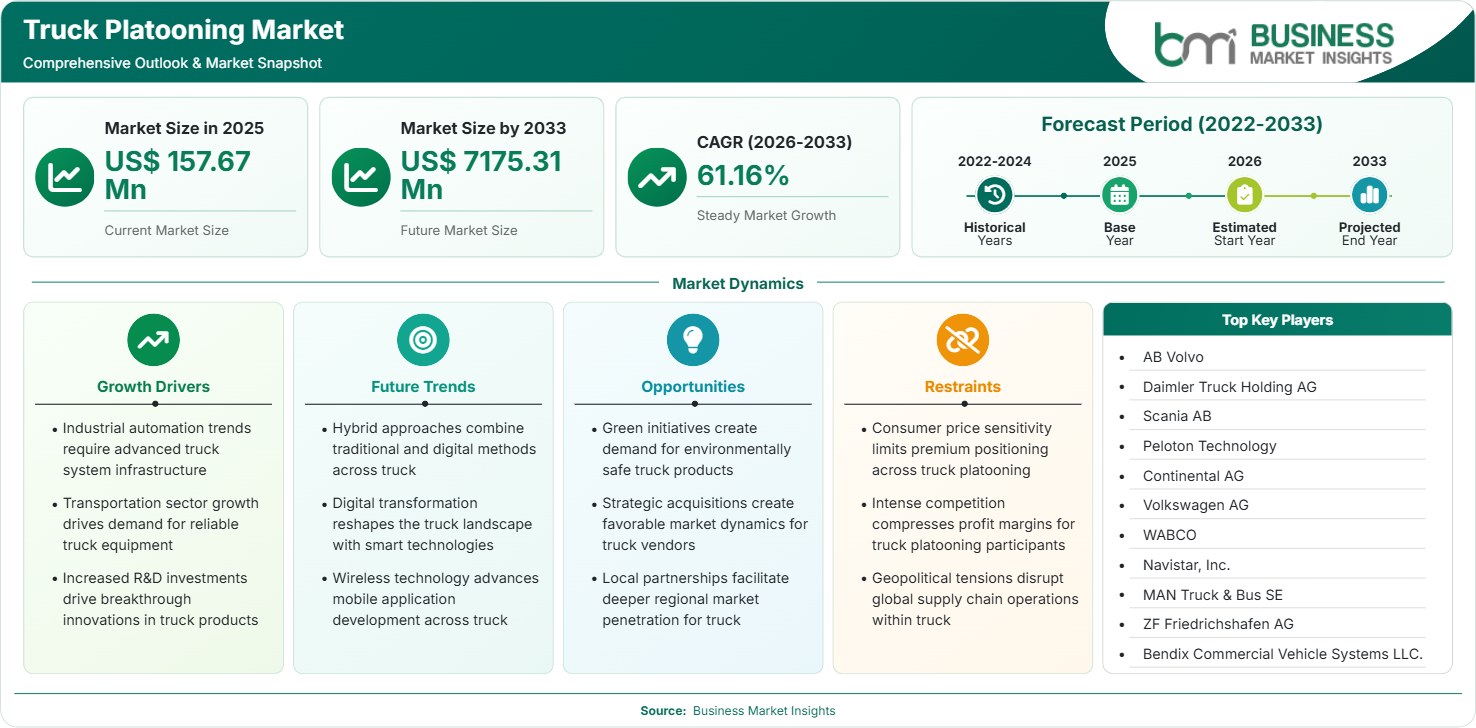
The Truck Platooning Market size was valued at US$ 157.67 million in 2025 and is projected to reach US$ 7,175.31 million by 2033, growing at a CAGR of 61.16% during 2026–2033, driven by connected safety systems, fuel optimization, autonomous freight, V2V communication, and logistics automation opportunities.

Report Coverage
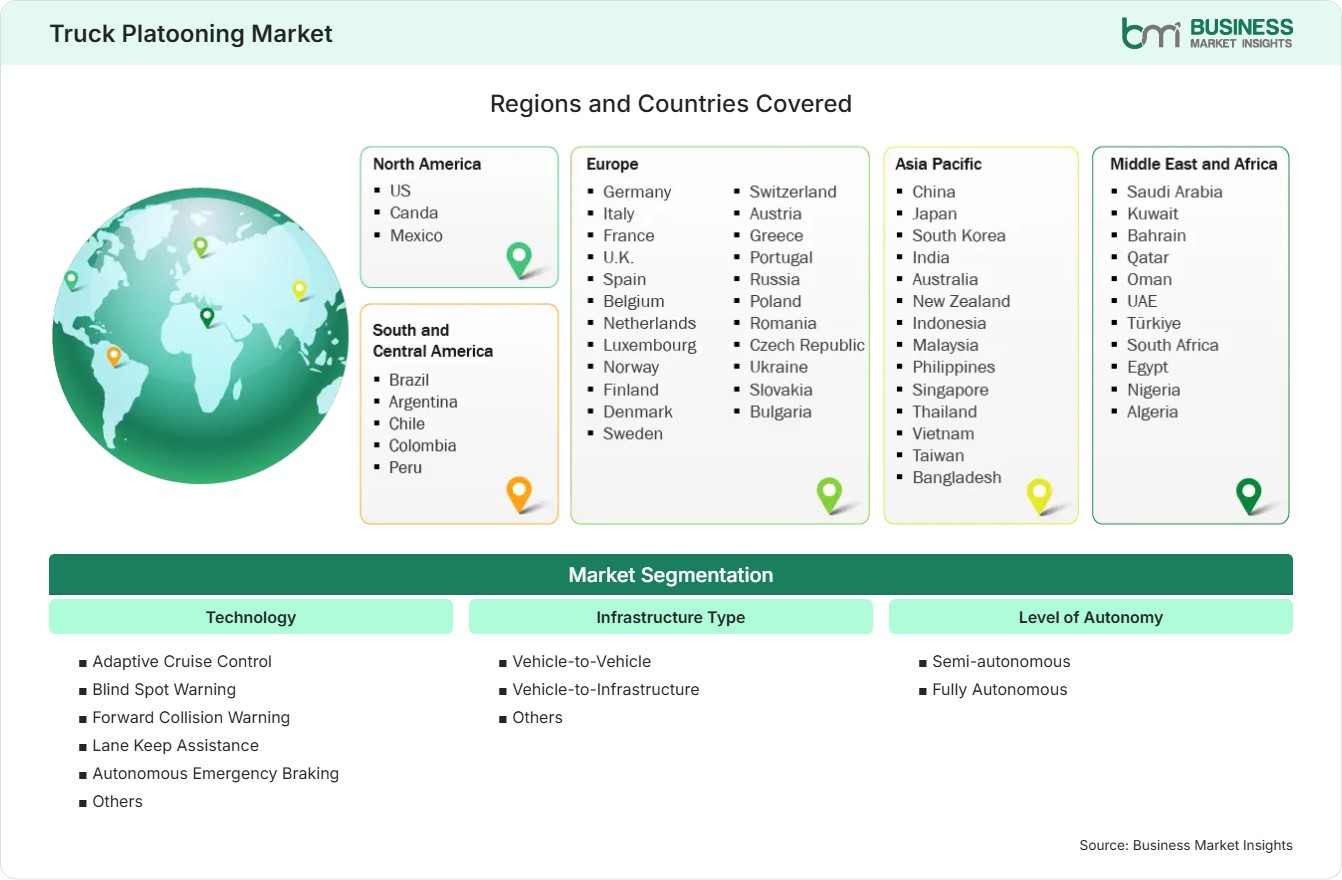
  • Technology: Adaptive Cruise Control , Blind Spot Warning , Forward Collision Warning , Lane Keep Assistance , Autonomous Emergency Braking , Others
  • Infrastructure Type: Vehicle-to-Vehicle , Vehicle-to-Infrastructure , Others
  • Level of Autonomy: Semi-autonomous, Fully Autonomous
US$ 157.67 Mn Market size in 2025
US$ 7175.31 Mn Market Size by 2033
61.16% CAGR, 2026 - 2033
2026-2033 Forecast Period

AI Overview

Truck Platooning Market Summary

  • North America Region: holds market share of 36%–40% in 2025, growing with a CAGR of 58%–61% influenced by autonomous trucking trials, fleet digitization, safety mandates, V2V deployment, fuel savings, corridor automation, driver productivity, and connected freight investment.
  • Fastest Growing Region: Asia Pacific holds market share of 22%–26% in 2025, growing with a CAGR of 64%–68% influenced by autonomous freight programs, logistics modernization, smart highways, semiconductor capabilities, urban delivery demand, labor constraints, connectivity infrastructure, and OEM investments.
  • Leading Segment: Technology holds market share of 42%–46% in 2025, growing with a CAGR of 59%–62% driven by sensor fusion, adaptive controls, collision avoidance, electronic braking, connected architectures, software integration, fleet analytics, and safety-focused automation.
  • High Growth Segment: Fully Autonomous holds market share of 18%–22% in 2025, growing with a CAGR of 70%–74% driven by autonomous freight corridors, artificial intelligence, redundant controls, remote supervision, operational efficiency, labor optimization, safety improvements, and scalable hub-to-hub logistics.
  • Key Market Opportunity: Fleet orchestration platforms can connect routing, vehicle eligibility, V2V communication, safety status, and platoon formation, creating recurring software revenues while improving asset utilization and lowering operating costs.
  • Major Market Players: AB Volvo, Daimler Truck Holding AG, Scania AB, Peloton Technology, Continental AG, Volkswagen AG, WABCO, Navistar, Inc., MAN Truck & Bus SE, ZF Friedrichshafen AG, and Bendix Commercial Vehicle Systems LLC.
Strategic Insights

Truck Platooning Market: Strategic Insights

Truck Platooning Market Strategic Framework
FREE PDF
Request your free sample
Request free sample
Stakeholder View

Key Takeaways

  • The supply chain is evolving toward an integrated ecosystem comprising truck OEMs, Tier 1 suppliers, connectivity providers, fleet operators, mapping companies, cloud platforms, and infrastructure stakeholders. Competitive advantage increasingly depends on interoperability rather than individual hardware performance.
  • The strongest upside is concentrated in long-haul, high-utilization freight corridors where predictable routes increase the probability of matching vehicles and sustaining platoons. Fully autonomous following systems offer an additional pathway toward driver productivity and hub-to-hub automation.
  • Innovation is moving toward centralized computing, redundant steering and braking, AI-assisted perception, V2V coordination, over-the-air software updates, and cooperative control algorithms. Software-defined vehicle architectures can shorten development cycles and support continuous performance improvements.
  • Texas, California, and other major US freight corridors offer compelling investment cases because long-haul traffic density supports platoon matching, autonomous trucking trials, and connected fleet deployment. Volvo Autonomous Solutions began commercial autonomous freight operations in Texas in 2026.
  • Investment is increasingly directed toward partnerships rather than standalone technology development. Volvo Group and Daimler Truck launched Coretura in June 2025 to develop a standardized software-defined vehicle platform, illustrating the growing importance of shared commercial-vehicle software infrastructure.
Geographic Outlook

Truck Platooning Market Regional Highlights

North America Truck Platooning Market

North America accounted for a 36%–40% Truck Platooning Market share in 2025 and is projected to register a 58%–61% CAGR during 2026–2033. The region benefits from extensive interstate freight corridors, high heavy-duty truck utilization, mature telematics, and established ADAS deployment. The United States remains the primary demand center, while Canada contributes research and corridor-level validation. Fleet operators increasingly evaluate platooning against fuel economics, utilization rates, weather constraints, and route predictability rather than technology readiness alone. Research on Canadian freight corridors indicates real-world savings can be considerably below controlled-test results.

  • Freight corridors favor coordinated trucks because predictable routes and dense traffic increase opportunities for compatible vehicle pairing and sustained platoon operation.
  • US technology suppliers are advancing V2V communication, cloud coordination, collision mitigation, and automated-following capabilities, strengthening the region’s ecosystem depth.
  • Canada provides a valuable testing environment for evaluating fuel savings, emissions effects, road grades, precipitation, and platoon utilization under practical freight conditions.
  • Fleet investment increasingly combines platooning with autonomous trucking, connected diagnostics, predictive maintenance, and remote fleet management to improve total operational economics.

US Truck Platooning Market

The US accounted for 72%–76% of North America’s 2025 demand and is projected to grow at a 58%–61% CAGR over the Truck Platooning Market Forecast Period. Its position reflects a large Class 8 truck population, extensive interstate freight movement, advanced commercial-vehicle electronics, and strong autonomous trucking investment. The market is transitioning from demonstrations toward route-specific commercialization, where platooning economics depend on truck compatibility, traffic density, fuel prices, operating hours, safety performance, and reliable digital coordination. Peloton reports more than 7% combined fuel savings under its standardized system testing.

  • Texas is emerging as a strategic autonomous freight location, with commercial operations integrating autonomous Volvo trucks into established logistics networks between Dallas and Houston.
  • US suppliers are integrating forward collision warning, automatic emergency braking, radar, cameras, and V2V communication to create layered safety architectures for coordinated freight.
  • Fleet operators increasingly assess platooning through total cost of ownership, emphasizing utilization, driver productivity, insurance exposure, fuel consumption, and software subscription economics.

Europe Truck Platooning Market

Europe held a 29%–33% Truck Platooning Market share in 2025 and is forecast to record a 59%–62% CAGR through 2033. Germany, Sweden, France, and the Netherlands continue to be major technology hubs and manufacturing regions, with Germany being the foremost region for commercial vehicle engineering. Sweden is an innovation hub of high growth, having 63%–66% CAGR, aided by connectivity in trucks and expertise in autonomous freight. European rollout is governed by cross-border interoperability, UNECE regulations on automated driving, cyber security, and interbrand vehicle interoperability. 2025 and 2026 regulatory developments will continue to work on automated-driving legislation.

  • Germany benefits from dense OEM and Tier 1 supplier capabilities spanning sensors, braking, steering, transmissions, electronic control units, and commercial-vehicle software.
  • Sweden combines major truck manufacturing capabilities with autonomous transport development, supporting rapid experimentation in controlled logistics and industrial environments.
  • The Netherlands and France offer attractive corridor opportunities because advanced logistics infrastructure and cross-border freight flows support connected vehicle experimentation.
  • Regulatory harmonization remains essential because multi-brand platoons require consistent communication, safety, cybersecurity, and automated-driving requirements across national borders.

Asia Pacific Truck Platooning Market

Asia Pacific represented a 22%–26% share of the Truck Platooning Market in 2025 and is projected to expand at a 64%–68% CAGR through 2033. China, Japan, South Korea, and India provide the region’s principal growth centers. China leads manufacturing scale, Japan emphasizes autonomous logistics, South Korea combines connectivity with commercial vehicle technology, and India offers long-term potential from freight digitization. Japan’s earlier platooning programs demonstrated how government-backed testing can connect OEM development with road infrastructure. Regional growth increasingly depends on smart highways, vehicle connectivity, logistics automation, and labor productivity.

  • China’s manufacturing ecosystem can accelerate adoption through domestic production of sensors, electronic controllers, communication equipment, and commercial vehicle platforms.
  • Japan offers strong potential for automated freight because established logistics operators and advanced vehicle technologies create a suitable environment for controlled autonomous deployment.
  • South Korea benefits from 5G connectivity, electronics expertise, intelligent transport infrastructure, and OEM capabilities that support coordinated commercial vehicle functions.
  • India presents a longer-term opportunity as freight corridors modernize and truck operators adopt telematics, ADAS, digital fleet management, and automated safety technologies.

Rest of World Truck Platooning Market

South and Central America accounted for approximately 4%–6% of global Truck Platooning Market demand in 2025, with a modeled 51%–55% CAGR through 2033. Brazil is the principal opportunity because of its large road-freight network, agricultural logistics, and heavy-truck dependence. Mexico also offers attractive corridor economics due to manufacturing-linked freight movement and proximity to US logistics networks. Adoption will favor routes where fleet density and predictable operating conditions support repeatable platoon formation.

The Middle East and Africa collectively represented a modeled 4%–6% share and are forecast to grow at 53%–57%. Saudi Arabia, the UAE, and South Africa provide stronger near-term opportunities, supported by logistics infrastructure investment, mining, ports, and long-distance freight applications.

  • Brazil can use platooning to improve long-haul freight efficiency where repeated routes and high truck utilization create stronger economic justification.
  • Mexico provides an important cross-border opportunity because manufacturing supply chains create concentrated freight corridors connecting domestic distribution with North American markets.
  • Saudi Arabia and the UAE can integrate connected trucks with smart logistics zones, automated ports, digital freight systems, and advanced highway infrastructure.
  • South Africa offers applications in mining and long-distance freight, where predictable routes can support controlled autonomous and coordinated vehicle deployments.
Global Market Geography
FREE PDF
Request your free sample
Request free sample
Segment Analysis

Truck Platooning Market Segmentation

Technology

Technology accounted for a 42%–46% share in 2025 and is projected to expand at a 59%–62% CAGR during 2026–2033. The segment encompasses core safety and control functions that enable coordinated truck operation. The Truck Platooning Market scope increasingly extends from individual ADAS features toward integrated sensor, software, braking, steering, and communication architectures that support safer and more responsive platoons.

  • Adaptive Cruise Control (ACC): ACC provides the longitudinal control foundation for maintaining vehicle speed and following distance. Its established deployment lowers integration barriers and supports progression toward cooperative control.
  • Blind Spot Warning (BSW): BSW improves awareness of vehicles entering adjacent zones during platoon formation and lane changes. Integration with connected systems can support safer maneuver coordination.
  • Forward Collision Warning (FCW): FCW detects potential frontal collisions and provides early alerts. Its integration with platooning architectures strengthens layered safety by combining vehicle perception with coordinated braking responses.
  • Lane Keep Assistance (LKA): LKA supports lateral positioning and helps maintain lane discipline during extended highway operation. Integration with connectivity and automated controls can strengthen future autonomous-following capabilities.
  • Autonomous Emergency Braking (AEB): AEB provides automated braking when collision risks are detected, complementing V2V coordination. Its importance increases as platoons operate with shorter, electronically controlled following gaps.

Infrastructure Type

Infrastructure Type held a 34%–38% share in 2025 and is projected to grow at a 60%–63% CAGR during 2026–2033. Connected infrastructure supports communication, positioning, traffic awareness, and operational coordination. The Truck Platooning Market share within infrastructure is influenced by highway digitization, wireless reliability, fleet cloud platforms, and interoperability requirements across vehicle manufacturers and logistics operators.

  • Vehicle-to-Vehicle (V2V): V2V communication synchronizes acceleration, braking, and safety information between trucks. Low-latency links enable coordinated responses and are fundamental to practical platooning operations.
  • Vehicle-to-Infrastructure (V2I): V2I enables trucks to receive roadway, traffic, weather, routing, and infrastructure information. It can improve platoon eligibility decisions and support connected freight corridor management.

Level of Autonomy

Level of Autonomy accounted for a 20%–24% share in 2025 and is forecast to register a 67%–71% CAGR during 2026–2033. Semi-autonomous systems currently provide a lower deployment barrier, while fully autonomous architectures offer greater long-term productivity potential. The Truck Platooning Market trends increasingly connect autonomy with hub-to-hub logistics, remote supervision, and redundant vehicle controls.

  • Semi-autonomous: Semi-autonomous platooning retains human involvement while automating selected speed, braking, or following functions. This model lowers adoption barriers and enables fleets to validate connected operations progressively.
  • Fully Autonomous: Fully autonomous platooning combines automated perception, control, communication, and safety systems. Its development supports driverless following vehicles, scalable freight automation, and higher asset productivity.
Market Forces

Truck Platooning Market Dynamics

Key Market Drivers

Connected Vehicle Architectures Accelerate Coordinated Freight

V2V communication is becoming a core enabling layer because platooning depends on synchronized acceleration, braking, vehicle status, and safety information. Peloton states that its system electronically connects trucks so the rear vehicle can respond rapidly to lead-truck actions, while its network operations cloud manages pairing and operating conditions. The Truck Platooning Market growth therefore depends not only on vehicle electronics but also on communication reliability, authentication, cybersecurity, and fleet-level orchestration. In the new architectural designs, the use of radars, cameras, electronic braking systems, localization systems, cellular connections, and communication is combined together. By adopting the concept of software-defined vehicle architecture for their cars, it has become easy for car manufacturers to bring these systems together in one place through central computation. An example of such an approach is the Coretura Project.

Fuel Efficiency and Emissions Optimization Strengthen Fleet Economics

Fuel consumption is still an important commercial factor in trucking companies since long-distance trucks log many miles annually. Although aerodynamic drafting helps to lower the resistance, the effectiveness of this approach depends on following distance, truck design, road gradient, weather, traffic conditions, and usage of platooning. According to the study done in 2025, it was found that fuel usage could be cut down to 6.6 percent for the follower truck; in one corridor study, it was observed that fuel usage could be decreased by 6.5 percent for short platoons and 3.7 percent on average for a 60% usage rate. The Truck Platooning Market trends will prefer intelligent platooning, predictive matching, and operational optimization which will ensure sustainable use instead of merely reducing the distance between vehicles.

Autonomous Freight Development Expands Commercial Adoption Pathways

Autonomous trucking is broadening the value proposition of platooning beyond fuel efficiency. The lead vehicle which is connected can give information about the route, perception data and instructions to the following vehicle. This helps in simplifying some technical challenges related to autonomous trucks. The Volvo Autonomous Solutions together with the DSV have been operational in offering autonomous freight transport in Texas in the year 2026 from Dallas to Houston with the help of Volvo VNL Autonomous and Aurora Driver technology. Moreover, the Volvo Group has indicated that the autonomous solutions business unit of Volvo Group intends to conduct driverless on-highway operations by Q1 2027.

Key Market Opportunities

Fleet Orchestration Creates Recurring Software Revenue

The next investment opportunity lies in software that determines when, where, and with whom trucks should platoon. Orchestrated fleet systems can use information about route schedules, cargo needs, truck health, braking capabilities, weather, traffic conditions, connectivity, and vehicle compliance to find commercially feasible platooning pairings. This system solves one inherent flaw in ad hoc platooning, where both trucks need to be available at the right time in the right corridor. Thus, the software allows higher utilization rates without having all trucks operate in a platoon all the time. Possible revenue models for the connected fleets could be subscription-based model, transactional model, fleet optimization, analytics, and remote management. With more connected fleets, the value of the decision layer supplier is increasing with all OEMs. This provides a scalable commercial pathway beyond hardware installation, supporting the Truck Platooning Market growth.

Autonomous Following Supports Hub-to-Hub Freight Automation

Fully autonomous following can become an attractive bridge between driver-assisted platooning and complete driverless freight networks. This concept would make use of a human-controlled lead vehicle to provide routing information while an autonomously controlled trailing truck would control certain driving operations. This could be a more simplified process for deploying self-driving vehicles. The best application for this idea would be on highly repetitive routes that connect distribution centers, ports, warehousing facilities, and manufacturing facilities. This will make it possible for us to start from small scale use of the route and later increase its operation area when we are successful in the small scale uses. Investments should be prioritized on steering, braking, high performance computer, perception, remote assistances, cybersecurity, and control centers.

Electric Truck Platooning Opens Energy Optimization Opportunities

Electric heavy-duty trucks create a new opportunity because platooning can be evaluated alongside battery range, charging schedules, route planning, and energy management. In 2025, a study on electric trucks in platooning has been conducted taking into account such factors as charging stations, routes, leader swapping, and cost of operations. As the results have shown, platooning could be combined with electric fleets optimization. As for the advantages of the technology in a business context, it shifts from the sphere of savings in fuel costs to a wider sphere of energy consumption management. Thanks to algorithms, one can calculate the leaders of trucks, locations where to recharge the electric vehicle, as well as possible detours for forming a platoon and checking whether such solution is economically feasible.

Market Restraints and Challenges

Variable Real-World Savings Limit Business-Case Certainty

Factor: The gains from fuel and emissions depend on weather, grade, traffic, truck type, separation, and use of the platoon.

Impact: Return on investment for fleet operators may be lower compared to controlled trials because of additional costs involved in installing the technology, training drivers, using communication equipment, and other expenditures, which makes it hard to invest in technology. In 2025, scientific studies showed that return on investment at corridor level may decrease to 3.7% on assumption of 60% vehicle use although more savings were possible during optimal conditions. This shows how important the choice of routes and vehicle fleets is. One should take into account cost of ownership in practice and not aerodynamic savings only. This consideration is especially true for smaller fleets with less compatible trucks since low density of vehicles hinders platooning.

Interoperability and Regulatory Complexity Slow Cross-Border Deployment

Factor: A platoon needs to be equipped with the right communications, safety features, cybersecurity measures, vehicle controls, and regulation regardless of the make of truck.

Impact: Fragmented standards might drive up validation costs and hinder the widespread multi-brand deployment of the technology. The UN ECE carries on with the work on the regulation of automated driving, involving common provisions for automated driving systems and assessment related to AI technology in 2025 and 2026. Consequently, the regulatory landscape continues to evolve, rather than being fully established. The software update, cybersecurity, data management, functional safety, and liability issues have to be handled by manufacturers in the context of connected vehicles. All these aspects will result in higher costs for engineering and validation, especially for the suppliers operating in several countries.

Company Analysis

Competitive Landscape

The Truck Platooning Market analysis indicates that competition is increasingly centered on integrated ADAS, V2V connectivity, autonomous control, commercial vehicle electronics, and software-defined architectures. The companies below represent the supplied competitive set.

Company Name

Overview

Products and Services relevant to this market

AB Volvo

Swedish commercial vehicle manufacturer with extensive heavy-duty truck, connectivity, safety, and autonomous transport capabilities.

Volvo trucks, autonomous transport solutions, connected services, ADAS technologies, fleet software, and automated driving platforms.

Daimler Truck Holding AG

Germany-based commercial vehicle manufacturer with major Mercedes-Benz, Freightliner, and FUSO truck operations and autonomous-driving investments.

Heavy-duty trucks, Active Drive Assist, connected vehicle systems, automated-driving platforms, fleet services, and autonomous trucking technologies.

Scania AB

Swedish commercial vehicle manufacturer focused on heavy trucks, intelligent transport systems, safety, efficiency, and connected fleet operations.

Heavy trucks, ADAS, connected fleet services, powertrain technologies, autonomous transport development, and driver-assistance systems.

Peloton Technology

US automated vehicle technology company specializing in connected truck platooning and driver-assistive commercial vehicle automation.

Platoon Pro, V2V communications, connected braking, network operations cloud, automated following, radar-based safety, and platoon management.

Continental AG

German technology supplier providing sensors, electronic systems, vehicle control technologies, and commercial vehicle automation capabilities.

Radar and camera systems, electronic control units, ADAS, automated driving technologies, connectivity, and vehicle safety systems.

Volkswagen AG

German automotive group with commercial vehicle exposure through its broader truck and mobility portfolio and technology ecosystem.

Commercial vehicle technologies, connected mobility, automated-driving development, software platforms, sensors, and vehicle electronics.

WABCO

Commercial vehicle technology brand now integrated within ZF, historically recognized for braking, stability, automation, and fleet solutions.

Electronic braking systems, vehicle control, safety systems, telematics, fleet management, and automated commercial vehicle technologies.

Navistar, Inc.

US commercial vehicle manufacturer serving heavy-duty transportation fleets with connected vehicle and safety technology capabilities.

International trucks, advanced driver assistance, connected fleet systems, safety technologies, and commercial vehicle automation integration.

MAN Truck & Bus SE

German commercial vehicle manufacturer developing connected, efficient, automated, and digitally managed truck solutions.

MAN trucks, driver assistance, autonomous driving technologies, fleet connectivity, telematics, safety systems, and automated transport solutions.

ZF Friedrichshafen AG

German Tier 1 supplier with broad commercial vehicle expertise spanning steering, braking, driveline, chassis, software, and automation.

Re AX steering, Pro Connect technologies, braking systems, sensors, vehicle control, fleet software, autonomous driving components, and commercial vehicle systems.

Bendix Commercial Vehicle Systems LLC

US commercial vehicle safety supplier specializing in advanced braking, stability, collision mitigation, and driver-assistance systems.

Fusion safety systems, AEB, collision mitigation, forward warning, stability control, radar, cameras, and commercial vehicle ADAS.

Trust & Transparency

Research Methodology

The market analysis combines proprietary research with secondary data from government agencies, company disclosures, regulatory filings, industry databases and expert interviews. Market estimates are validated through data triangulation, cross-market benchmarking and analyst review.

View Full Research Methodology

Questions Answered

Frequently Asked Questions

Why is Truck Platooning Market Report research important for investors?

A Truck Platooning Market Report can help investors distinguish technology demonstrations from scalable commercial applications by evaluating corridor economics, interoperability, automation levels, regulatory progress, supplier capabilities, fleet utilization, and the transition from hardware sales toward software-enabled recurring revenues.

What role does software play in platoon formation?

Software can match trucks according to route, timing, cargo, braking characteristics, weather, traffic, and operational eligibility. This improves the probability of forming viable platoons and creates opportunities for recurring revenue through fleet optimization, analytics, connectivity, and remote management services.

How does autonomous following change fleet economics?

Autonomous following can shift platooning from fuel-saving assistance toward labor productivity and automated freight operations. The commercial value depends on regulatory approval, route design, remote supervision requirements, vehicle utilization, insurance costs, and the ability to maintain safe operations across changing conditions.

What makes a freight corridor suitable for platooning?

Suitable corridors generally feature predictable routes, substantial heavy-truck traffic, compatible fleet schedules, reliable communications, controlled access, and consistent road conditions. High truck density increases the probability that vehicles can identify compatible partners without creating excessive waiting or routing costs.

What technologies are essential for truck platooning deployment?

V2V communications, radar, cameras, electronic braking, ACC, lane-control technologies, high-performance computing, positioning, cybersecurity, and cloud-based fleet coordination form the principal technical foundation. Deployment quality depends on how these systems operate together rather than on any single component.

Access the Full Truck Platooning Market Report

Get segment-level forecasts, regional estimates, competitive benchmarking, company profiles and downloadable Excel datasets.

Access the full Truck Platooning Market Report
350 pages PDF & Excel | 2026-08-31
Similar Research

Related Market Reports