Connected Truck Market Regional Highlights
North America Connected Truck Market
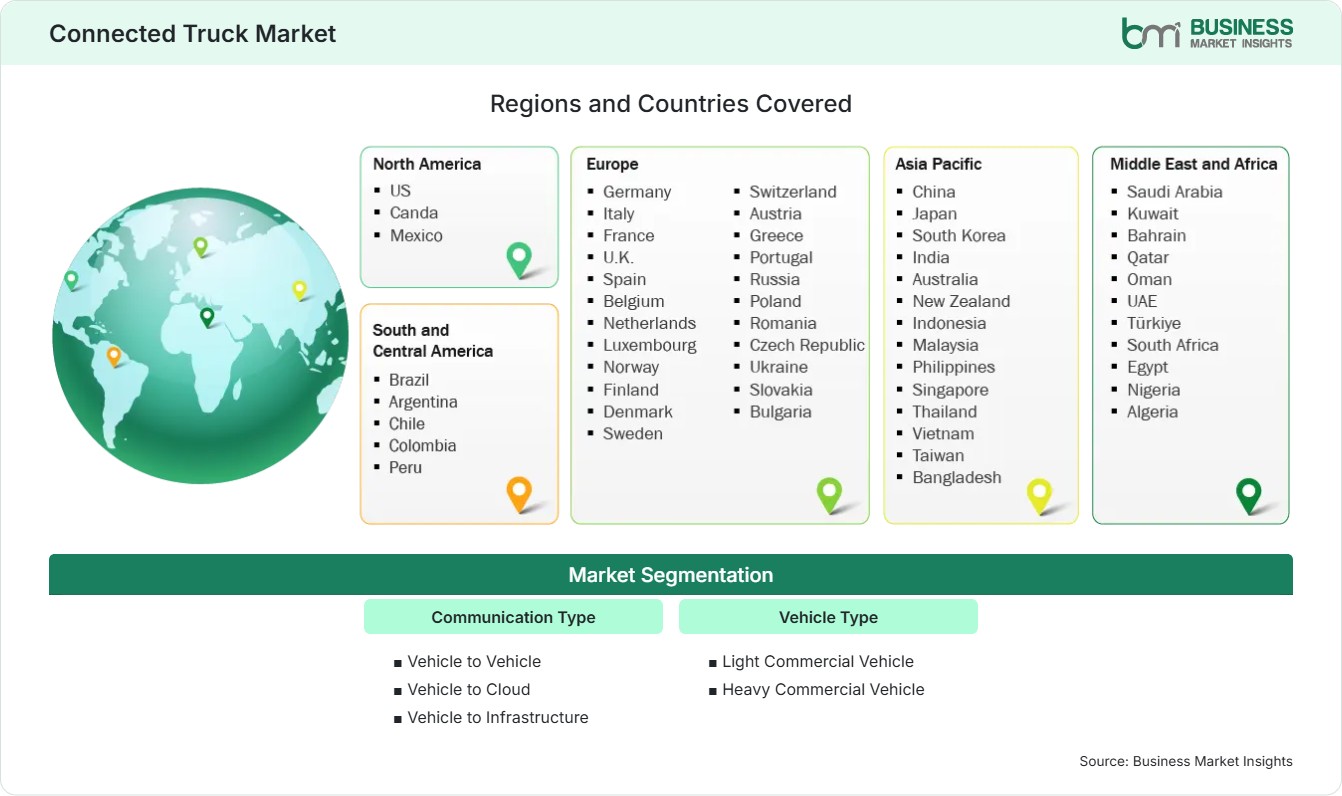
North America accounts for 37%–40% Connected Truck Market share in 2025 and is projected to grow at a CAGR of 18.0%–18.8% through 2033. Strong adoption of telematics solutions, increasing logistics modernization efforts, and growing demand for operational efficiency continue supporting regional leadership.
- Fleet operators are increasingly investing in connected technologies to improve visibility and performance.
- Telematics solutions continue helping companies optimize fuel efficiency and route planning.
- Regulatory emphasis on fleet safety is accelerating technology adoption.
- Real-time vehicle monitoring systems are becoming standard across commercial fleets.
- Logistics providers continue leveraging connectivity solutions to enhance supply chain efficiency.
- Integration of AI and predictive maintenance technologies is creating new opportunities.
US Connected Truck Market
The United States contributes approximately 86%–90% of North American revenue and is expected to register a CAGR of 18.2%–19.0% through 2033. Strong logistics networks, extensive trucking operations, and rapid adoption of smart transportation technologies continue supporting market leadership.
- Fleet operators continue deploying advanced telematics and connectivity platforms.
- Demand for predictive maintenance solutions is rising steadily.
- Commercial transportation companies are increasingly investing in data-driven operations.
- Connected vehicle technologies are enhancing safety, efficiency, and compliance.
- Autonomous trucking development continues creating long-term growth opportunities.
Europe Connected Truck Market
Europe represents 25%–28% of global revenue in 2025 and is anticipated to expand at a CAGR of 18.7%–19.4% through 2033. Advanced transportation infrastructure, increasing smart mobility initiatives, and growing logistics digitalization continue supporting regional growth. Germany remains the leading market while Poland demonstrates stronger growth momentum.
- Germany continues leading regional demand due to strong commercial vehicle manufacturing capabilities.
- Poland is among the fastest-growing markets and is estimated to register a CAGR of 20.0%–20.8% during the forecast period.
- Fleet connectivity adoption is expanding throughout logistics networks.
- Vehicle safety and efficiency requirements are driving telematics investments.
- Smart mobility initiatives continue supporting connected truck market development.
- Freight operators increasingly utilize cloud-based fleet management solutions.
Asia Pacific Connected Truck Market
Asia Pacific accounts for 24%–27% of global revenue in 2025 and is expected to achieve the fastest CAGR of 20.3%–21.1% through 2033. Growing freight transportation demand, rapid industrialization, and increasing investments in digital logistics infrastructure continue supporting strong market growth.
- China remains the largest regional market due to substantial commercial vehicle deployment and logistics activity.
- India is projected to achieve approximately 21.2%–22.0% CAGR, supported by transportation modernization and growing digital logistics adoption.
- Fleet operators are increasingly implementing telematics and IoT-based monitoring systems.
- Growth in e-commerce logistics is accelerating connected truck adoption.
- Government initiatives promoting smart transportation are supporting market expansion.
- Connected mobility investments continue strengthening long-term growth prospects.
Rest of World Connected Truck Market
Rest of World accounts for 8%–11% of global revenue in 2025 and is projected to expand at a CAGR of 18.4%–19.2% through 2033. Increasing transportation modernization, freight activity expansion, and investments in smart fleet technologies continue supporting market growth.
- Brazil continues generating demand through logistics modernization initiatives.
- The UAE is investing in smart transportation and connected mobility infrastructure.
- Saudi Arabia is expected to achieve approximately 19.5%–20.3% CAGR through 2033, supported by logistics and transportation development programs.
- Fleet operators continue expanding deployment of intelligent tracking systems.
- Demand for real-time fleet visibility is driving technology adoption.
- Digital transformation initiatives are creating favorable market conditions.