
Fire Trucks Market Outlook: Size, Share, Trends, Growth Analysis, Competitive Landscape & Forecast, 2026-2033

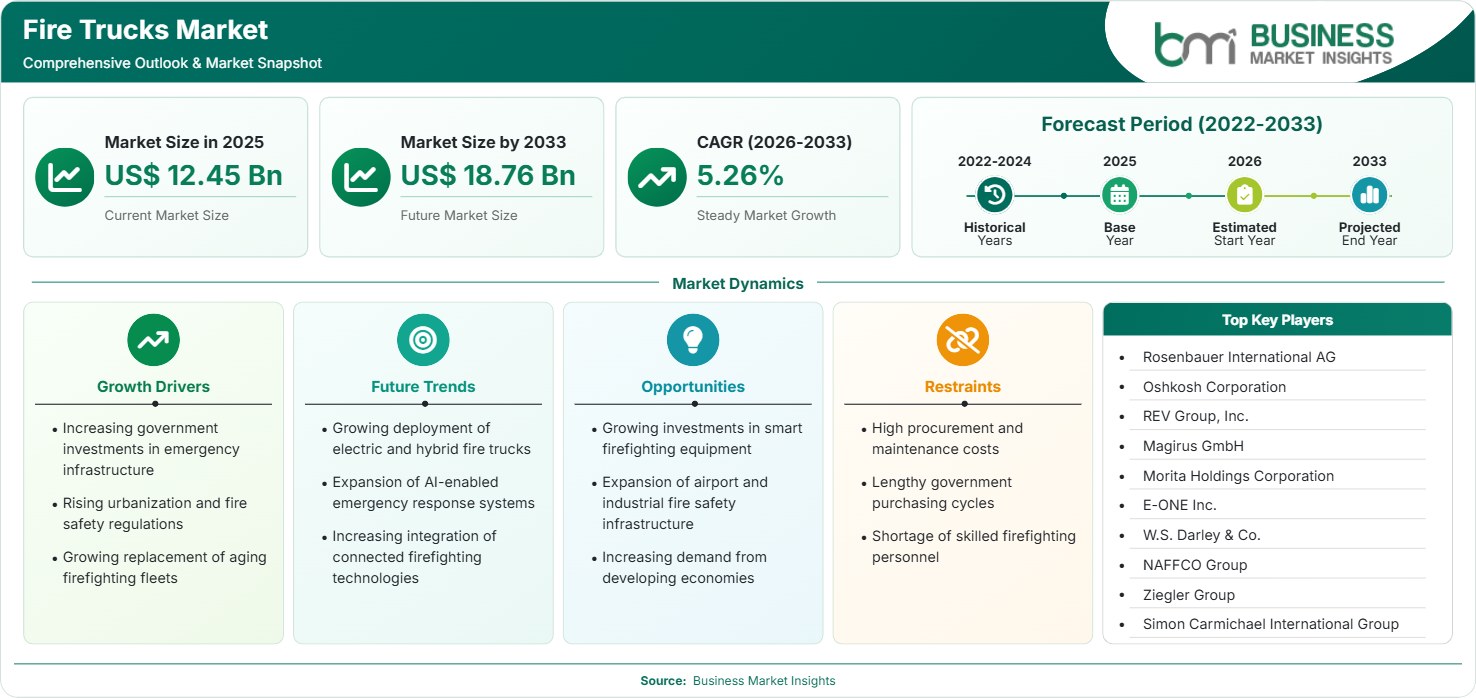
The Fire Trucks Market size was valued at US$ 12.45 Billion in 2025 and is projected to reach US$ 18.76 Billion by 2033, growing at a CAGR of 5.26% from 2026 to 2033. Increasing emergency response investments, urban fire safety requirements, fleet modernization programs, and adoption of advanced firefighting technologies are driving market development.

Report Coverage
  • Product Type: Aerials, Pumpers, Tankers, Rescue, Others
  • Application: Residential and Commercial, Airports and Enterprises, Military, Others
US$ 12.45 Bn Market size in 2025
US$ 18.76 Bn Market Size by 2033
5.26% CAGR, 2026 - 2033
2026-2033 Forecast Period

AI Overview

Fire Trucks Market Summary

  • North America Region: North America holds a 32%–35% market share in 2025 and is projected to grow at a 4.8%–5.3% CAGR during 2026–2033. Growth is supported by government emergency infrastructure funding, replacement of aging firefighting fleets, strict safety standards, and adoption of technologically advanced vehicles. The U.S. market expands at a 4.9%–5.4% CAGR due to municipal fleet upgrades, wildfire response requirements, and modernization initiatives.
  • Fastest Growing Region: Asia Pacific accounts for a 28%–31% market share in 2025 and grows at a 6.0%–6.5% CAGR during 2026–2033. Rapid urbanization, expanding industrial infrastructure, increasing fire safety regulations, and rising investments in emergency services are supporting regional demand.
  • Leading Segment: Pumpers account for a 38%–42% market share in 2025 and expand at a 5.0%–5.5% CAGR during 2026–2033 due to widespread municipal usage, essential firefighting capabilities, and demand for reliable emergency response vehicles.
  • High Growth Segment: Aerial fire trucks represent a 18%–21% market share in 2025 and grow at a 5.8%–6.3% CAGR during 2026–2033 due to increasing high-rise construction, urban fire risks, and demand for advanced rescue capabilities.
  • Key Market Opportunity: Smart firefighting systems, connected emergency vehicles, airport safety infrastructure, industrial fire protection, and developing economy investments are creating new opportunities for manufacturers.
  • Major Market Players: Rosenbauer International AG, Oshkosh Corporation, REV Group, Inc., Magirus GmbH, Morita Holdings Corporation, E-ONE Inc., W.S. Darley & Co., NAFFCO Group, Ziegler Group, and Simon Carmichael International Group.
Strategic Insights

Fire Trucks Market: Strategic Insights

Fire Trucks Market Strategic Framework
FREE PDF
Request your free sample
Request free sample
Stakeholder View

Key Takeaways

  • The fire truck value chain includes specialized vehicle manufacturers, chassis suppliers, firefighting equipment providers, technology developers, government agencies, and emergency service operators. Collaboration across this ecosystem influences product innovation and procurement efficiency.
  • Pumpers remain a major opportunity area due to their essential role in municipal firefighting operations, while aerial platforms are gaining attention because of increasing high-rise construction and complex rescue requirements.
  • Technology integration is becoming a competitive factor, with manufacturers focusing on connected vehicles, automated systems, improved safety features, and data-enabled emergency response capabilities.
  • Asia Pacific provides significant growth opportunities due to urban expansion, industrial development, infrastructure investment, and increasing government focus on emergency preparedness.
  • Companies are pursuing strategic expansion through fleet modernization contracts, regional partnerships, product customization, and development of specialized firefighting vehicles.
  • Rising wildfire incidents and climate-related emergency risks are encouraging authorities to strengthen firefighting capabilities and invest in advanced response equipment.
Geographic Outlook

Fire Trucks Market Regional Highlights

North America Fire Trucks Market

North America accounts for 32%–35% of the global market in 2025 and is projected to grow at a 4.8%–5.3% CAGR during 2026–2033. The region has a mature emergency response infrastructure supported by strong municipal funding, advanced firefighting standards, and continuous fleet modernization programs. Increasing wildfire risks, urban expansion, and replacement of aging vehicles are encouraging fire departments to invest in upgraded emergency response fleets. The presence of established manufacturers and strong government procurement frameworks further supports the development of technologically advanced firefighting vehicles across the region.

  • The United States represents the largest regional contributor due to extensive municipal firefighting networks, wildfire management requirements, and increasing investments in emergency preparedness programs.
  • Government initiatives focused on improving public safety infrastructure are supporting procurement of advanced fire trucks equipped with improved pumping systems, communication technologies, and rescue capabilities.
  • Rising frequency of natural disasters, including wildfires and extreme weather events, is increasing demand for specialized firefighting vehicles with enhanced operational performance.
  • Fire departments are replacing older fleets with modern vehicles that provide improved fuel efficiency, safety features, and advanced emergency response capabilities.

US Fire Trucks Market

The U.S. market represents 85%–88% of North America's market share in 2025 and is expected to grow at a 4.9%–5.4% CAGR during 2026–2033. Growth is supported by government spending on emergency services, modernization of municipal fleets, and increasing demand for specialized firefighting equipment. Rising urban development and industrial expansion are creating additional requirements for efficient fire response systems in fire trucks market. Fire departments are increasingly adopting advanced vehicles with improved mobility, digital communication systems, and enhanced safety features to improve emergency response effectiveness.

  • Municipal fire departments continue fleet replacement programs to upgrade aging vehicles and improve operational reliability during emergency situations.
  • Increasing wildfire incidents across several regions are driving demand for specialized fire trucks designed for challenging terrain and large-scale fire suppression operations.
  • Industrial facilities, airports, and commercial complexes are investing in dedicated firefighting vehicles to meet safety requirements and reduce emergency response risks.
  • Adoption of smart firefighting technologies is increasing as agencies focus on real-time monitoring, communication, and operational efficiency.

Europe Fire Trucks Market

Europe holds 24%–27% market share in 2025 and expands at a 4.5%–5.0% CAGR during 2026–2033. The regional fire trucks market is supported by strict fire safety regulations, modernization of emergency services, and increasing adoption of environmentally efficient firefighting vehicles. Countries including Germany, France, and the United Kingdom are investing in advanced rescue systems and fleet upgrades. Growing emphasis on public safety standards and sustainable emergency response solutions is influencing procurement decisions across European markets.

  • Germany contributes significantly due to strong industrial infrastructure, advanced emergency response systems, and demand for specialized firefighting equipment.
  • France and the United Kingdom are increasing investments in modern rescue vehicles and municipal firefighting fleet improvements.
  • European safety regulations are encouraging adoption of vehicles with improved operational efficiency, enhanced safety features, and environmentally compliant technologies.
  • Growing urban development and industrial activity are supporting demand for fire trucks across commercial and institutional applications.

Asia Pacific Fire Trucks Market

Asia Pacific represents 28%–31% market share in 2025 and is projected to grow at a 6.0%–6.5% CAGR during 2026–2033. The region is witnessing strong growth due to rapid urbanization, industrial expansion, infrastructure development, and increasing government focus on emergency preparedness in fire trucks market. Developing economies are strengthening firefighting capabilities through modernization programs and increased public safety investments. Growth in airports, manufacturing facilities, and urban housing projects is creating demand for different categories of firefighting vehicles.

  • China is a major contributor due to large-scale infrastructure development, industrial expansion, and government initiatives aimed at improving emergency response systems.
  • India is experiencing rising demand through urban growth, industrial development, smart city initiatives, and increasing awareness of fire safety requirements.
  • Southeast Asian countries are investing in emergency infrastructure as commercial development, tourism, and industrial activities continue expanding.
  • Increasing construction of high-rise buildings is supporting demand for aerial fire trucks and specialized rescue vehicles.
  • Regional governments are collaborating with international manufacturers to improve firefighting capabilities and introduce advanced technologies.

Rest of World Fire Trucks Market

The Rest of World region accounts for 10%–12% market share in 2025 and grows at a 5.2%–5.7% CAGR during 2026–2033. Growth is supported by infrastructure development, industrial expansion, airport modernization, and improving emergency response systems across emerging markets. Middle Eastern countries are investing in advanced firefighting capabilities due to large commercial projects, while Latin America and Africa are gradually improving public safety infrastructure in fire trucks market.

  • Middle Eastern countries are increasing procurement of specialized firefighting vehicles for airports, industrial facilities, and large-scale infrastructure projects.
  • Latin American markets are adopting modern fire trucks to replace aging fleets and improve municipal emergency response capabilities.
  • African countries are witnessing gradual growth through urban expansion, industrial development, and international support for safety infrastructure.
  • Growing investments in airports, energy facilities, and manufacturing projects are creating demand for specialized firefighting equipment.
  • Developing economies offer long-term opportunities as governments increase spending on emergency services and disaster management capabilities.

Global Market Geography
FREE PDF
Request your free sample
Request free sample
Segment Analysis

Fire Trucks Market Segmentation

Product Type

The product type segment includes Aerials, Pumpers, Tankers, Rescue, and Others. Pumpers account for the leading fire trucks market share due to their essential role in municipal firefighting operations, water supply capabilities, and widespread deployment among emergency response agencies. The segment is projected to grow at a 5.26%–5.6% CAGR during 2026–2033, supported by fleet replacement programs, urban fire safety requirements, and increasing demand for reliable emergency vehicles.

  • Aerials: Growth is supported by increasing high-rise construction, urban fire risks, and demand for elevated rescue operations. These vehicles are gaining adoption among metropolitan fire departments requiring advanced access capabilities.
  • Pumpers: Maintain dominance due to their critical firefighting functions, including water pumping, fire suppression, and emergency response applications across residential, commercial, and industrial areas.
  • Tankers: Demand is increasing in regions with limited water infrastructure and rural areas requiring large-capacity water transportation for firefighting operations.
  • Rescue: Adoption is rising due to increasing demand for specialized emergency response vehicles equipped for accidents, disaster management, and complex rescue operations.

Application

The application segment consists of Residential and Commercial, Airports and Enterprises, Military, and Others. Residential and commercial applications represent the largest share due to increasing urbanization, fire safety regulations, and municipal emergency response requirements. The segment is expected to grow at a 5.0%–5.5% CAGR during 2026–2033. Expanding infrastructure development and rising awareness of fire protection systems are supporting fire trucks market growth.

  • Residential and Commercial: Leads demand due to increasing building density, stricter fire safety standards, and the need for efficient municipal emergency response services.
  • Airports and Enterprises: Growth is driven by airport expansion, industrial safety requirements, and demand for specialized firefighting vehicles capable of handling large-scale emergencies.
  • Military: Adoption is supported by defense modernization programs, military base safety requirements, and demand for specialized emergency response equipment.
Market Forces

Fire Trucks Market Dynamics

Key Market Drivers

Increasing government investments in emergency infrastructure

Growing government focus on strengthening emergency response capabilities is driving demand for advanced firefighting vehicles worldwide. Municipal authorities and public safety agencies are increasing investments in fire stations, rescue equipment, and fleet modernization programs to improve disaster preparedness. Rising incidents of urban fires, industrial accidents, and climate-related emergencies are encouraging governments to upgrade outdated firefighting fleets with advanced vehicles. Funding programs aimed at improving public safety infrastructure are supporting procurement of modern fire trucks equipped with improved mobility, communication systems, and firefighting capabilities. These investments are significantly contributing to the expansion of the Fire Trucks Market growth across developed and developing economies.

Rising urbanization and fire safety regulations

Rapid urban development and increasing population density are creating greater demand for efficient firefighting solutions. Expansion of residential complexes, commercial buildings, industrial facilities, and high-rise structures is increasing the complexity of fire response requirements. Governments are implementing stricter fire safety regulations, building codes, and emergency preparedness standards, encouraging organizations to maintain advanced firefighting capabilities. Urban authorities are investing in specialized vehicles, including aerial platforms and rescue trucks, to address challenges associated with dense city environments. These regulatory developments and infrastructure changes are strengthening demand for modern firefighting fleets and supporting long-term Fire Trucks Market trends.

Growing replacement of aging firefighting fleets

The replacement of outdated firefighting vehicles is becoming a major growth factor as many municipalities and emergency service providers operate fleets that require modernization. Older vehicles often face limitations related to operational efficiency, safety features, maintenance requirements, and compatibility with modern firefighting equipment. Upgrading aging fleets enables departments to improve response times, reduce maintenance costs, and enhance firefighter safety. Developed markets are increasingly investing in fleet renewal programs, while emerging economies are also focusing on replacing older equipment as emergency infrastructure improves. This replacement cycle is creating sustained demand opportunities for manufacturers offering reliable and technologically advanced fire trucks market.

Key Market Opportunities

Growing investments in smart firefighting equipment

Increasing adoption of digital technologies in emergency services is creating opportunities for manufacturers developing smart firefighting solutions. Connected cars, advanced monitoring technology, automation and communication technology are some areas that have seen increased interest from fire departments. Smart firefighting systems play an important role in ensuring that emergency crews have real time data and make better decisions in case of emergencies. Integrating such advanced technologies into the firefighting trucks can provide manufacturers with a competitive edge in offering improved performance and safety features. The increasing use of technology in developing emergency response systems has opened up new opportunities in firefighting services.

Expansion of airport and industrial fire safety infrastructure

Increasing investments in airports, manufacturing facilities, energy plants, and industrial complexes are generating demand for specialized firefighting vehicles. Airports require dedicated firefighting equipment capable of responding to aircraft emergencies, while industrial facilities need advanced vehicles for handling complex fire risks. Expansion of global aviation infrastructure and industrial development projects is increasing procurement of specialized fire trucks with enhanced capabilities. Companies providing customized solutions for airport rescue and industrial firefighting applications can benefit from rising infrastructure investments. Growing emphasis on workplace safety and regulatory compliance is further supporting adoption across enterprise environments.

Increasing demand from developing economies

Developing economies are creating significant growth opportunities due to urbanization, industrialization, and increasing investments in public safety infrastructure. Many emerging countries are upgrading emergency response systems to address growing fire risks associated with expanding cities and industrial facilities. Government initiatives aimed at improving disaster management capabilities are encouraging procurement of modern firefighting vehicles. International manufacturers are increasing their presence in these markets through partnerships, local production, and customized product offerings. Rising awareness of fire safety standards and infrastructure modernization programs are expected to support long-term demand growth in developing regions.

Market Restraints and Challenges

High procurement and maintenance costs

Factor: Fire trucks require significant investment due to specialized vehicle designs, advanced firefighting equipment, customized configurations, and continuous maintenance requirements. Impact: High acquisition and operating costs can limit purchasing capacity, especially among smaller municipalities and organizations with restricted budgets. Maintenance expenses related to specialized components, equipment upgrades, and vehicle servicing further increase lifecycle costs. Budget constraints may delay fleet modernization projects in certain regions. Manufacturers are addressing this challenge by developing cost-efficient solutions, improving vehicle durability, and offering flexible procurement options. However, high ownership costs remain a key factor affecting market adoption.

Lengthy government purchasing cycles

Factor: A significant portion of fire truck purchases is made through government agencies and municipal authorities, which often involve complex approval procedures, budget allocation processes, and regulatory evaluations. Impact: Extended procurement timelines can delay order execution and create uncertainty for manufacturers. Government purchasing decisions may require multiple approval stages, competitive bidding processes, and compliance assessments before contracts are finalized. These lengthy cycles can affect revenue planning and inventory management for suppliers. Companies are focusing on stronger government relationships, customized proposals, and efficient contract management strategies to navigate procurement challenges.

Company Analysis

Competitive Landscape

The Fire Trucks Market analysis indicates a competitive environment shaped by vehicle innovation, emergency response requirements, customization capabilities, government contracts, and technological advancement. Leading manufacturers are focusing on developing advanced firefighting vehicles with improved safety features, higher operational efficiency, and specialized configurations for municipal, industrial, airport, and military applications. Companies are strengthening their market position through product launches, regional expansion, partnerships with emergency agencies, and investments in smart firefighting solutions.

Company Name

Overview

Products and Services relevant to this market

Rosenbauer International AG

Global manufacturer specializing in firefighting vehicles, equipment, and emergency response solutions.

Provides fire trucks, aerial platforms, rescue vehicles, airport firefighting vehicles, and customized emergency response systems.

Oshkosh Corporation

International specialty vehicle manufacturer serving defense, emergency response, and industrial sectors.

Offers advanced fire apparatus, airport rescue firefighting vehicles, and specialized emergency response vehicles.

REV Group, Inc.

Manufacturer of specialty vehicles including emergency and commercial vehicles across multiple industries.

Provides fire apparatus, rescue vehicles, emergency response units, and customized firefighting solutions.

Magirus GmbH

Firefighting technology company known for manufacturing advanced emergency vehicles and aerial rescue equipment.

Offers fire engines, aerial ladder platforms, rescue vehicles, and firefighting equipment solutions.

Morita Holdings Corporation

Japanese manufacturer specializing in firefighting vehicles and emergency response equipment.

Provides fire engines, rescue vehicles, water tankers, and specialized firefighting systems.

E-ONE Inc.

Fire apparatus manufacturer providing customized emergency vehicles for professional firefighters.

Offers pumpers, aerial platforms, rescue vehicles, and custom-built fire trucks for various applications.

W.S. Darley & Co.

Emergency equipment supplier supporting firefighting and public safety organizations.

Provides fire apparatus, pumps, firefighting equipment, and emergency response solutions.

NAFFCO Group

Fire protection company offering firefighting systems, equipment, and emergency solutions globally.

Provides fire trucks, rescue vehicles, firefighting equipment, and integrated fire safety solutions.

Ziegler Group

European firefighting equipment manufacturer specializing in emergency response vehicles.

Offers fire engines, rescue vehicles, pumpers, and customized firefighting solutions.

Simon Carmichael International Group

Specialist manufacturer and supplier of emergency response vehicles and equipment.

Provides firefighting vehicles, airport rescue solutions, and customized emergency response systems.

Trust & Transparency

Research Methodology

The market analysis combines proprietary research with secondary data from government agencies, company disclosures, regulatory filings, industry databases and expert interviews. Market estimates are validated through data triangulation, cross-market benchmarking and analyst review.

View Full Research Methodology

Questions Answered

Frequently Asked Questions

What challenges affect fire trucks market forecasts?

High procurement costs, maintenance expenses, and lengthy government purchasing procedures can limit adoption and delay fleet modernization projects.

Which applications create demand for fire trucks?

Residential and commercial buildings, airports, industrial facilities, military locations, and government infrastructure require firefighting vehicles.

Why are smart firefighting solutions gaining importance?

Smart firefighting technologies improve communication, monitoring, operational efficiency, and decision-making during emergency response situations.

Which fire truck type holds the largest market share?

Pumpers hold a leading position due to their essential role in municipal firefighting operations, water supply, and emergency response activities.

What factors are driving demand for fire trucks market report?

Demand is increasing due to government investments in emergency infrastructure, urbanization, fire safety regulations, and replacement of aging firefighting fleets.

Access the Full Fire Trucks Market Report

Get segment-level forecasts, regional estimates, competitive benchmarking, company profiles and downloadable Excel datasets.

Access the full Fire Trucks Market Report
350 pages PDF & Excel | 2026-08-31
Similar Research

Related Market Reports