
Heavy Duty Trucks Market Outlook: Size, Share, Trends, Growth Analysis, Competitive Landscape & Forecast, 2022-2033

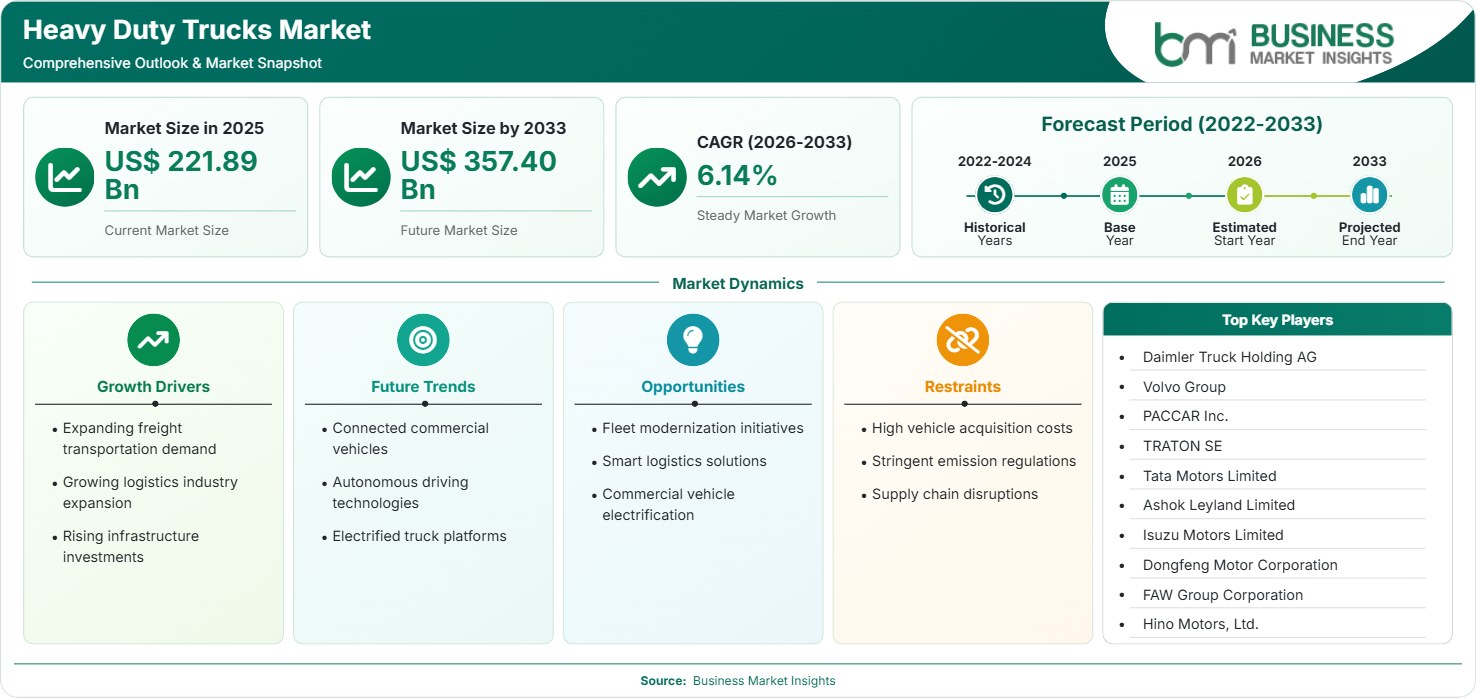
The Heavy Duty Trucks Market size was valued at US$ 221.89 billion in 2025 and is projected to reach US$ 357.40 billion by 2033, growing at a CAGR of 6.14% during 2026–2033. Rising freight transportation demand, expanding logistics networks, and increasing infrastructure investments are accelerating market growth, while fleet modernization, smart logistics technologies, and commercial vehicle electrification create significant long-term opportunities.

Report Coverage
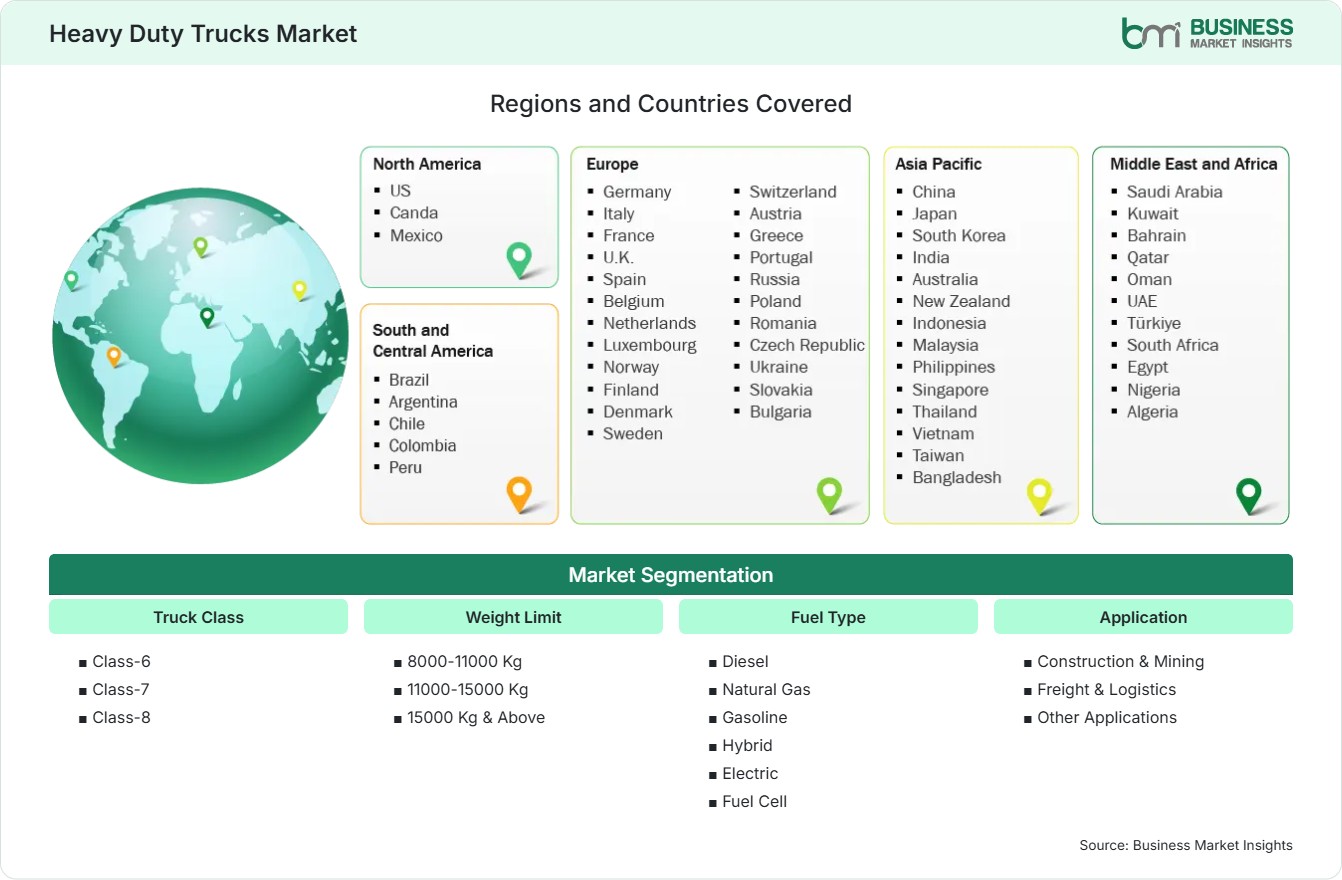
  • Truck Class: Class-6, Class-7, Class-8
  • Weight Limit: 8000-11000 Kg, 11000-15000 Kg, 15000 Kg & Above
  • Fuel Type: Diesel, Natural Gas, Gasoline, Hybrid, Electric, Fuel Cell
  • Application: Construction & Mining, Freight & Logistics, Other Applications
US$ 221.89 Bn Market size in 2025
US$ 357.40 Bn Market Size by 2033
6.14% CAGR, 2026 - 2033
2026-2033 Forecast Period

01 AI Overview

Heavy Duty Trucks Market Summary

  • North America: North America holds 31%–34% market share in 2025 and is projected to grow at a CAGR of 5.8%–6.5% during 2026–2033. Strong freight transportation demand, expanding e-commerce logistics, and continuous fleet replacement programs support regional growth. The U.S. market is anticipated to register a CAGR of 6.0%–6.7% through 2033.
  • Fastest Growing Region: Asia Pacific accounts for 39%–42% of the market in 2025 and is forecast to expand at a CAGR of 6.8%–7.5% during 2026–2033. Rapid industrialization, infrastructure development, and growing commercial transportation activities continue strengthening regional demand.
  • Leading Segment: Class-8 trucks represent 48%–51% market share in 2025 and are expected to grow at a CAGR of 6.3%–7.0% throughout the forecast period. High freight capacity, long-haul transportation demand, and infrastructure projects continue driving segment leadership.
  • High Growth Segment: Electric fuel type accounts for 6%–8% market share in 2025 and is projected to register the fastest CAGR of 22.0%–23.5% during 2026–2033. Government incentives, zero-emission regulations, and battery technology improvements continue accelerating adoption.
  • Key Market Opportunity: Increasing adoption of connected fleet technologies, autonomous driving systems, predictive maintenance platforms, and electric heavy-duty trucks presents substantial growth opportunities for manufacturers and fleet operators.
  • Major Market Players: Daimler Truck Holding AG, Volvo Group, PACCAR Inc., TRATON SE, Tata Motors Limited, Ashok Leyland Limited, Isuzu Motors Limited, Dongfeng Motor Corporation, FAW Group Corporation, Hino Motors Ltd.
02 Strategic Insights

Heavy Duty Trucks Market: Strategic Insights

Heavy Duty Trucks Market Strategic Framework
FREE PDF
Request your free sample
Request free sample
03 Stakeholder View

Key Takeaways

  • The freight industry continues to be the most profitable segment owing to the growth in global trading activities and e-commerce that drives the need for heavy-duty commercial vehicles.
  • Modernization initiatives have prompted transport companies to upgrade from old diesel-fueled vehicles to technologically superior trucks that offer better mileage, increased safety, and cost-efficiency.
  • Advanced digital technologies such as telematics, predictive maintenance, artificial intelligence, and fleet management have become important competitive advantages in the sector.
  • Asia Pacific offers the greatest opportunity for long-term investments because of its growing industrialization, infrastructure development, production of commercial vehicles, and government investments in the development of transportation.
  • Collaborations among truck manufacturers, battery providers, developers of autonomous technology, and fleet management firms are leading to fast technological advancements in the field.
04 Geographic Outlook

Heavy Duty Trucks Market Regional Highlights

North America Heavy Duty Trucks Market

North America accounts for 31%–34% of the global market in 2025 and is projected to grow at a CAGR of 5.8%–6.5% through 2033. Strong freight transportation demand, advanced highway infrastructure, fleet replacement initiatives, and widespread adoption of connected commercial vehicle technologies continue supporting regional market leadership. The Heavy Duty Trucks Market share remains significant due to high commercial transportation activity and mature logistics networks.

  • Strong demand from freight, logistics, and construction industries.
  • Fleet replacement programs encourage adoption of fuel-efficient commercial vehicles.
  • Advanced telematics and fleet connectivity improve operational efficiency.
  • Growing investments in electric truck charging infrastructure support market development.

US Heavy Duty Trucks Market

The United States represents the largest regional market and is expected to expand at a CAGR of 6.0%–6.7% during the forecast period. Expanding e-commerce, industrial production, infrastructure modernization, and logistics investments continue supporting sustained demand for heavy-duty commercial vehicles.

  • Large logistics operators continue modernizing commercial vehicle fleets.
  • Rising investments in autonomous trucking technologies support innovation.
  • Infrastructure development strengthens long-haul transportation demand.

Europe Heavy Duty Trucks Market

The Europe region represents 24%-27% of market share in 2025 and is expected to grow at a CAGR of 5.9%-6.6% during the forecast period. Germany dominates the regional demand; however, Poland shows promising growth rates owing to development in freight transportation and logistics investments, and commercial vehicle manufacturing.

  • Strict emission regulations accelerate low-emission truck adoption.
  • Germany remains the leading commercial vehicle manufacturing hub.
  • Poland experiences strong logistics and transportation sector expansion.
  • Fleet electrification initiatives continue gaining momentum across the region.

Asia Pacific Heavy Duty Trucks Market

Asia Pacific represents 39%–42% of the global market in 2025 and is expected to register the fastest CAGR of 6.8%–7.5% through 2033. China dominates regional revenue, while India records the highest growth due to infrastructure investments, industrial expansion, and increasing commercial transportation demand.

  • Large-scale infrastructure projects increase heavy truck utilization.
  • Expanding manufacturing activity strengthens freight transportation demand.
  • Commercial vehicle production continues growing across major economies.
  • Government investments accelerate logistics modernization and highway development.

Rest of World Heavy Duty Trucks Market

The Rest of World region accounts for 6%–8% of the market in 2025 and is projected to grow at a CAGR of 5.7%–6.4% during 2026–2033. Brazil, Saudi Arabia, and South Africa continue investing in mining, construction, logistics infrastructure, and commercial transportation, supporting steady market expansion.

  • Mining and construction activities generate sustained truck demand.
  • Infrastructure investments strengthen regional freight transportation.
  • Fleet modernization programs improve commercial vehicle efficiency.
  • Growing logistics networks support long-term heavy-duty truck adoption.
Global Market Geography
FREE PDF
Request your free sample
Request free sample
05 Segment Analysis

Heavy Duty Trucks Market Segmentation

Truck Class

The Truck Class segment accounted for 46%–49% of the overall market in 2025 and is projected to register a CAGR of 6.2%–6.9% during 2026–2033. Increases in the amount of cargo traffic, expansion of infrastructure development initiatives, and an increasing demand for trucks with higher load capacity are some of the factors that are continuing to push growth in the truck industry in all categories of trucks. Fleets prefer to buy trucks that are high on load capacity, have increased fuel efficiency, are equipped with improved safety systems, and also advanced telematics features.

  • Class-6: Class-6 trucks are widely used for regional freight distribution, municipal services, utility operations, and medium-haul transportation. Growing urban logistics activities and expanding infrastructure maintenance projects continue supporting steady demand for these versatile commercial vehicles.
  • Class-7: Class-7 trucks serve diverse applications including construction material transportation, refuse collection, refrigerated logistics, and regional freight movement. Increasing investments in commercial infrastructure and urban distribution networks continue strengthening segment growth.
  • Class-8: Class-8 represents the largest truck class owing to its extensive utilization in long-haul freight transportation, mining operations, heavy construction, and industrial logistics. Continuous improvements in fuel efficiency, driver assistance technologies, and connected fleet management systems further reinforce segment leadership.

Weight Limit

The Weight Limit segment represented 37%–40% of the market in 2025 and is expected to expand at a CAGR of 6.1%–6.8% during the forecast period. Increasing transportation of bulk materials, industrial equipment, construction supplies, and consumer goods is driving demand across multiple vehicle weight categories. Manufacturers continue developing lighter chassis materials, more efficient drivetrains, and higher payload configurations to improve operating efficiency while complying with regional transportation regulations. Fleet operators increasingly prefer optimized vehicle designs that maximize cargo capacity without compromising safety or fuel economy.

  • 8000–11000 Kg: Trucks within this category are commonly utilized for urban freight distribution, municipal operations, and regional commercial transportation requiring maneuverability, operational flexibility, and moderate payload capacity.
  • 11000–15000 Kg: This segment supports medium-distance freight transportation, industrial logistics, construction activities, and specialized commercial applications where balanced payload capacity and operational efficiency are essential.
  • 15000 Kg & Above: Heavy-capacity trucks dominate long-haul freight, mining, infrastructure development, and industrial transportation owing to their superior payload capabilities, durability, and ability to operate under demanding working conditions.

Fuel Type

The Fuel Type segment held a market share of 44%-47% in 2025 and is expected to register a CAGR of 6.4%-7.1% between 2026 and 2033. The shift towards sustainable mobility is prompting manufacturers to adopt alternative fuel types for their commercial vehicle powertrains while maintaining operational efficiency and regulatory compliance. The Heavy Duty Trucks Market trends indicate increasing investment in electric, hybrid, natural gas, and hydrogen-powered commercial vehicles, alongside ongoing improvements in conventional diesel engine technologies.

  • Diesel: Diesel continues to dominate the market because of its proven reliability, high torque output, extensive fueling infrastructure, and suitability for long-haul transportation and heavy commercial applications.
  • Natural Gas: Natural gas-powered trucks are gaining adoption among fleet operators seeking lower emissions and reduced operating costs, particularly in urban freight distribution and municipal transportation services.
  • Gasoline: Gasoline-powered heavy-duty trucks maintain limited adoption in selected regional applications where operational requirements and fleet economics support their utilization.
  • Hybrid: Hybrid commercial trucks provide improved fuel efficiency and lower emissions while supporting fleet operators transitioning toward cleaner transportation technologies without sacrificing operational flexibility.
  • Electric: Electric heavy-duty trucks represent the fastest-growing fuel segment due to government incentives, battery technology improvements, expanding charging infrastructure, and increasing corporate sustainability commitments.
  • Fuel Cell: Hydrogen fuel cell trucks are attracting investment for long-haul commercial transportation because they offer zero tailpipe emissions, extended driving range, and shorter refueling times compared with battery-electric alternatives.

Application

The Application segment accounted for around 39%-42% of the overall market in 2025 and is expected to grow at a CAGR of 6.3%-7.0% through 2033. The rising trends of global trading, infrastructural development, mining expenditure, and modernizing logistics activities are continuously contributing to the increasing demand for commercial heavy-duty vehicles across multiple industrial sectors.

  • Construction & Mining: Heavy-duty trucks remain indispensable for transporting aggregates, minerals, machinery, and construction materials across infrastructure development, mining operations, and industrial projects requiring high durability and payload capacity.
  • Freight & Logistics: Freight and logistics represent the largest application segment owing to growing domestic distribution, international trade, cross-border transportation, and rapidly expanding e-commerce supply chains requiring reliable long-haul trucking solutions.
06 Market Forces

Heavy Duty Trucks Market Dynamics

Key Market Drivers

Expanding freight transportation demand

The rise in domestic and international trade has been increasing the volume of freight transport throughout the world. The fast-growing rate of the manufacturing industry, international business, and even electronic commerce has led to an increase in the need for efficient heavy-duty trucks for transporting goods over long distances. The trucking companies are focusing on acquiring technologically advanced trucks that have better fuel efficiency and predictive maintenance features.

Growing logistics industry expansion

The continued growth in the number of third-party logistics operators, warehouse facilities, and integrated supply chains is driving demand for heavy-duty trucks. Firms are continuously increasing their fleets of trucks to cater to the increased transport of goods resulting from industrial operations, retail activities, and global business transactions. Telematics technology and route planning software are making the whole process more efficient.

Rising infrastructure investments

Governments around the world are spending large amounts of money on building highways, bridges, railway lines, ports, airports, industrial belts, and urban infrastructure projects. This creates a need for transporting construction materials, equipment, and machinery, hence a need for large-capacity trucks. Continued public spending on infrastructure provides sustainable growth prospects for heavy-duty truck companies.

Key Market Opportunities

Fleet modernization initiatives

The transportation industry is increasingly adopting fuel-efficient, electronically enabled, low-emission commercial trucks to replace aging fleets, thereby creating ample business opportunities, as indicated in the Heavy Duty Trucks Market forecasts. Up-to-date fleet modernization initiatives have been successful in making operations more efficient, lowering maintenance expenses, promoting the safety of drivers, and ensuring compliance with regulations. In addition, the increasing use of telematics, predictive maintenance systems, and alternative-fuel heavy-duty trucks will help achieve fleet optimization in the long run.

Smart logistics solutions

The inclusion of such innovative technologies as artificial intelligence, telematics, preventive maintenance, IoT integration, and fleet management solutions brings changes to the commercial transport industry. Smart logistics systems enhance route planning, vehicle utilization, cargo visibility, and fuel efficiency.

Commercial vehicle electrification

The fast development of batteries, hydrogen fuel cell technology, charging stations, and incentives from governments is rapidly pushing the market to electrify its trucks. Increasingly stringent sustainability goals for businesses and strategies for emission-free transportation will continue to provide good long-term prospects for manufacturers focusing on electric trucks.

Market Restraints and Challenges

High vehicle acquisition costs

Factor: Heavy-duty trucks equipped with advanced powertrains, emission control systems, telematics, and safety technologies require significant upfront investment, particularly for electric and fuel-cell models. Impact: High capital expenditure may delay fleet replacement decisions among small and medium-sized fleet operators, limiting faster adoption of technologically advanced commercial vehicles despite long-term operational savings.

Stringent emission regulations

Factor: Governments continue implementing increasingly strict emission standards that require manufacturers to invest heavily in cleaner engines, alternative fuels, battery-electric technologies, and hydrogen-powered commercial vehicles. Impact: Compliance with evolving environmental regulations increases research and development expenditure, manufacturing complexity, and vehicle prices while creating significant technological challenges for commercial vehicle manufacturers and fleet operators.

07 Company Analysis

Competitive Landscape

The competitive landscape is characterized by strong competition among global commercial vehicle manufacturers, reflecting a key aspect of the Heavy Duty Trucks Market analysis, as companies focus on fuel-efficient powertrains, fleet connectivity, electrification, and autonomous driving technologies. Leading manufacturers continue investing in research and development, strategic partnerships, production expansion, and digital fleet management solutions to strengthen their market positions. Increasing adoption of electric heavy-duty trucks, hydrogen fuel-cell technologies, and intelligent transportation systems is further accelerating innovation, enhancing fleet efficiency, and transforming the competitive dynamics of the global heavy-duty truck industry.

Company Name

Overview

Products and Services Relevant to this Market

Daimler Truck Holding AG

Global commercial vehicle manufacturer with an extensive portfolio of heavy-duty trucks, buses, and mobility solutions.

Heavy-duty trucks, electric trucks, fleet management solutions, connected vehicle technologies, aftersales services.

Volvo Group

Leading manufacturer of commercial trucks, construction equipment, and transport solutions with global operations.

Heavy-duty trucks, electric trucks, autonomous transport solutions, telematics, fleet connectivity services.

PACCAR Inc.

Global producer of premium commercial vehicles through renowned truck brands and advanced transportation technologies.

Heavy-duty trucks, diesel engines, connected fleet systems, vehicle diagnostics, financial services.

TRATON SE

Commercial vehicle group operating multiple truck brands with a focus on sustainable transportation solutions.

Heavy-duty trucks, electric commercial vehicles, digital fleet management, mobility solutions, aftermarket services.

Tata Motors Limited

Indian automotive manufacturer producing commercial vehicles for domestic and international transportation markets.

Heavy-duty trucks, construction vehicles, logistics trucks, connected fleet technologies, electric commercial vehicles.

Ashok Leyland Limited

Leading commercial vehicle manufacturer serving freight, logistics, construction, and defense sectors.

Heavy-duty trucks, haulage vehicles, tippers, alternative fuel trucks, fleet management solutions.

Isuzu Motors Limited

Japanese commercial vehicle manufacturer specializing in trucks, diesel engines, and transportation solutions.

Heavy-duty trucks, diesel engines, commercial vehicles, logistics solutions, aftermarket support.

Dongfeng Motor Corporation

Major Chinese automotive manufacturer producing commercial trucks and industrial vehicles.

Heavy-duty trucks, logistics vehicles, electric commercial trucks, fleet mobility solutions.

FAW Group Corporation

One of China's largest commercial vehicle manufacturers with diversified heavy-duty truck offerings.

Heavy-duty trucks, tractor units, logistics vehicles, intelligent transportation technologies.

Hino Motors Ltd.

Commercial vehicle manufacturer specializing in medium and heavy-duty trucks with advanced diesel technologies.

Heavy-duty trucks, hybrid commercial vehicles, fleet management solutions, maintenance services.

08 Industry Activity

Recent Developments

May 2026

Volvo Trucks announced a new generation of heavy-duty trucks featuring an all-new fuel-efficient combustion engine platform compatible with renewable fuels, upgraded electric drivelines offering ranges of up to 700 km, and enhanced software-defined vehicle technologies to accelerate freight decarbonization.

April 2026

Volvo Trucks unveiled its new heavy-duty electric truck range with driving distances of up to 700 km and Megawatt Charging System (MCS) capability, enabling long-haul transport with faster charging and higher productivity.

March 2026

Daimler Truck AG announced the establishment of Coretura, a joint venture with the Volvo Group to develop a software-defined vehicle platform and standardized commercial vehicle operating system for next-generation heavy-duty trucks.

April 2025

Scania CV AB acquired Northvolt Systems Industrial, including its battery pack manufacturing operations, research and development center, and approximately 260 employees, strengthening Scania's electrification strategy for heavy-duty trucks and off-road applications.

10 Trust & Transparency

Research Methodology

The market analysis combines proprietary research with secondary data from government agencies, company disclosures, regulatory filings, industry databases and expert interviews. Market estimates are validated through data triangulation, cross-market benchmarking and analyst review.

View Full Research Methodology

11 Questions Answered

Frequently Asked Questions

What future opportunities are expected to shape the market?

Future opportunities include commercial vehicle electrification, hydrogen fuel-cell adoption, smart fleet management platforms, connected vehicle technologies, autonomous driving systems, predictive maintenance solutions, and sustainable freight transportation initiatives.

Who are the major companies operating in the Heavy Duty Trucks Market Report?

Major companies include Daimler Truck Holding AG, Volvo Group, PACCAR Inc., TRATON SE, Tata Motors Limited, Ashok Leyland Limited, Isuzu Motors Limited, Dongfeng Motor Corporation, FAW Group Corporation, and Hino Motors Ltd.

Which region dominates the market?

Asia Pacific leads the market with a 39%–42% share in 2025, supported by rapid industrialization, expanding manufacturing activities, infrastructure development, and strong commercial vehicle production across China, India, and other regional economies. Q3. Which truck class holds the largest market share? The Class-8 segment dominates the market with a 48%–51% share in 2025 owing to its extensive use in long-haul freight transportation, mining operations, heavy construction, and industrial logistics applications.

What factors are driving the Heavy Duty Trucks Market?

The market is driven by expanding freight transportation, growing logistics activities, increasing infrastructure investments, fleet modernization programs, and rising adoption of connected commercial vehicle technologies that improve operational efficiency and reduce ownership costs.

Access the Full Heavy Duty Trucks Market Report

Get segment-level forecasts, regional estimates, competitive benchmarking, company profiles and downloadable Excel datasets.

Access the full Heavy Duty Trucks Market Report
350 pages PDF & Excel | 2026-07-31