
Heavy Duty Electric Trucks Market Outlook: Size, Share, Trends, Growth Analysis, Competitive Landscape & Forecast, 2026-2033

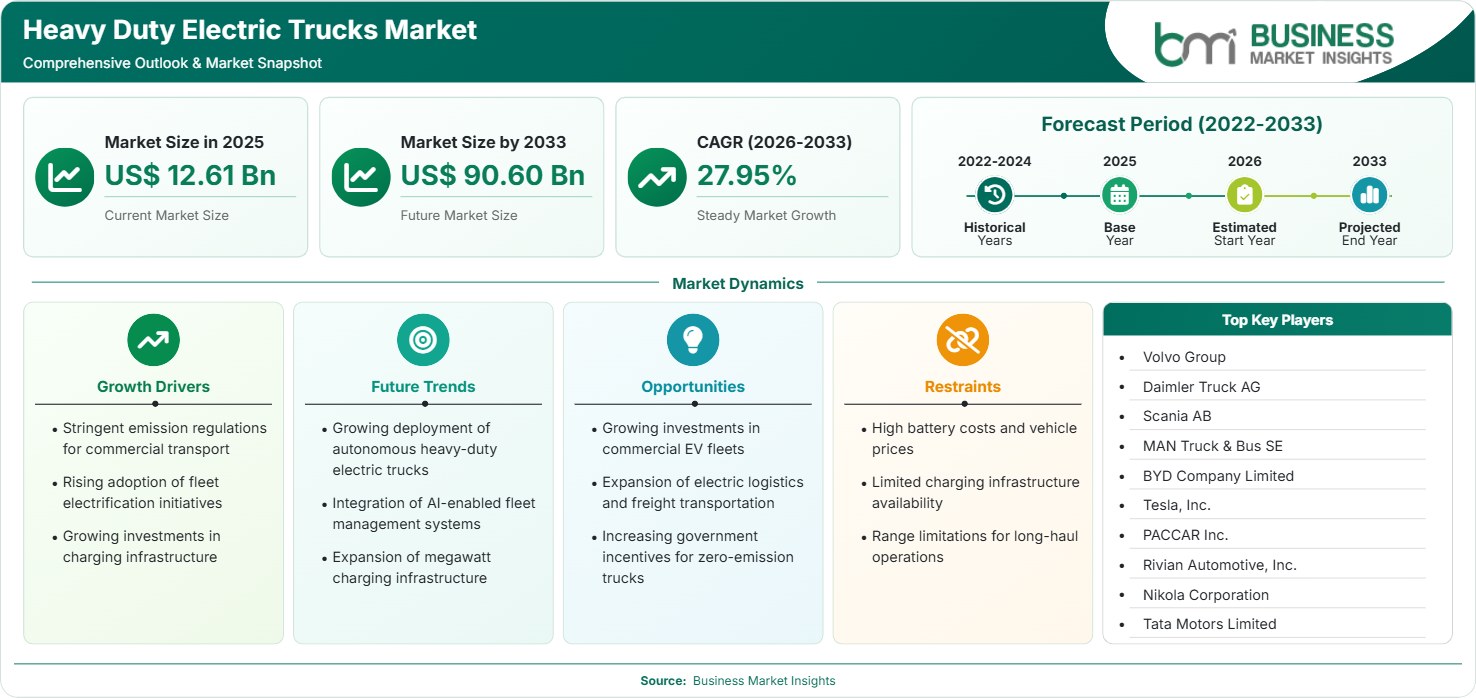
The Heavy Duty Electric Trucks Market size was valued at US$ 12.61 Billion in 2025 and is projected to reach US$ 90.60 Billion by 2033, growing at a CAGR of 27.95% during 2026–2033, supported by fleet electrification, government emission mandates, charging infrastructure expansion, and rising investment in zero-emission commercial transportation.

Report Coverage
  • Propulsion Type: Battery Electric Trucks, Fuel Cell Electric Trucks
  • Range: Less than 300 km, 300-500 km, More than 500 km
  • Battery Capacity: 150-300 kWh, 300-600 kWh, Above 600 kWh
  • Application: Long-Haul Transportation, Construction & Mining, Municipal & Utility Services, Logistics & Distribution, Others
  • Ownership Model: Fleet-Owned, Leasing / Rental, Truck-as-a-Service
US$ 12.61 Bn Market size in 2025
US$ 90.60 Bn Market Size by 2033
27.95% CAGR, 2026 - 2033
2026-2033 Forecast Period

AI Overview

Heavy Duty Electric Trucks Market Summary

  • North America Region: North America held approximately 27%–31% market share in 2025 and is projected to register a 27.0%–28.4% CAGR during 2026–2033. Growth is supported by fleet electrification programs, charging corridor expansion, and emission reduction regulations. The U.S. market is expected to grow at a 27.5%–28.8% CAGR from 2026–2033, driven by commercial fleet investments, federal incentives, and logistics sector electrification.
  • Fastest Growing Region: Asia Pacific accounted for approximately 38%–42% market share in 2025 and is anticipated to expand at a 29.0%–30.5% CAGR during 2026–2033. Strong manufacturing capacity, supportive government policies, and increasing deployment of electric commercial vehicles continue to strengthen regional demand.
  • Leading Segment: Battery Electric Trucks (BEV) represented approximately 74%–78% market share in 2025 and are expected to grow at a 28.2%–29.5% CAGR during 2026–2033. Growth is driven by improving battery technology, lower operating costs, and expanding charging infrastructure.
  • High Growth Segment: Logistics & Distribution accounted for approximately 30%–34% market share in 2025 and is forecast to grow at a 29.5%–31.0% CAGR through 2033. Rising e-commerce activity, urban freight electrification, and fleet modernization continue supporting adoption.
  • Key Market Opportunity: Expanding commercial EV fleets, government incentive programs, and rapid investment in freight electrification infrastructure are creating significant opportunities for manufacturers, fleet operators, and charging solution providers.
  • Major Market Players: Volvo Group, Daimler Truck AG, Scania AB, MAN Truck & Bus SE, BYD Company Limited, Tesla, Inc., PACCAR Inc., Rivian Automotive, Inc., Nikola Corporation, and Tata Motors Limited.
Strategic Insights

Heavy Duty Electric Trucks Market: Strategic Insights

Heavy Duty Electric Trucks Market Strategic Framework
FREE PDF
Request your free sample
Request free sample
Stakeholder View

Key Takeaways

  • Fleet electrification is transforming the commercial vehicle ecosystem, encouraging collaboration among truck manufacturers, battery suppliers, charging operators, and fleet management companies.
  • Logistics and distribution fleets represent the strongest commercial opportunity due to predictable operating routes and increasing last-mile and regional freight demand.
  • Battery innovation is improving vehicle range, charging speed, and operational efficiency, enabling wider deployment across heavy-duty transportation segments.
  • Asia Pacific remains the most attractive investment destination because of strong manufacturing capacity, government incentives, and large commercial vehicle production volumes.
  • Strategic partnerships between truck manufacturers and charging infrastructure providers are accelerating commercialization of electric freight transportation.
  • Digital fleet management, telematics, and predictive maintenance solutions are becoming essential value-added services supporting electric truck adoption.
Geographic Outlook

Heavy Duty Electric Trucks Market Regional Highlights

North America Heavy Duty Electric Trucks Market

North America accounted for approximately 27%–31% of global revenue in 2025 and is projected to expand at a 27.0%–28.4% CAGR during 2026–2033. The region benefits from stringent emission regulations, large-scale fleet electrification programs, and continuous investment in high-capacity charging infrastructure. The Heavy Duty Electric Trucks Market share remains strong across the United States and Canada, supported by commercial fleet operators, logistics companies, and government incentives encouraging zero-emission freight transportation.

  • The United States leads regional demand through federal and state incentive programs, expanding charging corridors, growing commercial EV fleets, and increasing investments in electric freight transportation.
  • Canada is supporting market growth through clean transportation policies, zero-emission freight corridor investments, and partnerships among utilities, truck manufacturers, and fleet operators.
  • Leading truck manufacturers are expanding production capacity while battery suppliers and charging infrastructure providers continue strengthening commercial electric vehicle ecosystems.
  • Growth in e-commerce, regional freight transportation, and corporate sustainability initiatives is accelerating the replacement of diesel-powered trucks with battery electric alternatives across major logistics networks.

US Heavy Duty Electric Trucks Market

The United States represented approximately 81%–85% of North American revenue in 2025 and is expected to grow at a 27.5%–28.8% CAGR during 2026–2033. Demand is supported by large logistics fleets, expanding charging infrastructure, and federal funding for clean transportation projects. Commercial fleet operators are increasingly investing in electric heavy-duty trucks to reduce operating costs and comply with stricter emission standards in Heavy Duty Electric Trucks Market.

  • Government funding under clean transportation programs is supporting charging infrastructure, commercial fleet electrification, and domestic electric truck manufacturing.
  • Major logistics companies are adopting battery electric trucks to reduce fuel costs, lower maintenance expenses, and achieve carbon reduction goals.
  • Domestic truck manufacturers are expanding production while technology providers improve battery performance, charging efficiency, and vehicle reliability for commercial applications.
  • Utility companies are partnering with fleet operators to strengthen grid infrastructure and provide reliable charging solutions for commercial transportation fleets.

Europe Heavy Duty Electric Trucks Market

Europe accounted for approximately 24%–28% of global revenue in 2025 and is projected to register a 26.5%–27.8% CAGR during 2026–2033. Strong environmental regulations, carbon reduction targets, and government support for commercial vehicle electrification continue driving market expansion. Germany leads the Heavy Duty Electric Trucks market, while the Netherlands, France, and the Nordic countries demonstrate strong adoption through freight electrification initiatives.

  • Germany maintains regional leadership through advanced truck manufacturing, expanding charging infrastructure, and growing investments in zero-emission freight transportation across industrial and logistics sectors.
  • The Netherlands is developing high-power charging corridors that support cross-border freight movement and encourage the adoption of heavy-duty electric trucks across European logistics routes.
  • France is strengthening commercial EV adoption through financial incentives, public procurement programs, and investments in clean transportation infrastructure for logistics and municipal fleets.
  • Nordic countries are accelerating market growth with abundant renewable electricity, supportive government policies, and early adoption of electric commercial vehicles in freight and construction applications.
  • European manufacturers are increasing research and development investments to enhance battery technology, vehicle efficiency, charging performance, and long-haul capabilities for heavy-duty electric trucks.

Asia Pacific Heavy Duty Electric Trucks Market

Asia Pacific represented approximately 38%–42% of global revenue in 2025 and is projected to record the fastest growth at a 29.0%–30.5% CAGR during 2026–2033. The region benefits from large-scale commercial vehicle production, supportive industrial policies, expanding battery manufacturing, and rapid deployment of electric freight vehicles. China dominates the Heavy Duty Electric Trucks Market demand, while India, Japan, and South Korea continue strengthening investment in commercial vehicle electrification.

  • China leads the regional market through large-scale production capacity, extensive commercial fleet deployment, government incentives, and expanding charging infrastructure for heavy-duty electric vehicles.
  • India is emerging as a promising market due to rising logistics demand, supportive EV manufacturing policies, and increasing investments in commercial vehicle electrification.
  • Japan is advancing battery electric and hydrogen-powered commercial vehicle programs through technology innovation and strategic industry partnerships.
  • South Korea is strengthening its position with advanced battery manufacturing, government-backed clean mobility initiatives, and growing exports of electric commercial vehicle technologies.
  • Rapid industrialization, expanding freight transportation, and increasing e-commerce activity are creating favorable conditions for heavy-duty electric truck adoption across the Asia Pacific region.

Rest of World Heavy Duty Electric Trucks Market

The Rest of World region accounted for approximately 5%–8% of global revenue in 2025 and is expected to grow at a 25.5%–27.0% CAGR during 2026–2033. Latin America is gradually adopting electric commercial vehicles through urban logistics projects, while the Middle East and Africa are investing in sustainable transportation infrastructure. Brazil, the UAE, Saudi Arabia, and South Africa are among the leading markets supporting future commercial EV deployment.

  • Brazil is expanding adoption through pilot fleet electrification projects, increasing investments in urban logistics, and government initiatives encouraging cleaner commercial transportation technologies.
  • The United Arab Emirates is investing in sustainable mobility infrastructure while supporting commercial fleet electrification through smart city projects and national carbon reduction strategies.
  • Saudi Arabia is encouraging zero-emission transportation through industrial diversification programs, renewable energy investments, and development of future-ready commercial mobility infrastructure.
  • South Africa is witnessing gradual market expansion as logistics companies evaluate electric trucks to reduce operating expenses and comply with evolving environmental sustainability requirements.
  • Growing investments in renewable energy, commercial logistics modernization, and charging infrastructure are expected to create long-term growth opportunities across emerging economies.
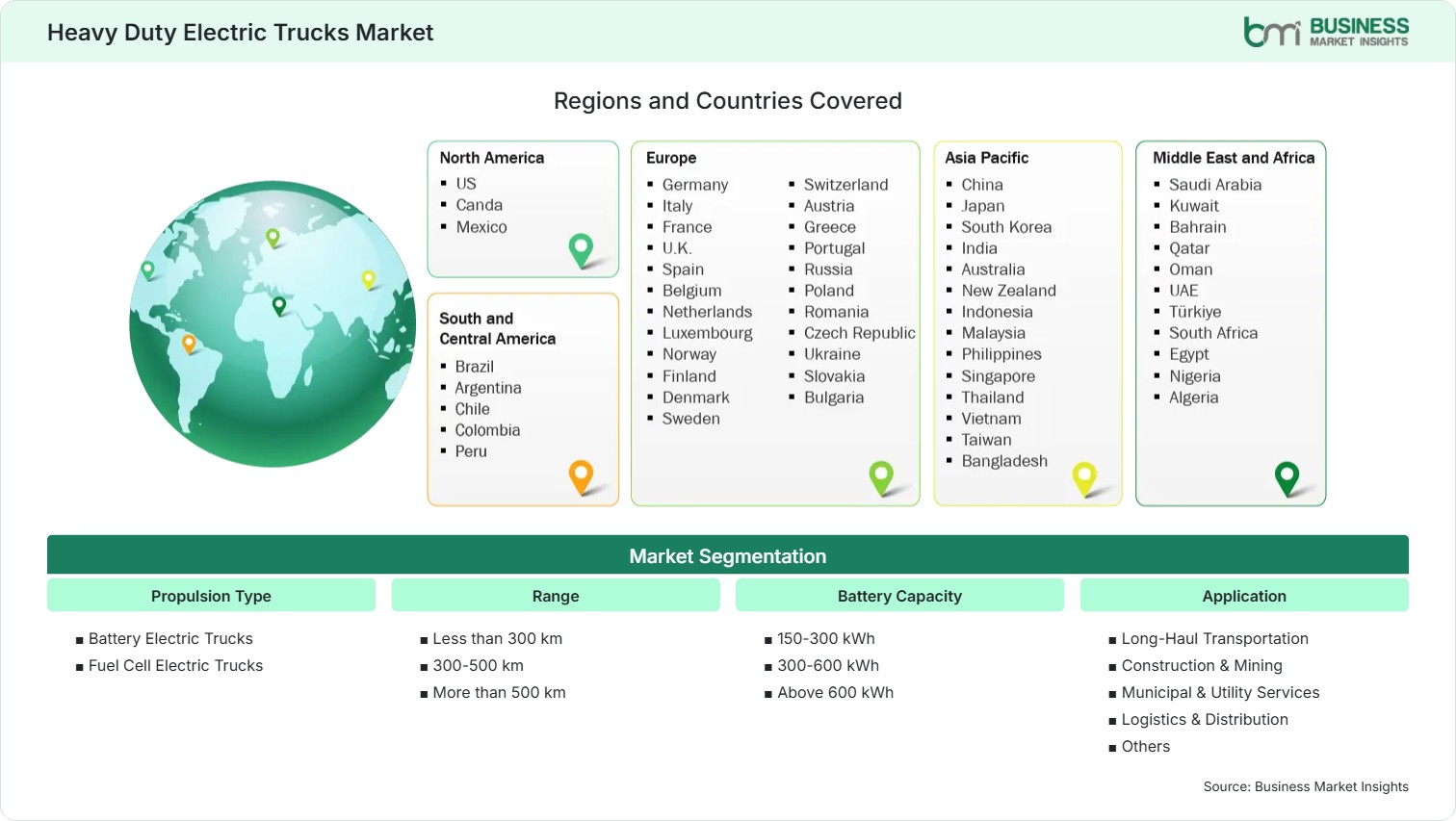
Global Market Geography
FREE PDF
Request your free sample
Request free sample
Segment Analysis

Heavy Duty Electric Trucks Market Segmentation

Propulsion Type

The propulsion type segment represents the technological foundation of the market, influenced by battery advancements, hydrogen infrastructure development, and fleet operating requirements. Battery Electric Trucks (BEV) accounted for approximately 74%–78% share in 2025 and are projected to grow at a 28.2%–29.5% CAGR during 2026–2033. Their dominance is supported by expanding charging networks, improving battery efficiency, lower operating costs, and increasing deployment across logistics, municipal, and regional freight transportation.

  • Battery Electric Trucks (BEV): BEVs dominate commercial fleet electrification due to improving battery technology, lower maintenance requirements, reduced operating costs, and expanding charging infrastructure across major transportation corridors.
  • Fuel Cell Electric Trucks (FCEV): FCEVs are gaining adoption for heavy-duty operations requiring longer driving ranges, faster refueling, and continuous operation across freight and industrial transportation applications.

Range

The range segment reflects operational requirements across different freight and commercial transportation applications. 300–500 km vehicles accounted for approximately 41%–45% share in 2025 and are expected to grow at a 28.5%–29.8% CAGR during 2026–2033. This range offers an effective balance between battery capacity, payload efficiency, and operational flexibility for regional logistics

  • Less than 300 km: Trucks with shorter operating ranges are widely deployed in urban freight, municipal services, and local distribution routes requiring frequent daily operations.
  • 300–500 km: Medium-range trucks support regional transportation by balancing driving distance, charging efficiency, payload capability, and fleet operating costs.
  • More than 500 km: Long-range electric trucks are gaining interest for intercity freight transportation where extended driving capability improves operational productivity.

Battery Capacity

Battery capacity plays a critical role in determining vehicle range, payload capability, charging frequency, and operational efficiency. 300–600 kWh batteries represented approximately 44%–48% share in 2025 and are projected to register a 28.8%–30.0% CAGR during 2026–2033. The segment benefits from its ability to support medium and long-distance freight transportation while maintaining acceptable charging times.

  • 150–300 kWh: These battery systems are commonly used in medium-duty operations, municipal fleets, and short-distance commercial transportation requiring moderate energy storage.
  • 300–600 kWh: Medium-capacity batteries provide an optimal combination of driving range, operational efficiency, charging performance, and payload capability for commercial fleet operators.
  • Above 600 kWh: High-capacity battery systems are increasingly adopted in long-haul freight operations requiring extended range, higher energy availability, and reduced charging frequency.

Application

Application demand varies based on fleet utilization, transportation distance, and operating requirements. Logistics & Distribution accounted for approximately 30%–34% of the market share in 2025 and is projected to grow at a 29.5%–31.0% CAGR during 2026–2033. Growth is driven by e-commerce expansion, regional freight demand, and corporate sustainability initiatives. The Heavy Duty Electric Trucks Market trends indicate increasing adoption across municipal services, construction, and long-haul freight transportation as charging infrastructure continues to expand.

  • Long-Haul Transportation: Long-haul applications are expanding through improvements in battery technology, charging infrastructure, and vehicle efficiency supporting extended freight operations.
  • Construction & Mining: Construction and mining operators are evaluating electric trucks to reduce emissions, lower maintenance costs, and improve operational sustainability.
  • Municipal & Utility Services: Municipal fleets are increasingly deploying electric trucks for waste collection, maintenance services, and public utility operations in urban areas.
  • Logistics & Distribution: Logistics providers continue investing in electric truck fleets to improve operational efficiency, reduce fuel expenses, and meet sustainability objectives.

Ownership Model

Ownership models are evolving as fleet operators seek flexible financing options and lower capital expenditure. Fleet-Owned vehicles accounted for approximately 58%–62% share in 2025 and are expected to expand at a 27.5%–28.8% CAGR during 2026–2033. Large logistics companies continue investing directly in electric truck fleets to optimize operations and reduce lifecycle costs, while leasing and Truck-as-a-Service models are attracting smaller fleet operators.

  • Fleet-Owned: Large transportation companies prefer direct ownership to maximize operational control, optimize asset utilization, and achieve long-term cost savings.
  • Leasing / Rental: Leasing models are gaining popularity by reducing upfront investment requirements and allowing fleet operators to adopt newer vehicle technologies.
  • Truck-as-a-Service (TaaS): TaaS solutions combine vehicle access, maintenance, charging, and digital fleet management into flexible subscription-based commercial transportation services.
Market Forces

Heavy Duty Electric Trucks Market Dynamics

Key Market Drivers

Stringent emission regulations for commercial transport

The governments of all countries have increased their policies to introduce emission standards to decrease greenhouse gas emissions through the means of commercial transportation. Measures like EU's CO2 emission standard for heavy-duty vehicles, clean vehicle standard by US Environmental Protection Agency, and many more similar regulations in Asia have been adopted to encourage operators of fleets to convert diesel vehicles into zero emission vehicles. This is driving the adoption of electric vehicles in terms of their manufacturing and technology development. The Heavy Duty Electric Trucks Market growth is further supported by financial incentives, tax benefits, and procurement programs promoting sustainable freight transportation across public and private sectors.

Rising adoption of fleet electrification initiatives

Logistics firms, retailers, and transport businesses are now including electric trucks in their fleets for reducing costs and meeting corporate sustainability goals. Fleet electrification helps in reducing the cost of fuel, maintenance, and compliance with environmental standards. Fleet management companies are collaborating with truck manufacturers and charging companies for fast deployment within regional and urban transport systems. The use of digital fleet management systems, predictive maintenance systems, and telematics is further enhancing the efficiency of operations. This will help in further growth of the use of electric trucks in business applications.

Growing investments in charging infrastructure

Increased investment in charging infrastructure for trucks is making it easier to operate electric trucks that are heavy duty. Governments, utilities, and private investors are investing in high-capacity charging stations that will be installed on freight routes, logistic centers, and industrial areas in order to reduce downtime due to charging. Megawatt chargers and energy management systems are facilitating increased charging speeds and efficient fleet management. The Heavy Duty Electric Trucks Market trends indicate that continued charging network expansion will remain a critical factor supporting long-term market development and wider commercial deployment.

Key Market Opportunities

Growing investments in commercial EV fleets

There is an increase in the deployment of electric trucks by commercial fleets to enhance efficiency and cut down costs in the transport sector. Commitments in environmental considerations, cost benefits, and incentives from the government are driving modernization of fleets in the logistics, retail, and manufacturing industries. Companies are scaling up production as financial institutions are coming up with flexible means of financing fleets. High demands from major transportation companies benefit truck manufacturers, battery makers, charging firms, and digital fleet management firms. The Heavy Duty Electric Trucks Market forecast indicates sustained investment across commercial fleet electrification throughout the forecast period.

Expansion of electric logistics and freight transportation

E-commerce and regional logistics growth are developing positive conditions for implementing heavy-duty electric trucks. The growing demand from logistics companies for efficient, clean transport that can provide services within cities and regions is evident. The advances in batteries, increased range of trucks, and development of recharging stations facilitate adoption of electric freight vehicles by logistics companies. The cooperation of fleet owners and truck producers is still contributing to the commercial success of such vehicles. Emerging markets offer excellent possibilities as well, especially when governments promote sustainability in logistics and commercial transport.

Increasing government incentives for zero-emission trucks

Governments in North America, Europe, and Asia Pacific have been making continuous efforts to push for the adoption of electric vehicles by means of offering grants, tax credits, purchase incentives, and infrastructure financing. The financial support helps in lowering the cost of buying the vehicle while motivating enterprises to upgrade their existing fuel-based fleet with electric vehicles. There has also been an effort through public procurement policies to boost the demand for the technology from the transport and utility sectors of cities.

Market Restraints and Challenges

High battery costs and vehicle prices

Factor: Heavy-duty electric trucks require large battery packs that significantly increase manufacturing costs compared with conventional diesel vehicles. Impact: Higher purchase prices slow fleet replacement decisions, particularly among small and medium-sized transportation companies with limited capital investment capacity. Although battery costs continue declining, upfront vehicle expenses remain a major adoption barrier. Manufacturers are addressing this challenge through battery innovation, localized production, financing programs, and economies of scale, but affordability continues influencing purchasing decisions across commercial transportation markets.

Limited charging infrastructure availability

Factor: Commercial charging infrastructure remains insufficient across several freight corridors, industrial regions, and long-haul transportation routes. Impact: Limited charging availability restricts operational flexibility, increases route planning complexity, and slows fleet electrification for long-distance commercial transport. Significant investments are being directed toward high-capacity charging stations, grid upgrades, and megawatt charging technologies to overcome infrastructure limitations. Until these networks expand further, charging accessibility will continue affecting adoption rates, particularly for long-haul freight operators requiring reliable nationwide charging coverage.

Company Analysis

Competitive Landscape

The Heavy Duty Electric Trucks Market analysis is driven by innovation in battery technology, fleet electrification, strategic collaborations, and production expansion. Leading manufacturers are strengthening their portfolios through electric truck launches, charging ecosystem development, and advanced mobility solutions.

Company Name

Overview

Products and Services relevant to this market

Volvo Group

Global commercial vehicle manufacturer.

Heavy-duty electric trucks and fleet services.

Daimler Truck AG

Leading commercial truck producer.

Battery electric and fuel cell trucks.

Scania AB

Manufacturer of sustainable transport solutions.

Electric trucks and charging services.

MAN Truck & Bus SE

European commercial vehicle company.

Heavy-duty electric trucks and fleet solutions.

BYD Company Limited

Global electric vehicle manufacturer.

Battery electric trucks and battery systems.

Tesla, Inc.

Developer of electric commercial vehicles.

Tesla Semi and charging solutions.

PACCAR Inc.

Global truck manufacturing company.

Electric trucks and aftermarket services.

Rivian Automotive, Inc.

Electric vehicle technology company.

Commercial electric vehicles and software.

Nikola Corporation

Manufacturer of zero-emission trucks.

Battery electric and hydrogen fuel cell trucks.

Tata Motors Limited

Commercial vehicle manufacturer.

Electric trucks and mobility solutions.

Trust & Transparency

Research Methodology

The market analysis combines proprietary research with secondary data from government agencies, company disclosures, regulatory filings, industry databases and expert interviews. Market estimates are validated through data triangulation, cross-market benchmarking and analyst review.

View Full Research Methodology

Questions Answered

Frequently Asked Questions

How does this Heavy Duty Electric Trucks Market report support business decisions?

The report provides detailed insights into regional opportunities, competitive developments, technology trends, market segmentation, and future investment prospects for industry participants.

What are the major challenges affecting market expansion?

High battery costs, expensive vehicle acquisition, and limited charging infrastructure across long-haul transportation routes continue to restrain faster commercial adoption.

Which region offers the strongest growth opportunities?

Asia Pacific provides the highest growth potential due to strong manufacturing capabilities, supportive government policies, battery production investments, and increasing deployment of electric commercial vehicles.

Which propulsion technology dominates the market?

Battery Electric Trucks (BEVs) hold the largest market share because of improving battery performance, lower maintenance costs, expanding charging networks, and increasing commercial fleet adoption.

What is driving demand for heavy duty electric trucks market?

Demand is primarily driven by stricter emission regulations, fleet electrification initiatives, lower operating costs, expanding charging infrastructure, and government incentives supporting zero-emission commercial transportation.

Access the Full Heavy Duty Electric Trucks Market Report

Get segment-level forecasts, regional estimates, competitive benchmarking, company profiles and downloadable Excel datasets.

Access the full Heavy Duty Electric Trucks Market Report
350 pages PDF & Excel | 2026-08-07
Similar Research

Related Market Reports