
Electric Van Market Outlook: Size, Share, Trends, Growth Analysis, Competitive Landscape & Forecast, 2026-2033

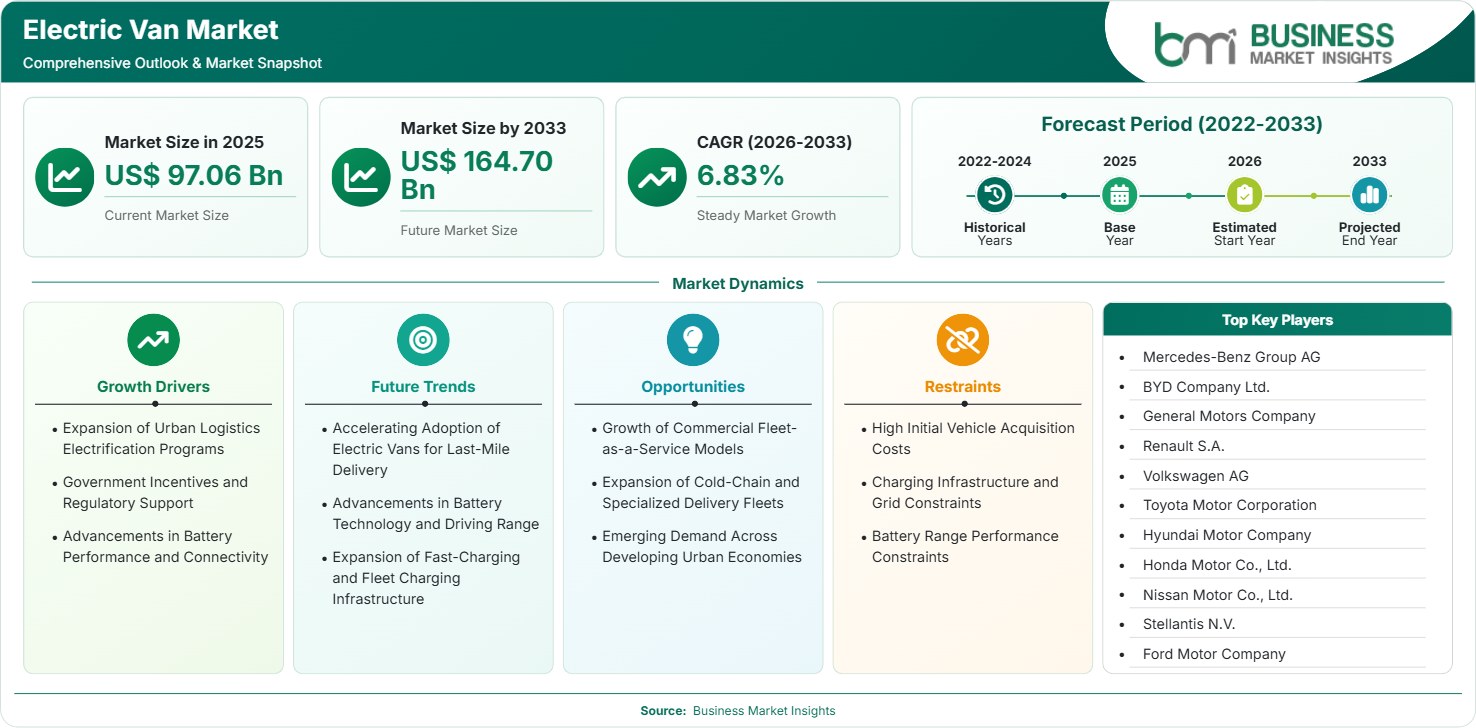
The Electric Van Market size was valued at US$ 97.06 Billion in 2025 and is projected to reach US$ 164.70 Billion by 2033, growing at a CAGR of 6.83% during 2026–2033, driven by fleet electrification mandates, expanding charging infrastructure, battery cost optimization, urban emission regulations, last-mile delivery demand, and growing investment in connected commercial mobility solutions.

Report Coverage
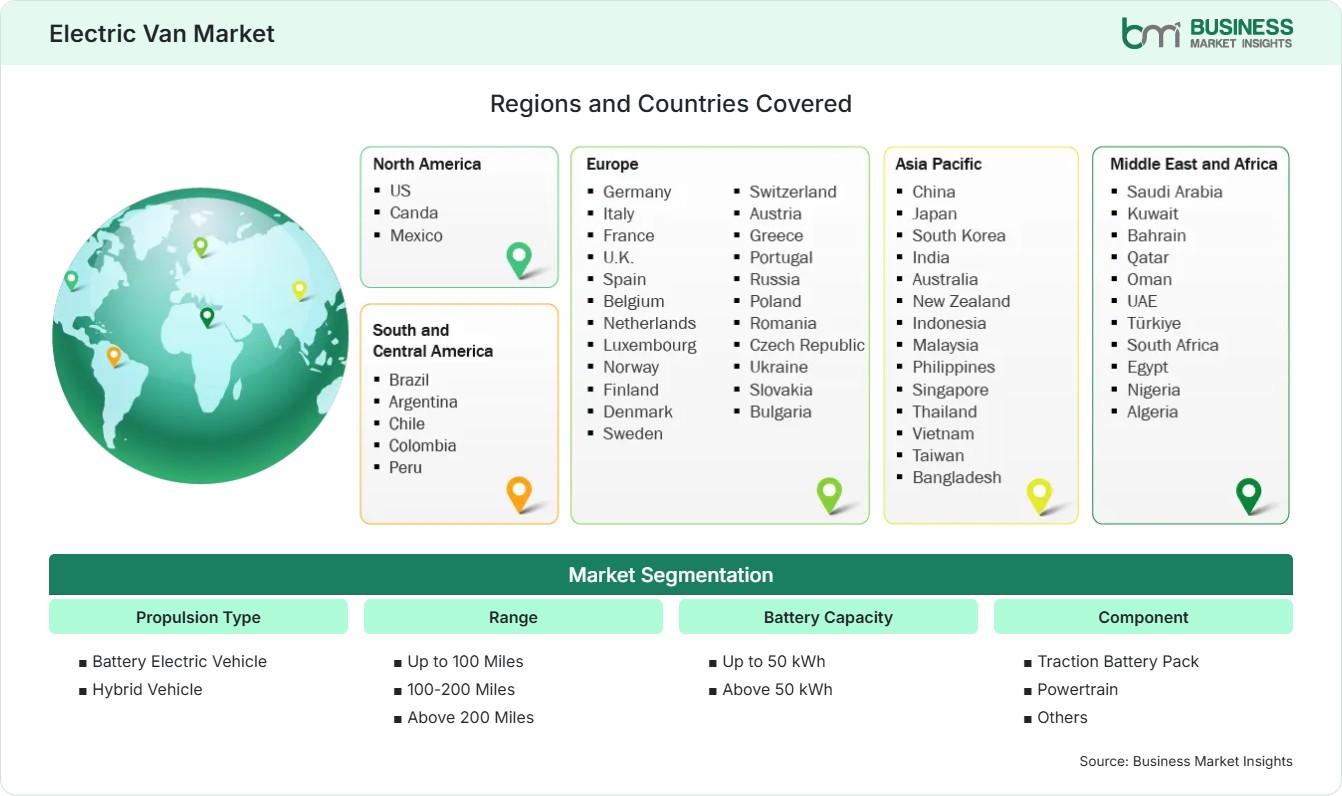
  • Propulsion Type: Battery Electric Vehicle, Hybrid Vehicle
  • Range: Up to 100 Miles, 100-200 Miles, Above 200 Miles
  • Battery Capacity: Up to 50 kWh, Above 50 kWh
  • Component: Traction Battery Pack, Powertrain, Others
US$ 97.06 Bn Market size in 2025
US$ 164.70 Bn Market Size by 2033
6.83% CAGR, 2026 - 2033
2026-2033 Forecast Period

AI Overview

Electric Van Market Summary

  • North America Region: North America holds a market share of 34%–37% in 2025, growing at a CAGR of 6.1%–6.6% during 2026–2033. Demand is supported by fleet electrification programs, logistics modernization, government incentives, charging expansion, corporate sustainability commitments, e-commerce delivery growth, battery innovation, operational cost reduction initiatives, urban emission targets, and digital fleet management adoption. The U.S. maintains regional leadership with strong commercial fleet replacement activity and a CAGR of 6.2%–6.7%.
  • Fastest Growing Region: Asia Pacific holds a market share of 28%–31% in 2025, growing at a CAGR of 7.8%–8.4% during 2026–2033. Accelerated urban logistics expansion, supportive EV policies, domestic battery manufacturing, rising parcel volumes, smart city investments, and commercial fleet electrification programs continue strengthening regional adoption across major economies.
  • Leading Segment: Battery Electric Vehicle (BEV) holds a market share of 72%–75% in 2025, growing at a CAGR of 7.0%–7.5% during 2026–2033. Improved battery density, lower operating costs, fleet sustainability goals, expanding charging infrastructure, regulatory compliance requirements, and increasing manufacturer model availability support segment leadership globally.
  • High Growth Segment: Above 200 Miles holds a market share of 24%–27% in 2025, growing at a CAGR of 8.5%–9.1% during 2026–2033. Demand benefits from intercity logistics requirements, charging convenience, route flexibility, battery technology advances, fleet productivity improvements, and expanding commercial applications requiring extended operational range.
  • Key Market Opportunity: Growing electrification of urban logistics fleets creates opportunities for vehicle manufacturers, battery suppliers, charging providers, software developers, and fleet operators seeking lower emissions, reduced operating costs, and regulatory compliance.
  • Major Market Players: Mercedes-Benz Group AG, BYD Company Ltd., General Motors Company, Renault S.A., Volkswagen AG, Toyota Motor Corporation, Hyundai Motor Company, Honda Motor Co., Ltd., Nissan Motor Co., Ltd., Stellantis N.V., and Ford Motor Company.
Strategic Insights

Electric Van Market: Strategic Insights

Electric Van Market Strategic Framework
FREE PDF
Request your free sample
Request free sample
Stakeholder View

Key Takeaways

  • The value chain is becoming increasingly integrated as vehicle manufacturers, battery suppliers, charging infrastructure providers, telematics vendors, and fleet operators collaborate to improve operational efficiency and lifecycle economics.
  • Last-mile delivery fleets represent one of the strongest growth opportunities because urban emission regulations and e-commerce expansion are driving accelerated replacement of conventional commercial vehicles.
  • Product innovation is shifting toward higher energy-density batteries, vehicle-to-grid capabilities, intelligent route optimization, and cloud-based fleet management systems that enhance productivity and energy utilization.
  • Asia Pacific offers a compelling investment case due to domestic battery production capabilities, government support programs, large logistics networks, and rapidly expanding commercial vehicle electrification initiatives.
  • Strategic partnerships, battery supply agreements, and manufacturing joint ventures are becoming critical as industry participants seek secure supply chains and improved production scalability.
  • Data-driven fleet services, predictive maintenance solutions, and subscription-based mobility offerings are creating recurring revenue opportunities beyond traditional vehicle sales.
Geographic Outlook

Electric Van Market Regional Highlights

North America Electric Van Market

North America accounted for approximately 34%–37% share in 2025 and is projected to expand at a CAGR of 6.1%–6.6% during 2026–2033. Regional demand is supported by commercial fleet electrification initiatives, advanced charging infrastructure deployment, and sustainability commitments among major logistics providers. The region benefits from strong corporate investment, supportive policy frameworks, and increasing adoption of connected fleet technologies. The Electric Van Market share remains highest in North America due to established fleet replacement cycles and substantial e-commerce delivery volumes.

  • Leading logistics firms have embarked on a path toward fleet electrification to reduce fuel costs, enhance sustainability, and comply with more stringent environmental regulations.
  • The government and state governments are offering incentives for the purchase and installation of fast chargers, which help in adoption in commercial segments like transport, retail and municipal.
  • The connected fleet management system has made it possible to optimize routes, battery life, and maintenance to increase efficiency and vehicle utilization.
  • Growing investment in public and private fast-charging stations has reduced operational barriers to broader commercial use.
  • Urban initiatives for low-emission transportation are pushing businesses to switch from an ICE fleet to zero emission fleet.

US Electric Van Market

The United States represents approximately 78%–82% of regional demand in 2025 and is forecast to register a CAGR of 6.2%–6.7% through 2033. Large-scale logistics operations, strong corporate sustainability commitments, and increasing commercial EV investments support adoption. Major fleet operators continue integrating electrified delivery vehicles into distribution networks while leveraging digital fleet management systems to maximize efficiency and lower operating costs.

  • E-commerce fulfillment expansion continues generating demand for commercial delivery vehicles capable of supporting high-frequency urban logistics operations.
  • Corporate decarbonization targets are encouraging fleet operators to transition toward electric commercial transportation solutions supported by dedicated charging infrastructure.
  • Technology investments in telematics, battery analytics, and route optimization are improving fleet economics and operational visibility.
  • Public-private partnerships are supporting charging network expansion across major logistics hubs and commercial transportation corridors.

Europe Electric Van Market

Europe held approximately 29%–32% share in 2025 and is expected to grow at a CAGR of 6.8%–7.3% during 2026–2033. Strong environmental regulations, carbon reduction targets, and extensive urban emission-control policies continue driving adoption. Germany remains the leading Electric Van Market with growth around 6.9%–7.4%, while France represents one of the fastest-developing national markets supported by incentive programs and fleet modernization initiatives.

  • Urban low-emission zones continue encouraging businesses to adopt cleaner commercial transportation alternatives for city-based operations.
  • Fleet operators are increasingly prioritizing electrified delivery networks to align with sustainability reporting requirements and ESG commitments.
  • Charging infrastructure investments across key freight corridors are supporting broader commercial deployment and operational flexibility.
  • Domestic vehicle manufacturing capabilities enable faster commercialization of new technologies and localized supply chain development.
  • Public procurement programs are accelerating adoption among municipal transportation and utility service fleets.

Asia Pacific Electric Van Market

Asia Pacific accounted for approximately 28%–31% share in 2025 and is projected to record the fastest regional expansion in Electric Van Market at a CAGR of 7.8%–8.4% through 2033. China leads regional demand with strong manufacturing capacity and policy support, while India emerges as a high-growth market with expansion near 8.5%–9.0%. Rapid urbanization, e-commerce growth, and domestic battery production investments continue strengthening regional competitiveness.

  • Strong government support programs are encouraging commercial fleet electrification through incentives, infrastructure funding, and manufacturing initiatives.
  • Domestic battery production capabilities help reduce supply chain risks while improving affordability and scalability.
  • Rapid expansion of urban delivery networks is increasing demand for efficient commercial transportation solutions.
  • Smart city development projects are supporting deployment of connected mobility platforms and charging infrastructure.
  • Growing commercial vehicle manufacturing investments are strengthening regional production ecosystems and export capabilities.

Rest of World Electric Van Market

The Rest of World region represented approximately 7%–10% share in 2025 and is anticipated to expand at a CAGR of 6.5%–7.0% through 2033. South and Central America are experiencing gradual adoption supported by sustainability initiatives and fleet modernization efforts. In the Middle East and Africa, infrastructure development and government-backed clean mobility strategies are contributing to demand growth. The Electric Van Market growth outlook remains positive as commercial electrification projects expand.

  • Brazil continues leading South American adoption through logistics sector modernization and growing sustainability commitments.
  • The United Arab Emirates is emerging as a regional hub for commercial EV deployment supported by smart mobility initiatives.
  • Infrastructure investments remain critical to accelerating fleet electrification across developing economies.
  • Commercial transportation operators increasingly evaluate electrified fleets to reduce long-term operating expenditures.
  • International partnerships are supporting technology transfer, charging deployment, and vehicle assembly initiatives.
Global Market Geography
FREE PDF
Request your free sample
Request free sample
Segment Analysis

Electric Van Market Segmentation

Propulsion Type

Propulsion type remains the most influential purchasing factor across commercial fleet operations. This segment accounted for approximately 72%–75% share in 2025 and is projected to expand at a CAGR of 7.0%–7.5% through 2033. Growing environmental regulations, declining battery costs, operational savings, and broader charging infrastructure deployment continue supporting adoption. The Electric Van Market scope continues expanding as fleet operators prioritize sustainable transportation investments.

  • Battery Electric Vehicle (BEV): Dominates commercial deployment due to zero tailpipe emissions, lower maintenance requirements, improving battery performance, and favorable operating economics for urban and regional logistics applications.
  • Hybrid Vehicle (HEV): Supports operators requiring operational flexibility in areas with limited charging infrastructure while enabling progressive fleet electrification and fuel consumption reduction.

Range

Range capabilities increasingly influence procurement decisions as commercial operators seek greater route flexibility and reduced charging interruptions. The segment held approximately 31%–34% Electric Van Market share in 2025 and is expected to grow at a CAGR of 7.4%–7.9% through 2033. Extended-range platforms support broader logistics applications while improving fleet productivity and operational efficiency.

  • Up to 100 Miles: Suitable for urban delivery routes, municipal services, and localized transportation activities requiring predictable daily driving patterns.
  • 100–200 Miles: Addresses regional delivery requirements by balancing battery costs, operational flexibility, and charging accessibility for commercial fleets.
  • Above 200 Miles: Benefits long-distance logistics operations requiring enhanced route flexibility, fewer charging interruptions, and improved utilization rates.

Battery Capacity

Battery capacity directly impacts vehicle range, payload capability, and operational efficiency. This segment accounted for approximately 58%–61% share in 2025 and is anticipated to register a CAGR of 7.2%–7.7% through 2033. Technological advancements continue improving energy density, charging performance, and lifecycle economics while supporting broader fleet adoption.

  • Up to 50 kWh: Supports light-duty commercial applications operating within shorter urban routes where charging accessibility is readily available.
  • Above 50 kWh: Enables longer operational cycles, improved route flexibility, and enhanced suitability for demanding logistics applications requiring extended driving ranges.

Component

Component innovation remains essential for improving vehicle performance, efficiency, and reliability. This segment represented approximately 35%–38% share in 2025 and is forecast to expand at a CAGR of 7.6%–8.1% through 2033. Ongoing Electric Van Market trends indicate growing investment in advanced batteries, intelligent power electronics, and thermal management technologies.

  • Traction Battery Pack: Serves as the core energy storage system, influencing range, vehicle performance, charging efficiency, and lifecycle costs.
  • Powertrain: Supports energy conversion and propulsion efficiency while enhancing driving performance and overall operational reliability.
Market Forces

Electric Van Market Dynamics

Key Market Drivers

Expansion of Urban Logistics Electrification Programs

Electrification is rapidly spreading in urban logistics networks due to emission-reduction targets set by city governments and large companies. More than half of consumers worldwide today receive their merchandise via e-commerce channels, placing greater demands on delivery companies to operate efficiently without generating emissions. Transport companies are upgrading their fleets with electric vehicles to meet urban transportation emissions standards. Moreover, there have been many developments in charging network quality, battery longevity, and fleet management software that facilitate adoption.

Government Incentives and Regulatory Support

Policies that aim to speed up the deployment of commercial electric vehicles are being rolled out by governments at the national and regional level. Purchase rebates, tax credits, zero-emission standards, and charging infrastructure financing have been helping to make the business case more viable for fleet operators. The emission standards in Europe, clean transportation programs in North America, and manufacturing incentives in the Asia-Pacific region have made manufacturers increase their production capacity. Regulatory regimes are increasingly enabling fleet replacement schemes while providing demand certainty for vehicle and component makers. Public procurement campaigns, such as those related to municipal service and utility fleets, help as well.

Advancements in Battery Performance and Connectivity

Advancements in battery technology have increased driving range, reduced charging times, and improved the operational reliability of electric vehicles. Modern-day commercial fleets include telematics, predictive maintenance, and smart energy management systems. There are advantages for fleet managers in terms of minimizing downtime, optimal routing, and improved vehicle utilization. At the same time, economies of scale in battery production contribute to lowering costs of ownership and availability of batteries. Connectivity ensures that fleet operators can effectively track vehicle performance and plan charging cycles.

Key Market Opportunities

Growth of Commercial Fleet-as-a-Service Models

Fleet-as-a-Service business models present a substantial opportunity for manufacturers, mobility providers, and financing organizations. The Electric Van Market Forecasts indicate increasing demand for subscription-based vehicle access, charging integration, maintenance packages, and digital fleet services. The majority of small- to mid-sized companies would favor the certainty of regular operating costs over a substantial upfront investment in vehicle purchases. Service integration not only simplifies adoption but also increases scalability potential. Firms that provide an integrated mobility solution can create continuous revenue-generation models and enhance customer retention.

Expansion of Cold-Chain and Specialized Delivery Fleets

The temperature-controlled logistics networks are growing quickly due to the rising popularity of pharmaceutical logistics, food delivery, and the health-care logistics sector. Electrified commercial vehicles with refrigeration technology offer logistics providers opportunities to minimize their environmental footprint while ensuring the quality of goods throughout the process. The current regulatory emphasis on sustainable logistics encourages logistics providers to update their fleets in cold logistics applications. Improvements in battery technology enable logistics providers to have greater confidence in using electrified vehicles for specialty transportation.

Emerging Demand Across Developing Urban Economies

Urbanization in Asia, Latin America, and some Middle Eastern countries has been creating demand for effective commercial transport systems. The growing number of e-commerce platforms, the adoption of green transport measures by governments, and investments in electric car charging facilities have created favorable market conditions. Increasingly, fleet operators are considering electrification as a solution to lowering fuel and operational costs. The increasing capacity for domestic production makes this possible. All of these create opportunities for international companies to expand their production, partnerships, and distribution systems in these markets.

Market Restraints and Challenges

High Initial Vehicle Acquisition Costs

Factor: Electric commercial vehicles typically require higher upfront capital investment than conventional alternatives due to battery costs and advanced electronic systems. Impact: Many fleet operators, particularly small businesses, delay purchasing decisions despite long-term operational savings. The availability of financing and the residual value of batteries can also play an important role in determining the time required for investment. Although battery prices have been continually dropping, purchase cost remains a major factor in various markets. The manufacturers have tried to address the problem by introducing financing options such as leasing and subscriptions.

Charging Infrastructure and Grid Constraints

Factor: Charging infrastructure deployment remains uneven across regions, particularly in rural and developing markets. Impact: Limited charging availability can restrict route planning flexibility and operational efficiency for commercial fleet operators. Problems with grid capacity, delays in the permitting process, and infrastructure investments may hinder the widespread use of EVs. Commercial entities generally need a specialized charging system that allows simultaneous charging of several cars. This means that any infrastructure deficiencies can pose problems for the implementation of EV projects.

Company Analysis

Competitive Landscape

The Electric Van Market analysis highlights intense competition among established automotive manufacturers focused on electrification, battery innovation, connected mobility, and commercial fleet solutions.

Company Name

Overview

Products and Services Relevant to this Market

Mercedes-Benz Group AG

Global premium automotive manufacturer with strong commercial vehicle expertise and expanding electric mobility portfolio.

eSprinter electric vans, fleet services, connected mobility solutions, battery-electric commercial vehicle technologies.

BYD Company Ltd.

Leading Chinese EV manufacturer with vertically integrated battery and vehicle production capabilities.

Electric commercial vans, battery systems, fleet electrification solutions, charging technologies.

General Motors Company

Major automotive producer investing heavily in electric vehicle platforms and commercial mobility.

BrightDrop electric delivery vehicles, fleet management tools, connected commercial transportation services.

Renault S.A.

European automotive leader with established electric vehicle expertise and commercial van offerings.

Electric vans, fleet mobility services, charging ecosystem partnerships, commercial transportation solutions.

Volkswagen AG

Global manufacturer advancing electrification through modular EV architectures and digital mobility technologies.

ID. Buzz Cargo, electric commercial vehicles, software-enabled fleet management systems.

Toyota Motor Corporation

Automotive leader investing in electrified mobility, batteries, and commercial transportation innovation.

Electrified commercial vehicles, hybrid technologies, mobility platforms, fleet services.

Hyundai Motor Company

Global vehicle manufacturer expanding electric commercial transportation and connected vehicle capabilities.

Electric vans, battery-electric platforms, digital fleet technologies, mobility services.

Honda Motor Co., Ltd.

Automotive company pursuing electrification strategies across passenger and commercial transportation segments.

Electrified vehicle technologies, energy management systems, connected mobility solutions.

Nissan Motor Co., Ltd.

Pioneer in electric mobility with extensive experience in battery-electric vehicle development.

Electric commercial vehicles, battery technologies, fleet electrification solutions.

Stellantis N.V.

Multinational automotive group with broad commercial vehicle portfolio and electrification investments.

Electric vans, fleet connectivity platforms, charging partnerships, commercial mobility services.

Ford Motor Company

Leading commercial vehicle manufacturer expanding electrified transportation offerings globally.

E-Transit electric vans, fleet telematics, charging solutions, commercial mobility services.

Trust & Transparency

Research Methodology

The market analysis combines proprietary research with secondary data from government agencies, company disclosures, regulatory filings, industry databases and expert interviews. Market estimates are validated through data triangulation, cross-market benchmarking and analyst review.

View Full Research Methodology

Questions Answered

Frequently Asked Questions

Which commercial applications create the greatest demand for electric vans?

Last-mile delivery, parcel logistics, municipal services, food distribution, healthcare transportation, and field-service operations represent major commercial applications driving vehicle deployment globally.

What does the Electric Van Market Report indicate about future technology development?

The report highlights growing emphasis on higher energy-density batteries, intelligent fleet connectivity, predictive maintenance systems, faster charging technologies, and integrated energy management platforms.

How do electric vans reduce operating expenses for fleet operators?

Electric vehicles typically offer lower energy costs, reduced maintenance requirements, fewer moving parts, and enhanced operational monitoring through connected fleet management systems.

Which region is expected to experience the strongest expansion through 2033 in Electric Van Market?

Asia Pacific is projected to record the fastest growth due to strong policy support, battery manufacturing investments, expanding urban logistics networks, and increasing commercial vehicle electrification programs.

What factors are accelerating adoption of electric vans among commercial fleets?

Rising fuel costs, sustainability commitments, government incentives, emission regulations, and improvements in battery performance are encouraging logistics providers and service operators to electrify vehicle fleets.

Access the Full Electric Van Market Report

Get segment-level forecasts, regional estimates, competitive benchmarking, company profiles and downloadable Excel datasets.

Access the full Electric Van Market Report
350 pages PDF & Excel | 2026-08-27