Market Summary
Executive Summary and Global Market Analysis
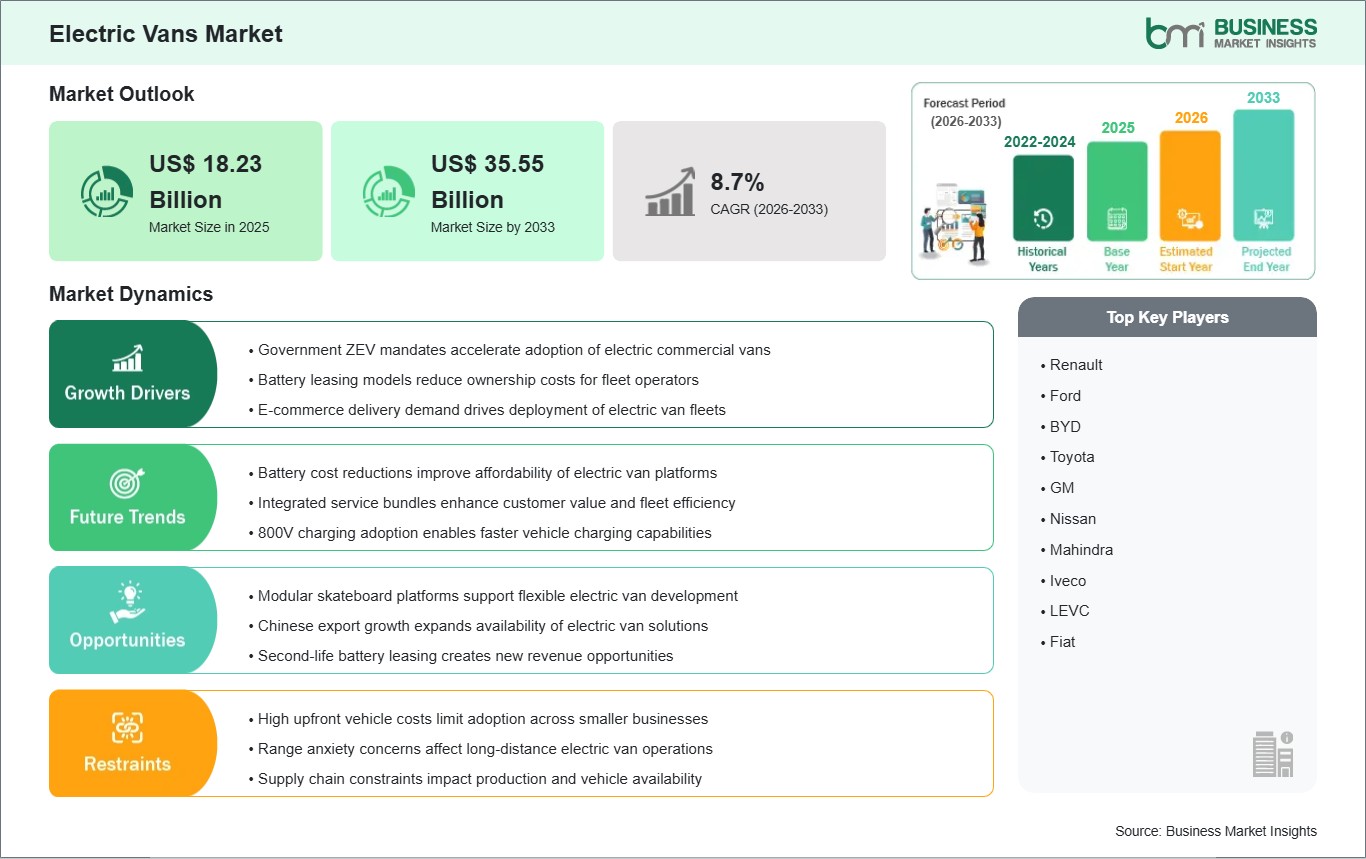
Electric vans are light and medium commercial vehicles powered fully or partly by electricity, made for carrying cargo or passengers. They mark an important change in urban logistics by providing zero-emission options instead of traditional gas-powered fleets. More fleet operators are using these vans to improve last-mile delivery and meet stricter city environmental rules.
Companies around the world are adopting electric vans because of strict sustainability goals and the long-term savings from lower maintenance. More fleets are switching to electric as cities limit access for diesel vehicles. Better battery technology also helps reduce worries about range, making electric vans practical for daily use.
Cargo vans play a big role in logistics, while passenger vans are becoming more common in company shuttles and city transit. Most electric vans use battery-electric systems, with hybrids offering longer range for regional deliveries. Businesses make most of the purchases, while personal use is still a small but growing area, mainly for multi-purpose needs.
Car makers are moving to designs made just for electric vehicles, instead of adapting old gas-powered models. This change lets them place batteries better, which improves stability and safety. The market includes both established car companies using their large factories and new companies offering advanced, software-focused fleet solutions.
Segment Analysis
Electric Vans Market Segmentation
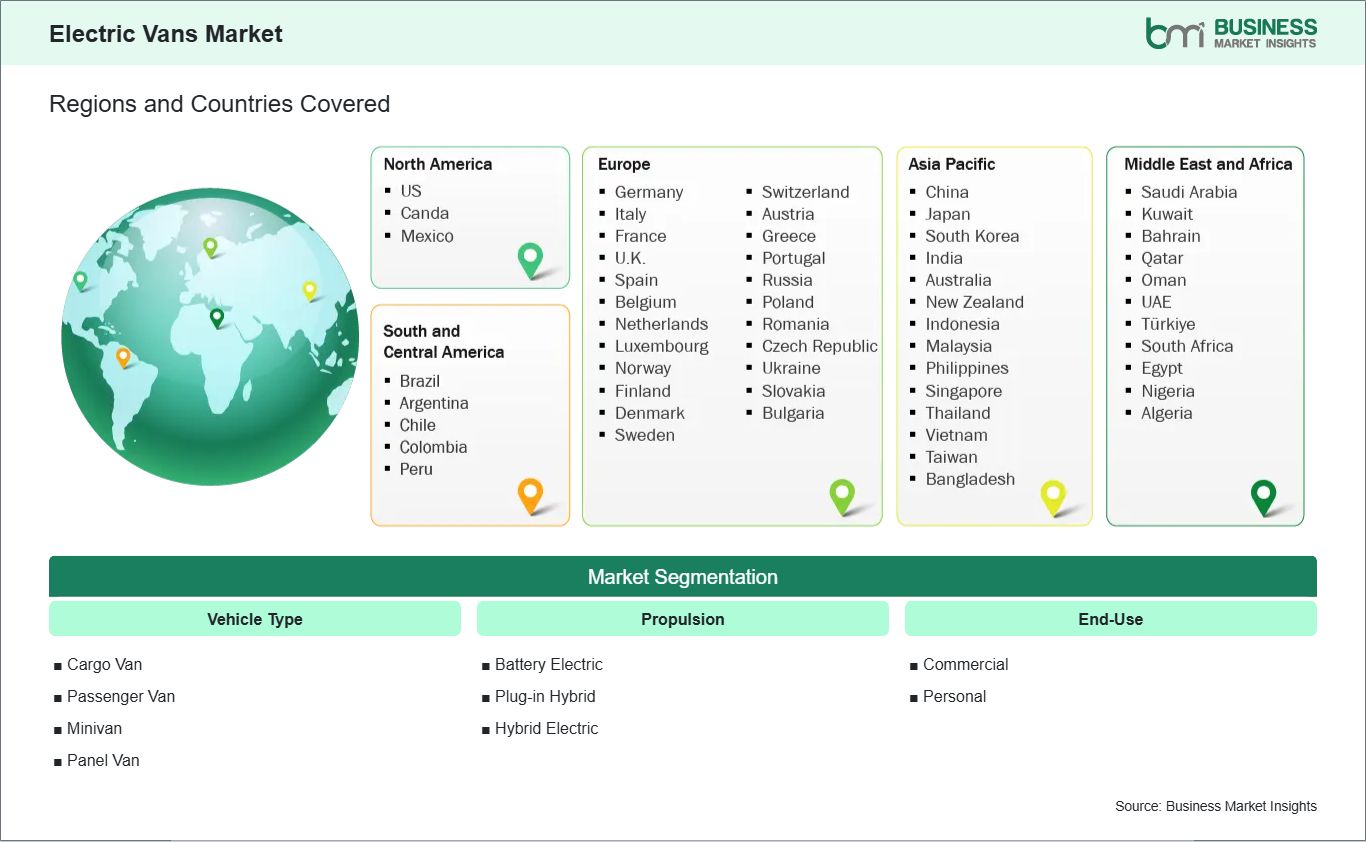
The electric vans market is segmented based on vehicle type, propulsion, and end-use, reflecting the diversified deployment of electrified transport solutions across commercial distribution networks and private transit sectors.
By Vehicle Type
- Cargo Van: Dedicated freight configurations prioritize maximum payload capacity and volumetric efficiency for urban parcel distribution.
- Passenger Van: Shared mobility models focus on cabin comfort, safety systems, and optimized seating layouts for fleet transit.
- Minivan: Multi-purpose designs cater to dual-use scenarios, balancing family transportation needs with small-scale commercial utility.
- Panel Van: Rigid-walled delivery vehicles offer secure, customizable cargo spaces suitable for specialized trades and technical service providers.
By Propulsion
- Battery Electric: Pure electric drivetrains eliminate tailpipe emissions entirely while delivering the lowest operational cost per mile.
- Plug-in Hybrid: Dual-source powertrains combine short-range electric operation with an internal combustion engine to alleviate range limitations.
- Hybrid Electric: Self-charging configurations improve fuel economy through regenerative braking without requiring dedicated external charging infrastructure.
By End-Use
- Commercial: Logistics corporations and independent contractors deploy fleets to satisfy corporate sustainability mandates and reduce operational overhead.
- Personal: Private consumers select electrified vans to accommodate large families or support recreational, outdoor-oriented lifestyles.
Market Forces
Electric Vans Market Drivers and Opportunities
Government ZEV mandates
Across the world, regulatory agencies are adopting stringent zero-emissions guidelines in order to reduce the emissions of greenhouse gases and enhance the quality of air in metropolitan cities. Through this legislation, it is mandatory that fleet companies adopt zero-emissions vehicles and replace their existing internal combustion vehicles. This has created a dire need for fleet conversion at once.
The legal obligations compel logistics companies to adopt new approaches towards their future procurement and develop extensive charging facilities at the depots. The legal pressure converts the environmental obligation, which was an initiative of corporate social responsibility, into a legal obligation. Ultimately, through this legislation, the values of vehicles will change and favor only electric vehicles.
Modular skateboard platforms
The shift to a pure electric vehicle architecture allows for the construction of a compact and modular chassis that incorporates both the battery cells and drivetrain modules. From an engineering standpoint, this approach has created a clear separation between the chassis framework and the upper body design, enabling carmakers to swap out various cabin setups without any hassles. It thus becomes possible to develop vehicles with different physical forms using the same platform, including both high-capacity cargo trucks and transport shuttles.
For carmakers relying on such standardized platforms, there is a remarkable level of flexibility in their manufacturing process as well as much lower costs associated with the introduction of new vehicles. As a result, automotive firms will be able to offer customers personalized fleets that meet the exact volume specifications of individual logistics companies.
Size and Share Analysis
Electric Vans Market Size and Share Analysis
The electric vans market is projected to grow from US$ 18.23 billion in 2025 to US$ 35.55 billion by 2033, registering a CAGR of 8.7% from 2026 to 2033.
By vehicle type, the cargo van accounts for a significant share due to the exponential rise of e-commerce fulfillment requirements and the subsequent pressure on logistics companies to deploy zero-emission vehicles for high-frequency, short-range urban delivery routes.
By propulsion, the battery electric leads the market owing to the compounding benefits of zero tailpipe emissions, substantial long-term maintenance savings, and preferential access granted to fully electric commercial fleets within restricted zero-emission municipal zones.
Report Coverage
Electric Vans Market Report Coverage and Deliverables
The "Electric Vans Market Size and Forecast (2022-2033)" report provides a detailed analysis of the market covering below areas:
- Market size and forecast at global, regional, and country levels for all key market segments covered under the scope
- Market trends, along with market dynamics such as drivers, restraints, and key opportunities
- Market analysis covering key trends, global and regional frameworks, major players, regulations, and recent developments
- Industry landscape and competitive analysis covering market concentration, heat map analysis, prominent players, and recent developments
- Detailed company profiles, including SWOT analysis
Geographic Insights
Electric Vans Market Geographic Insights
The electric vans market shows diverse regional adoption patterns influenced by localized regulatory pressures, charging infrastructure maturity, and regional logistics architecture. Global development remains uneven, with highly industrialized zones exhibiting rapid fleet transitions while developing regions encounter infrastructure bottlenecks. The variance in financial incentives and local manufacturing capabilities further fragments the global landscape, creating distinct ecosystems for commercial fleet electrification.
North American deployment is characterized by large-scale corporate procurement contracts and a distinct preference for high-capacity, heavy-duty cargo configurations. Corporate logistics giants in this region drive volume through centralized fleet orders aimed at cross-state distribution hubs. Federal tax credits incentivize local assembly, forcing an emphasis on establishing robust domestic battery supply chains to support high-output manufacturing facilities.
The Asia Pacific region demonstrates leadership through extensive manufacturing ecosystems, dominant battery component supply chains, and aggressive municipal pollution controls. High urban density across major metropolitan areas accelerates the utilization of compact delivery vehicles for dense neighborhood distribution networks. Local governments support this transition by offering preferential vehicle registration schemes and funding dense public charging networks in commercial corridors.
European markets progress rapidly under the influence of impending bans on fossil-fuel vehicles and the widespread proliferation of low-emission urban zones. Emerging markets in Latin America and the Middle East represent nascent territories where adoption is tied to private pilot programs in major capital cities. These developing regions face slower initial penetration, though momentum builds as infrastructure investment transforms urban distribution hubs.
Industry Activity
Recent Developments
The electric vans market is evaluated by gathering qualitative and quantitative data post primary and secondary research, which includes important corporate publications, association data, and databases. Recent developments and news in the market include:
- In April 2026, Chery Commercial Vehicle announced that it launched its new electric-first commercial vehicle brand, DELIVAN, in the European market. Debuting at the Commercial Vehicle Show, the brand showcased an electric light commercial vehicle alongside conceptual configurations for micro-cargo and autonomous robot-cargo vans.
- In February 2026, Toyota Motor Corporation announced that it officially released the battery-electric vehicle (BEV) version of its Pixis Van in Japan. Featuring a 36.6 kWh floor-mounted lithium-ion battery and a rear-wheel-drive system, the compact van is engineered specifically for last-mile urban delivery services and small tradespeople.
Trust & Transparency
Research Methodology
The market analysis combines proprietary research with secondary data from government agencies, company disclosures, regulatory filings, industry databases and expert interviews. Market estimates are validated through data triangulation, cross-market benchmarking and analyst
review.
View Full Research Methodology
Key Sources Referred:
Society of Automotive Engineers Institute of Electrical and Electronics Engineers (IEEE) European Automobile Manufacturers' Association (ACEA) Japan Automobile Manufacturers Association (JAMA) China Association of Automobile Manufacturers (CAAM) Indian Automotive Component Manufacturers Association (ACMA) International Energy Agency (IEA) Electric Drive Transportation Association (EDTA) International Road Transport Union (IRU) Company Websites Company Annual Reports Company Investor Presentations