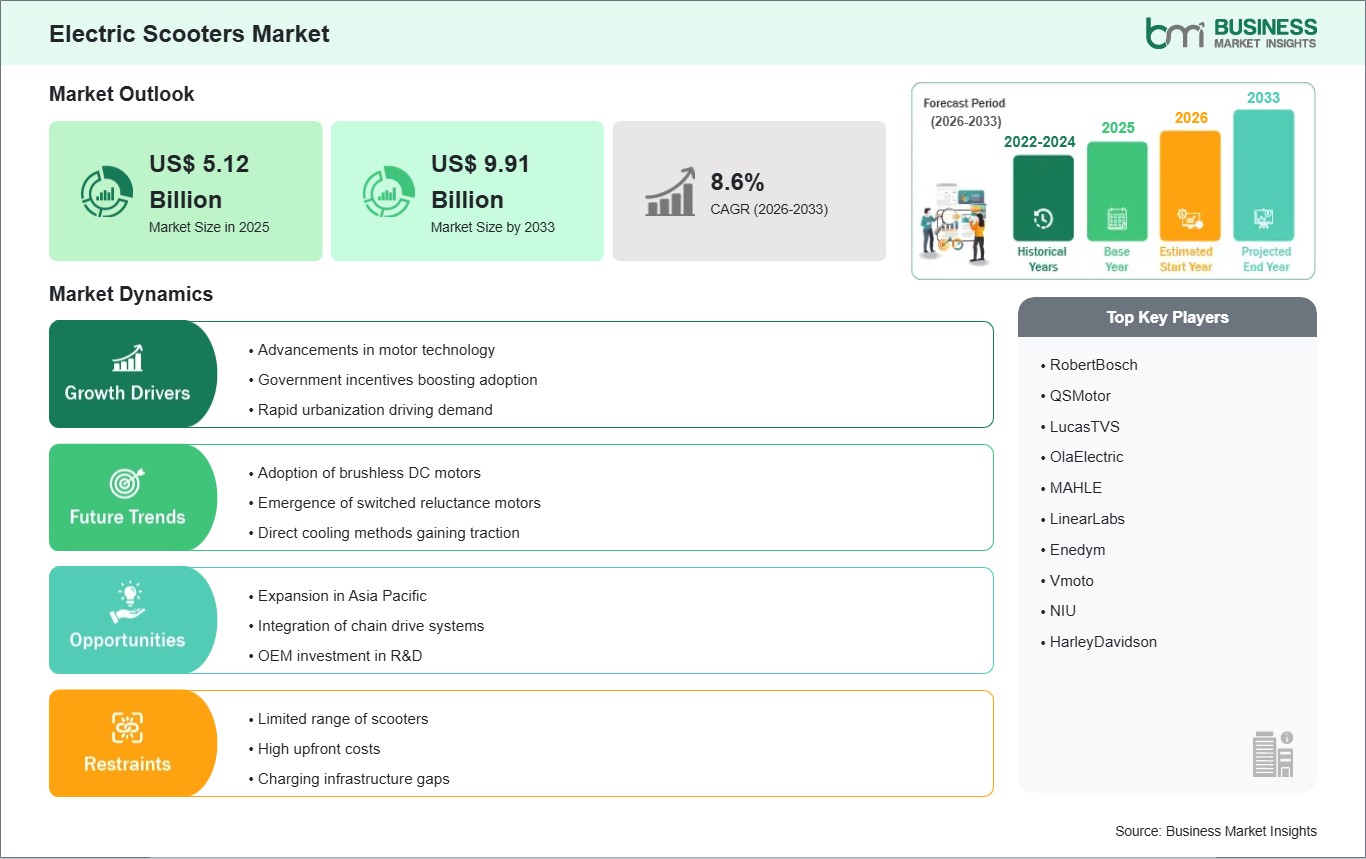
The electric scooter motors market size is expected to reach US$ 9.91 billion by 2033 from US$ 5.12 billion in 2025. The market is estimated to record a CAGR of 8.6% during 2026 to 2033.
Electric scooter motors are propulsion systems that convert electrical energy into mechanical power to drive electric scooters, mopeds, and electric motorcycles. These motors are a critical component of electric two-wheelers, directly influencing vehicle performance, acceleration, efficiency, range, and riding experience. Advances in motor design, power density, and thermal management are making electric mobility more efficient and cost-effective.
The market is experiencing rapid growth due to increasing adoption of electric two-wheelers, supportive government policies promoting clean transportation, and ongoing innovations in motor technologies. Manufacturers are focusing on developing lightweight, compact, and highly efficient motor systems that maximize energy utilization while minimizing maintenance requirements.
The transition toward sustainable mobility and rising urbanization are accelerating demand for electric scooters and motorcycles worldwide. As consumers seek environmentally friendly and economical transportation options, electric scooter manufacturers are increasingly investing in advanced motor technologies to improve vehicle performance and range.
Technological innovations including brushless motor architectures, advanced magnetic materials, integrated motor controllers, and enhanced cooling systems are driving significant improvements in efficiency and durability. Furthermore, the growing popularity of connected and intelligent electric vehicles is encouraging the development of smart motor systems capable of real-time diagnostics and performance optimization. As electric two-wheeler production scales globally, demand for high-performance and cost-efficient electric scooter motors is expected to increase substantially over the forecast period.

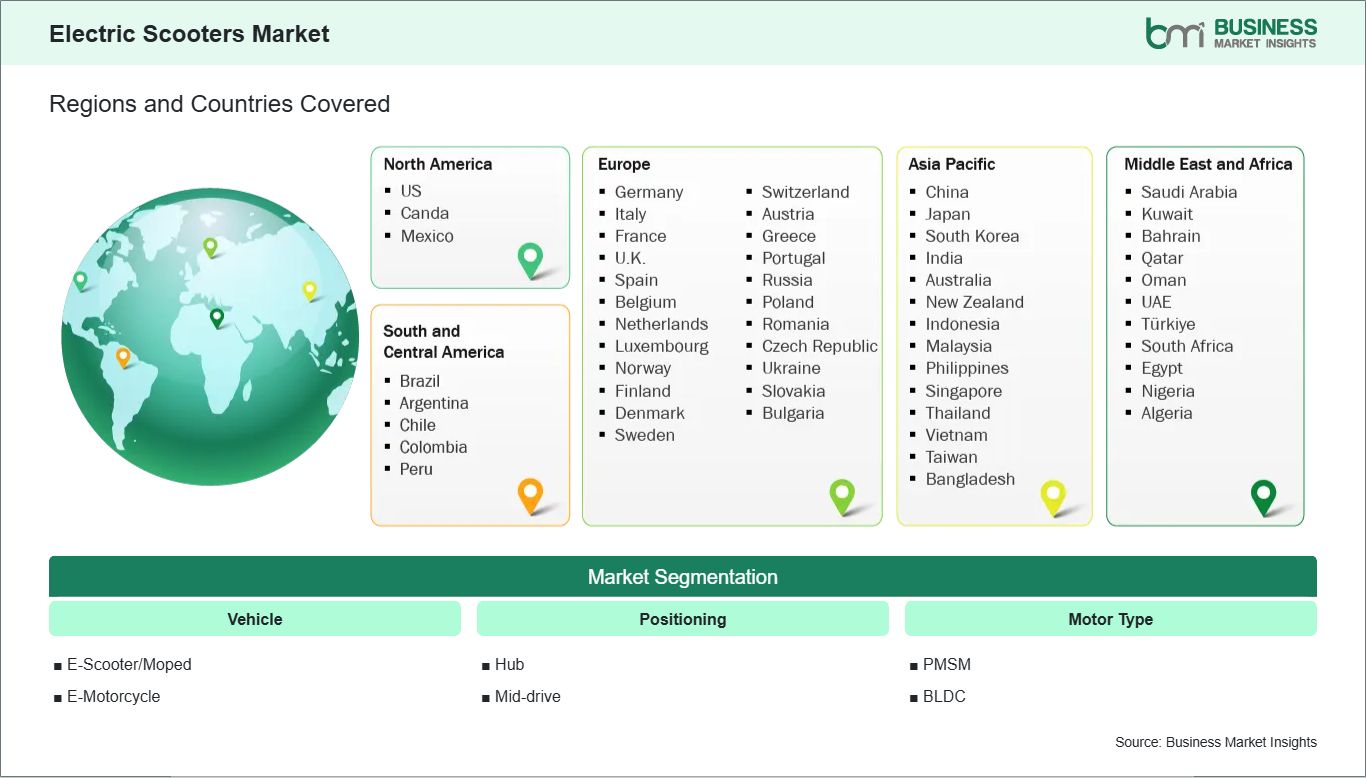
The electric scooter motors market is segmented based on vehicle, positioning, and motor type, reflecting the diverse technical requirements across electric two-wheeler applications.
The electric scooter motor industry has seen a sizeable increase in demand due to continued advancements in motor technology. Manufacturers are producing new motor systems that will provide greater levels of efficiency, weight savings, and compactness, allowing them to operate at higher output levels while consuming less energy than previously developed products. The development and introduction of new permanent magnet materials, winding designs, electronic control systems, and thermal management technologies are providing improvements in motor efficiency, reliability, and longevity. Additionally, advances in the architecture of electric scooter and motorcycle motors will allow for an increase in the rate of acceleration, distance travelled per charge, and overall performance of the motor vehicle.
Additionally, as the focus on optimizing energy efficiency continues to grow and manufacturers continue to improve their technologies to minimize battery consumption, motor manufacturers are increasing their investment in research and development activities. The increasing development of electric two-wheelers will continue to make them competitive with conventional, petroleum fueled internal combustion engine alternatives and will continue to contribute to the overall growth and acceptance of these types of vehicles into the marketplace.
With its prominent position as the largest producer of two-wheeled vehicles in the world and as a leader in the adoption of electric vehicles, the Asia Pacific region offers a significant opportunity for growth for the electric scooter motors market. The rapid demand for electric scooters and motorcycles is being driven by increasing demand from places such as China, India, Vietnam, Indonesia, Taiwan and South Korea.
Consumers are moving towards electric mobility due to supportive government policies, growing urban populations, higher fuel prices and increased environmental awareness. In addition, with many of the large EV manufacturers and component manufacturers located in the region, there are increasingly sophisticated manufacturing capabilities and innovation in the region.
The growing development of charging infrastructure, battery-swapping ecosystems and localised supply chains is also supporting the adoption of electric two-wheelers in the region and as production volumes continue to grow, the Asia Pacific region is expected to continue to be the growth driver for electric scooter motor manufacturers.

The electric scooter motors market is projected to grow from US$ 5.12 billion in 2025 to US$ 9.91 billion by 2033, registering a CAGR of 8.6% from 2026 to 2033.
By vehicle, the E-Scooter/Moped segment accounts for a major market share owing to widespread urban mobility adoption and strong demand for affordable electric transportation solutions. The E-Motorcycle segment is expected to witness robust growth due to increasing consumer preference for higher-performance electric vehicles.
By positioning, hub motors continue to dominate market demand due to their simple design, low maintenance requirements, and cost advantages. Mid-drive motors are gaining traction in premium and performance-oriented vehicle categories.
By motor type, PMSM motors account for a substantial share due to their superior efficiency and power density characteristics. BLDC motors remain widely adopted across cost-sensitive vehicle segments and entry-level electric scooters.
| Report Attribute | Details |
|---|---|
| Market size in 2025 | US$ 5.12 Billion |
| Market Size by 2033 | US$ 9.91 Billion |
| Global CAGR (2026 - 2033) | 8.6% |
| Historical Data | 2022-2024 |
| Forecast period | 2026-2033 |
| Segments Covered | By Vehicle
|
|
Regions and Countries Covered
| |
| North America | US, Canada, Mexico |
| Europe | Germany, Italy, France, U.K., Spain, Belgium, Netherlands, Luxembourg, Norway, Finland, Denmark, Sweden, Switzerland, Austria, Greece, Portugal, Russia, Poland, Romania, Czech Republic, Ukraine, Slovakia, Bulgaria |
| Asia-Pacific | China, Japan, South Korea, India, Australia, New Zealand, Indonesia, Malaysia, Philippines, Singapore, Thailand, Vietnam, Taiwan, Bangladesh |
| South and Central America | Brazil, Argentina, Chile, Colombia, Peru |
| Middle East and Africa | Saudi Arabia, United Arab Emirates, Kuwait, Bahrain, Qatar, Oman, Turkiye, South Africa, Egypt, Nigeria, Algeria |
| Market leaders and key company profiles |
|
The "Electric Scooters Market Size and Forecast (2022 - 2033)" report provides a detailed analysis of the market covering below areas:
Electric scooters are emerging as a viable mode of transport within urban areas, highlighting the need for established infrastructure to support their use. Regional development of electric scooters is driven by the increased adoption of electric vehicles, government incentives, urbanization trends, manufacturing capabilities, and investment in charging infrastructure.
In North America, the increase in demand for electric two-wheelers is spurred by the rising awareness for protecting the environment, the development of infrastructure to enable urban mobility, and the technological advancement for electric transport. Furthermore, there is a growing amount of investment in the development of future generation motors and battery technologies that will drive future growth within the industry.
The Asia Pacific is the leading and fastest growing market for electric scooter motors driven by high volume production of electric two-wheelers, strong government incentive programs, and rapidly growing consumer demand for electric two-wheelers with China and India continuing to be the primary drivers of future growth as they both rapidly adopt electric mobility solutions.
In Europe, the growth of electric scooter motors is driven by stringent emission regulations, numerous sustainability initiatives, and the increasing acceptance of electric solutions in urban mobility. Demand for high efficiency motor technologies is especially strong in the premium level / product segment.
As emerging markets continue to develop, the Middle East and Africa, along with Central and South America will continue to grow through urbanization and additional investments in sustainable transportation infrastructure.

The electric scooter motors market is evaluated by gathering qualitative and quantitative data post primary and secondary research, which includes important corporate publications, association data, and databases. Recent developments and news in the market include:
The Electric Scooters Market is valued at US$ 5.12 Billion in 2025, it is projected to reach US$ 9.91 Billion by 2033.
As per our report Electric Scooters Market, the market size is valued at US$ 5.12 Billion in 2025, projecting it to reach US$ 9.91 Billion by 2033. This translates to a CAGR of approximately 8.6% during the forecast period.
The Electric Scooters Market report typically cover these key segments-
The historic period, base year, and forecast period can vary slightly depending on the specific market research report. However, for the Electric Scooters Market report:
The Electric Scooters Market is populated by several key players, each contributing to its growth and innovation. Some of the major players include:
The Electric Scooters Market report is valuable for diverse stakeholders, including:
Essentially, anyone involved in or considering involvement in the Electric Scooters Market value chain can benefit from the information contained in a comprehensive market report.
Please tell us your area of interest
(Market Segments/ Regions and Countries/ Companies)