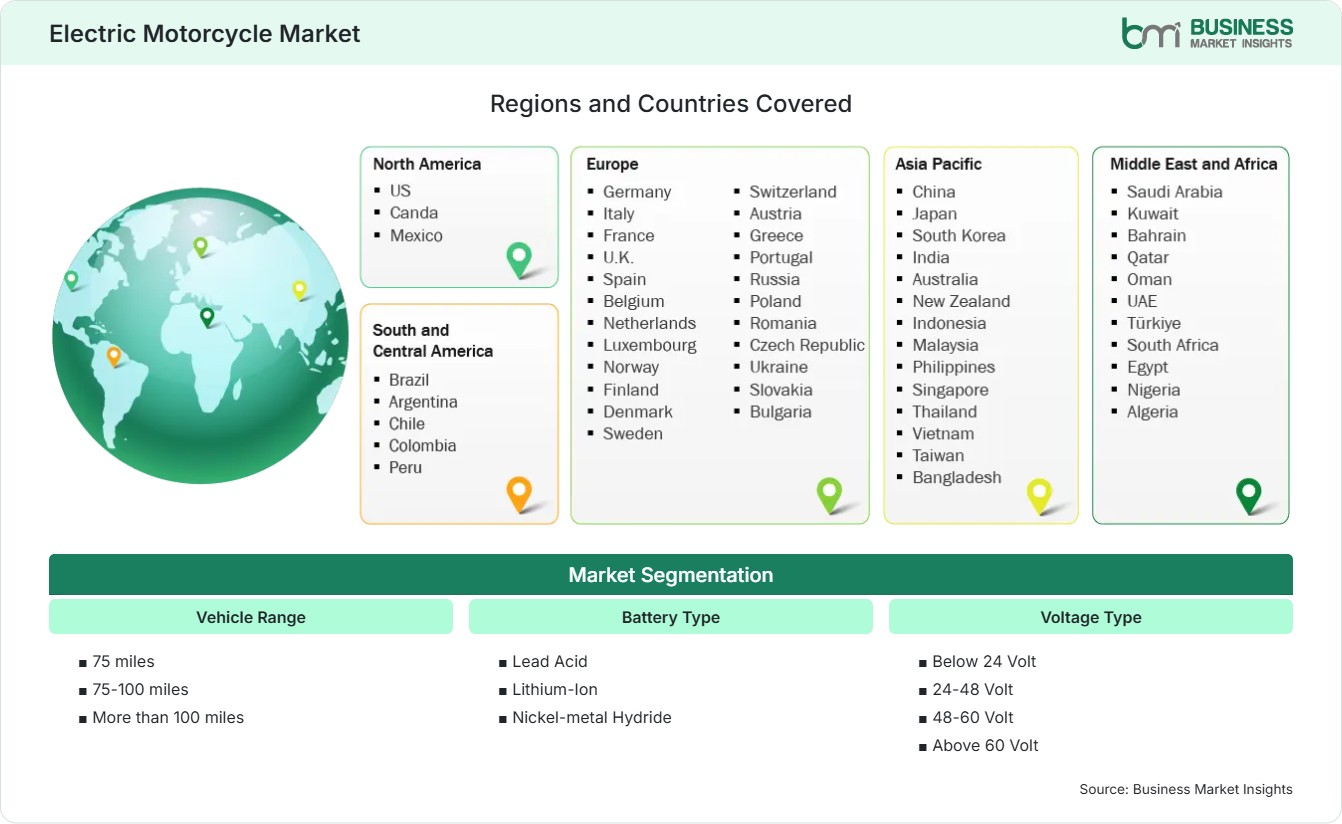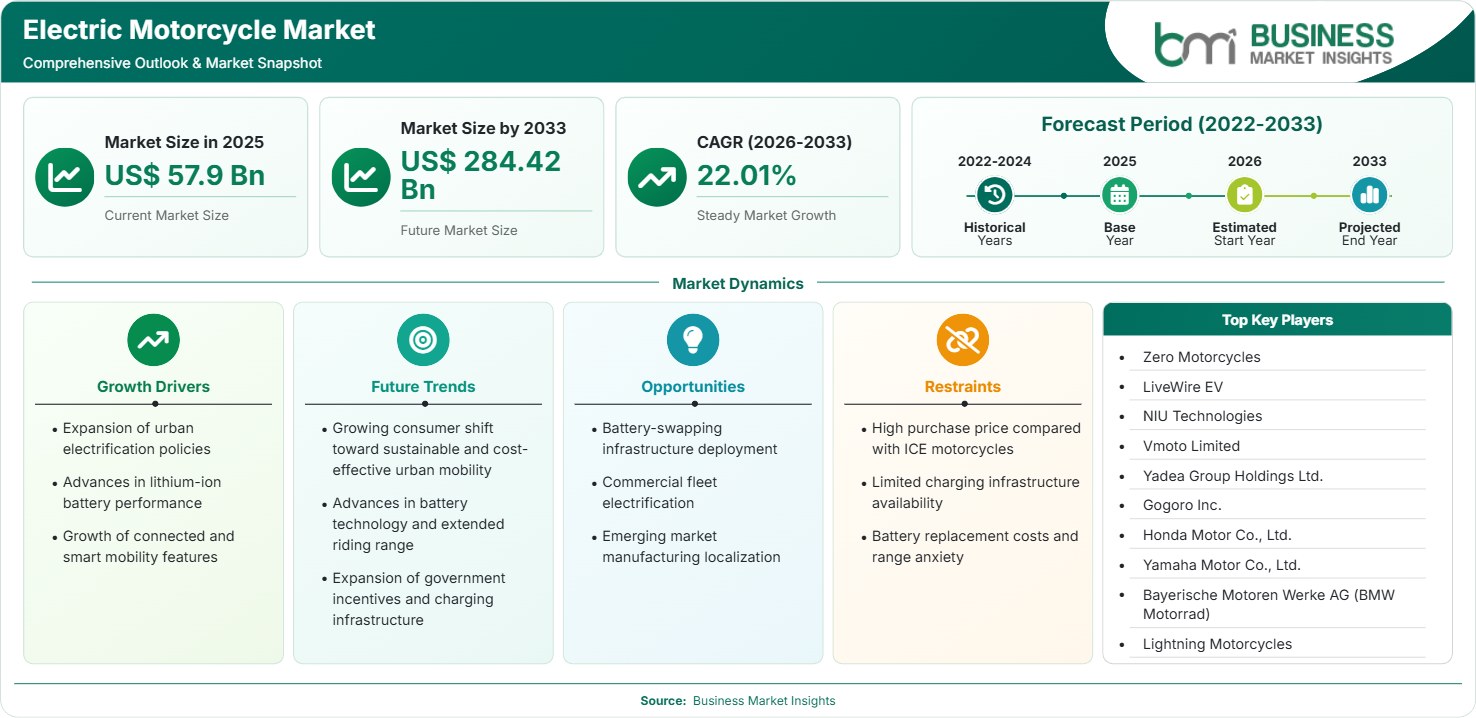
Electric Motorcycle Market Regional Highlights
North America Electric Motorcycle Market
North America accounts for 18%–21% market share in 2025 and is projected to expand at a 19%–21% CAGR through 2033. Premium motorcycles dominate demand, with adoption supported by sustainability initiatives, charging infrastructure investments, and increasing consumer interest in performance-focused electric mobility. The Electric Motorcycle Market share in this region is reinforced by established manufacturers and expanding retail networks across major metropolitan areas.
- Rising demand for premium motorcycles supports higher average selling prices and accelerates technology adoption.
- Federal and state-level incentives improve affordability for consumers and commercial operators.
- Battery innovation partnerships strengthen domestic manufacturing capabilities and supply-chain security.
- Fleet operators increasingly evaluate electric two-wheelers for urban logistics and service applications.
- Connected mobility features improve customer engagement, safety monitoring, and lifecycle management.
US Electric Motorcycle Market
The US represents approximately 72%–76% of North American Electric Motorcycle Market demand and advances at a 20%–22% CAGR. Consumer interest in high-performance motorcycles, expanding charging networks, and growing environmental awareness support market development. The country remains a focal point for product innovation, premium model launches, and software-enabled riding experiences.
- Premium electric motorcycles achieve strong visibility through dealer expansion and direct-to-consumer channels.
- Fleet adoption in urban delivery and municipal transportation continues rising.
- Advanced battery research contributes to greater range and charging efficiency.
- Technology-oriented consumers support connected feature adoption and subscription services.
Europe Electric Motorcycle Market
Europe maintains 24%–27% share in 2025 and grows at a 20%–22% CAGR. Regulatory pressure on vehicle emissions, dense urban populations, and widespread sustainability targets drive adoption. Germany leads regional revenue generation, while Italy and France contribute significant demand. Spain exhibits one of the highest growth trajectories with CAGR ranging between 22% and 24%.
- Stringent emissions regulations encourage transition from conventional motorcycles.
- Public charging infrastructure investments strengthen long-distance usability.
- Shared mobility providers expand deployment across major cities.
- Germany leads regional revenues, while Spain records stronger expansion rates.
- Lightweight vehicle incentives support broader market penetration.
Asia Pacific Electric Motorcycle Market
Asia Pacific holds 46%–49% share in 2025 and records 24%–26% CAGR, making it both the largest and fastest-expanding regional market. China leads manufacturing and consumption, while India, Indonesia, and Vietnam experience accelerated adoption. Electric Motorcycle Market growth benefits from affordability improvements, strong battery production capabilities, and extensive urban mobility requirements.
- China remains the dominant production and consumption center for electric two-wheelers.
- India attracts substantial investments in localized battery manufacturing.
- Indonesia and Vietnam benefit from large commuter populations and supportive regulations.
- Domestic brands improve affordability and increase consumer accessibility.
- Battery-swapping networks support operational efficiency and convenience.
Rest of World Electric Motorcycle Market
Rest of World contributes 8%–11% share in 2025 and is expected to grow at 21%–23% CAGR. South and Central America are experiencing growing urban adoption, while Middle East and Africa markets remain at a relatively early stage. Brazil leads Latin American demand, whereas the UAE and South Africa exhibit higher growth momentum.
- Urban sustainability programs encourage electrified mobility investments.
- Fleet operators explore electric motorcycles for delivery and service applications.
- Import partnerships improve product availability and market reach.
- Charging infrastructure development remains a key competitive differentiator.
- Rising fuel costs strengthen consumer interest in electric alternatives.