Market Summary
Executive Summary and Global Market Analysis
Electric scooters and motorcycles are battery-powered two-wheelers that utilize electric motors and rechargeable battery systems to provide efficient, low-emission transportation. These vehicles offer an alternative to conventional internal combustion engine (ICE) two-wheelers, delivering lower operating costs, reduced maintenance requirements, and improved environmental performance.
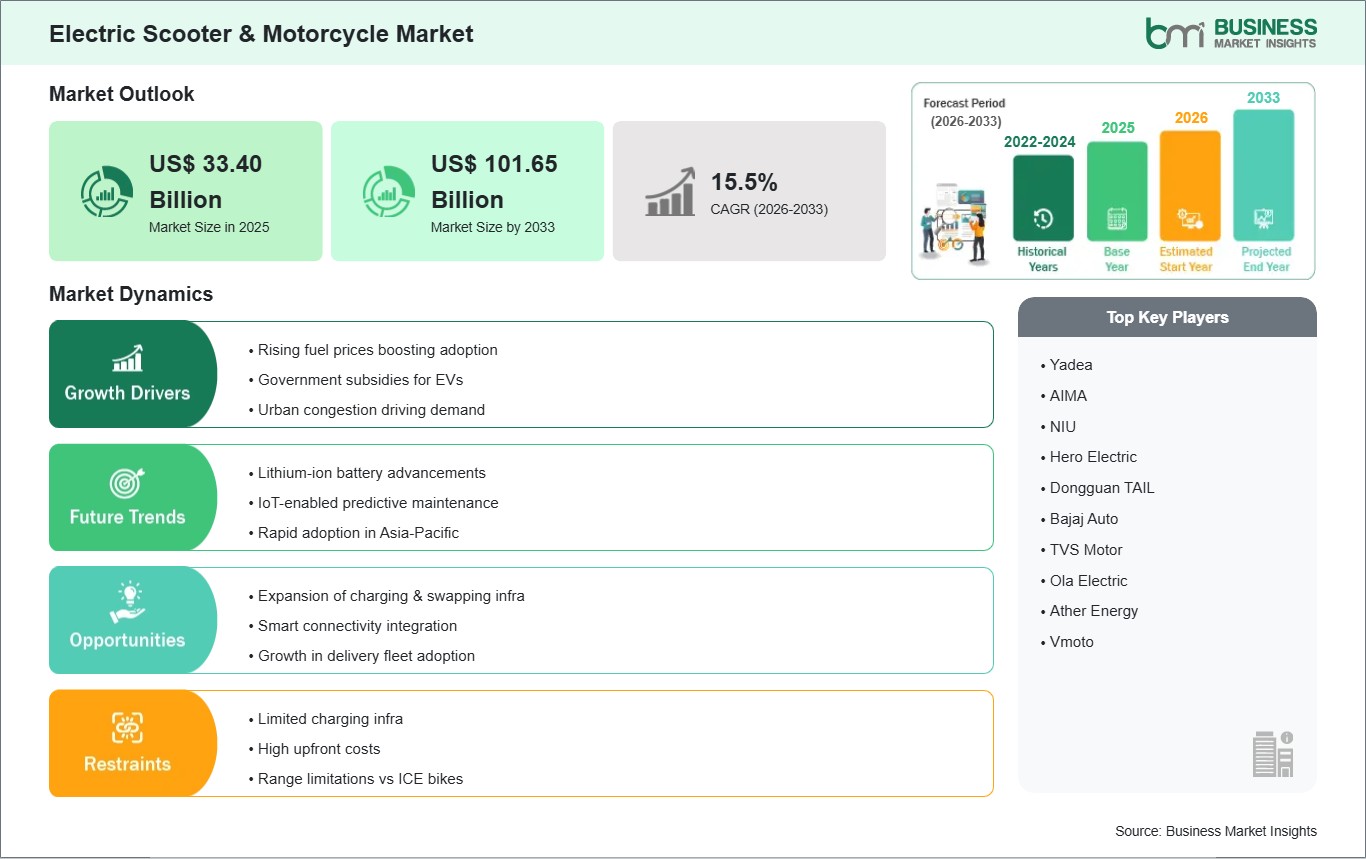
The market is witnessing consistent growth as consumers, businesses, and governments increasingly prioritize sustainable mobility solutions. Rising fuel prices, favorable government incentives, and increasing urban congestion are accelerating the adoption of electric two-wheelers across both developed and emerging markets.
Electric scooters continue to dominate market demand due to their affordability, ease of use, and suitability for urban commuting. Meanwhile, electric motorcycles are gaining traction among consumers seeking higher performance, longer range, and enhanced riding capabilities. Technological advancements in battery systems, connectivity solutions, and charging infrastructure are further improving the value proposition of electric two-wheelers.
The expansion of e-commerce, last-mile delivery services, and shared mobility platforms is also creating significant demand for commercial electric two-wheelers. Fleet operators are increasingly adopting electric scooters and motorcycles to reduce fuel costs and meet sustainability objectives. Manufacturers are focusing on lightweight vehicle architectures, improved battery performance, smart connectivity features, and advanced safety technologies to enhance user experience and increase market penetration.
Segment Analysis
Electric Scooter & Motorcycle Market Segmentation
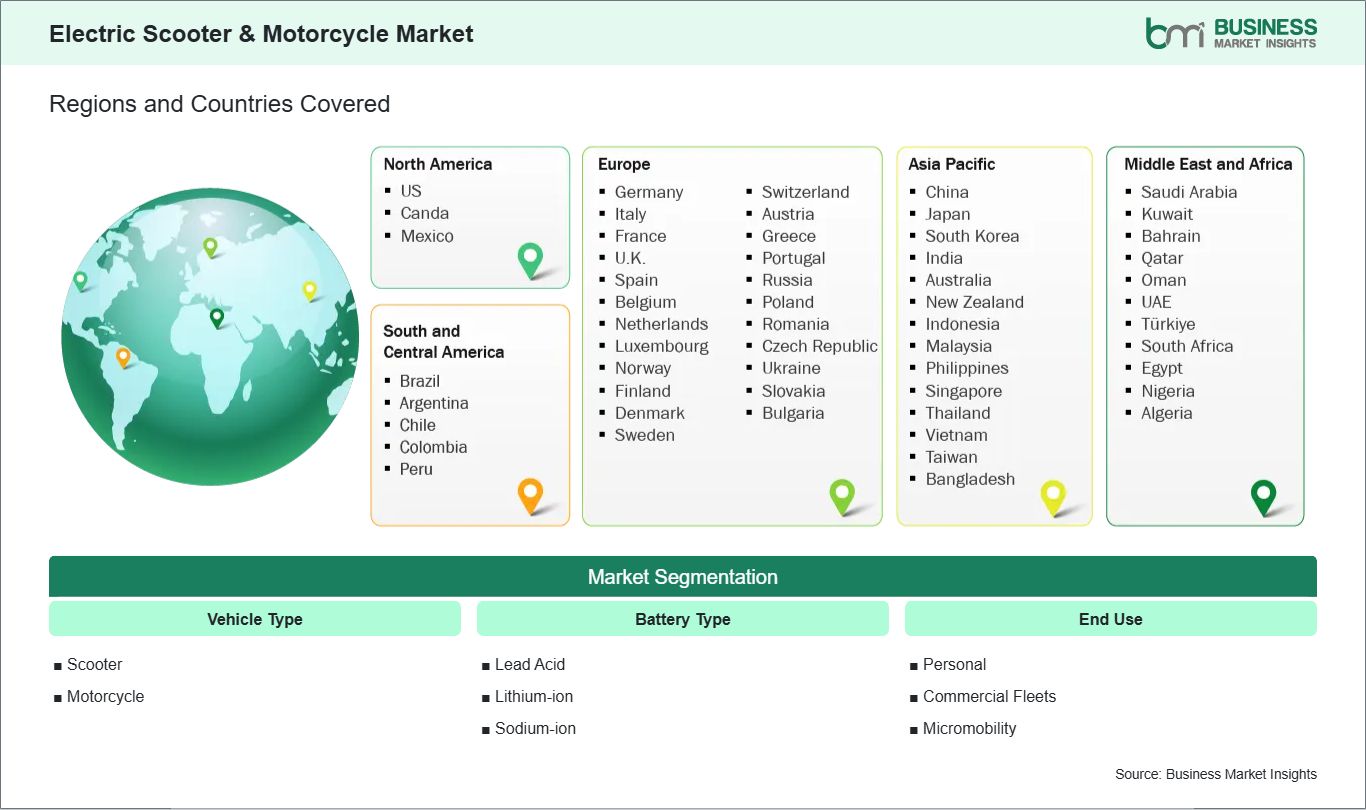
The electric scooter and motorcycle market is segmented based on vehicle type, battery type, and end use, reflecting the diverse applications and evolving technology landscape of electric two-wheelers.
By Vehicle Type
- Scooter: Accounts for a significant share of the market owing to strong demand for urban commuting, affordability, ease of operation, and widespread adoption in shared mobility and delivery applications.
- Motorcycle: Witnessing increasing adoption due to improvements in battery technology, performance capabilities, and growing consumer preference for long-range electric mobility solutions.
By Battery Type
- Lead Acid: Maintains deployment in cost-sensitive markets due to lower upfront costs despite limitations in energy density and lifecycle performance.
- Lithium-ion: Dominates market growth owing to superior energy density, faster charging capability, longer lifespan, and declining battery costs.
- Sodium-ion: Emerging as a promising alternative battery technology due to improved material availability, safety benefits, and potential cost advantages.
By End Use
- Personal: Represents the largest segment driven by increasing consumer preference for economical and environmentally friendly transportation.
- Commercial Fleets: Experiencing rapid adoption as delivery service providers and fleet operators seek lower operating costs and improved sustainability.
- Micromobility: Growing steadily through shared mobility platforms and urban transportation programs focused on reducing congestion and emissions.
Market Forces
Electric Scooter & Motorcycle Market Drivers and Opportunities
Rising Fuel Prices Boosting Adoption
There has been a marked increase in the number of people using electric scooters and bikes due to rising prices for fuel throughout the world. There is a growing need for people to find cheaper ways to get around without having to rely on changing fuel prices, as well as to lower their overall cost of ownership.
Compared with traditional internal combustion engine (ICE) powered motorcycles and scooters, electric two-wheelers have much lower operating costs (i.e., lower fuel costs and fewer repairs). As fuel prices continue to fluctuate, more and more consumers and fleet operators are realizing the long-term costs associated with using electric vehicles.
Urban workers, delivery services, and commercial fleets will be able to take advantage of electric two-wheelers by realizing large savings in their day-to-day operating expenses. Rising fuel prices will continue to be a significant factor in the continued evolution of the electric vehicle market during the forecast period.
Expansion of Charging and Swapping Infrastructure
Charging and battery-swapping infrastructure expansion provides a substantial growth opportunity for the electric motorcycle and scooter sector. The main impediments to the electric two-wheeler market are questions related to the availability of charging stations and the range of vehicles.
Many government entities, utilities, manufacturers, and independent infrastructure companies are currently putting money into public charging networks and developing battery-swapping ecosystems for greater convenience and less time charging. Electric scooters and motorcycles have a special appeal to commercial fleets and delivery businesses that are trying to minimize vehicle downtime in order to remain competitive in the marketplace.
Electric mobility is expected to be significantly bolstered by an increase in available and accessible charging infrastructure, leading to a dramatic increase in electric two-wheeler marketing for urban and semi-urban areas and long-term growth of the entire electric two-wheeler industry.
Size and Share Analysis
Electric Scooter & Motorcycle Market Size and Share Analysis
The electric scooter and motorcycle market is projected to grow from US$ 33.40 billion in 2025 to US$ 101.65 billion by 2033, registering a CAGR of 15.5% from 2026 to 2033.
By vehicle type, scooters account for the largest market share owing to their affordability, convenience, and suitability for urban transportation. Electric motorcycles are expected to witness strong growth as manufacturers introduce higher-performance models with extended range capabilities.
By battery type, lithium-ion batteries dominate market revenues due to their superior performance characteristics and declining production costs. Lead-acid batteries continue to serve cost-sensitive segments, while sodium-ion technology is emerging as a potential future growth area.
By end use, personal ownership represents the largest demand segment. Commercial fleets are experiencing rapid growth driven by e-commerce expansion and last-mile delivery requirements, while micromobility applications continue to expand across urban mobility ecosystems.
Report Coverage
Electric Scooter & Motorcycle Market Report Coverage and Deliverables
The "Electric Scooter and Motorcycle Market Size and Forecast (2022 - 2033)" report provides a detailed analysis of the market covering below areas:
- Market size and forecast at global, regional, and country levels for all key market segments covered under the scope
- Market trends, along with market dynamics such as drivers, restraints, and key opportunities
- Market analysis covering key trends, global and regional frameworks, major players, regulations, and recent developments
- Industry landscape and competitive analysis covering market concentration, heat map analysis, prominent players, and recent developments
- Detailed company profiles, including SWOT analysis
Geographic Insights
Electric Scooter & Motorcycle Market Geographic Insights
Different regions have different growth rates related to how much government funding is available for electric scooters and motorcycles, fuel prices, development of the charging infrastructure, urbanization and how likely people are to accept electric vehicles.
North America is slowly growing due to factors such as greater awareness of environmental issues, initiatives for urban mobility and improved charging infrastructure throughout North America. In particular, the demand for electric scooters and motorcycles in urban areas has been growing rapidly due to the need for sustainable transportation options.
The electric scooter and motorcycle market in the Asia-Pacific region is currently the largest and fastest-growing worldwide. Driving forces behind this growth include the development of significant manufacturing capabilities, the existence of government incentives to promote electric two-wheelers, high ownership rates of two-wheeling vehicles in many countries and a rapidly growing urbanized society. This region's major markets, which include China, India, Taiwan, Vietnam and Indonesia, will be among the largest contributors to future global growth in the electric two-wheeled vehicle marketplace.
In Europe, the electric scooter and motorcycle market has continued to develop rapidly, mainly due to increased environmental regulations, increased use of sustainable transportation methods and increased investment by manufacturers and operators in electric two-wheelers. Many of the key areas for growth within Europe come from companies that operate shared mobility programs and urban commuters.
There are two emerging markets for electric scooters and motorcycles: the Middle East and Africa, and South and Central America. In both of these regions, the increasing rate of urbanization, supportive government policies and the expanding presence of charging infrastructure will help facilitate future adoption of electric two-wheelers.
Industry Activity
Recent Developments
The electric scooter & motorcycle market is evaluated by gathering qualitative and quantitative data post primary and secondary research, which includes important corporate publications, association data, and databases. Recent developments and news in the market include:
- In November 2025, Yahama Motor launched AEROX E electric sport scooter and EC-06 electric scooter in India, including a collaboration with River Mobility. The AEROX E electric sport scooter is one of Yamaha's high value-added models developed in line with its premium segment strategy for the ASEAN region and other emerging markets, as outlined in its Medium-Term Management Plan.
- In January 2025, Ola Electric has commenced deliveries of its Gen 3 electric scooters across India. The portfolio includes the entry-level S1 X, S1 Pro, and S1 Pro Plus all of which were launched on 31 January 2025. The Gen 3 platform brings along a host of changes over its predecessor. The most notable revisions include 20 per cent in peak power and battery range.
Trust & Transparency
Research Methodology
The market analysis combines proprietary research with secondary data from government agencies, company disclosures, regulatory filings, industry databases and expert interviews. Market estimates are validated through data triangulation, cross-market benchmarking and analyst
review.
View Full Research Methodology
Key Sources Referred:
International Energy Agency (IEA) International Organization of Motor Vehicle Manufacturers (OICA) World Bank International Monetary Fund International Trade Administration World Trade Organization European Automobile Manufacturers' Association