
Motorcycle Lighting Market Outlook: Size, Share, Trends, Growth Analysis, Competitive Landscape & Forecast, 2026-2033

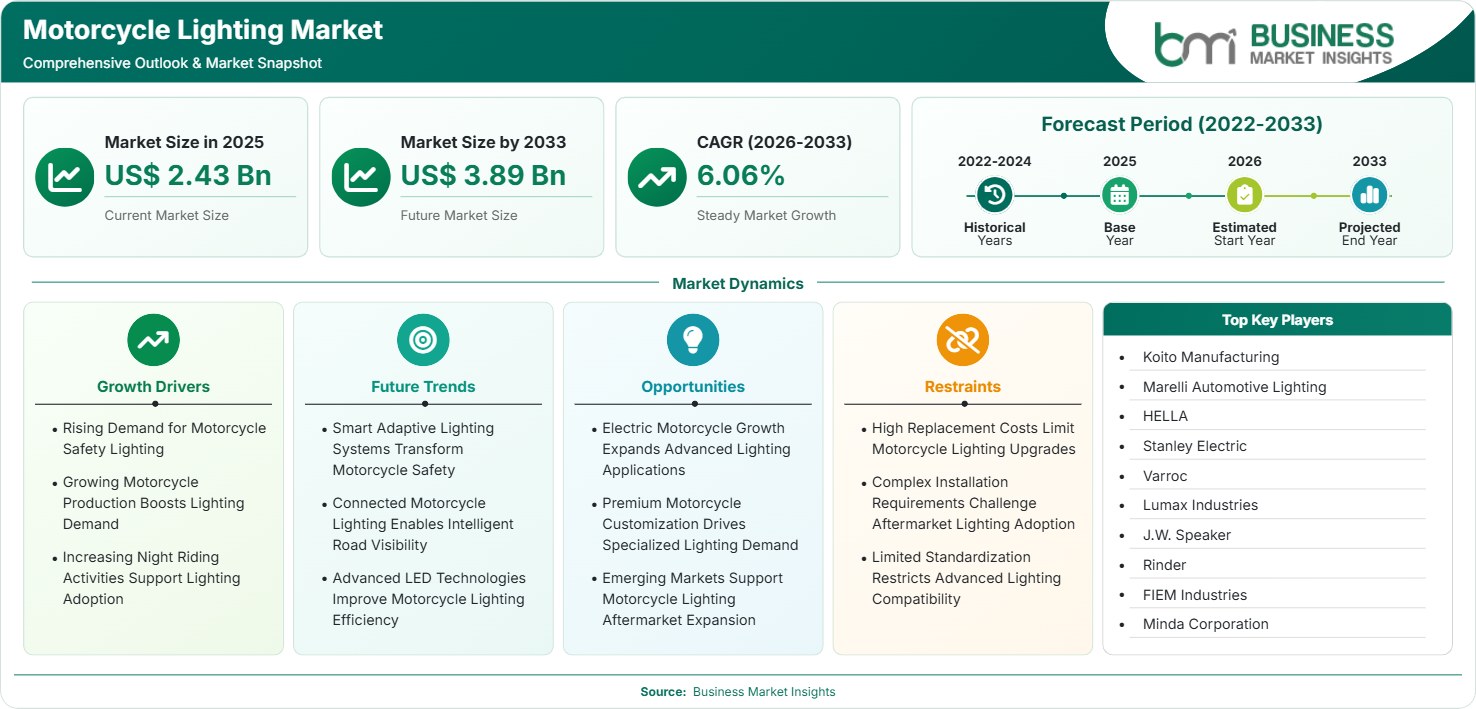
The Motorcycle Lighting Market size was valued at US$ 2.43 billion in 2025 and is projected to reach US$ 3.89 billion by 2033, growing at a CAGR of 6.06% during 2026–2033, driven by safety requirements, LED adoption, electric motorcycles, premium customization, and aftermarket replacement opportunities.

Report Coverage
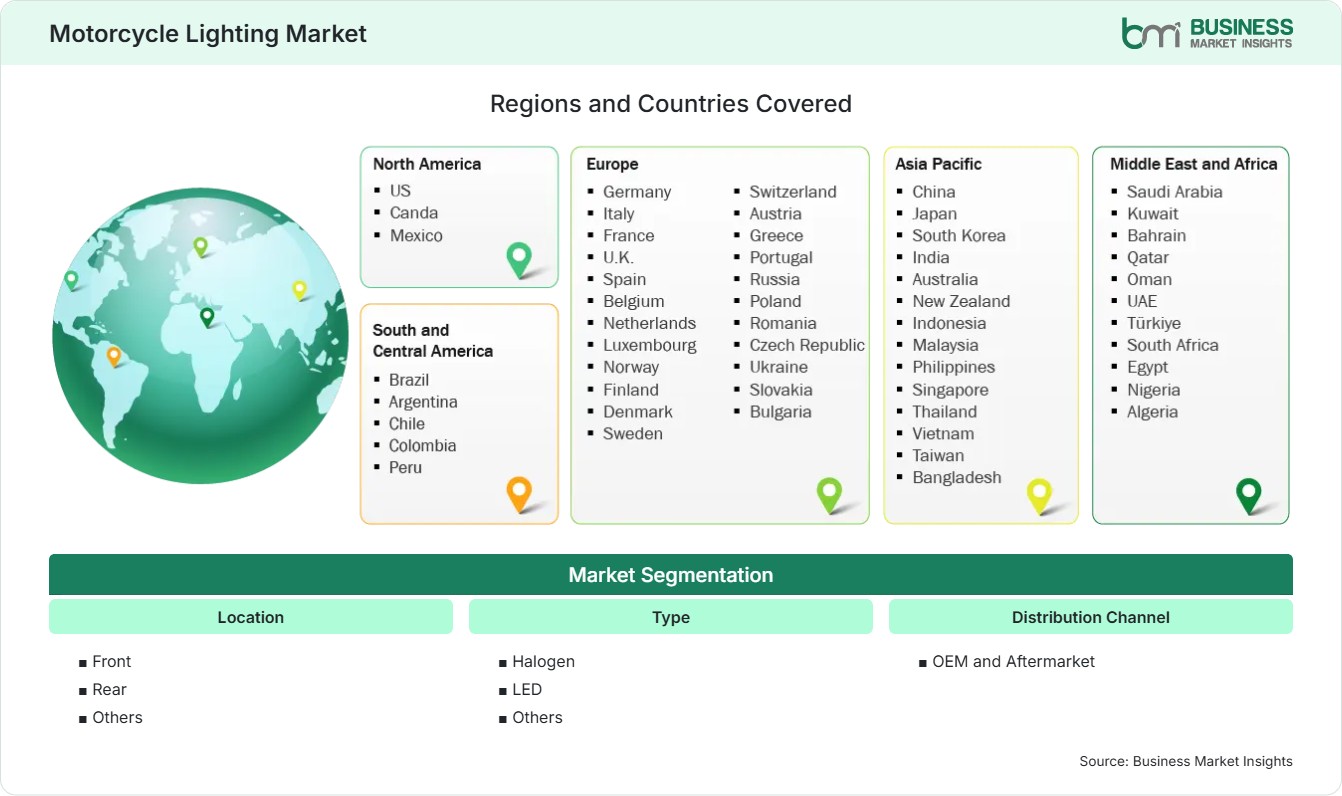
  • Location: Front, Rear, Others
  • Type: Halogen, LED, Others
  • Distribution Channel: OEM and Aftermarket
US$ 2.43 Bn Market size in 2025
US$ 3.89 Bn Market Size by 2033
6.06% CAGR, 2026 - 2033
2026-2033 Forecast Period

01 AI Overview

Motorcycle Lighting Market Summary

  • North America Region: North America holds a market share of 22%–26% in 2025, growing with a CAGR of 5.20%–5.80% influenced by safety-focused lighting upgrades, premium motorcycles, customization demand, and advanced LED adoption. The US Motorcycle Lighting Market accounts for most regional demand, supported by high-value motorcycles and aftermarket customization. US demand is advancing at a 5.30%–5.80% CAGR as riders prioritize LED visibility, premium styling, and replacement upgrades.
  • Fastest Growing Region: Asia Pacific holds a market share of 38%–42% in 2025, growing with a CAGR of 7.20%–7.80% influenced by high motorcycle volumes, expanding urban mobility, electric two-wheelers, rising incomes, and growing aftermarket availability.
  • Leading Segment: Front lighting holds a market share of 54%–58% in 2025, growing with a CAGR of 6.20%–6.70% influenced by daytime visibility requirements, safety priorities, LED conversion, improved optics, and rising adoption of integrated headlamp assemblies.
  • High Growth Segment: LED lighting holds a market share of 48%–52% in 2025, growing with a CAGR of 8.00%–8.60% influenced by lower power consumption, longer service life, compact packaging, design flexibility, and expanding electric motorcycle applications.
  • Key Market Opportunity: Electric motorcycle platforms create opportunities for compact, efficient, digitally controlled lighting systems, while premium customization and emerging-market aftermarket channels broaden revenue potential across replacement and accessory applications.
  • Major Market Players: Koito Manufacturing Co., Ltd., Marelli Automotive Lighting, HELLA GmbH & Co. KGaA, Stanley Electric Co., Ltd., Varroc Engineering Limited, Lumax Industries Limited, J.W. Speaker Corporation, Rinder-RID, Fiem Industries Limited, and Minda Corporation Limited.
02 Strategic Insights

Motorcycle Lighting Market: Strategic Insights

Motorcycle Lighting Market Strategic Framework
FREE PDF
Request your free sample
Request free sample
03 Stakeholder View

Key Takeaways

  • The value chain is shifting from standalone bulbs toward integrated lighting modules, creating opportunities for suppliers capable of combining optics, electronics, thermal management, and vehicle-specific mounting systems.
  • LED products offer the strongest upside because efficiency, compactness, longevity, and design flexibility align with both premium motorcycles and electric platforms requiring disciplined energy management.
  • Product innovation is moving toward adaptive illumination, sensor integration, connected controls, and electronically managed lighting architectures that can improve visibility while enabling differentiated motorcycle styling.
  • Asia Pacific offers the strongest investment case because high two-wheeler utilization, expanding production, urban mobility requirements, and increasing electric motorcycle adoption support both OEM and aftermarket demand.
  • Strategic partnerships between motorcycle manufacturers, lighting specialists, electronics suppliers, and aftermarket distributors can accelerate product localization and broaden access to advanced lighting technologies.
  • Manufacturers that balance regulatory compliance, installation simplicity, durability, and affordability will be better positioned to capture replacement demand alongside new-vehicle fitment opportunities.
04 Geographic Outlook

Motorcycle Lighting Market Regional Highlights

North America Motorcycle Lighting Market

North America represents 22%–26% of the Motorcycle Lighting Market share in 2025 and is projected to expand at a 5.20%–5.80% CAGR during 2026–2033. Demand centers on premium motorcycles, touring applications, safety upgrades, and customization. The US remains the dominant country, supported by established aftermarket networks and higher spending on accessories.

  • Premium motorcycle ownership supports demand for sophisticated lighting assemblies that complement higher-value vehicle platforms and encourage manufacturers to differentiate models through distinctive illumination signatures.
  • Aftermarket customization creates recurring opportunities for auxiliary lamps, replacement headlamps, turn signals, and specialized lighting kits designed around touring, adventure, and performance motorcycles.
  • LED adoption benefits from longer operating life and efficient power use, particularly among riders seeking dependable lighting during extended touring and recreational riding conditions.
  • Regulatory compliance and product certification remain important purchasing considerations, favoring established suppliers with tested designs, durable components, and reliable distribution relationships.

US Motorcycle Lighting Market

The US accounts for 17%–20% of the Motorcycle Lighting Market share in 2025 and is projected to grow at a 5.30%–5.80% CAGR during 2026–2033. Demand is supported by a mature motorcycle aftermarket, premium touring models, customization culture, and replacement requirements. Riders increasingly consider lighting a safety and styling component rather than a basic replacement item.

  • Touring and adventure motorcycles create demand for auxiliary illumination, high-output headlamps, and durable products capable of supporting long-distance riding across variable weather and road conditions.
  • Premium customization encourages buyers to select distinctive lighting signatures and upgraded LED systems, supporting higher-value aftermarket products beyond standard replacement bulbs.
  • Online channels improve product accessibility by connecting specialized lighting suppliers with riders seeking model-specific solutions, installation guidance, and compatibility information.

Europe Motorcycle Lighting Market

Europe represents 19%–23% of the Motorcycle Lighting Market share in 2025 and is projected to advance at a 5.70%–6.30% CAGR during 2026–2033. Germany, Italy, France, Spain, and the UK form leading demand centers, while Italy and Spain provide high-growth opportunities at approximately 6.10%–6.80% CAGR. Regulatory compliance, premium motorcycle production, and urban mobility needs support adoption.

  • Germany benefits from strong engineering capabilities and premium motorcycle demand, creating opportunities for advanced lighting electronics, high-quality replacement components, and integrated optical systems.
  • Italy remains influential through motorcycle manufacturing and design expertise, supporting specialized lighting development for performance, sport, touring, and premium motorcycle applications.
  • Spain offers attractive growth through urban mobility and motorcycle utilization, encouraging demand for efficient lighting replacement products and affordable LED conversion solutions.
  • Regulatory harmonization favors suppliers able to deliver tested, compliant lighting systems across multiple European markets while reducing complexity for OEM and aftermarket distribution.

Asia Pacific Motorcycle Lighting Market

Asia Pacific represents 38%–42% of the Motorcycle Lighting Market share in 2025 and is projected to expand at a 7.20%–7.80% CAGR through 2033. India, China, Indonesia, Vietnam, and Thailand are leading demand markets, while India and Indonesia offer high-growth potential near 7.50%–8.20% CAGR. High two-wheeler usage, expanding production, urban mobility, and electric motorcycle development support lighting demand.

  • India provides substantial opportunity for the Motorcycle Lighting Market because motorcycles remain central to personal mobility, while expanding manufacturing ecosystems support both OEM supply and replacement-market distribution.
  • Indonesia and Vietnam benefit from intensive two-wheeler use, creating recurring replacement demand and opportunities for affordable LED products distributed through extensive retail networks.
  • China supports technology development through electric mobility expansion, encouraging compact lighting electronics, efficient LED modules, and digitally managed systems for next-generation motorcycles.
  • Thailand remains an important production and export hub, supporting demand for localized components and lighting systems integrated into motorcycle manufacturing supply chains.

Rest of World Motorcycle Lighting Market

South and Central America represent an important portion of Rest of World demand, supported by motorcycle-based mobility and expanding aftermarket activity. Brazil, Colombia, Mexico, and Argentina provide leading opportunities, while Colombia and Brazil can achieve approximately 6.40%–7.00% CAGR. Demand is influenced by urban congestion, affordable transport needs, and replacement requirements. Local distribution networks remain important for reaching independent repair shops and motorcycle owners.

  • Brazil combines a large motorcycle population with an established manufacturing ecosystem, creating opportunities for OEM lighting suppliers and aftermarket distributors serving diverse vehicle categories.
  • Colombia's extensive motorcycle usage supports recurring replacement demand, particularly for durable, affordable products that can withstand intensive daily transportation applications.
  • South Africa provides a gateway for regional aftermarket distribution, while commercial motorcycles and delivery services create demand for dependable lighting systems.
  • Gulf markets offer premium customization opportunities, with higher-income consumers supporting specialized lighting products that emphasize styling, performance, and advanced optical design.
Global Market Geography
FREE PDF
Request your free sample
Request free sample
05 Segment Analysis

Motorcycle Lighting Market Segmentation

Location

Location-based demand is led by Front lighting, which held 54%–58% share in 2025 and is projected to expand at a 6.20%–6.70% CAGR during 2026–2034. Safety, visibility, regulatory requirements, and LED adoption support front systems, while rear and auxiliary applications benefit from replacement, signaling, and styling requirements across OEM and aftermarket channels.

  • Front: Front lighting remains central to motorcycle visibility, supporting headlamps, daytime running functions, and integrated LED designs. Demand benefits from safety priorities, compact optics, improved illumination, and premium styling.
  • Rear: Rear lighting includes tail, brake, and signaling functions that improve rider visibility. LED adoption supports compact assemblies, faster illumination, lower power consumption, and distinctive styling across new motorcycles.
  • Others: Auxiliary and specialized lighting applications address touring, adventure, customization, and visibility needs. Demand depends on installation flexibility, regulatory compliance, durability, and consumer preference for enhanced motorcycle functionality.

Type

Type-based demand is led by LED products, which held 48%–52% share in 2025 and are projected to grow at an 8.00%–8.60% CAGR during 2026–2034. The Motorcycle Lighting Market scope is expanding as manufacturers and riders prioritize efficient, durable, compact lighting technologies. Halogen remains relevant in cost-sensitive replacement applications, while other technologies serve specialized requirements.

  • Halogen: Halogen lighting retains demand across older motorcycles and price-sensitive replacement markets. Broad availability and familiar installation support continued use, although efficiency and service-life limitations encourage gradual migration toward LED alternatives.
  • LED: LED systems provide efficient illumination, longer service life, compact packaging, and greater styling flexibility. Their suitability for electric motorcycles and digitally controlled architectures supports strong adoption across OEM and aftermarket applications.
  • Others: Alternative technologies address specialized applications requiring distinctive optical performance, advanced functionality, or customization. Adoption depends on affordability, regulatory acceptance, integration complexity, and availability through specialist distribution channels.

Distribution Channel

Distribution demand is divided between OEM and Aftermarket channels, with OEM systems holding 57%–61% share in 2025 and projected to expand at a 5.80%–6.30% CAGR during 2026–2034. The Motorcycle Lighting Market trends favor factory-integrated LED systems as manufacturers prioritize safety, styling, and electronics integration, while aftermarket channels benefit from replacement and customization demand.

  • OEM: OEM demand is supported by rising motorcycle production and greater integration of lighting into vehicle design. Manufacturers increasingly specify compact LED modules and electronically managed systems during product development.
  • Aftermarket: Aftermarket demand benefits from replacement cycles, customization, accident-related repairs, and upgrades. Online retail and specialist distributors broaden product availability, while installation complexity can influence consumer adoption.
06 Market Forces

Motorcycle Lighting Market Dynamics

Key Market Drivers

Rising Demand for Motorcycle Safety Lighting

Motorcycle lighting expansion will be fueled by an increased focus on rider visibility in congested urban environments and at night. The demand for daytime running lights in many markets will ensure continued use of lighting equipment, while LED lighting offers rapid lighting performance, energy efficiency, and longer lifespans. In the case of Koito, the company highlights motorcycle LED headlamp technology that provides energy efficiency, durability, space savings, and safer riding conditions. These factors promote the use of lighting technologies in motorcycle design beyond mere accessories. Purchase decisions driven by safety concerns will favor aftermarket lighting system sales among customers seeking better visibility without buying new motorcycles.

Growing Motorcycle Production Boosts Lighting Demand

Increasing motorcycle production increases the addressable market for motorcycle headlamps, rear lamps, turn indicators, and combined lighting systems. High-volume markets in Asia are particularly significant, given that motorcycles are used for commuting, deliveries, and commercial purposes. Increased production means greater opportunities for localized manufacturing of parts and systems, as well as for platform-oriented development and cooperation. The manufacturing ecosystem is gradually moving towards greater use of LEDs as efficient components, which are also characterized by compact packaging and styling. Suppliers that build partnerships with motorcycle OEMs can rely on recurring platform and replacement business when vehicles are put into operation.

Increasing Night Riding Activities Support Lighting Adoption

The use of motorcycles in the evening and at night creates an ongoing need for reliable lighting and its replacements. Delivery services, commuter traffic, tourism, and long-distance riding expose riders to situations in which headlights are essential factors in purchase decisions. Consumers are more focused on evaluating luminosity, beam spread, durability, and energy consumption when choosing replacement lights. Such tendencies drive LED sales even higher while keeping the market demand for affordable products. This market opportunity could be utilized through specific light kits for each model, reliable housing materials, better cooling systems, and easier installation. Distributors of aftermarket products could increase their sales by supplying relevant information about installations.

Key Market Opportunities

Electric Motorcycle Growth Expands Advanced Lighting Applications

There is considerable potential to develop effective lighting architectures for electric motorcycles, given the need for manufacturers to manage electrical power used by the propulsion system, battery management systems, connectivity systems, and auxiliary systems. LED lighting systems are ideal for such a challenge, as they provide substantial illumination with minimal power. In addition, new electric motorcycles offer manufacturers an opportunity to design new wiring, control, and lighting systems without modifying previous designs. There will be chances for integrated daytime running lights, connected signals, adaptive lighting, and digital lighting signatures.

Premium Motorcycle Customization Drives Specialized Lighting Demand

Customization offers a good path for lighting manufacturers to serve customers who value style, performance, and customization. LED technology allows for customization of lights for individualized light signatures, compact design, sequential indicator lights, secondary illumination, and custom models. It is important to note that the aftermarket is about more than replacements; people may choose to replace existing lighting systems to enhance both style and performance. This will enable manufacturers to maximize their profits by selling complete packages that include optics, mounts, wiring, and instructions. Premium touring and adventure motorcycles offer a relevant application area.

Emerging Markets Support Motorcycle Lighting Aftermarket Expansion

The emerging markets offer growth potential in the Motorcycle Lighting Market due to the large number of motorcycles, which ensures sustained demand for replacements, maintenance, and upgrades. Such growth could be driven by greater distribution reach, e-commerce, local workshops, and specialty accessory stores. Suppliers could consider developing a product line-up that caters to low-cost replacements on the one hand and LED lights on the other, appealing to riders looking for better visibility and styling options. The market is most relevant to South and Southeast Asia and selected parts of Latin America.

Market Restraints and Challenges

High Replacement Costs Limit Motorcycle Lighting Upgrades

Factor: The LED kits can have higher initial costs than regular halogen replacement bulbs due to their integration of optics, electronic control units, thermal management systems, and housings. Effect: High costs can deter consumers from upgrading, as they are more interested in saving money. This factor is especially important in developing countries where motorcycles are purchased purely for economic reasons. The problem occurs when changing an entire lighting assembly is needed rather than just a light bulb. Suppliers can reduce the impact of this factor by offering different designs, components, and price levels.

Complex Installation Requirements Challenge Aftermarket Lighting Adoption

Factor: An advanced light installation on a motorcycle may require specialized wiring, installation, electrical compatibility testing, or professional installation, particularly when transitioning from traditional motorcycle lighting to a more modern LED system. Impact: The difficulty of installation increases overall ownership costs, which may dissuade customers from purchasing due to the lack of plug-and-play capabilities. Additionally, incorrect installation compromises reliability and safety standards, preventing customers from utilizing such advanced technology. This problem may be solved by manufacturers via dedicated kits for different models.

07 Company Analysis

Competitive Landscape

The Motorcycle Lighting Market analysis indicates competition is shaped by OEM relationships, lighting engineering capabilities, product reliability, geographic reach, and aftermarket distribution. Leading participants increasingly compete through LED technology, compact optical systems, integrated electronics, and customized solutions. The competitive environment includes global automotive lighting specialists and regional manufacturers serving motorcycle OEMs and replacement markets.

Company Name

Overview

Products and Services relevant to this market

Koito Manufacturing Co., Ltd.

Global lighting specialist with extensive automotive engineering capabilities and established motorcycle lighting expertise across major mobility markets.

LED motorcycle headlamps, lighting systems, optical technologies, integrated lamp solutions, and advanced lighting development services.

Marelli Automotive Lighting

Global automotive technology supplier developing advanced lighting and electronics solutions with strong capabilities in intelligent illumination.

Front and rear lighting, lighting electronics, integrated modules, sensor-related technologies, and customized vehicle lighting solutions.

HELLA GmbH & Co. KGaA

International automotive supplier with broad expertise in vehicle lighting, electronics, and aftermarket components serving global mobility customers.

Headlamps, rear lamps, signaling products, lighting electronics, replacement components, and vehicle-specific lighting technologies.

Stanley Electric Co., Ltd.

Japanese lighting technology company with extensive expertise in automotive and motorcycle illumination systems and optical engineering.

Motorcycle headlamps, rear combination lamps, LED modules, optical components, and electronically integrated lighting technologies.

Varroc Engineering Limited

Global automotive component manufacturer with capabilities spanning exterior lighting and electronic systems for vehicle manufacturers.

Automotive lighting systems, LED modules, headlamps, rear lamps, electronic controls, and integrated exterior lighting solutions.

Lumax Industries Limited

Indian automotive lighting manufacturer serving OEM customers with localized production and broad vehicle application expertise.

Headlamps, tail lamps, LED lighting systems, signaling products, and integrated automotive lighting assemblies.

J.W. Speaker Corporation

Specialist lighting manufacturer known for engineered LED products and applications across powersports and specialty vehicles.

LED headlights, auxiliary lamps, turn signals, work lights, and specialized motorcycle lighting products.

Rinder-RID

Lighting manufacturer serving mobility applications with expertise in vehicle lighting components and replacement-oriented solutions.

Motorcycle and automotive lighting assemblies, signaling products, replacement lamps, and vehicle-specific lighting components.

Fiem Industries Limited

Indian automotive component supplier with established capabilities in lighting systems for two-wheelers and other vehicle categories.

Headlamps, tail lamps, indicators, LED lighting systems, and integrated lighting assemblies for motorcycles and scooters.

Minda Corporation Limited

Diversified automotive component manufacturer with capabilities across vehicle systems and growing opportunities in advanced mobility components.

Automotive electrical systems, lighting-related components, vehicle electronics, and integrated solutions supporting two-wheeler applications.

10 Trust & Transparency

Research Methodology

The market analysis combines proprietary research with secondary data from government agencies, company disclosures, regulatory filings, industry databases and expert interviews. Market estimates are validated through data triangulation, cross-market benchmarking and analyst review.

View Full Research Methodology

11 Questions Answered

Frequently Asked Questions

What does the Motorcycle Lighting Market Report indicate about future competition?

Competition is moving toward integrated solutions that combine efficient LED sources, optics, electronics, vehicle-specific design, and installation support. Suppliers that balance advanced functionality with affordability, regulatory compliance, durability, and easy installation are likely to strengthen their positions across OEM and aftermarket channels.

Why is aftermarket compatibility becoming more important?

Motorcycle owners often seek upgrades without replacing their vehicles, making model compatibility essential for successful aftermarket adoption. Products that simplify installation, provide clear fitment information, and maintain electrical compatibility can reduce purchase uncertainty and improve consumer confidence.

How are electric motorcycles changing lighting requirements?

Electric platforms encourage manufacturers to prioritize energy-efficient LED systems and compact electronics because lighting must operate alongside battery management, propulsion, connectivity, and other electrical functions. New vehicle architectures also create opportunities for integrated and digitally controlled lighting designs.

Which motorcycle applications present the strongest opportunity for advanced lighting?

According to Motorcycle Lighting Market forecast, Electric motorcycles, premium touring models, adventure motorcycles, and high-use commuter vehicles present attractive opportunities. These applications benefit from efficient illumination, compact packaging, improved visibility, distinctive styling, and lighting systems designed for demanding operating conditions.

What factors are improving motorcycle lighting return on investment?

Longer LED service life, lower power consumption, reduced replacement frequency, improved visibility, and declining maintenance requirements can strengthen lifecycle economics. The strongest returns typically occur in high-use motorcycles, commercial fleets, and premium applications where reliability and downtime reduction carry greater financial value.

Access the Full Motorcycle Lighting Market Report

Get segment-level forecasts, regional estimates, competitive benchmarking, company profiles and downloadable Excel datasets.

Access the full Motorcycle Lighting Market Report
350 pages PDF & Excel | 2026-08-07