
Automotive Lighting Market Outlook: Size, Share, Trends, Growth Analysis, Competitive Landscape & Forecast, 2026-2033

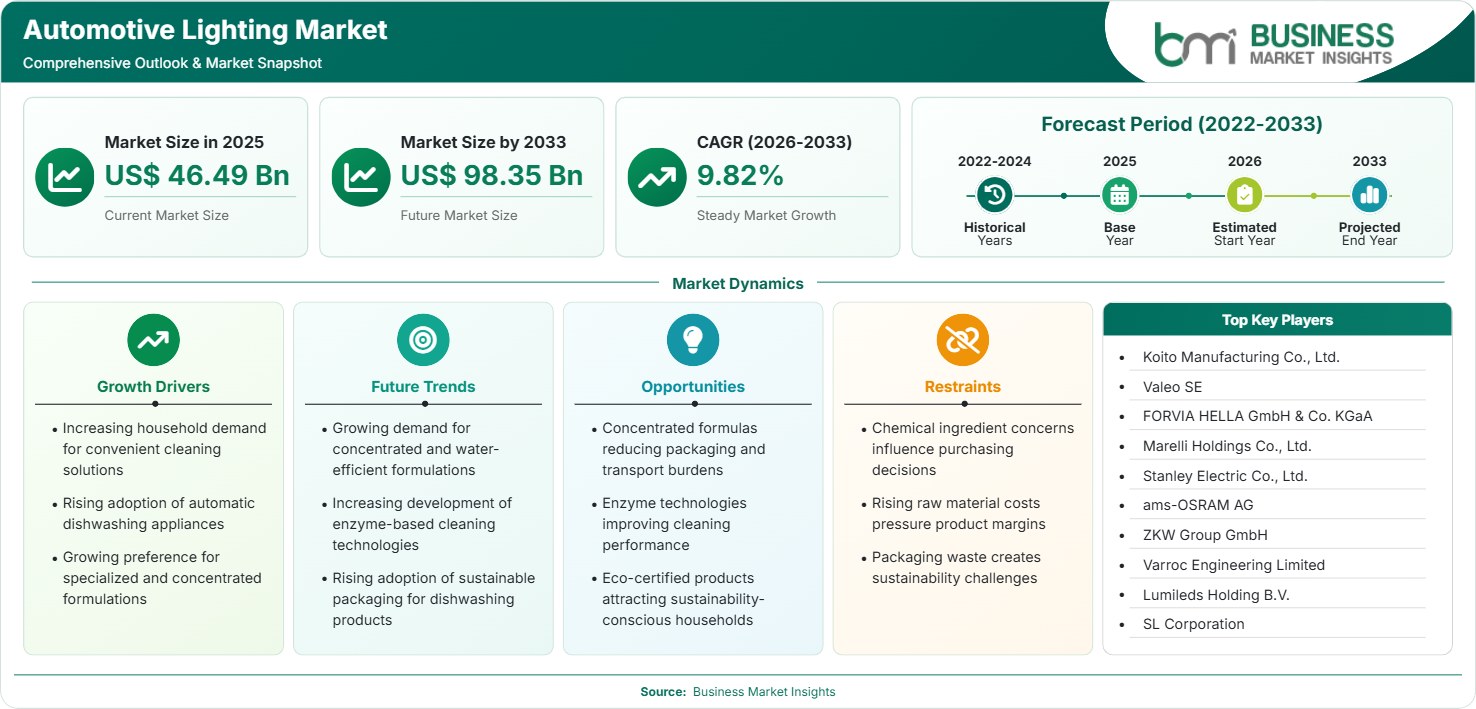
The Automotive Lighting Market size was valued at US$ 46.49 Billion in 2025 and is projected to reach US$ 98.35 Billion by 2033, growing at a CAGR of 9.82% during 2026–2033. Rising LED penetration, vehicle electrification, adaptive lighting adoption, safety regulations, and intelligent lighting integration are creating strong opportunities across OEM and aftermarket channels globally.

Report Coverage
  • Technology: LED, Halogen, Xenon
  • Product Type: Interior, Exterior
  • Sales Channel: OEM, Aftermarket
US$ 46.49 Bn Market size in 2025
US$ 98.35 Bn Market Size by 2033
9.82% CAGR, 2026 - 2033
2026-2033 Forecast Period

AI Overview

Automotive Lighting Market Summary

  • North America Region: Holds a market share of 23%–26% in 2025, growing with a CAGR of 8.8%–9.3% during 2026–2033, driven by premium vehicle sales, ADAS integration, EV production expansion, intelligent headlamp adoption, safety regulations, aftermarket upgrades, connected mobility investments, supplier innovation, software-defined lighting demand, and fleet modernization initiatives. Brief U.S. analysis: strong EV production, premium SUV demand, and adaptive lighting deployment support a CAGR of 8.9%–9.4%.
  • Fastest Growing Region: Asia Pacific holds a market share of 41%–44% in 2025, growing with a CAGR of 10.8%–11.4% during 2026–2033, supported by vehicle manufacturing concentration, EV expansion, semiconductor availability, urbanization, premiumization trends, regulatory upgrades, increasing disposable incomes, rising OEM investments, export-oriented production, and smart lighting deployment.
  • Leading Segment: LED technology holds a market share of 58%–62% in 2025, growing with a CAGR of 10.0%–10.6% during 2026–2033, supported by efficiency benefits, design flexibility, lower energy consumption, EV compatibility, durability advantages, premium vehicle penetration, intelligent control capabilities, regulatory alignment, reduced maintenance requirements, and styling differentiation.
  • High Growth Segment: Exterior lighting holds a market share of 68%–72% in 2025, growing with a CAGR of 10.6%–11.0% during 2026–2033, supported by adaptive headlamps, communication lighting, safety requirements, signature brand designs, EV differentiation strategies, regulatory compliance, higher lighting content per vehicle, software integration, and autonomous-driving applications.
  • Key Market Opportunity: Expansion of software-defined vehicle architectures enables intelligent lighting functions, over-the-air upgrades, dynamic beam control, vehicle-to-pedestrian communication, and premium personalization features, creating substantial value opportunities for suppliers and automakers.
  • Major Market Players: Koito Manufacturing Co., Ltd.; Valeo SE; FORVIA HELLA GmbH & Co. KGaA; Marelli Holdings Co., Ltd.; Stanley Electric Co., Ltd.; ams-OSRAM AG; ZKW Group GmbH; Varroc Engineering Limited; Lumileds Holding B.V.; SL Corporation.
Strategic Insights

Automotive Lighting Market: Strategic Insights

Automotive Lighting Market Strategic Framework
FREE PDF
Request your free sample
Request free sample
Stakeholder View

Key Takeaways

  • The value chain is now incorporating optics, semiconductors, software, thermal management, and electronics, which means that partnerships with suppliers have become important for achieving competitive differentiation.
  • The exterior lighting systems offer the greatest potential benefit since the amount of equipment on each vehicle is increasing and adaptive beam technologies are becoming more widespread.
  • Innovation is now turning to matrix LEDs, digital projection modules, communication lighting, and software-defined control platforms.
  • There are highly attractive investment opportunities in China, India and Southeast Asia as a result of growth in vehicle production and the expansion of electric vehicle manufacturing.
  • The commercialization of intelligent lighting systems is being speeded up by strategic collaborations between lighting specialists, semiconductor companies, and OEMs.
  • Demand for after-market products is increasing since consumers are looking for LED upgrades, customization options, and energy-efficient alternatives.
Geographic Outlook

Automotive Lighting Market Regional Highlights

North America Automotive Lighting Market

North America accounted for approximately 23%–26% Automotive Lighting Market share in 2025 and is expected to grow at a CAGR of 8.8%–9.3% through 2033. Demand is supported by premium vehicle sales, EV deployment, and rapid integration of adaptive lighting technologies. OEM investments in connected vehicles continue increasing lighting sophistication. Strong pickup truck and SUV production further supports demand for high-performance exterior systems. Regulatory emphasis on visibility, efficiency, and collision reduction encourages technology upgrades across passenger and commercial vehicle fleets.

  • The use of advanced headlamps is becoming more common in electric pick-ups and in premium SUVs, which, as a result, increases the average amount of lighting equipment per vehicle.
  • OEMs emphasize intelligent illumination systems that support ADAS functionality and safer nighttime driving.
  • Programs to modernize fleets encourage companies to replace their commercial vehicles.
  • The development of next-generation lighting control is supported by strong semiconductor and electronics ecosystems.
  • The increasing trend towards personalization is leading to greater demand from the aftermarket sector for premium LED products.

US Automotive Lighting Market

The U.S. represented around 74%–78% share within North America in 2025 and is forecast to register a CAGR of 8.9%–9.4% through 2033. Growth stems from the expansion of domestic EV manufacturing, increasing luxury-vehicle penetration, and the rising deployment of adaptive beam technologies. Federal safety initiatives and consumer preference for technologically advanced vehicles continue supporting innovation among lighting suppliers and OEM partners.

  • Increasingly, domestic manufacturers of electric vehicles are using distinctive lighting designs to differentiate one vehicle brand from another.
  • The demand from the luxury and premium crossover sectors is leading to the use of matrix LED and dynamic lighting features.
  • OEMs are increasing their investments in software-defined vehicle architectures, which expands the opportunities for intelligent lighting integration.
  • The increasing demand for replacements leads to higher sales of advanced LED systems in the aftermarket.

Europe Automotive Lighting Market

Europe held 25%–28% Automotive Lighting Market share in 2025 and is projected to grow at a CAGR of 8.5%–9.0%. The region benefits from stringent vehicle safety requirements, established premium automotive production, and leadership in adaptive lighting innovation. Germany remains the largest contributor, while Eastern European manufacturing capacity continues expanding. France and the Nordic countries demonstrate strong adoption of energy-efficient lighting technologies integrated into electrified vehicle platforms.

  • Germany is at the forefront of regional demand due to its sophisticated OEM engineering and its production of high-value vehicles.
  • France is showing a growing use of intelligent lighting that is part of ADAS ecosystems.
  • The use of matrix LED and laser-based technology is supported in the premium vehicle segments.
  • The efforts to introduce electric lighting have increased the demand for efficient lighting systems.
  • Central and Eastern Europe is attractive to manufacturers in so far as it supports regional supply chains.

Asia Pacific Automotive Lighting Market

Asia Pacific accounted for 41%–44% Automotive Lighting Market share in 2025 and records the fastest CAGR of 10.8%–11.4% through 2033. China remains the dominant market due to large-scale vehicle production and EV leadership. India represents a high-growth opportunity supported by rising passenger vehicle ownership. Expanding OEM capacity, localized component manufacturing, and increasing consumer preference for advanced vehicle features continue strengthening regional demand for sophisticated lighting solutions.

  • China is leading the way in installing intelligent lighting on both electric and internal combustion engine vehicles.
  • India's strong level of adoption is the result of regulatory improvements and increasing affordability of vehicles.
  • Japanese and South Korean suppliers continue to hold a lead in the fields of optics and LEDs.
  • Regional-level manufacturing enables efficient production of lighting systems.
  • The tendency towards premiumization is increasing the demand for exterior signature lighting technologies.

Rest of World Automotive Lighting Market

The Rest of World region accounted for 8%–11% Automotive Lighting Market share in 2025 and is anticipated to expand at a CAGR of 8.7%–9.2% through 2033. South and Central America benefit from vehicle assembly growth and aftermarket modernization.

Middle East and Africa markets gain traction through commercial vehicle demand, infrastructure development, and increasing imports of technologically advanced vehicles. Brazil leads South American demand, while Saudi Arabia and the UAE represent important growth markets.

  • Brazil remains the largest South American market, supported by domestic motor vehicle production.
  • The countries that are part of the GCC are seeing an increasing number of people purchasing premium vehicles fitted with sophisticated lighting systems.
  • The growth of the logistics sector leads to increased demand for commercial vehicle lighting.
  • Aftermarket upgrades make a significant contribution to the generation of revenue in each region.
  • The expansion of infrastructure leads to longer vehicle ownership and replacement cycles.
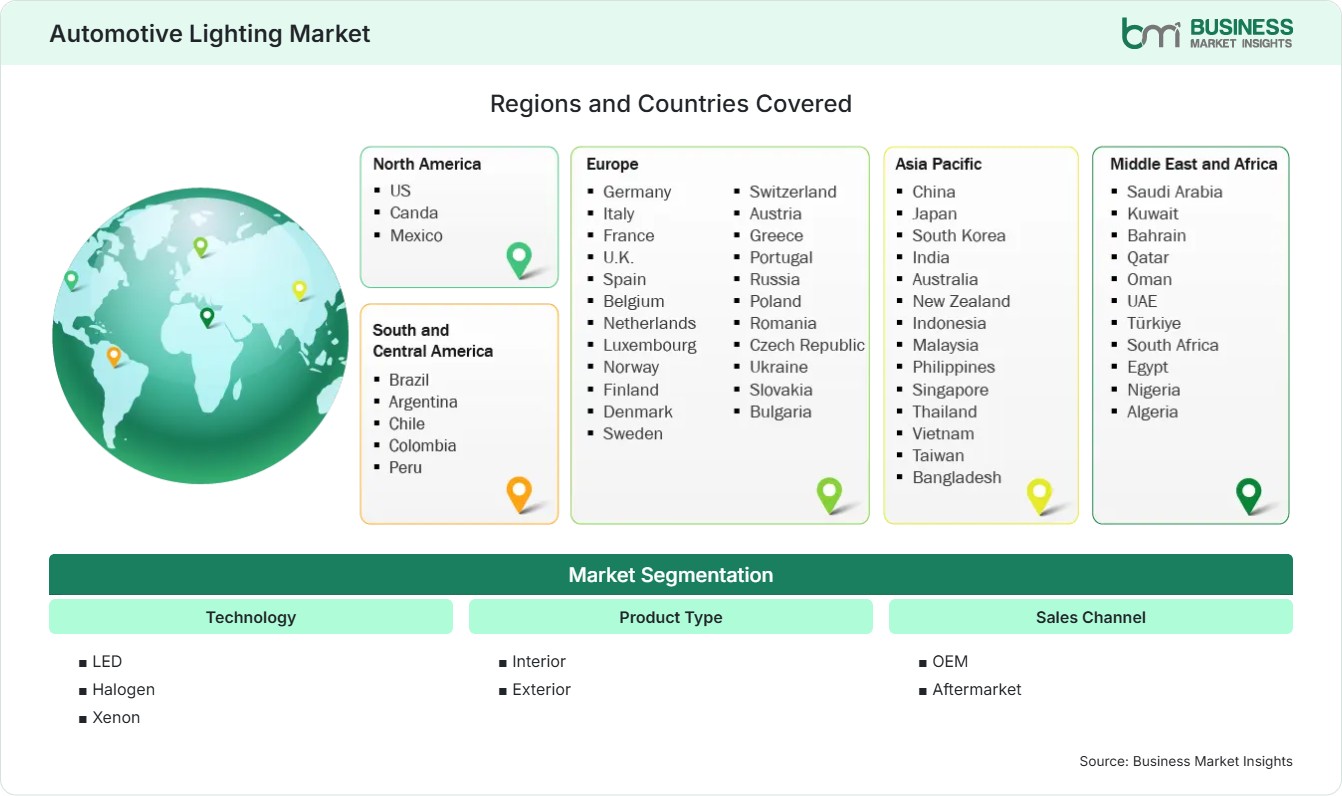
Global Market Geography
FREE PDF
Request your free sample
Request free sample
Segment Analysis

Automotive Lighting Market Segmentation

Vehicle Type

Vehicle Type accounted for diverse demand patterns across applications. Passenger vehicles represented the largest share at 68%–72% in 2025, while the segment is projected to grow at 9.7%–10.2% CAGR through 2033. The Automotive Lighting Market scope continues expanding as OEMs increase lighting content, safety functions, and styling differentiation across vehicle categories.

  • Passenger Vehicles: Largest revenue contributor due to high production volumes, LED adoption, premium features, and increasing consumer demand for advanced visibility and design-oriented lighting solutions.
  • Light Commercial Vehicles: Adoption grows through fleet modernization, e-commerce logistics expansion, and greater emphasis on safety, durability, and lower operating costs.
  • Heavy Commercial Vehicles: Demand is supported by long-haul transportation requirements, improved visibility regulations, and increasing replacement cycles across trucking and industrial fleets.

Technology

Technology preferences are shifting decisively toward efficient and intelligent systems. LED captured 58%–62% share in 2025 and is expected to achieve 10.0%–10.6% CAGR through 2033. Automotive Lighting Market trends reflect consumer preference for durability, aesthetics, and energy savings combined with automaker requirements for flexible vehicle design.

  • LED: Dominates due to lower power consumption, longer lifespan, compact architecture, and compatibility with adaptive lighting technologies.
  • Halogen: Maintains relevance in cost-sensitive vehicle categories despite gradual substitution by advanced alternatives.
  • Xenon: Remains utilized in selected premium applications requiring high-intensity illumination and enhanced nighttime visibility.

Product Type

Product innovation remains concentrated within exterior applications. Exterior systems held 68%–72% share in 2025 and are forecast to grow at 10.6%–11.0% CAGR through 2033. Higher safety content, regulatory requirements, and brand differentiation strategies continue accelerating investment across multiple lighting functions.

Interior

  • Ambient Lamp: Enhances cabin experience through personalization, comfort, and premium vehicle differentiation.
  • Reading Lamp: Maintains demand through passenger convenience requirements and evolving interior designs.
  • Backlighting: Supports human-machine interfaces, infotainment visibility, and improved cabin functionality.

Exterior

  • Headlamps: Core revenue generator driven by adaptive beam functionality and advanced visibility requirements.
  • Tail lamps: Increasingly used for styling differentiation and communication-oriented vehicle signatures.
  • Brake lamps: Supported by mandatory safety requirements and enhanced response visibility technologies.
  • Signal Lamp: Adoption rises with smart signaling and improved traffic communication capabilities.
  • Exterior decoration lamp: Gains traction as automakers emphasize vehicle identity and personalization.
  • Exterior Illumination Function Lamp: Supports safety communication and vehicle-environment interaction features.

Sales Channel

OEM channels dominate revenue generation with approximately 79%–83% share in 2025 and projected CAGR of 9.6%–10.1% through 2033. Increasing integration complexity and software-enabled functionality encourage direct supplier collaboration with automakers, although aftermarket demand remains attractive for upgrade-oriented consumers.

  • OEM: Leads demand through factory-installed lighting systems, advanced integrations, and long-term supply agreements.
  • Aftermarket: Benefits from replacement demand, customization preferences, and widening availability of LED upgrade solutions.
Market Forces

Automotive Lighting Market Dynamics

Key Market Drivers

Expansion of Vehicle Electrification Programs

The global push by electric vehicle (EV) programs to expand is leading to higher demand for energy-efficient and lightweight automotive lighting systems. Since LED and intelligent lighting technologies use less power and allow for more flexibility in vehicle design, EV makers are placing increasing emphasis on them. Lighting is now also playing a significant role in the styling of EVs, with manufacturers employing unique signature lighting to enhance their brand identity and make their vehicle models easier to recognize. The aim of improving battery efficiency is also promoting the use of lightweight and low-power lighting solutions, which can help to optimize the total energy consumption of the vehicle. The strong growth in EV production in China, Europe, and North America is opening up new opportunities for lighting suppliers. Moreover, as communication features and software-defined vehicle technologies are incorporated, lighting systems are becoming more advanced and valuable as part of modern vehicle architectures.

Growing Adoption of Adaptive and Intelligent Lighting

The growing focus on vehicle safety is encouraging automakers to adopt adaptive driving beam, matrix LED, and other intelligent lighting technologies. These systems can adjust illumination based on road conditions and surrounding traffic, helping drivers maintain better visibility in different driving situations. Automakers are increasingly connecting lighting systems with cameras, sensors, and vehicle software to make illumination more responsive and useful. Automotive Lighting Market growth is supported by safety regulations and industry efforts aimed at improving nighttime driving while reducing glare for other road users. Advanced lighting can also support functions such as pedestrian visibility, lane illumination, and driver awareness. Premium vehicles continue to be early adopters of these technologies, but falling technology costs are gradually making advanced lighting systems more accessible for mid-range vehicle models across different markets.

Rising Consumer Preference for Premium Vehicle Features

Automotive lighting is now playing a more important role in the design, branding, and overall user experience of vehicles, rather than merely carrying out a basic lighting function. Since consumers tend to link sophisticated lighting features with higher vehicle quality, better safety, and more modern technology, car manufacturers are increasing the use of dynamic exterior lighting patterns, ambient interior lighting, and multifunctional lighting units. Such features not only make vehicles more visually striking but also offer extra functions. In emerging economies, premiumisation is growing in importance as people with rising incomes seek out cars that have more advanced features and better aesthetics. The fact that consumers are more willing to pay for improved visibility, unique designs, and technology-oriented features is leading automakers and suppliers to keep improving their lighting systems. This trend is fostering innovation in all types of passenger vehicles and opening up new opportunities for companies that are developing advanced automotive illumination technologies.

Key Market Opportunities

Software-Defined Lighting Ecosystems

The development of software-defined vehicles is creating new opportunities for lighting systems that can be updated, customized, and enhanced throughout the vehicle's lifecycle. Instead of relying only on fixed hardware functions, future lighting systems can support over-the-air software updates that introduce new features or improve existing capabilities. These systems could provide customizable beam patterns, dynamic communication signals, and personalized lighting experiences based on driver preferences or specific driving conditions. Automotive Lighting Market Forecasts are increasingly reflecting the potential for software-enabled revenue in addition to traditional hardware sales. Suppliers that can combine optics, electronics, sensors, and software development capabilities may gain a stronger competitive position as vehicle architectures become more digital. This shift could also create new revenue streams through feature upgrades, subscriptions, and software-based function activation after the vehicle has been purchased.

Vehicle-to-Pedestrian Communication Technologies

The increasing use of autonomous and semi-autonomous vehicles is leading to a demand for new methods of communicating a vehicle's movements and intentions to pedestrians, cyclists, and other road users. Since traditional signals like brake lights and turn indicators might not be enough in future mobility environments in which vehicles carry out more driving tasks on their own, intelligent projection systems, dynamic lighting interfaces, and other visual communication technologies could be of help in conveying actions such as stopping, turning, or getting ready to move. Investing in communication-oriented lighting will not only enhance safety but also help manufacturers meet evolving regulations and mobility requirements. With urban transportation systems becoming more connected and as autonomous driving technologies advance, lighting suppliers who have expertise in advanced visual signaling may discover valuable opportunities for partnership. Furthermore, working with manufacturers who are developing autonomous mobility platforms can lead to new applications for intelligent exterior lighting systems.

Emerging Market Penetration and Localization

The increasing number of vehicles owned in India, Southeast Asia, Latin America, and some Middle Eastern economies is creating substantial opportunities for companies that supply automotive lighting. As incomes rise and car production expands, consumers are increasingly likely to buy vehicles with more advanced features, such as improved exterior and interior lighting systems. In parallel, manufacturers are making greater use of local production and supply chains to lower costs, shorten delivery times, and increase their resilience to global disruptions. Local manufacturing can enable lighting suppliers to serve car makers more efficiently while allowing them to adjust their products to the specific requirements and price levels expected in different regions. Furthermore, the expansion of dealership networks and the development of aftermarket ecosystems can offer additional routes for selling lighting products and replacement parts. Businesses that enter these markets with technologies that are both scalable and cost-effective and have solid local partnerships will be better positioned to take advantage of the growing demand. The ongoing shift towards vehicle electrification and the continued addition of new features can also enhance long-term prospects in these areas.

Market Restraints and Challenges

High Development and Integration Costs

Factor: Advanced matrix LED, laser, and software-controlled lighting solutions require significant investment in optics, electronics, validation, and regulatory compliance. Impact: The higher cost of development may act as a constraint in the adoption of such technologies in low-cost vehicles. There is a need for the suppliers to balance the innovation and cost to maintain the quality levels. This may be especially difficult for small producers due to constraints in R&D and engineering.

Supply Chain Complexity and Semiconductor Dependence

Factor: Modern lighting systems rely on semiconductors, sensors, control units, LEDs, and precision optics sourced through global supply networks. Impact: Component shortages, logistics disruptions, and geopolitical uncertainty can affect production schedules and increase procurement costs. Complex supplier ecosystems require strong coordination and inventory management. Dependence on specialized electronic components exposes manufacturers to operational risks, particularly during periods of elevated demand or constrained production capacity.

Company Analysis

Competitive Landscape

The Automotive Lighting Market analysis indicates competition centered on technology innovation, OEM partnerships, production scale, and software integration capabilities.

Company Name

Overview

Products and Services relevant to this market

Koito Manufacturing Co., Ltd.

Global leader specializing in automotive lighting technologies with strong OEM relationships.

LED headlamps, adaptive driving beam systems, rear lighting, signaling solutions.

Valeo SE

Major automotive supplier with broad expertise in intelligent mobility systems.

Matrix lighting, adaptive headlamps, digital lighting software, interior illumination.

FORVIA HELLA GmbH & Co. KGaA

Leading lighting and electronics supplier serving global vehicle manufacturers.

Headlamps, lighting electronics, signaling systems, intelligent illumination modules.

Marelli Holdings Co., Ltd.

Automotive technology company focused on advanced vehicle systems.

Exterior lighting, smart lamps, integrated lighting architectures.

Stanley Electric Co., Ltd.

Specialized developer of automotive LEDs and illumination solutions.

LED modules, headlamps, signal lamps, electronic lighting components.

ams-OSRAM AG

Semiconductor and photonics specialist supporting automotive applications.

LEDs, sensors, optical semiconductors, intelligent lighting technologies.

ZKW Group GmbH

Premium lighting provider serving luxury and mass-market OEMs.

Adaptive headlamps, LED systems, daytime running lights.

Varroc Engineering Limited

Supplier with significant automotive lighting manufacturing presence.

Exterior lighting systems, LED lamps, signaling products.

Lumileds Holding B.V.

Global LED technology company supporting automotive innovation.

High-performance automotive LEDs and lighting solutions.

SL Corporation

Automotive component manufacturer with strong lighting portfolio.

Headlamps, rear lamps, fog lamps, integrated lighting systems.

Trust & Transparency

Research Methodology

The market analysis combines proprietary research with secondary data from government agencies, company disclosures, regulatory filings, industry databases and expert interviews. Market estimates are validated through data triangulation, cross-market benchmarking and analyst review.

View Full Research Methodology

Questions Answered

Frequently Asked Questions

Why is software becoming important in vehicle lighting?

Software enables adaptive functions, over-the-air updates, communication capabilities, and personalized lighting experiences, transforming lighting into a strategic vehicle feature.

What does the Automotive Lighting Market Report typically evaluate?

The Automotive Lighting Market Report generally examines market size, segment performance, technology evolution, regional dynamics, competitive positioning, and future growth opportunities.

Which technology segment is expected to remain dominant?

LED technology is expected to maintain leadership because of durability, lower energy consumption, compact design flexibility, and compatibility with intelligent lighting functions.

How are electric vehicles influencing lighting demand?

Electric vehicles require energy-efficient solutions and frequently use distinctive lighting signatures, increasing lighting value per vehicle.

What factors are accelerating adoption of advanced automotive lighting systems?

LED efficiency, adaptive beam functionality, vehicle electrification, safety regulations, and consumer demand for premium vehicle features are key adoption drivers.

Access the Full Automotive Lighting Market Report

Get segment-level forecasts, regional estimates, competitive benchmarking, company profiles and downloadable Excel datasets.

Access the full Automotive Lighting Market Report
350 pages PDF & Excel | 2026-09-10
Similar Research

Related Market Reports