
Automotive Belts Market Outlook: Size, Share, Trends, Growth Analysis, Competitive Landscape & Forecast, 2026-2033

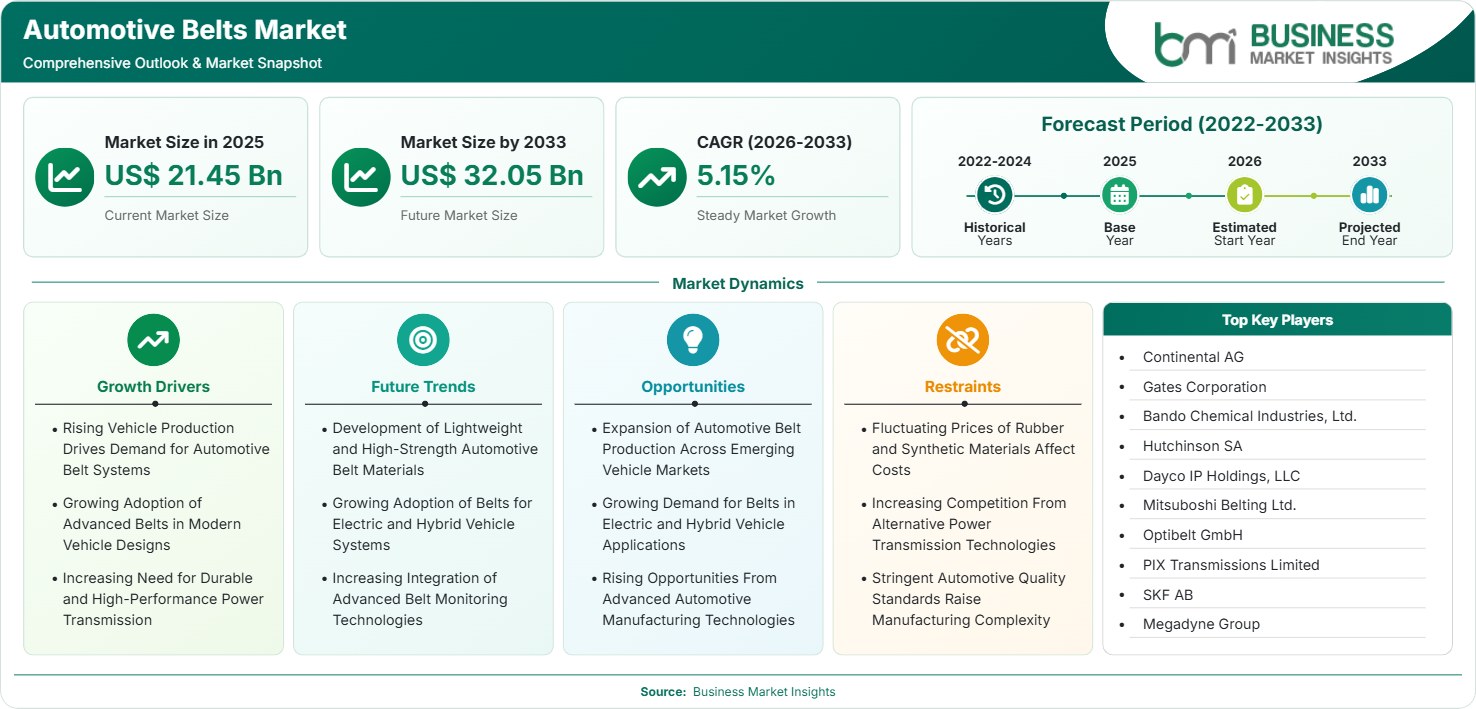
The Automotive Belts Market size was valued at US$ 24.45 Billion in 2025 and is projected to reach US$ 32.05 Billion by 2033, growing at a CAGR of 5.15% during 2026–2033, driven by vehicle production, replacement demand, belt durability, electrification, lightweighting, and advanced power transmission systems.

Report Coverage
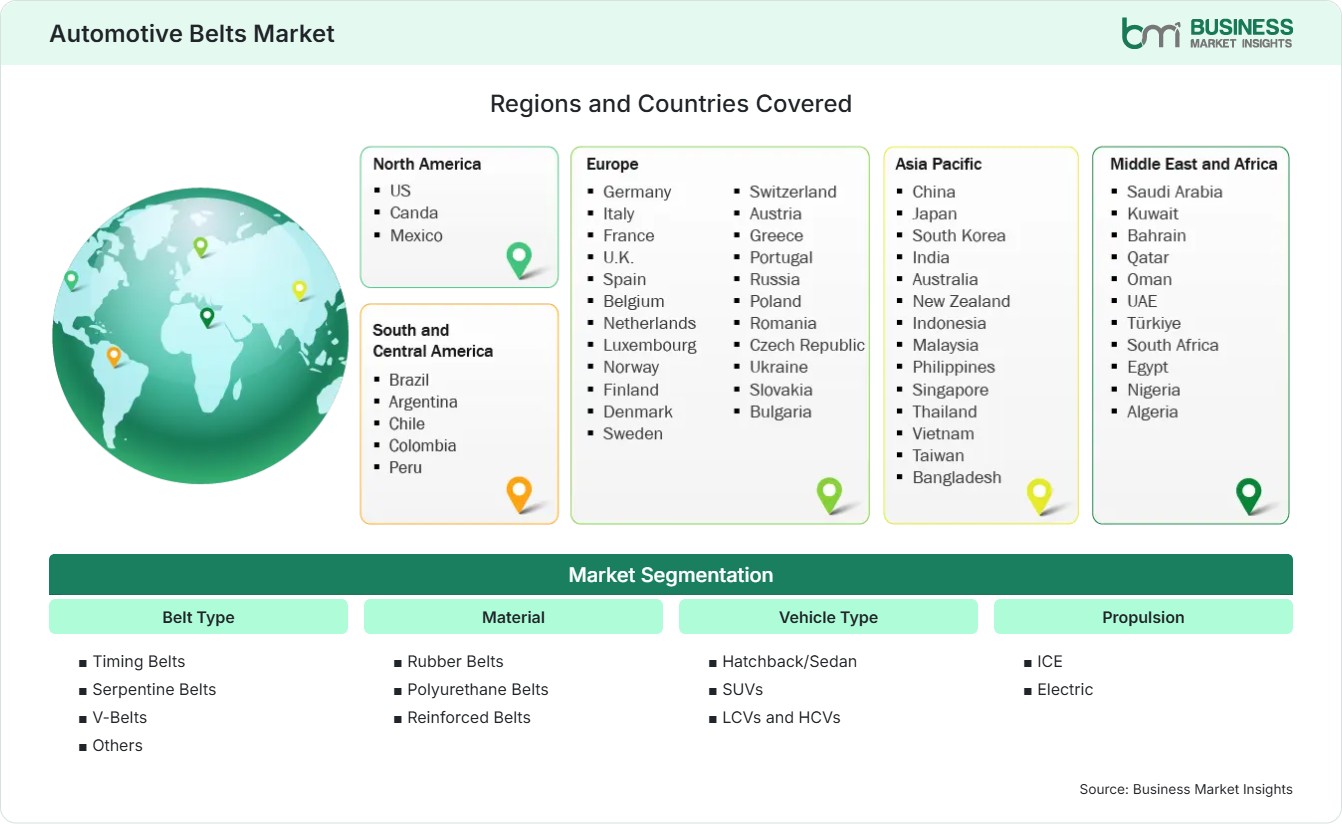
  • Belt Type: Timing Belts, Serpentine Belts, V-Belts, Others
  • Material: Rubber Belts, Polyurethane Belts, Reinforced Belts
  • Vehicle Type: Hatchback/Sedan, SUVs, LCVs and HCVs
  • Propulsion: ICE, Electric
  • Sales Channel: OEM, Aftermarket
US$ 21.45 Bn Market size in 2025
US$ 32.05 Bn Market Size by 2033
5.15% CAGR, 2026 - 2033
2026-2033 Forecast Period

AI Overview

Automotive Belts Market Summary

  • North America Region: North America holds an estimated 22%–25% share in 2025, growing at a CAGR of 4.6%–5.0%, supported by a mature vehicle parc, aftermarket replacement demand, advanced belt technologies, and opportunities in hybridization and high-mileage applications. The US market is estimated to grow at a 4.7%–5.1% CAGR during 2026–2033, supported by a large installed vehicle base, commercial fleets, premium aftermarket penetration, and demand for durable serpentine and timing systems.
  • Fastest Growing Region: Asia Pacific holds an estimated 38%–42% of Automotive Belts Market share in 2025, growing at a CAGR of 5.8%–6.3%, supported by expanding vehicle production, localization, rising disposable incomes, aftermarket development, industrial investment, and increasing adoption of advanced belt materials across China, India, and Southeast Asia.
  • Leading Segment: Timing Belts account for an estimated 38%–42% share in 2025, growing at a CAGR of 4.8%–5.2%, supported by continued ICE vehicle fleets, replacement cycles, precise engine synchronization, lightweighting, lower noise, and development of durable reinforced belt constructions.
  • High Growth Segment: Electric propulsion represents an estimated 5%–8% share in 2025, growing at a CAGR of 10.0%–13.0%, driven by expanding hybrid architectures, auxiliary electric systems, thermal management, compact drive modules, specialized belt requirements, and rising vehicle electrification across emerging and developed markets.
  • Key Market Opportunity: Opportunities are emerging in belt-in-oil systems, high-strength polyurethane, and aftermarket kits that combine belts, tensioners, pulleys, and installation support.
  • Major Market Players: Continental AG, Gates Corporation, Bando Chemical Industries, Ltd., Hutchinson SA, Dayco IP Holdings, LLC, Mitsuboshi Belting Ltd., Optibelt GmbH, PIX Transmissions Limited, SKF AB, Megadyne Group.
Strategic Insights

Automotive Belts Market: Strategic Insights

Automotive Belts Market Strategic Framework
FREE PDF
Request your free sample
Request free sample
Stakeholder View

Key Takeaways

  • The supply chain is shifting toward integrated belt-system solutions, with manufacturers increasingly supplying belts alongside tensioners, idlers, pulleys, and installation kits.
  • The strongest upside lies in hybrid powertrains, advanced auxiliary drives, belt-in-oil systems, and specialized electric vehicle applications.
  • Product innovation is moving toward high-strength tensile cords, and digitally supported maintenance strategies designed to extend service intervals.
  • Asia Pacific presents the most compelling capacity and investment case because production scale, component localization, expanding domestic vehicle fleets, and rapid electrification combine to support both OEM and aftermarket demand.
  • Consolidation opportunities are strongest around specialist belt manufacturers, regional aftermarket distributors, and technology suppliers capable of combining material science with application engineering and vehicle-specific coverage.
  • Suppliers with broad global distribution, strong OE validation, and aftermarket catalog depth are better positioned to manage platform complexity as automakers adopt multiple propulsion technologies simultaneously.
Geographic Outlook

Automotive Belts Market Regional Highlights

North America Automotive Belts Market

North America automotive belts market holds a 22%–25% share of global revenue in 2025 and is projected to expand at a 4.6%–5.0% CAGR through 2033. The region has advantages of having an established installed base of vehicles, well-established repair infrastructure, a substantial presence of commercial fleets, and a high demand for timing and serpentine system replacements. While the US is the major national market, Mexico has advantages through the investments made in vehicle manufacturing and supply chain management. Canada has contributions to make via passenger cars, commercial fleets, and replacements. Electrification adds more demands for thermal management and auxiliary drive systems.

  • The US aftermarket remains structurally attractive because a large active vehicle parc creates recurring replacement requirements, while fleet operators prioritize preventive maintenance, reduced downtime, and longer component service intervals.
  • Mexico provides manufacturing opportunities as automakers and suppliers expand regional production networks, increasing demand for locally sourced components and reinforcing the importance of integrated North American supply chains.
  • Advanced EPDM, aramid-reinforced constructions, and precision-engineered serpentine systems are gaining traction where vehicles operate under high temperatures, heavy loads, extended mileage, and demanding accessory-drive configurations.

US Automotive Belts Market

The US automotive belts market represents approximately 78%–82% of North America's 2025 revenue and is projected to grow at a 4.7%–5.1% CAGR through 2033. Demand is supported by vehicle longevity, extensive independent repair networks, commercial fleets, and replacement cycles. The market increasingly favors OE-matched components, complete repair kits, and belts engineered for complex accessory routing.

  • A large and aging vehicle population supports replacement demand, with workshops increasingly preferring complete belt-drive kits that reduce installation errors and improve component compatibility.
  • Fleet operators prioritize predictable maintenance and lower downtime, creating opportunities for premium belts designed around longer service intervals, improved heat resistance, and enhanced resistance to contamination.
  • Hybridization supports continued demand for belt expertise because powertrain complexity requires specialized solutions across engine accessories, thermal management, and electrically assisted systems.

Europe Automotive Belts Market

Europe automotive belts market accounts for an estimated 25%–28% share in 2025 and is expected to grow at a 4.5%–4.9% CAGR through 2033. Germany remains the leading country, while Italy and France provide substantial manufacturing and aftermarket demand. Poland is emerging as a high-growth manufacturing hub at approximately 5.2%–5.7% CAGR, supported by supplier localization and vehicle production.

  • Germany maintains strong demand through its automotive manufacturing ecosystem, premium vehicle production, engineering capabilities, and extensive supplier base supporting high-performance timing and accessory-drive systems.
  • Poland is gaining importance as production capacity and component localization expand, creating opportunities for belt manufacturers supplying OEM programs and regional aftermarket distribution networks.
  • France and Italy retain established demand through passenger vehicles, commercial fleets, replacement parts, and specialist automotive manufacturing, with hybridization supporting transitional belt applications.

Asia Pacific Automotive Belts Market

Asia Pacific automotive belts market represents approximately 38%–42% of 2025 revenue and is projected to grow at a 5.8%–6.3% CAGR, making it the fastest-growing regional market. China leads regional demand, while India and Japan maintain substantial production and replacement ecosystems. India is a high-growth market at approximately 6.5%–7.0% CAGR, supported by expanding vehicle production, aftermarket formalization, and rising ownership.

  • China remains the leading market because of its extensive vehicle production base, large domestic fleet, established component ecosystem, and rapid expansion of electric and hybrid vehicle manufacturing.
  • India combines expanding passenger and commercial vehicle production with a growing replacement market, creating opportunities for manufacturers offering durable, cost-efficient products and broader regional distribution.
  • Japan maintains strong demand for precision-engineered belts, supported by established automotive production, stringent quality expectations, and technology development across hybrid and advanced powertrain platforms.
  • Southeast Asia is emerging as a high-growth manufacturing zone, with Thailand, Indonesia, and Vietnam benefiting from vehicle localization, supply-chain investment, and accelerating electric mobility adoption.

Rest of World Automotive Belts Market

South and Central America automotive belts market account for part of the Rest of World opportunity, with Brazil and Mexico-linked supply networks supporting demand across passenger and commercial vehicles. Brazil remains the leading South American market, while Colombia and Argentina offer selective aftermarket potential. Middle East and Africa demand is concentrated in passenger vehicles, commercial fleets, and harsh operating environments requiring heat-resistant products. The combined Rest of World region represents approximately 10%–14% share in 2025 and is projected to grow at a 4.0%–4.5% CAGR through 2033.

  • Brazil benefits from a large vehicle parc and established automotive manufacturing ecosystem, supporting replacement demand for timing, serpentine, and accessory-drive belts across passenger and commercial vehicles.
  • Saudi Arabia and the UAE provide premium aftermarket opportunities because high temperatures and extensive vehicle usage increase emphasis on heat resistance, durability, and dependable maintenance programs.
  • South Africa serves as a regional aftermarket hub, with demand supported by commercial fleets, passenger vehicles, replacement cycles, and distribution networks serving neighboring markets.
  • Argentina and Colombia offer selective growth potential as vehicle parc expansion and replacement activity create opportunities for suppliers with strong regional coverage and competitive product portfolios.
Global Market Geography
FREE PDF
Request your free sample
Request free sample
Segment Analysis

Automotive Belts Market Segmentation

Belt Type

Timing Belts lead the segment with an estimated 38%–42% of global automotive belts market share in 2025 and a 4.8%–5.2% CAGR during 2026–2033. Serpentine and V-belts benefit from accessory-drive complexity, fleet maintenance, and durable material innovation.

  • Timing Belts: Critical for synchronized engine operation, these belts benefit from replacement cycles, precision manufacturing, reinforced tensile cords, and continued ICE and hybrid vehicle penetration across global markets.
  • Serpentine Belts: Multi-accessory systems support demand through alternator, compressor, steering, and water-pump drives, with EPDM and aramid reinforcement improving durability under complex routing and higher operating temperatures.
  • V-Belts: Established in legacy and commercial applications, V-belts remain relevant where simple, reliable power transmission is required, particularly across older vehicles, utility fleets, and selected heavy-duty applications.

Material

Rubber Belts account for an estimated 62%–66% of automotive belts market share in 2025 and are projected to grow at a 4.5%–4.9% CAGR during 2026–2033. Rubber remains dominant because of cost efficiency, flexibility, and established OEM qualification.

  • Rubber Belts: Widely adopted for timing and accessory drives, rubber compounds offer flexibility, cost competitiveness, and established manufacturing processes while evolving toward improved heat, oil, and ozone resistance.
  • Polyurethane Belts: Used where high tensile strength and dimensional stability are required, polyurethane offers opportunities in specialized drives, compact architectures, and applications demanding resistance to wear and environmental exposure.
  • Reinforced Belts: Aramid and advanced tensile-cord reinforcement enable higher load capacity, reduced stretch, and longer service life, supporting premium applications with demanding temperature, vibration, and mileage requirements.

Vehicle Type

Hatchback/Sedan vehicles represent an estimated 50%–54% of automotive belts market share in 2025 and are projected to grow at a 4.6%–5.0% CAGR during 2026–2033. Their large global installed base supports recurring replacement demand. SUVs are expanding faster because of continued consumer preference, while LCVs and HCVs benefit from fleet utilization and maintenance intensity.

  • Hatchback/Sedan: Large installed fleets and high replacement volumes sustain demand, particularly across mature markets where aging vehicles generate recurring timing and accessory-belt maintenance requirements.
  • SUVs: Growing global preference for SUVs increases demand for durable belt systems capable of supporting heavier vehicle loads, complex accessory configurations, and demanding thermal operating conditions.
  • LCVs: Delivery fleets and service vehicles require reliable accessory systems and preventive maintenance, creating demand for long-life belts, complete kits, and replacement products optimized for frequent operation.
  • HCVs: Heavy commercial vehicles require high-load power transmission and durable components, supporting specialized reinforced belts and aftermarket solutions designed to minimize downtime and maintenance interruptions.

Propulsion

ICE vehicles retain an estimated 88%–92% share in 2025 and are projected to grow at a 3.8%–4.3% CAGR during 2026–2033. Electric propulsion is smaller but represents the fastest-growing opportunity. Hybrid vehicles bridge both technologies and preserve demand for selected engine-driven systems.

  • ICE: The dominant installed fleet supports sustained demand for timing, serpentine, V-belts, and accessory systems, with replacement activity remaining important across mature and emerging automotive markets.
  • Electric: EV growth creates opportunities for specialized belts in thermal management, auxiliary systems, compact drive modules, and selected transmission-related applications as vehicle architectures evolve.

Sales Channel

OEM channels account for an estimated 58%–62% share in 2025 and are projected to grow at a 4.6%–5.0% CAGR during 2026–2033. OEM demand benefits from vehicle production and platform contracts, while aftermarket growth is supported by fleet aging and repair activity.

  • OEM: Long-term platform contracts, stringent qualification requirements, and integrated vehicle development favor manufacturers with advanced engineering capabilities, global production footprints, and reliable quality systems.
  • Aftermarket: Replacement cycles, independent workshops, vehicle longevity, and preventive maintenance support demand for belts, tensioners, pulleys, and complete repair kits across mature and emerging markets.

Application

Engine Timing Systems represent an estimated 36%–40% share in 2025 and are projected to grow at a 4.7%–5.1% CAGR during 2026–2033. Accessory applications remain important because modern vehicles require reliable alternator, steering, and air-conditioning drives.

  • Engine Timing Systems: Precision synchronization remains essential in ICE and hybrid engines, sustaining demand for high-strength timing belts designed around controlled tolerances and long replacement intervals.
  • Alternator Drive: Reliable energy generation requires durable accessory belts capable of handling continuous operation, vibration, and changing loads across passenger vehicles and commercial fleets.
  • Power Steering: Belt-driven hydraulic systems remain relevant across legacy and commercial vehicle fleets, while hybridization creates transitional demand for specialized solutions in mixed powertrain architectures.
  • Air Conditioning Compressor: High thermal loads and continuous seasonal usage require belts with strong resistance to heat, contamination, tension loss, and repeated flexing.
Market Forces

Automotive Belts Market Dynamics

Key Market Drivers

Rising Vehicle Production Drives Demand for Automotive Belt Systems

The market growth is enhanced by increasing manufacturing in Asia along with replacement in developed economies. Increased complexity in automotive systems also leads to an increase in the number of parts running on accessory drive, thus making the need for reliable belts greater. Automotive Belts Market trend focuses on high-temperature EPDM, aramid reinforcement, tight tolerance and increased service life. The revival in production shows that component demand is still highly dependent on vehicle production, despite changes in propulsion technology and manufacturing.

Growing Adoption of Advanced Belts in Modern Vehicle Designs

Engineers in the automotive industry are implementing thin profiles, high tensile strength cord, enhanced EPDM formulation, and oil-belt design in order to reduce weight and pack better under harsh thermal conditions. Gates highlights the development of their Micro-V belt which features an enhanced EPDM and aramid fiber technology, whereas Dayco has introduced aftermarket belt-in-oil design for turbocharged vehicles. Such innovations help in enhancing market growth owing to increased value of each belt and greater scope for replacements in new vehicle models. It also creates entry barriers due to need for durability, precision, and quiet operation with complex driveline systems.

Increasing Need for Durable and High-Performance Power Transmission

Modern vehicles are designed to accommodate more compact packaging, higher accessory loads, higher mileage expectations, and greater sensitivity to noise and vibration. These factors make it necessary to use belts that can withstand high temperatures, heavy exposure to oil and contaminants, misalignment, fatigue, and constant flexing. This market development focuses on reinforced belts and full drive system solutions that incorporate belts, pulleys, and tensioners. Thus, future market development prospects are fueled by demand for the replacement of high-end products.

Key Market Opportunities

Expansion of Automotive Belt Production Across Emerging Vehicle Markets

The growing manufacturing hubs in India, Southeast Asia, Mexico, and certain Latin American countries offer chances to increase capacity, localization, and distribution of after-market parts. Higher vehicle ownership leads to a greater installed base that needs scheduled replacements, while local manufacturing helps cut logistical costs and enhance response to OEM demands. Such capabilities will help build stronger customer relations and reduce supply risks while producing specialized products for passenger cars and commercial fleets.

Growing Demand for Belts in Electric and Hybrid Vehicle Applications

Electrification offers a differential advantage rather than an equal opportunity for a drop in belt consumption. Combustion engines and many of their accessories are used in hybrid cars, while the electric vehicle architecture brings specific needs for thermal management, compressors, pumps, and small auxiliary drives. Automotive Belts Market forecast, hence becoming more dependent on suppliers' ability to adapt their products to a new operating environment, including higher electrical integration, lower noise requirements, reduced available space, and changing load profiles.

Rising Opportunities from Advanced Automotive Manufacturing Technologies

Advanced manufacturing technologies increase consistency, dimensional control, material efficiency, and traceability, allowing for faster development cycles. Automated inspection, digital process control, simulation-driven design, and quality prediction systems enable manufacturers to reduce defect rates and validate more complex belt shapes. Smart maintenance is another area of potential application, where sensing and data analysis may eventually allow fleets to monitor and prevent belt degradation.

Market Restraints and Challenges

Fluctuating Prices of Rubber and Synthetic Materials Affect Costs

Factor: Fluctuations in the costs of natural rubber, synthetic elastomers, polyurethane, reinforcement fibers, energy, and logistics could increase costs of production and make sourcing more difficult. Impact: Increased input costs would reduce suppliers' profit margins, raise replacement part prices, and prompt customers to postpone nonessential maintenance. Belt manufacturing is especially vulnerable to changes in material and tensile cord costs, given the stringent technical requirements that do not permit substitution of the materials without further testing. Small-sized suppliers may be more vulnerable to fluctuations in commodity costs, owing to their smaller buying clout and reduced hedging options.

Increasing Competition from Alternative Power Transmission Technologies

Factor: Timing chains, direct electrical drives, electric motor systems, and electrification of vehicle platforms could serve as substitutes for selected applications of belts. Impact: Component manufacturers might observe a decline in volumes of their addressable market for specific engine and auxiliary applications, especially due to the growing presence of electric vehicles and re-engineering by carmakers. Nevertheless, other transmission technologies do not preclude the use of belts in all applications since hybrid drivetrains, auxiliary equipment, thermal management systems, and the spare parts market still need such solutions.

Company Analysis

Competitive Landscape

The Automotive Belts Market analysis indicates the competition in the market by factors such as OE relationships globally, market reach for aftermarket sales, material knowledge, application engineering, and regional production capability. Leading firms in the market are engaged in competing through offering a complete drive system and not individual belts.

Company Name

Overview

Products and Services relevant to this market

Continental AG

Global automotive supplier with extensive expertise in power transmission and vehicle systems, serving OEM and replacement markets.

Timing belts, serpentine belts, accessory drive systems, belt kits, tensioners, pulleys, and aftermarket technical support.

Gates Corporation

Global power transmission specialist with broad automotive OE and aftermarket capabilities and extensive belt engineering expertise.

Timing belts, Micro-V belts, V-belts, stretch-fit belts, belt kits, tensioners, pulleys, and diagnostic tools.

Bando Chemical Industries, Ltd.

Japanese manufacturer with established expertise in automotive and industrial power transmission products and global manufacturing operations.

Automotive timing belts, V-belts, serpentine belts, accessory-drive products, and specialized rubber transmission solutions.

Hutchinson SA

French technology supplier specializing in vibration control, fluid management, sealing, and belt-related automotive systems.

Automotive drive belts, elastomer systems, vibration-control solutions, power transmission components, and integrated vehicle applications.

Dayco IP Holdings, LLC

Specialist supplier serving automotive OE, aftermarket, industrial, and mobility applications with strong belt-system expertise.

Timing belts, belt-in-oil systems, serpentine belts, tensioners, pulleys, kits, and advanced drive-system solutions.

Mitsuboshi Belting Ltd.

Japanese belt manufacturer with a broad portfolio covering automotive, industrial, and specialty power transmission applications.

Automotive timing belts, V-belts, ribbed belts, transmission belts, belt kits, and engineered rubber products.

Optibelt GmbH

European power transmission specialist focused on high-performance belt engineering and application-specific drive solutions.

Timing belts, ribbed belts, V-belts, polyurethane belts, reinforced products, and technical drive-system services.

PIX Transmissions Limited

Indian power transmission manufacturer with extensive belt production and distribution capabilities across global markets.

Automotive V-belts, timing belts, ribbed belts, wrapped belts, reinforced constructions, and aftermarket transmission products.

SKF AB

Global bearing and rotating-equipment specialist with complementary power transmission and automotive aftermarket capabilities.

Belts, belt kits, tensioners, pulleys, accessory drive components, and integrated automotive repair solutions.

Megadyne Group

Power transmission specialist offering engineered belts and systems for demanding automotive and industrial applications.

Timing belts, V-belts, synchronous belts, polyurethane products, specialty transmission solutions, and technical application support.

Trust & Transparency

Research Methodology

The market analysis combines proprietary research with secondary data from government agencies, company disclosures, regulatory filings, industry databases and expert interviews. Market estimates are validated through data triangulation, cross-market benchmarking and analyst review.

View Full Research Methodology

Questions Answered

Frequently Asked Questions

Which product capabilities will differentiate suppliers in automotive belts market report?

Differentiation will increasingly depend on OE validation, vehicle-specific engineering, global catalog coverage, integrated repair kits, advanced materials, and the ability to adapt belt systems for hybrid, electric, and high-efficiency vehicle platforms.

How are material innovations changing belt performance?

EPDM compounds, aramid reinforcement, polyurethane, and advanced tensile cords improve resistance to heat, oil, fatigue, contamination, and stretching. These materials enable thinner, lighter, and longer-lasting products for increasingly demanding vehicle architectures.

Why is the aftermarket strategically important for belt manufacturers?

The aftermarket provides recurring demand from vehicle aging, scheduled replacement, commercial fleet maintenance, and preventive servicing. Complete kits containing belts, tensioners, and pulleys can increase average transaction value while reducing installation-related failures.

What makes belt-in-oil technology commercially important?

Belt-in-oil systems can support engine downsizing, lower weight, improved packaging, and favorable noise and vibration characteristics. Their increasing presence also creates future aftermarket replacement opportunities as equipped vehicles reach scheduled service intervals.

What is driving demand for automotive belts despite vehicle electrification?

Hybrid vehicles retain combustion engines and accessory systems, while EVs create selected opportunities in thermal management and auxiliary applications. The transition is therefore changing product mix rather than eliminating belt demand across the entire vehicle ecosystem.

Access the Full Automotive Belts Market Report

Get segment-level forecasts, regional estimates, competitive benchmarking, company profiles and downloadable Excel datasets.

Access the full Automotive Belts Market Report
350 pages PDF & Excel | 2026-08-10
Similar Research

Related Market Reports