
Automotive Infotainment Market Outlook: Size, Share, Trends, Growth Analysis, Competitive Landscape & Forecast, 2026-2033

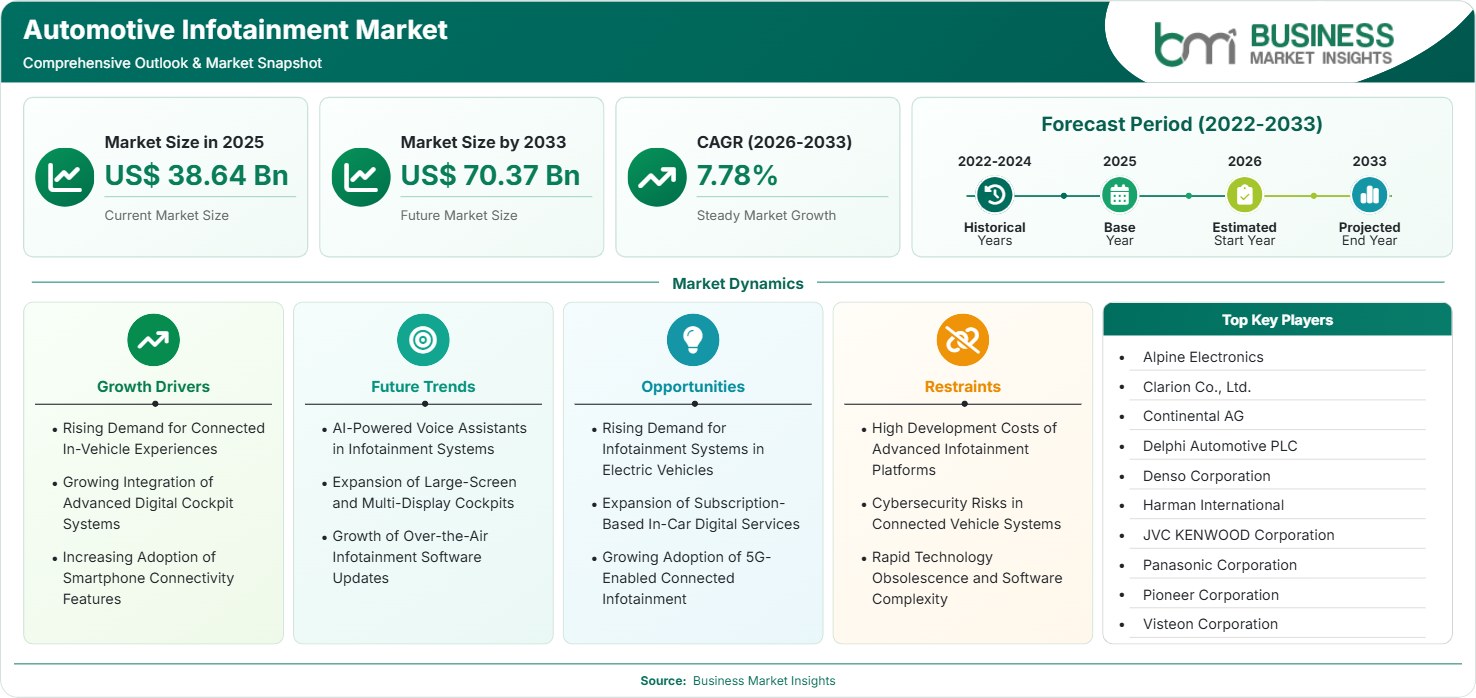
The Automotive Infotainment Market size was valued at US$ 38.64 Billion in 2025 and is projected to reach US$ 70.37 Billion by 2033, growing at a CAGR of 7.78% during 2026–2033. Rising consumer demand for connected vehicle experiences, increasing integration of advanced navigation systems, growing adoption of digital cockpits, and expanding vehicle connectivity technologies are supporting market growth across both developed and emerging automotive markets.

Report Coverage
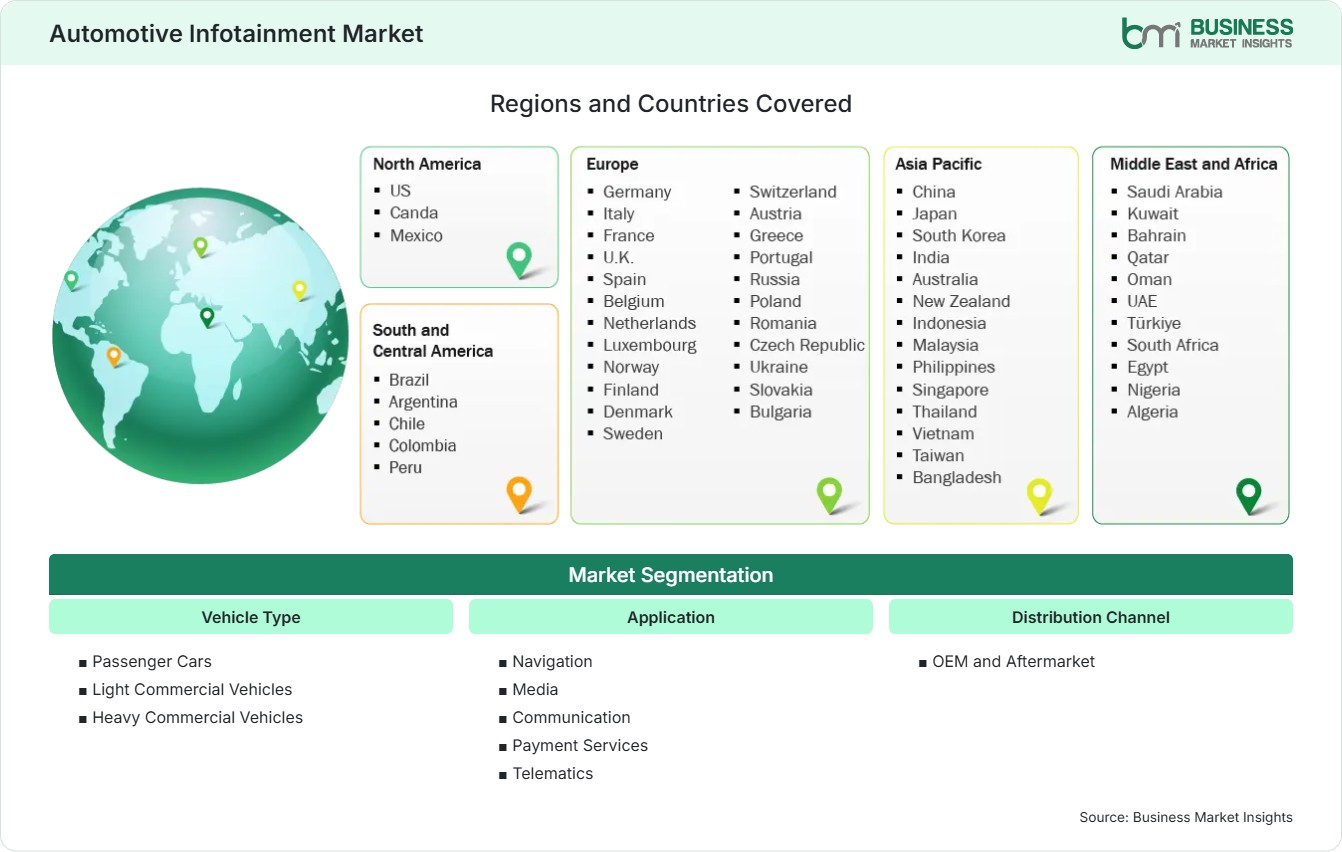
  • Vehicle Type: Passenger Cars, Light Commercial Vehicles, Heavy Commercial Vehicles
  • Application: Navigation, Media, Communication, Payment Services, Telematics
  • Distribution Channel: OEM and Aftermarket
US$ 38.64 Bn Market size in 2025
US$ 70.37 Bn Market Size by 2033
7.78% CAGR, 2026 - 2033
2026-2033 Forecast Period

AI Overview

Automotive Infotainment Market Summary

  • North America Region: North America holds a automotive infotainment market share of 34%–37% in 2025, growing with a CAGR of 7.1%–7.6% during 2026–2033. Strong adoption of connected vehicles, advanced digital cockpit technologies, premium vehicle demand, and growing consumer preference for integrated infotainment systems continue supporting regional growth. The U.S. market benefits from high vehicle technology penetration and increasing demand for in-car connectivity solutions, expanding at 7.2%–7.8% CAGR.
  • Fastest Growing Region: Asia Pacific accounts for 29%–32% share in 2025 and is projected to grow at a CAGR of 8.6%–9.1% through 2033. Expanding automotive production, rising disposable incomes, increasing electric vehicle adoption, and growing consumer demand for connected mobility experiences are driving regional expansion.
  • Leading Segment: Passenger Cars represent 62%–65% share in 2025 and are expected to grow at a CAGR of 7.5%–8.0% through 2033. Increasing integration of advanced infotainment features, digital dashboards, smartphone connectivity, and navigation systems continues supporting segment dominance.
  • High Growth Segment: Telematics accounts for 17%–20% share in 2025 and is forecast to grow at a CAGR of 9.2%–9.8% during 2026–2033. Rising connected vehicle adoption, real-time vehicle monitoring, fleet management requirements, and increasing demand for vehicle-to-cloud communication are driving growth.
  • Key Market Opportunity: Expansion of software-defined vehicles and connected mobility ecosystems is creating opportunities for infotainment providers to integrate artificial intelligence, cloud services, personalized user experiences, and advanced digital content capabilities.
  • Major Market Players: Alpine Electronics, Clarion Co., Ltd., Continental AG, Delphi Automotive PLC, Denso Corporation, Harman International, JVC KENWOOD Corporation, Panasonic Corporation, Pioneer Corporation, Visteon Corporation.
Strategic Insights

Automotive Infotainment Market: Strategic Insights

Automotive Infotainment Market Strategic Framework
FREE PDF
Request your free sample
Request free sample
Stakeholder View

Key Takeaways

  • Vehicle infotainment systems are increasingly becoming central components of connected vehicle strategies, combining entertainment, navigation, communication, and telematics capabilities within unified digital platforms.
  • Passenger cars continue generating the largest revenue contribution due to higher production volumes and growing consumer demand for advanced connected vehicle features.
  • Telematics applications represent a major growth area as manufacturers focus on connected services, vehicle monitoring, predictive maintenance, and real-time communication capabilities.
  • Asia Pacific automotive infotainment market offers substantial investment opportunities because of rising vehicle ownership, strong automotive production capacity, expanding middle-class populations, and increasing digital adoption.
  • Strategic partnerships among automakers, software providers, and consumer electronics companies are accelerating innovation and supporting development of advanced infotainment ecosystems.
  • Artificial intelligence, cloud integration, and personalized content delivery are emerging as important competitive differentiators across the automotive infotainment value chain.
Geographic Outlook

Automotive Infotainment Market Regional Highlights

North America Automotive Infotainment Market

North America accounts for 34%–37% Automotive Infotainment Market share in 2025 and is projected to grow at a CAGR of 7.1%–7.6% through 2033. Strong consumer demand for connected vehicles, advanced digital cockpit solutions, and premium in-car experiences continues supporting regional adoption. Automakers across the region are investing in intelligent infotainment systems that improve vehicle functionality, connectivity, and user engagement while supporting broader connected mobility initiatives.

  • Automotive manufacturers are increasingly integrating large touchscreen displays, voice-enabled controls, and cloud-based services to improve the overall driving experience. These investments are supporting the transition toward software-centric vehicle platforms and connected mobility ecosystems.
  • Rising demand for connected services such as real-time navigation, remote diagnostics, and vehicle monitoring is encouraging automakers to expand infotainment functionality beyond traditional entertainment applications.
  • Growing consumer preference for seamless smartphone integration and digital experiences is driving adoption of advanced infotainment platforms capable of supporting multiple connectivity and personalization features.
  • Premium and luxury vehicle segments continue acting as important innovation hubs, introducing new infotainment technologies that subsequently expand into mass-market vehicle categories.
  • Increasing adoption of over-the-air software updates is improving system functionality while enabling automakers to continuously enhance user experiences throughout the vehicle lifecycle.

US Automotive Infotainment Market

The United States contributes approximately 79%–83% of North American revenue and is expected to register a CAGR of 7.2%–7.8% through 2033. Strong technology adoption, high vehicle ownership rates, and increasing consumer demand for digital mobility experiences continue supporting automotive infotainment market expansion. Automotive manufacturers are actively incorporating advanced infotainment capabilities to improve customer satisfaction and strengthen product differentiation.

  • Consumers increasingly prioritize advanced connectivity features, navigation systems, streaming services, and smartphone integration when evaluating vehicle purchases.
  • Strong adoption of connected vehicles is supporting demand for telematics-enabled infotainment platforms capable of delivering real-time information and digital services.
  • Automakers continue collaborating with technology companies to strengthen software capabilities, improve user interfaces, and enhance digital customer experiences.
  • Increasing demand for electric vehicles is creating additional opportunities for integrated infotainment systems designed around connected and software-defined vehicle architectures.

Europe Automotive Infotainment Market

Europe represents 24%–27% of global revenue in 2025 and is anticipated to expand at a CAGR of 7.3%–7.9% through 2033. Strong automotive engineering capabilities, increasing vehicle electrification, and growing demand for connected mobility services are supporting regional growth. Germany remains the leading automotive infotainment market, while Poland demonstrates stronger growth potential driven by automotive industry expansion and increasing technology investments.

  • Germany continues leading regional adoption through its strong automotive manufacturing base and significant investments in next-generation in-vehicle digital technologies.
  • Poland is among the fastest-growing markets, recording an estimated CAGR of 8.2%–8.8%, supported by growing automotive production and increasing vehicle technology integration.
  • Vehicle electrification initiatives are encouraging greater deployment of sophisticated infotainment systems that enhance user engagement and vehicle connectivity.
  • Connected mobility services continue expanding across European markets as automakers prioritize digital experiences and intelligent transportation solutions.
  • Automotive manufacturers are increasingly utilizing infotainment systems as a platform for delivering subscription-based services and software-driven features.

Asia Pacific Automotive Infotainment Market

Asia Pacific accounts for 29%–32% of total revenue in 2025 and is expected to achieve the fastest CAGR of 8.6%–9.1% through 2033. Rising vehicle production, increasing disposable incomes, growing urbanization, and expanding adoption of connected technologies continue supporting automotive infotainment market expansion. China remains the largest market in the region, while India demonstrates strong growth potential driven by rapid automotive modernization and consumer demand for advanced vehicle features.

  • China continues dominating regional demand through large-scale vehicle production, high adoption of connected technologies, and increasing investments in intelligent mobility ecosystems.
  • India is projected to achieve approximately 9.3%–9.9% CAGR, supported by rising automotive sales, increasing digital adoption, and growing consumer preference for connected vehicle features.
  • Automotive manufacturers are increasingly offering infotainment systems across mid-range vehicle categories, improving accessibility and expanding market penetration.
  • Growing demand for navigation, communication, and media streaming services continues encouraging adoption of feature-rich infotainment platforms.
  • Expansion of electric vehicle production is creating opportunities for next-generation digital cockpit and connectivity solutions throughout the regional automotive ecosystem.

Rest of World Automotive Infotainment Market

Rest of World accounts for 9%–12% of global revenue in 2025 and is projected to expand at a CAGR of 7.5%–8.1% through 2033. Increasing vehicle sales, rising adoption of connected technologies, and ongoing automotive modernization efforts are supporting demand across emerging markets. Growing consumer interest in premium vehicle experiences is also encouraging infotainment adoption.

  • Brazil continues generating demand for infotainment solutions due to increasing vehicle production and growing consumer preference for connected automotive technologies.
  • The UAE is witnessing growing adoption of advanced infotainment features within premium and luxury vehicle segments, supported by strong consumer demand for digital experiences.
  • Saudi Arabia is expected to achieve approximately 8.1%–8.7% CAGR, driven by vehicle technology adoption, increasing automotive investments, and expanding connected mobility initiatives.
  • Automotive distributors and manufacturers are increasingly introducing technology-rich models to attract consumers seeking enhanced comfort, connectivity, and entertainment features.
  • Growing penetration of smartphones and digital services is strengthening demand for integrated infotainment platforms that support seamless connectivity and personalized user experiences.
Global Market Geography
FREE PDF
Request your free sample
Request free sample
Segment Analysis

Automotive Infotainment Market Segmentation

Vehicle Type

The vehicle type segment remains a fundamental contributor to infotainment system adoption as automakers increasingly integrate connected technologies across passenger and commercial vehicle categories. The segment accounts for approximately 62%–65% share in 2025 and is expected to grow at a CAGR of 7.5%–8.0% through 2033. The expanding Automotive Infotainment Market scope is supported by growing consumer expectations for connected driving experiences, digital cockpit integration, entertainment services, and intelligent vehicle communication capabilities.

  • Passenger Cars: Passenger cars remain the dominant vehicle category due to high production volumes and increasing consumer demand for navigation systems, multimedia capabilities, smartphone integration, and advanced digital cockpit features. Manufacturers are increasingly incorporating larger displays, voice assistants, and connectivity services to enhance user experiences.
  • Light Commercial Vehicles: Light commercial vehicles are witnessing increasing infotainment adoption as fleet operators prioritize connectivity, route optimization, communication capabilities, and telematics-enabled services to improve operational efficiency and driver productivity.
  • Heavy Commercial Vehicles: Heavy commercial vehicles increasingly utilize infotainment and telematics platforms to support fleet management, vehicle monitoring, driver communication, navigation assistance, and operational safety objectives across transportation networks.

Application

Application-based deployment continues expanding as infotainment systems evolve into multifunctional platforms that combine entertainment, connectivity, information delivery, and mobility services. This segment accounts for approximately 36%–39% share in 2025 and is projected to register a CAGR of 8.0%–8.5% through 2033. Current Automotive Infotainment Market trends indicate growing consumer demand for integrated ecosystems capable of delivering seamless digital experiences throughout the driving journey.

  • Navigation: Navigation applications remain among the most widely utilized infotainment functions, providing real-time traffic information, route optimization, location-based services, and enhanced travel convenience for vehicle users.
  • Media: Media applications support audio streaming, video content access, entertainment services, and personalized content consumption, improving the overall in-vehicle experience.
  • Communication: Communication solutions enable hands-free calling, voice messaging, smartphone integration, and connected communication services that promote safety and convenience for drivers.
  • Payment Services: Payment capabilities are increasingly integrated into infotainment ecosystems, enabling digital transactions related to fuel payments, toll collections, parking services, and mobility-related purchases.
  • Telematics: Telematics represents the fastest-growing application segment, supporting vehicle tracking, diagnostics, remote monitoring, predictive maintenance, and connected mobility services.

Distribution Channel

Distribution channel dynamics continue evolving as original equipment manufacturers and aftermarket providers expand infotainment offerings across vehicle categories. The segment accounts for approximately 33%–36% share in 2025 and is forecast to grow at a CAGR of 7.8%–8.3% through 2033. Increasing consumer interest in connectivity and digital vehicle experiences is strengthening demand across both factory-installed and retrofit infotainment solutions.

  • OEM: OEM channels dominate automotive infotainment market revenue as automakers increasingly integrate advanced infotainment systems directly into vehicle platforms during manufacturing. Factory-fitted solutions provide seamless integration, enhanced user experience, and stronger compatibility with vehicle electronics.
  • Aftermarket: Aftermarket providers continue benefiting from demand for infotainment upgrades among existing vehicle owners seeking enhanced connectivity, navigation, multimedia, and smart vehicle functionality without purchasing new vehicles.
Market Forces

Automotive Infotainment Market Dynamics

Key Market Drivers

Rising Demand for Connected In-Vehicle Experiences

In addition, consumers are expecting the experience from the vehicle itself to be similar to those provided by smartphones and other connected devices. The current generation of consumers expects navigation in real time, cloud-based solutions, streaming of multimedia content, voice assistance, and connected mobility solutions to be offered in one interface. To meet the demands of modern consumers, car manufacturers are implementing advanced infotainment systems in order to provide increased levels of convenience and connectivity. The connected vehicle ecosystem is allowing continuous software upgrades and availability of new digital services during the entire lifetime of the car.

Growing Integration of Advanced Digital Cockpit Systems

Digital cockpits have become an essential component of modern automotive architecture as automobile companies try to enhance customer experience, safety, and performance of vehicles. Digital cockpits integrate infotainment screens, digital instrument panels, control interfaces, navigation functions, and connectivity services into one interface. The use of better display technology, graphics processing capability, and software integration will enhance the user experience and driver interactions. Automobile companies are beginning to regard digital cockpits as a critical component that sets their products apart from the competition within the high-end and mass market categories.

Increasing Adoption of Smartphone Connectivity Features

Smartphone connectivity is one of the features that have become essential in current infotainment systems due to the desire by consumers to stay connected through applications, communication, navigation and entertainment even while traveling. Devices with technology allowing integration help make the driving experience easier and better. There is ongoing development of platforms that are able to integrate devices, allow voice control and deliver personal digital experiences. Smartphone proliferation and dependence on smartphones is prompting companies to increase compatibility between different infotainment platforms. This in turn is driving the demand for connectivity features.

Key Market Opportunities

Rising Demand for Infotainment Systems in Electric Vehicles

The growing adoption of electric vehicles is bringing forth many opportunities for infotainment system providers. For instance, the makers of electric cars tend to distinguish themselves by offering state-of-the-art digital experiences that come with bigger screens, smarter vehicle controls, connectivity, and customized user interface. Customers who are buying electric vehicles tend to have higher standards when it comes to the use of technology in their car. The infotainment systems in electric vehicles can be used in battery monitoring, charging and visualization of vehicle performance.

Expansion of Subscription-Based In-Car Digital Services

Car manufacturers are looking at various ways of using the subscription model as an option that will provide them with recurrent income from digital services provided in infotainment. Options like premium navigation, car diagnostics, software updates, entertainment services and others can be provided on subscription platforms. This helps in building customer loyalty and opening up new sources of income for the manufacturer, besides their income from the sale of vehicles. Digital ecosystems are made even stronger with software updates and connectivity.

Growing Adoption of 5G-Enabled Connected Infotainment

The deployment of 5G communication networks is creating opportunities to transform infotainment capabilities through faster connectivity, lower latency, and improved data transmission performance. Enhanced network speeds support real-time vehicle communication, cloud-based applications, high-definition content streaming, and advanced connected services. Automakers are increasingly incorporating next-generation connectivity technologies to enable richer digital experiences and support evolving mobility ecosystems. Long-term Automotive Infotainment Market Forecasts remain favorable as vehicle manufacturers continue investing in connected architectures designed to leverage the benefits of high-performance communication networks.

Market Restraints and Challenges

High Development Costs of Advanced Infotainment Platforms

Factor: Modern infotainment systems require substantial investment in software development, hardware integration, display technologies, cybersecurity frameworks, connectivity infrastructure, and user interface design. Continuous innovation and evolving consumer expectations further increase development complexity and resource requirements. Impact: High development costs can pressure profitability, increase product pricing, and create barriers for smaller technology providers. Automakers and suppliers must allocate significant resources to research, testing, certification, and software maintenance activities, potentially influencing investment decisions and extending product development timelines.

Cybersecurity Risks in Connected Vehicle Systems

Factor: Increasing connectivity within modern vehicles expands the potential attack surface for cyber threats targeting infotainment platforms, communication systems, and connected vehicle services. Cybercriminals may attempt unauthorized access to sensitive data, software systems, or connected infrastructure. Impact: Security vulnerabilities can affect consumer trust, regulatory compliance, and system reliability. Automotive manufacturers must invest heavily in cybersecurity technologies, threat monitoring capabilities, software validation processes, and continuous updates to protect connected vehicle ecosystems. These requirements increase operational complexity while remaining a persistent challenge across the infotainment technology landscape.

Company Analysis

Competitive Landscape

The Automotive Infotainment Market analysis highlights intense competition among automotive electronics manufacturers, cockpit technology developers, connectivity solution providers, and vehicle systems integrators. Companies are focusing on advanced digital cockpit platforms, AI-powered voice assistants, cloud connectivity, telematics integration, over-the-air update capabilities, and enhanced user experiences. Strategic collaborations with automakers and software providers continue shaping innovation across infotainment ecosystems.

Company Name

Overview

Products and Services relevant to this market

Alpine Electronics

Automotive electronics company specializing in premium in-vehicle entertainment and connectivity systems.

Infotainment systems, multimedia receivers, navigation systems, audio solutions, connectivity platforms, and vehicle entertainment technologies.

Clarion Co., Ltd.

Automotive infotainment and navigation technology provider serving global vehicle manufacturers and aftermarket customers.

Navigation systems, multimedia units, connected vehicle solutions, digital displays, audio systems, and infotainment platforms.

Continental AG

Global automotive technology company offering integrated cockpit, connectivity, and digital mobility solutions.

Digital cockpit platforms, telematics systems, infotainment displays, connectivity solutions, navigation technologies, and vehicle software systems.

Delphi Automotive PLC

Automotive technology supplier focused on connected vehicle platforms and electronic systems integration.

Vehicle electronics, infotainment modules, connected mobility solutions, telematics technologies, and advanced automotive software systems.

Denso Corporation

Automotive components manufacturer delivering advanced electronics and digital vehicle technologies.

In-vehicle infotainment systems, connectivity platforms, navigation solutions, cockpit electronics, and telematics technologies.

Harman International

Leading automotive infotainment and connected vehicle solutions provider serving global vehicle manufacturers.

Infotainment systems, digital cockpit solutions, connected car platforms, telematics systems, premium audio products, and cloud-connected services.

JVC KENWOOD Corporation

Consumer electronics and automotive technology company focused on multimedia and navigation solutions.

Multimedia receivers, navigation systems, connected infotainment solutions, communication platforms, and automotive audio technologies.

Panasonic Corporation

Technology company delivering advanced vehicle electronics and mobility-focused infotainment systems.

Infotainment platforms, digital displays, connectivity solutions, navigation systems, cockpit electronics, and telematics products.

Pioneer Corporation

Automotive entertainment and navigation technology provider serving OEM and aftermarket markets.

Multimedia systems, navigation solutions, vehicle connectivity platforms, digital entertainment products, and smart infotainment solutions.

Visteon Corporation

Automotive cockpit electronics specialist focused on digital clusters and infotainment integration.

Digital cockpit systems, infotainment software, display technologies, connected vehicle platforms, telematics solutions, and integrated dashboards.

Trust & Transparency

Research Methodology

The market analysis combines proprietary research with secondary data from government agencies, company disclosures, regulatory filings, industry databases and expert interviews. Market estimates are validated through data triangulation, cross-market benchmarking and analyst review.

View Full Research Methodology

Questions Answered

Frequently Asked Questions

How are electric vehicles influencing infotainment adoption?

Electric vehicle manufacturers increasingly utilize advanced infotainment systems to enhance customer experiences, support connected services, provide battery management information, and differentiate products through software-enabled capabilities.

What does this Automotive Infotainment Market Report cover?

This report covers vehicle type analysis, application trends, distribution channel insights, regional opportunities, competitive landscape assessment, market dynamics, and strategic growth prospects through 2033.

Why is telematics considered the fastest-growing application segment?

Telematics supports vehicle tracking, diagnostics, fleet management, predictive maintenance, and connected services, making it a critical component of modern connected vehicle ecosystems.

Which vehicle segment dominates the market?

Passenger cars represent the largest segment due to high production volumes and increasing consumer demand for enhanced connectivity, digital entertainment, navigation systems, and intelligent vehicle interfaces.

What factors are driving the growth of the automotive infotainment industry?

Growing demand for connected driving experiences, increasing adoption of digital cockpit systems, rising smartphone connectivity integration, and expanding telematics applications are among the primary factors supporting market growth.

Access the Full Automotive Infotainment Market Report

Get segment-level forecasts, regional estimates, competitive benchmarking, company profiles and downloadable Excel datasets.

Access the full Automotive Infotainment Market Report
350 pages PDF & Excel | 2026-08-07
Similar Research

Related Market Reports