
Automotive Seat Belts Market Outlook: Size, Share, Trends, Growth Analysis, Competitive Landscape & Forecast, 2026-2033

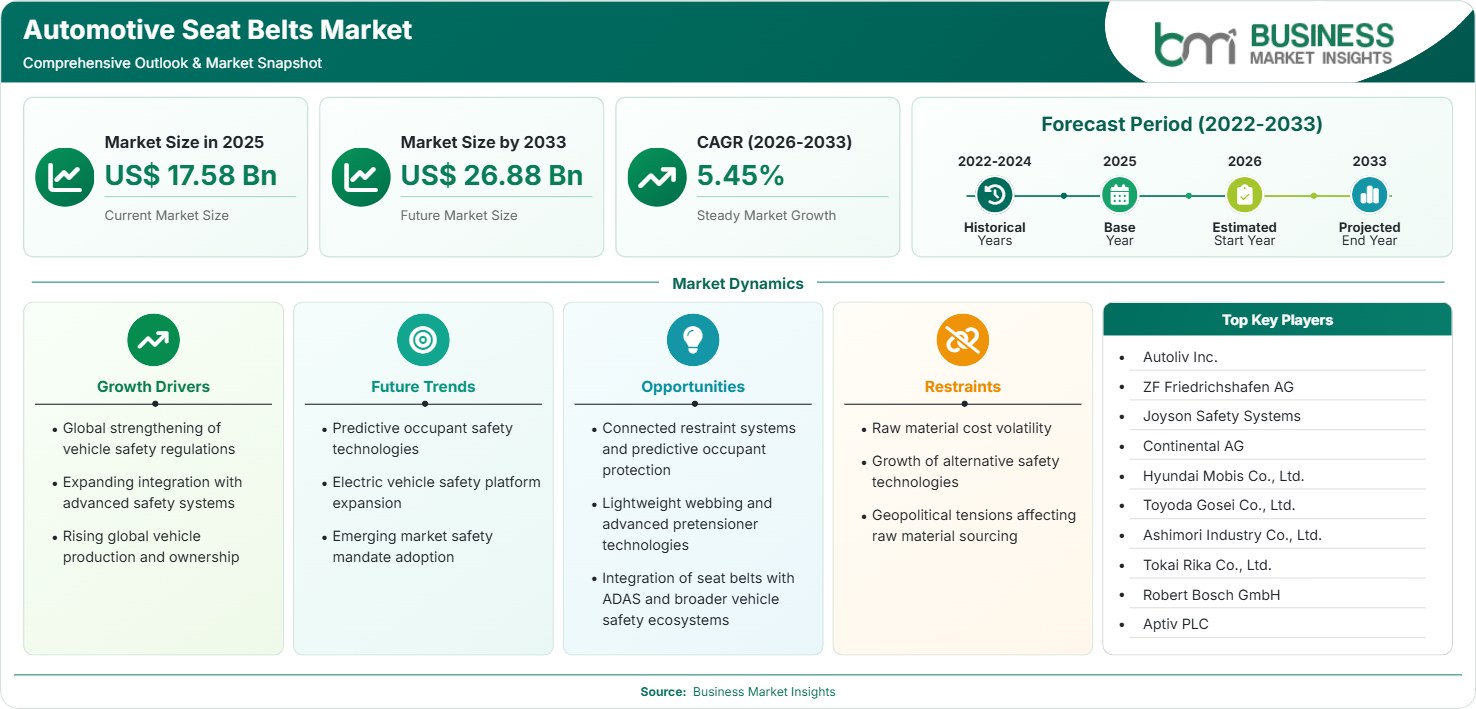
The Automotive Seat Belts Market size was valued at US$ 17.58 Billion in 2025 and is projected to reach US$ 26.88 Billion by 2033, growing at a CAGR of 5.45% during 2026–2033. Growth is supported by stricter vehicle safety regulations, rising vehicle production, expanding ADAS integration, increasing consumer safety awareness, and opportunities in smart restraint technologies and electric vehicles.

Report Coverage
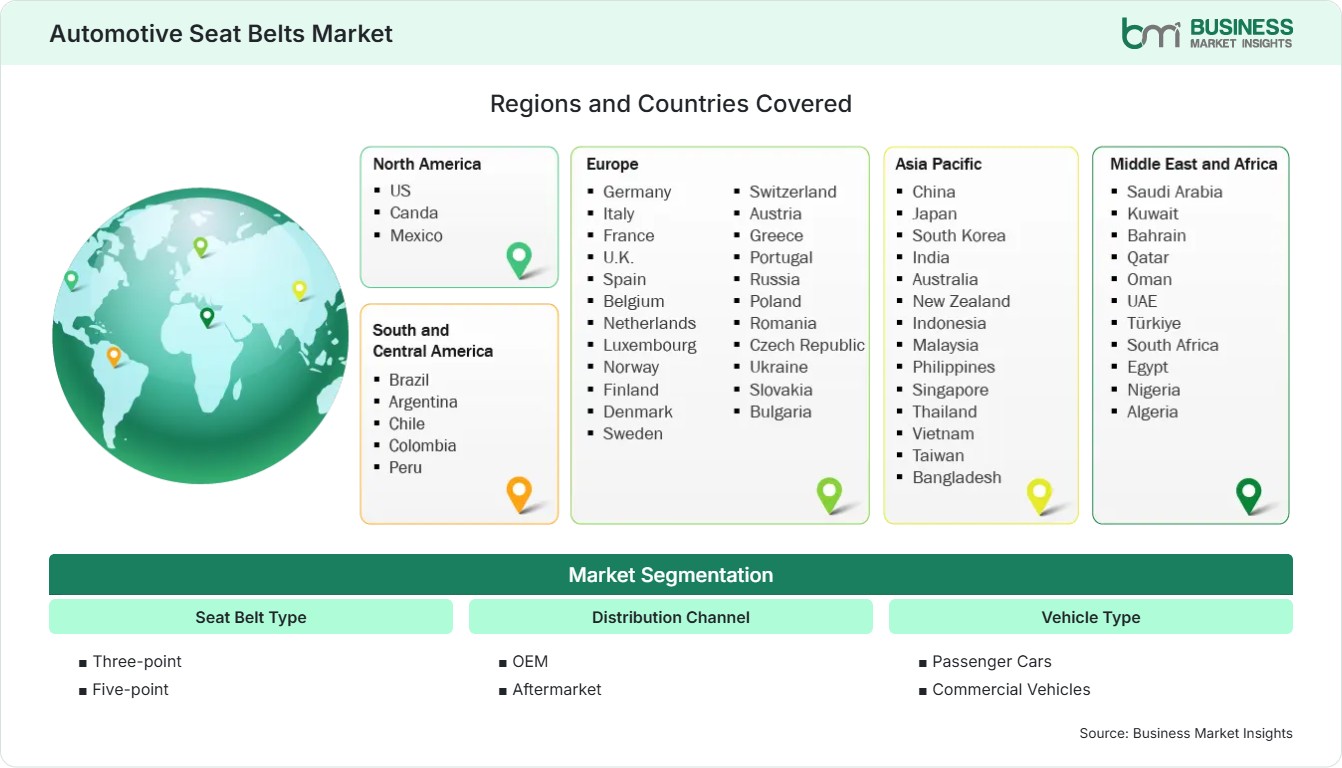
  • Seat Belt Type: Three-point, Five-point
  • Distribution Channel: OEM, Aftermarket
  • Vehicle Type: Passenger Cars, Commercial Vehicles
US$ 17.58 Bn Market size in 2025
US$ 26.88 Bn Market Size by 2033
5.45% CAGR, 2026 - 2033
2026-2033 Forecast Period

AI Overview

Automotive Seat Belts Market Summary

  • North America Region: Holds a market share of 31%–34% in 2025, growing with a CAGR of 4.8%–5.2% during 2026–2033. Key drivers include regulatory compliance, fleet safety modernization, smart restraint adoption, vehicle safety ratings, commercial fleet upgrades, and demand for integrated occupant protection systems. The U.S. market benefits from strong safety compliance and OEM technology adoption, expanding at 4.9%–5.3% CAGR.
  • Fastest Growing Region: Asia Pacific holds 28%–31% share in 2025 and advances at 6.4%–6.9% CAGR. Growth stems from vehicle ownership expansion, local manufacturing investments, safety regulation tightening, EV production growth, rising disposable income, and stronger crash-protection requirements.
  • Leading Segment: Three-point seat belts account for 78%–82% share in 2025 and grow at 5.1%–5.5% CAGR. Demand is supported by universal vehicle adoption, regulatory mandates, passenger protection standards, OEM standardization, affordability, and compatibility with advanced pretensioner systems.
  • High Growth Segment: OEM distribution holds 72%–76% share in 2025 and records 5.8%–6.2% CAGR. Expansion is driven by factory-installed safety systems, new vehicle production, integrated electronics, platform standardization, safety compliance requirements, and smart restraint implementation.
  • Key Market Opportunity: Integration of predictive seat belt technologies with connected safety systems enables improved occupant protection, supports autonomous mobility development, attracts OEM investment, and creates higher-value product differentiation opportunities.
  • Major Market Players: Autoliv Inc., ZF Friedrichshafen AG, Joyson Safety Systems, Continental AG, Hyundai Mobis Co., Ltd., Toyoda Gosei Co., Ltd., Ashimori Industry Co., Ltd., Tokai Rika Co., Ltd., Robert Bosch GmbH, Aptiv PLC.
Strategic Insights

Automotive Seat Belts Market: Strategic Insights

Automotive Seat Belts Market Strategic Framework
FREE PDF
Request your free sample
Request free sample
Stakeholder View

Key Takeaways

  • The industry value chain remains highly integrated, with global safety-system suppliers maintaining long-term OEM relationships and extensive testing, certification, and engineering capabilities.
  • Passenger vehicle applications continue generating the largest revenue opportunity, while advanced safety-equipped commercial fleets create attractive incremental demand.
  • Innovation is shifting toward connected restraint systems capable of interacting with sensors, crash prediction algorithms, and vehicle safety electronics.
  • Asia Pacific offers the strongest investment case due to expanding automotive production, safety-regulation implementation, and increasing penetration of advanced vehicle technologies.
  • Strategic consolidation among safety-system manufacturers is strengthening technology portfolios and enabling broader geographic reach across vehicle production hubs.
  • Smart restraint systems designed for autonomous and electric vehicles represent a major future source of premium product differentiation and profitability.
Geographic Outlook

Automotive Seat Belts Market Regional Highlights

North America Automotive Seat Belts Market

North America accounts for 31%–34% of the Automotive Seat Belts Market share in 2025 and is projected to expand at 4.8%–5.2% CAGR through 2033. Strong vehicle safety regulations, extensive commercial vehicle fleets, and high penetration of advanced occupant-protection technologies sustain demand. OEMs increasingly integrate intelligent restraint systems with sensor-based safety platforms. Robust replacement cycles and fleet modernization activities support aftermarket sales, while electric vehicle manufacturing strengthens demand for sophisticated restraint technologies across passenger and commercial vehicle categories.

  • Regulatory compliance remains a primary demand factor, with manufacturers prioritizing advanced pretensioners and load-limiting technologies.
  • Fleet operators increasingly adopt upgraded restraint systems to enhance occupant safety and liability management.
  • Vehicle safety rating programs continue influencing purchasing decisions across consumers and commercial buyers.
  • Connected safety technologies create opportunities for integrated restraint solutions across vehicle platforms.

US Automotive Seat Belts Market

The United States represents approximately 78%–82% of North American revenue and grows at 4.9%–5.3% CAGR. Demand reflects strong passenger vehicle production, advanced safety awareness, and extensive deployment of smart occupant-protection technologies. Federal safety standards encourage innovation in passive safety systems, while growing electric vehicle manufacturing increases integration opportunities between seat belts and electronic safety architectures. Suppliers benefit from long-established OEM ecosystems and continuous investment in automotive engineering and testing capabilities.

  • Advanced crash-protection standards sustain premium system adoption across domestic and imported vehicle platforms.
  • Electric vehicle manufacturers increasingly specify integrated restraint technologies paired with AI-enabled safety systems.
  • Commercial fleet operators support stable replacement demand through ongoing vehicle modernization programs.
  • Domestic R&D facilities accelerate development of predictive occupant-restraint technologies.

Europe Automotive Seat Belts Market

Europe captures 24%–27% market share in 2025 and advances at 4.7%–5.1% CAGR. Strict vehicle safety regulations and strong automotive engineering capabilities support demand. Germany remains the leading national market, while Eastern European vehicle manufacturing centers contribute incremental production volumes. The region emphasizes intelligent safety systems, lightweight materials, and sustainability objectives. Strong penetration of advanced driver assistance systems encourages closer integration between restraint technologies and broader vehicle safety architectures.

  • Germany leads regional demand supported by established automotive manufacturing capabilities.
  • Poland and the Czech Republic benefit from expanding vehicle production investments.
  • Regulatory frameworks encourage adoption of advanced passive safety technologies.
  • Sustainability initiatives stimulate research into recyclable components and lightweight materials.
  • Premium vehicle manufacturing supports demand for high-performance restraint solutions.

Asia Pacific Automotive Seat Belts Market

Asia Pacific region holds 28%–31% market share in 2025 and has the highest CAGR of 6.4%–6.9%. China drives regional demand owing to its large automobile production and stringent safety norms. India has high growth potential owing to the rising number of vehicles and regulatory compliance. Increasing production of electric vehicles, localization, and rising manufacturing capacity continue to strengthen the region.

  • China remains the largest market owing to extensive automotive manufacturing output.
  • India emerges as the highest-growth national market with accelerating safety compliance requirements.
  • Localized production supports cost efficiency and supply-chain resilience.
  • Expanding EV manufacturing creates new integration opportunities for intelligent restraints.
  • Rising consumer awareness continues enhancing adoption of advanced safety features.

Rest of World Automotive Seat Belts Market

Rest of World accounts for 12%-15% of the market share in 2025 and has a compound annual growth rate of 5.3%-5.7%. South and Central America gain from increased auto manufacturing activity and initiatives to raise safety awareness. The Middle East and Africa rely on demand from auto imports and fleet growth. The leading revenue contributor in the region is Brazil, whereas Saudi Arabia and the UAE offer promising opportunities for modernization.

  • Brazil remains the largest market across South and Central America.
  • Mexico benefits from automotive manufacturing links supporting safety-component demand.
  • Gulf countries increase vehicle-safety investments and fleet modernization efforts.
  • Commercial transportation growth enhances replacement and OEM opportunities.
  • Regulatory alignment progressively supports adoption of certified restraint systems.
Global Market Geography
FREE PDF
Request your free sample
Request free sample
Segment Analysis

Automotive Seat Belts Market Segmentation

Seat Belt Type

The segment constitutes the industry's basic product structure. The segment is estimated to have a share of 78% to 82% in 2025 for the leading category and will grow at a CAGR of 5.1% to 5.5%. The Automotive Seat Belts Market in this category continues to expand through alignment with safety regulations, integration of intelligent restraints, and increasing penetration across passenger and commercial vehicles.

  • Three-point: Dominates adoption across passenger vehicles due to regulatory acceptance, cost efficiency, occupant comfort, and compatibility with modern passive safety architectures.
  • Five-Point: Gains traction in specialized commercial, racing, and high-safety applications where enhanced occupant retention and protection capabilities are prioritized.

Distribution Channel

The distribution dynamics are increasingly influenced by the safety technology used in manufacturing plants. The OEM channels dominate, with 72%-76% market share in 2025, and are expected to grow at a 5.8%-6.2% CAGR. The Automotive Seat Belts Market trends also show greater integration of safety technologies during vehicle assembly, supporting OEM leadership.

  • OEM: Benefits from long-term supplier agreements, standardized safety specifications, and growing integration of advanced restraint technologies into new vehicle platforms.
  • Aftermarket: Supported by replacement demand, fleet maintenance requirements, regulatory compliance upgrades, and growing awareness regarding occupant protection standards.

Vehicle Type

Vehicle-type demand depends on various safety requirements and manufacturing trends. Passenger cars make up the largest segment, while commercial vehicles offer steady opportunities driven by fleet improvements, regulations, and occupational safety programs.

  • Passenger Cars: Generate the highest demand through large production volumes, mandatory fitment requirements, and increasing adoption of intelligent safety systems.
  • Commercial Vehicles: Supported by fleet safety programs, logistics sector growth, and expanding regulatory requirements concerning driver and passenger protection.
Market Forces

Automotive Seat Belts Market Dynamics

Key Market Drivers

Global Strengthening of Vehicle Safety Regulations

The legislative aspect concerning vehicle safety continues to be the major market driver. Various entities, such as UNECE, NHTSA, and regional transport organizations, maintain their requirements for occupant protection in new vehicles. Safety assessments help manufacturers implement modern restraint systems above compliance minimums. Trends in the Automotive Seat Belts Market show conformity with these regulations, especially in developing countries, which are introducing stricter crash requirements. Increased implementation contributes to high adoption rates among passenger and commercial vehicles. In an attempt to reduce road fatalities, certified restraint systems have become an essential part of the homologation process.

Expanding Integration with Advanced Safety Systems

The integration of passive and active safety features creates a significant need for smart restraints. Seat belts now work in conjunction with occupant detection features, crash prediction systems, and advanced driver assistance systems. The Automotive Seat Belts Market development is aided by the growing need for pretensioners that can be deployed before an impact occurs. These solutions help enhance protection while also improving vehicle safety ratings. Integrated occupant protection systems are necessary as car manufacturers work towards increasing automation. Suppliers focusing on software-based safety solutions have an edge over others.

Rising Global Vehicle Production and Ownership

Increasing vehicle ownership in developing economies is an engine of future demand. Urbanization and rising incomes, together with increasing mobility needs, will drive automobile production. Passenger vehicles account for the largest share of additional installations, while commercial transportation drives demand for additional volumes. OEM manufacturers are increasingly adopting high-performance restraint systems in response to changing customer needs. Increased manufacturing in Asia and parts of Latin America will create more opportunities to source components. Increasing production diversity across conventional, hybrid, and electric vehicles further broadens application prospects for advanced restraint solutions.

Key Market Opportunities

Predictive Occupant Safety Technologies

Technological innovations in sensors create predictive restraint systems that can react to potential crashes before they happen. Companies focusing on developing predictive algorithms, sensor technologies, and occupant positioning can pursue premium pricing strategies. The Automotive Seat Belts Market forecasts are now incorporating intelligent restraint usage due to increasing automation. Predictive safety features improve occupant safety and help build the next generation of vehicles. Early commercialization allows differentiation among the international suppliers. Cooperation between software, sensor, and automotive safety companies will facilitate implementation.

Electric Vehicle Safety Platform Expansion

Electric vehicles have opened up engineering possibilities, with different needs for battery protection, interior design, and weight optimization compared with traditional vehicles. More companies are now designing specific restraints for electric vehicles. The growing global investment in electrification is driving demand for performance-based safety components. Intelligent restraints that support advanced passenger positioning and safety electronics may deliver greater value. Suppliers capable of aligning with major EV manufacturers can secure long-term platform contracts and higher-margin revenue streams.

Emerging Market Safety Mandate Adoption

Some of the emerging countries have continued to enforce stringent car safety regulations. Increased emphasis on occupant safety standards leads to increased accessibility prospects from under-accessible markets. Some governments have started promoting the use of these standards through certification, public sensitization programs, and compliance measures. This presents chances for both international firms and local companies. Investments in local manufacturing and compliance can ensure improved market access prospects. This increased accessibility can translate into future revenue diversification prospects in mature automotive regions.

Market Restraints and Challenges

Factor: Raw Material Cost Volatility Impact: Margin Pressure

Volatility in polyester webbing materials, technical textiles, and metallic components presents persistent cost challenges. Manufacturers operating under fixed-price supply contracts often face limited flexibility when input costs increase rapidly. Impact: profitability can be squeezed despite stable order volumes, particularly for suppliers serving cost-sensitive vehicle segments. Global supply-chain disruptions may intensify procurement uncertainty and inventory management complexity. Companies increasingly pursue sourcing diversification and operational efficiency programs to mitigate exposure. Nevertheless, ongoing fluctuations continue creating uncertainty for long-term cost planning and investment allocation.

Factor: Growth of Alternative Safety Technologies Impact: Budget Competition

Automakers increasingly allocate resources toward cameras, radar systems, autonomous driving functions, and advanced crash-avoidance technologies. Impact: Investment prioritization may create competitive pressure for certain passive safety programs. While restraint systems remain mandatory, suppliers must demonstrate compatibility with broader vehicle safety ecosystems to maintain strategic relevance. Budget competition can influence development timelines, platform specifications, and technology adoption rates. Companies that fail to integrate products with digital safety architectures risk reduced competitiveness within increasingly software-driven automotive environments.

Company Analysis

Competitive Landscape

Automotive Seat Belts Market analysis indicates a concentrated competitive environment led by global safety-system specialists with extensive OEM relationships.

Company Name

Overview

Products and Services relevant to this market

Autoliv Inc.

Global leader in automotive safety systems with broad international manufacturing and engineering footprint.

Seat belts, pretensioners, load limiters, airbags, steering wheel safety components.

ZF Friedrichshafen AG

Major automotive technology supplier with integrated passive and active safety capabilities.

Seat belt systems, occupant safety technologies, sensors, electronics integration.

Joyson Safety Systems

International supplier formed through safety-system acquisitions and extensive OEM partnerships.

Seat belts, airbags, restraint electronics, occupant protection modules.

Continental AG

Diversified automotive technology company focused on intelligent mobility and safety.

Restraint-related electronics, integrated occupant safety solutions.

Hyundai Mobis Co., Ltd.

Leading mobility supplier supporting global vehicle manufacturers.

Smart restraint systems, safety modules, electronic safety integration.

Toyoda Gosei Co., Ltd.

Japanese manufacturer specializing in automotive safety and polymer technologies.

Seat belt components, airbags, occupant protection systems.

Ashimori Industry Co., Ltd.

Specialist supplier with experience in automotive restraint solutions.

Seat belts, webbing materials, safety-related components.

Tokai Rika Co., Ltd.

Automotive components provider serving global OEM customers.

Seat belt systems, switches, safety electronics, restraint mechanisms.

Robert Bosch GmbH

Global engineering company supporting vehicle safety innovation.

Sensors, vehicle safety electronics, integrated protection systems.

Aptiv PLC

Advanced automotive technology company focused on intelligent vehicle architecture.

Connected safety technologies, vehicle electronics, integration platforms.

Trust & Transparency

Research Methodology

The market analysis combines proprietary research with secondary data from government agencies, company disclosures, regulatory filings, industry databases and expert interviews. Market estimates are validated through data triangulation, cross-market benchmarking and analyst review.

View Full Research Methodology

Questions Answered

Frequently Asked Questions

What does the Automotive Seat Belts Market Report typically evaluate?

It evaluates market size, technology developments, competition, segment performance, regional demand patterns, regulatory factors, investment opportunities, and long-term growth prospects.

Which region offers the strongest growth prospects?

Asia Pacific provides the strongest growth outlook due to rising vehicle ownership, manufacturing investment, safety regulation implementation, and EV production expansion.

How are electric vehicles affecting industry development?

Electric vehicles encourage development of intelligent restraint systems integrated with advanced electronics, sensors, and predictive occupant-protection functions.

Which vehicle category generates the highest revenue?

Passenger cars represent the largest revenue contributor because of higher production volumes and mandatory seat belt installation across virtually all vehicle models.

What factors most strongly influence demand for automotive seat belts?

Safety regulations, vehicle production volumes, consumer awareness, fleet modernization, and adoption of advanced occupant-protection technologies are the primary demand drivers.

Access the Full Automotive Seat Belts Market Report

Get segment-level forecasts, regional estimates, competitive benchmarking, company profiles and downloadable Excel datasets.

Access the full Automotive Seat Belts Market Report
350 pages PDF & Excel | 2026-08-31