
Automotive Software Market Outlook: Size, Share, Trends, Growth Analysis, Competitive Landscape & Forecast, 2026-2033

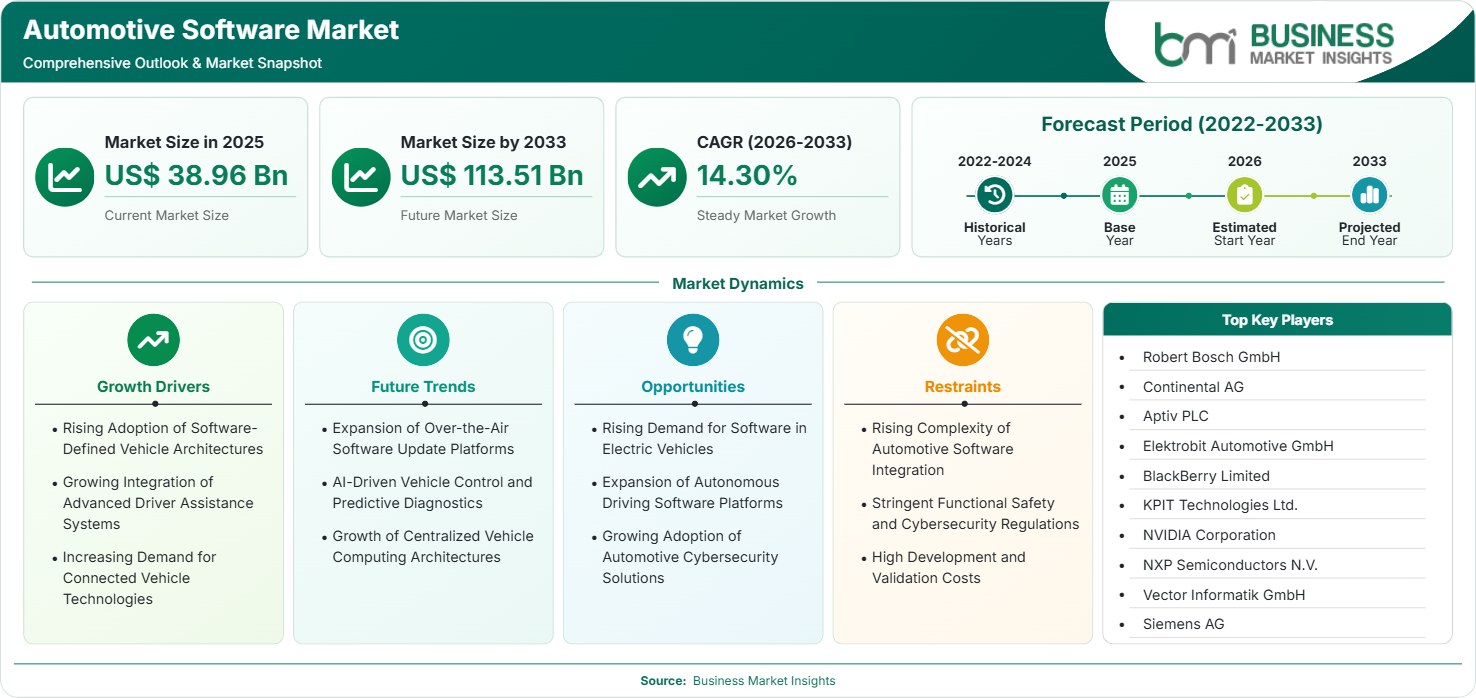
The Automotive Software Market size was valued at US$ 38.96 Billion in 2025 and is projected to reach US$ 113.51 Billion by 2033, growing at a CAGR of 14.30% during 2026–2033. Rising software-defined vehicle adoption, increasing vehicle connectivity, growing ADAS integration, and accelerating demand for over-the-air updates are creating substantial opportunities across the automotive technology ecosystem.

Report Coverage
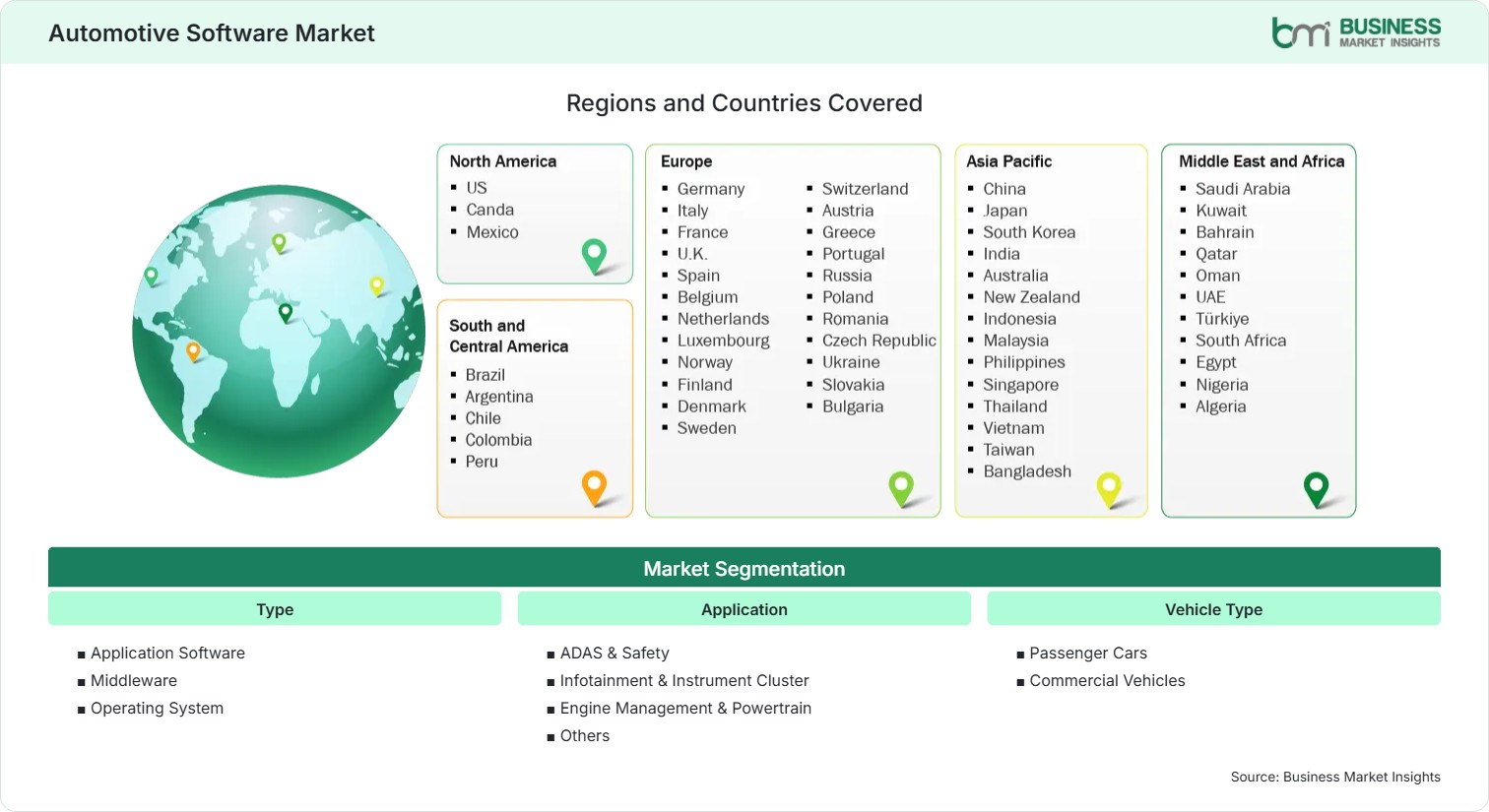
  • Type: Application Software, Middleware, Operating System
  • Application: ADAS & Safety, Infotainment & Instrument Cluster, Engine Management & Powertrain, Others
  • Vehicle Type: Passenger Cars, Commercial Vehicles
US$ 38.96 Bn Market size in 2025
US$ 113.51 Bn Market Size by 2033
14.30% CAGR, 2026 - 2033
2026-2033 Forecast Period

AI Overview

Automotive Software Market Summary

  • North America Region: North America holds a automotive software market share of 32%–35% in 2025, growing with a CAGR of 13%–15% during 2026–2033. Connected vehicle deployment, software-defined vehicle architectures, advanced ADAS adoption, cloud integration, and automotive cybersecurity investments continue supporting regional expansion. The U.S. market benefits from strong automotive technology innovation, digital mobility investments, and advanced vehicle electronics adoption, expanding at 13.5%–15.5% CAGR.
  • Fastest Growing Region: Asia Pacific accounts for 29%–32% share in 2025 and is projected to grow at a CAGR of 16%–18% through 2033. Rising vehicle production, electric mobility adoption, intelligent transportation development, software platform integration, and expanding connected vehicle ecosystems are accelerating market demand.
  • Leading Segment: Application Software represents 42%–45% share in 2025 and is expected to grow at a CAGR of 14%–16% through 2033. Growing vehicle intelligence requirements, infotainment upgrades, ADAS functionality expansion, and connected mobility services continue driving adoption.
  • High Growth Segment: ADAS & Safety accounts for 30%–33% share in 2025 and is forecast to grow at a CAGR of 17%–19% during 2026–2033. Increasing regulatory focus on vehicle safety, autonomous driving development, sensor integration, and driver assistance deployment support strong expansion.
  • Key Market Opportunity: Rapid transition toward software-defined vehicles is creating opportunities for cloud-connected platforms, vehicle operating systems, predictive diagnostics, cybersecurity solutions, and subscription-based automotive software services across global markets.
  • Major Market Players: BlackBerry Limited, KPIT Technologies Limited, Google LLC, Airbiquity Inc., Wind River Systems, Inc., Microsoft Corporation, MontaVista Software, LLC, Robert Bosch GmbH, Intellias, Harman International Industries, Incorporated.
Strategic Insights

Automotive Software Market: Strategic Insights

Automotive Software Market Strategic Framework
FREE PDF
Request your free sample
Request free sample
Stakeholder View

Key Takeaways

  • The automotive software market value chain is becoming increasingly software-centric, with automakers collaborating closely with operating system providers, cloud platforms, semiconductor suppliers, and digital service developers.
  • ADAS & Safety applications offer strong revenue opportunities as regulatory requirements and consumer demand continue driving adoption of advanced safety technologies.
  • Vehicle operating systems and middleware platforms are becoming critical enablers for software-defined vehicle architectures, supporting scalability and future feature deployment.
  • Asia Pacific offers one of the strongest investment opportunities due to expanding vehicle production, electric vehicle manufacturing growth, and increasing automotive digitalization.
  • Strategic partnerships, acquisitions, and software ecosystem collaborations are becoming increasingly common as companies seek technological differentiation and accelerated product development.
  • Subscription-based software services and over-the-air feature upgrades are emerging as important recurring revenue streams for vehicle manufacturers and technology providers.
Geographic Outlook

Automotive Software Market Regional Highlights

North America Automotive Software Market

North America accounts for 32%–35% Automotive Software Market share in 2025 and is projected to grow at a CAGR of 13%–15% through 2033. Strong demand for connected vehicles, high adoption of advanced driver assistance technologies, and significant investment in software-defined vehicle platforms support regional leadership. Automotive manufacturers continue investing in vehicle connectivity, cybersecurity solutions, cloud platforms, and intelligent mobility technologies. The region also benefits from a mature technology ecosystem and active participation from software developers, semiconductor companies, and mobility technology providers.

  • Software-defined vehicle strategies continue accelerating across major automakers, increasing demand for scalable operating systems, middleware platforms, and integrated software architectures.
  • Growing ADAS deployment is supporting development of sensor fusion software, autonomous driving applications, and real-time vehicle processing capabilities.
  • Automotive cybersecurity remains a major focus area as connected vehicles generate increasing volumes of operational and customer data.
  • Cloud-based vehicle management systems are gaining popularity for diagnostics, fleet monitoring, predictive maintenance, and software update management.
  • Strategic partnerships between automakers and technology companies continue driving innovation across digital mobility ecosystems.

US Automotive Software Market

The United States contributes approximately 78%–82% of North American revenue and is expected to register a CAGR of 13.5%–15.5% through 2033. Strong R&D investments, increasing deployment of connected vehicle technologies, and substantial software development capabilities continue supporting expansion. Automotive technology companies are actively advancing vehicle operating systems, cloud-enabled platforms, autonomous driving software, and mobility applications. Growing integration of artificial intelligence and data analytics into vehicle architectures is further strengthening automotive software market adoption across passenger and commercial vehicle segments.

  • Autonomous driving innovation continues generating demand for sophisticated perception, navigation, and vehicle control software solutions.
  • Connected vehicle ecosystems are expanding rapidly through integration of cloud connectivity, telematics platforms, and over-the-air update capabilities.
  • Fleet operators are increasingly utilizing software platforms for asset monitoring, route optimization, and operational efficiency improvements.
  • Regulatory emphasis on vehicle safety and cybersecurity is encouraging adoption of advanced software validation and compliance solutions.

Europe Automotive Software Market

Europe represents 25%–28% of global revenue in 2025 and is anticipated to expand at a CAGR of 13%–15% through 2033. Strong automotive manufacturing capabilities, vehicle electrification initiatives, and advanced mobility investments support regional growth. Automotive companies are increasingly integrating intelligent software platforms into both conventional and electric vehicles. Germany remains the leading regional automotive software market due to its automotive production strength, while Poland demonstrates strong growth momentum supported by increasing automotive technology investments and engineering services expansion.

  • Germany leads regional demand through its strong premium automotive industry and growing investment in software-driven vehicle innovation.
  • Poland is among the fastest-growing countries, recording an estimated CAGR of 15%–17% driven by engineering services expansion and digital automotive development.
  • Vehicle electrification programs continue generating demand for battery management, energy optimization, and charging software solutions.
  • Connected mobility services are encouraging investments in cloud-integrated vehicle software and digital user experience platforms.
  • Automotive suppliers are increasing software R&D efforts to support next-generation intelligent vehicle architectures.

Asia Pacific Automotive Software Market

Asia Pacific accounts for 29%–32% of total revenue in 2025 and is expected to register the fastest CAGR of 16%–18% through 2033. Strong vehicle production volumes, growing electric vehicle manufacturing, rising software integration, and supportive government initiatives are driving adoption. China remains the largest contributor to regional demand, while India demonstrates significant expansion potential due to increasing vehicle digitalization and software engineering capabilities. Continued investments in intelligent transportation, connectivity infrastructure, and autonomous driving technologies support long-term development.

  • China leads regional adoption through strong electric vehicle production and continued development of intelligent mobility ecosystems.
  • India is projected to achieve approximately 17%–19% CAGR, supported by growing automotive software engineering capabilities and vehicle technology investments.
  • Increasing consumer demand for connected infotainment systems is strengthening software adoption across passenger vehicle segments.
  • Automotive manufacturers are expanding deployment of cloud-enabled platforms and vehicle connectivity solutions.
  • Growth in electric mobility ecosystems continues generating demand for advanced software integration and energy management applications.

Rest of World Automotive Software Market

Rest of World accounts for 9%–12% of total revenue in 2025 and is projected to grow at a CAGR of 14%–16% through 2033. Automotive modernization efforts across Latin America, the Middle East, and Africa are creating demand for connected vehicle technologies and digital mobility solutions. Increasing vehicle safety requirements, growing electrification initiatives, and expanding transportation infrastructure projects continue supporting software deployment. Regional automotive ecosystems are gradually investing in advanced vehicle electronics and intelligent mobility capabilities.

  • Brazil remains a leading automotive software market due to expanding vehicle production activities and increasing adoption of connected automotive technologies.
  • Saudi Arabia is witnessing growing demand for intelligent mobility solutions supported by digital transformation and smart transportation initiatives.
  • Fleet management applications are becoming increasingly important for logistics, transportation, and commercial mobility operators.
  • Vehicle connectivity investments are supporting broader adoption of telematics, diagnostics, and cloud-enabled software services.
  • Emerging markets continue offering long-term opportunities for software providers focusing on scalable and cost-efficient solutions.
Global Market Geography
FREE PDF
Request your free sample
Request free sample
Segment Analysis

Automotive Software Market Segmentation

Type

The type segment represents the core software stack powering modern vehicles, from user-facing applications to underlying operating environments. The segment accounts for approximately 41%–44% share in 2025 and is expected to grow at a CAGR of 14%–16% through 2033. The expanding Automotive Software Market scope is supported by increasing software-defined vehicle development, connected mobility services, cloud integration, and advanced electronic architectures that require scalable and secure software platforms.

  • Application Software: Application software enables infotainment, navigation, telematics, diagnostics, driver assistance, and vehicle personalization functions, helping manufacturers improve user experience, functionality, and recurring digital service revenues.
  • Middleware: Middleware serves as the communication layer connecting applications, operating systems, and hardware components, enabling interoperability, data exchange, and efficient software deployment within increasingly complex vehicle architectures.
  • Operating System: Operating systems provide the foundational environment required to manage hardware resources, support vehicle functions, ensure system reliability, and facilitate software updates across connected automotive platforms.

Application

Application-based deployment remains a key determinant of software spending across the automotive ecosystem. This segment accounts for approximately 37%–40% share in 2025 and is projected to register a CAGR of 15%–17% during the forecast period. Current Automotive Software Market trends highlight rising investment in advanced safety technologies, intelligent cockpit solutions, connectivity platforms, and vehicle performance optimization systems as automakers seek greater functionality and differentiation.

  • ADAS & Safety: ADAS and safety applications support collision avoidance, lane assistance, adaptive cruise control, driver monitoring, and emergency response capabilities that improve vehicle safety and regulatory compliance.
  • Infotainment & Instrument Cluster: Infotainment and instrument cluster software enhances in-vehicle entertainment, navigation, connectivity, user interfaces, and digital cockpit experiences for vehicle occupants.
  • Engine Management & Powertrain: Engine management and powertrain applications optimize fuel efficiency, emissions performance, battery utilization, power delivery, and overall vehicle operating efficiency through advanced software control.
  • Others: Additional applications include predictive maintenance, cybersecurity, telematics management, remote diagnostics, vehicle personalization, subscription services, and software update management functions.

Vehicle Type

Vehicle type segmentation reflects growing software integration across both consumer and commercial transportation platforms. The segment accounts for approximately 34%–37% share in 2025 and is expected to grow at a CAGR of 14%–16% through 2033. Increasing digitalization, connectivity requirements, intelligent mobility initiatives, and regulatory expectations continue encouraging software deployment across diverse vehicle categories globally.

  • Passenger Cars: Passenger cars remain the largest adoption category due to growing demand for connectivity, infotainment systems, ADAS technologies, digital cockpit solutions, and software-enabled customer experiences.
  • Commercial Vehicles: Commercial vehicles increasingly utilize software platforms for fleet management, predictive maintenance, telematics, route optimization, regulatory compliance, and operational efficiency improvements.
Market Forces

Automotive Software Market Dynamics

Key Market Drivers

Rising Adoption of Software-Defined Vehicle Architectures

Automotive manufacturers are increasingly transitioning from hardware-centric vehicle designs toward software-defined architectures capable of supporting continuous feature upgrades and enhanced functionality. Modern vehicle platforms utilize centralized computing systems and scalable software frameworks that simplify deployment of new services and applications. This shift enables automakers to improve vehicle lifecycle management, accelerate innovation, and deliver differentiated user experiences. Software-defined vehicles also facilitate integration of cloud connectivity, artificial intelligence, and over-the-air update capabilities. As competition intensifies across both conventional and electric vehicle segments, manufacturers continue prioritizing software development investments to enhance operational flexibility, improve performance, and create long-term recurring revenue opportunities.

Growing Integration of Advanced Driver Assistance Systems

Advanced Driver Assistance Systems have become one of the most important software-driven components of modern vehicles. Automakers are incorporating features such as adaptive cruise control, lane-keeping assistance, automatic emergency braking, driver monitoring, and collision avoidance systems to improve safety and support evolving mobility requirements. The increasing sophistication of sensors, cameras, radar, and processing units is generating higher demand for advanced software algorithms capable of analyzing and interpreting vehicle surroundings. Regulatory emphasis on road safety and consumer preference for intelligent vehicle technologies continue supporting adoption. As manufacturers move closer toward higher levels of vehicle automation, software requirements associated with ADAS functionality are expected to expand significantly.

Increasing Demand for Connected Vehicle Technologies

Connected vehicles are transforming the automotive ecosystem through continuous communication between vehicles, infrastructure, cloud platforms, and digital service providers. Automakers increasingly deploy software platforms supporting telematics, remote diagnostics, predictive maintenance, navigation updates, and mobile application integration. Consumers are also demanding seamless digital experiences that mirror the connectivity available in smartphones and other personal devices. Growing deployment of 5G networks and cloud computing infrastructure is improving the performance of connected vehicle services while enabling new business models. The resulting demand for scalable software platforms capable of processing and managing large volumes of data continues driving investment across the automotive technology value chain.

Key Market Opportunities

Rising Demand for Software in Electric Vehicles

Electric vehicles rely heavily on software to manage critical functions including battery performance, charging optimization, thermal management, energy efficiency, and vehicle diagnostics. As governments and automakers continue supporting vehicle electrification strategies, demand for specialized software solutions is increasing across global markets. Advanced software capabilities help improve battery lifespan, maximize driving range, and enhance overall vehicle performance. In addition, digital features and subscription-based services are becoming important differentiators for electric vehicle manufacturers. Growing production volumes and expanding electric mobility ecosystems create attractive opportunities for software developers seeking to support the next generation of intelligent transportation technologies.

Expansion of Autonomous Driving Software Platforms

The development of autonomous mobility systems is expanding demand for sophisticated software capable of supporting perception, decision-making, navigation, and vehicle control functions. Autonomous driving platforms require integration of artificial intelligence, sensor fusion, high-definition mapping, and real-time processing technologies. Automotive manufacturers, technology companies, and mobility service providers continue investing substantial resources into autonomous vehicle research and development programs. As platform capabilities improve and commercialization efforts accelerate, new revenue opportunities are expected to emerge for software providers specializing in advanced mobility ecosystems. Long-term Automotive Software Market Forecasts remain supported by continued investment in autonomous transportation technologies and intelligent mobility solutions.

Growing Adoption of Automotive Cybersecurity Solutions

The rapid expansion of connected vehicle ecosystems is increasing the importance of protecting vehicles, data, and communication systems from cyber threats. Automotive cybersecurity software helps secure connected platforms, onboard networks, cloud communications, and vehicle control systems against unauthorized access and malicious attacks. Automakers are prioritizing cybersecurity integration throughout the vehicle development lifecycle to address regulatory requirements and strengthen consumer confidence. As software-defined vehicles become more complex and increasingly connected, cybersecurity solutions are expected to become a standard requirement across passenger and commercial vehicle platforms. This trend creates substantial opportunities for software vendors specializing in automotive security technologies.

Market Restraints and Challenges

Rising Complexity of Automotive Software Integration

Factor: Vehicle architectures increasingly involve multiple software layers, electronic control units, sensors, connectivity modules, and cloud-based services developed by numerous suppliers. Integrating these technologies into a cohesive ecosystem presents substantial engineering and validation challenges. Impact: Greater software complexity can increase development costs, extend product launch timelines, and create interoperability issues. Manufacturers must invest heavily in testing, quality assurance, and software maintenance to ensure reliability and performance. The challenge becomes even greater as automakers integrate advanced connectivity, autonomous driving capabilities, and software-defined vehicle architectures across multiple vehicle platforms simultaneously.

Stringent Functional Safety and Cybersecurity Regulations

Factor: Governments and regulatory agencies continue introducing stricter requirements related to vehicle safety, cybersecurity, software reliability, and data protection. Compliance with standards governing software performance and operational security requires significant technical expertise and ongoing investments. Impact: Regulatory compliance can increase development timelines, certification costs, and validation requirements for automotive software providers. Companies must continuously update products to address evolving standards and security risks. Failure to comply can result in delayed vehicle programs, financial penalties, reputational damage, and reduced automotive software automotive software market competitiveness, particularly within highly regulated automotive environments.

Company Analysis

Competitive Landscape

The Automotive Software Market analysis highlights a highly competitive environment characterized by increasing investments in software-defined vehicle platforms, cloud-connected mobility ecosystems, cybersecurity solutions, digital cockpit technologies, and autonomous driving software. Market participants are focusing on strategic collaborations with automotive OEMs, expanding software engineering capabilities, enhancing over-the-air update functionality, and developing scalable operating systems capable of supporting next-generation vehicle architectures.

Company Name

Overview

Products and Services relevant to this market

BlackBerry Limited

Technology company known for embedded software and secure operating systems widely deployed across connected and intelligent vehicle platforms.

QNX operating systems, automotive middleware, embedded software platforms, vehicle safety solutions, cybersecurity technologies, and software-defined vehicle support systems.

KPIT Technologies Limited

Automotive engineering and software specialist supporting vehicle manufacturers in digital transformation, electrification, and autonomous mobility programs.

Vehicle software integration, autonomous driving software, electric mobility platforms, digital engineering services, middleware solutions, and connected vehicle technologies.

Google LLC

Global technology company delivering vehicle operating systems, mapping solutions, cloud services, and connected mobility applications.

Android Automotive OS, Google Maps integration, cloud platforms, automotive app ecosystems, navigation services, and connected vehicle software solutions.

Airbiquity Inc.

Connected vehicle technology provider specializing in cloud-based automotive software delivery and vehicle lifecycle management solutions.

Over-the-air updates, telematics platforms, software update management, connected vehicle services, diagnostics solutions, and cloud mobility applications.

Wind River Systems, Inc.

Provider of intelligent edge software and real-time operating systems supporting automotive digital transformation initiatives.

Automotive operating systems, middleware platforms, virtualization software, edge computing technologies, and software-defined vehicle infrastructure solutions.

Microsoft Corporation

Global technology company supporting automotive digitalization through cloud computing, artificial intelligence, and connected vehicle services.

Azure cloud services, automotive AI platforms, connected vehicle infrastructure, mobility analytics, cybersecurity solutions, and software development environments.

MontaVista Software, LLC

Embedded software provider supporting automotive manufacturers through Linux-based operating systems and vehicle software platforms.

Embedded Linux solutions, automotive operating systems, middleware technologies, software integration services, and vehicle platform development tools.

Robert Bosch GmbH

Diversified automotive technology company integrating software, electronics, mobility systems, and intelligent vehicle solutions.

ADAS software, vehicle control systems, connectivity software, cybersecurity solutions, digital mobility platforms, and automotive engineering services.

Intellias

Automotive software engineering company supporting mobility innovation, digital cockpit development, and connected transportation initiatives.

Automotive software development, autonomous mobility platforms, cloud integration, connected vehicle solutions, mapping technologies, and mobility applications.

Harman International Industries, Incorporated

Automotive technology provider focused on digital cockpit solutions, connectivity platforms, and intelligent vehicle experiences.

Infotainment systems, digital cockpit software, connected vehicle technologies, telematics solutions, cloud integration services, and mobility software platforms.

Trust & Transparency

Research Methodology

The market analysis combines proprietary research with secondary data from government agencies, company disclosures, regulatory filings, industry databases and expert interviews. Market estimates are validated through data triangulation, cross-market benchmarking and analyst review.

View Full Research Methodology

Questions Answered

Frequently Asked Questions

Which vehicle category offers stronger software opportunities?

Passenger vehicles currently account for the largest software adoption due to increasing demand for connected experiences, infotainment systems, ADAS capabilities, and over-the-air update functionality. Commercial vehicles also represent an attractive opportunity due to growing fleet digitization initiatives.

What does this Automotive Software Market Report cover?

This report evaluates market dynamics, technology developments, segment performance, competitive positioning, regional opportunities, end-user adoption patterns, and strategic growth factors influencing the industry between 2026 and 2033.

How are electric vehicles contributing to software demand?

Electric vehicles require advanced software for battery management, charging optimization, thermal control, energy efficiency enhancement, remote diagnostics, and vehicle performance monitoring, making software a central component of EV functionality.

Which application segment is expected to generate the highest demand?

ADAS and safety applications are expected to generate significant demand due to increasing regulatory requirements, growing consumer awareness regarding vehicle safety, and ongoing investments in autonomous and semi-autonomous driving technologies.

What are the major technologies influencing automotive software development?

Software-defined vehicle architectures, cloud connectivity platforms, artificial intelligence, edge computing, automotive operating systems, and over-the-air update technologies are among the major technologies shaping software innovation across modern vehicle platforms.

Access the Full Automotive Software Market Report

Get segment-level forecasts, regional estimates, competitive benchmarking, company profiles and downloadable Excel datasets.

Access the full Automotive Software Market Report
350 pages PDF & Excel | 2026-08-07
Similar Research

Related Market Reports