Market Summary
Executive Summary and Global Market Analysis
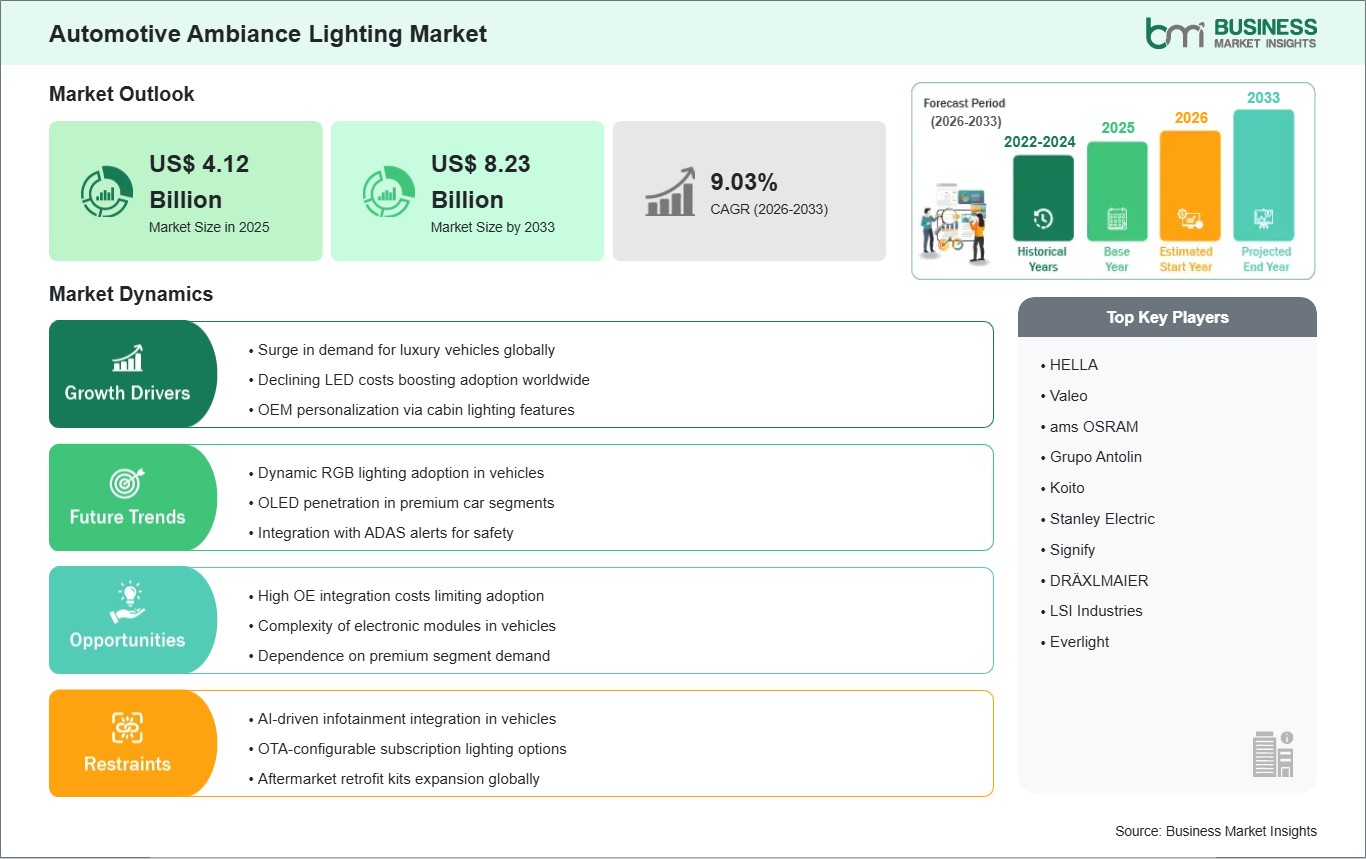
Automotive ambiance lighting refers to interior lighting systems designed to enhance the visual appeal, comfort, and user experience inside vehicles. These systems use technologies such as LED, OLED, and fiber-optic lighting to illuminate various interior areas, including dashboards, doors, footwells, and center consoles. Automotive ambiance lighting has evolved from a luxury feature to a widely adopted element in modern vehicles, helping manufacturers create personalized and premium cabin environments. The market is growing as consumers increasingly value vehicle aesthetics, customization options, and enhanced in-cabin experiences. The rising integration of connected technologies and digital cockpits is also supporting the adoption of advanced lighting solutions.
There are some challenges that could slow market growth. Advanced lighting technologies and customization features can increase vehicle production costs, making them less accessible for entry-level vehicle segments. Automotive manufacturers must also ensure that lighting systems meet safety requirements and do not distract drivers during vehicle operation. Integrating complex lighting systems into vehicle interiors requires specialized design and engineering expertise, which can increase development timelines. In addition, fluctuations in electronic component supply chains can affect the availability of lighting modules and related components. These challenges can create cost and production pressures for manufacturers.
Even with these challenges, the market is expected to grow as vehicle interiors become more sophisticated and customer-focused. New opportunities are emerging through intelligent lighting systems that can respond to driving conditions, user preferences, and vehicle functions. The growing popularity of electric vehicles is also encouraging manufacturers to differentiate their cabin designs through advanced ambiance lighting features. Innovations in OLED technology, dynamic color customization, and interactive lighting solutions are expanding the possibilities for interior vehicle design. As automotive manufacturers continue to focus on comfort, personalization, and premium user experiences, automotive ambiance lighting is expected to become an increasingly important feature across multiple vehicle categories.
Segment Analysis
Automotive Ambiance Lighting Market Segmentation
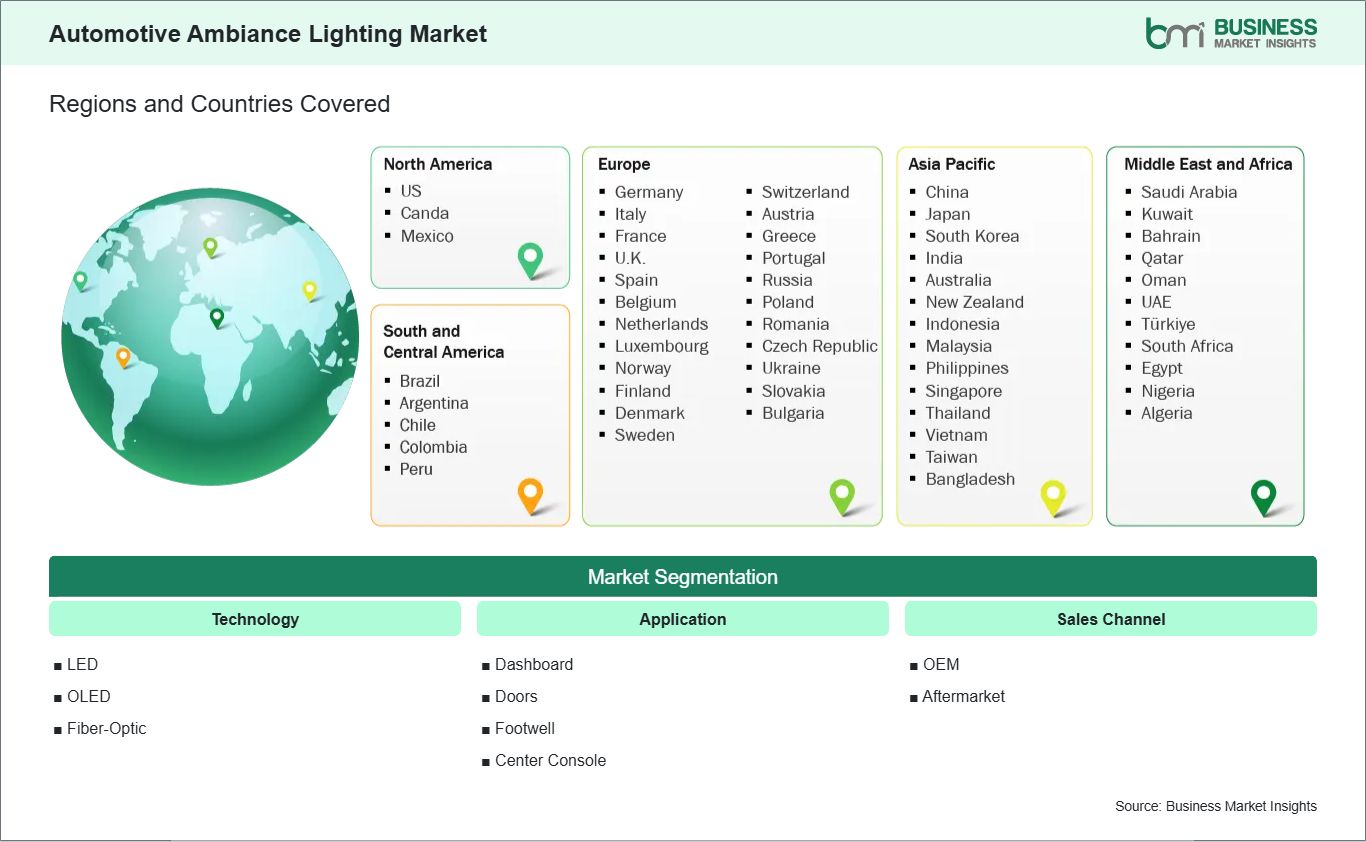
The Automotive Ambiance Lighting market is segmented based on technology, application, and sales channel, reflecting the growing demand for advanced interior lighting solutions across vehicle categories.
By Technology
- LED: Widely adopted due to energy efficiency, flexibility, and cost-effectiveness
- OLED: Preferred for premium vehicle interiors because of superior design flexibility and visual quality
- Fiber-Optic: Used to create uniform and customizable lighting effects across vehicle cabins
By Application
- Dashboard: Enhances cabin aesthetics and driver interaction with vehicle controls
- Doors: Improves interior appearance and passenger comfort
- Footwell: Provides subtle illumination and enhances cabin ambiance
- Center Console: Supports premium interior design and user convenience
By Sales Channel
- OEM: Represents the largest share due to factory-installed lighting systems in new vehicles
- Aftermarket: Growing demand for customized and upgraded vehicle interior lighting solutions
Market Forces
Automotive Ambiance Lighting Market Drivers and Opportunities
Growing Consumer Preference for Premium and Personalized Interiors
The demand for automotive ambiance lighting is increasing as consumers place greater importance on comfort, aesthetics, and personalization within vehicle interiors. Modern vehicle buyers expect cabins to provide a premium experience that reflects individual preferences and enhances overall satisfaction. Ambient lighting systems allow manufacturers to create distinctive interior environments through customizable colors, brightness settings, and dynamic lighting effects.
The growing popularity of premium vehicles and advanced infotainment systems is further supporting market growth. Automotive manufacturers are increasingly integrating ambiance lighting into vehicle designs to improve customer experience and differentiate their products in competitive markets. Electric vehicles are also contributing to demand, as manufacturers focus on creating modern and technologically advanced cabin environments. As consumer expectations continue to evolve toward personalization and enhanced user experiences, automotive ambiance lighting is becoming an essential component of contemporary vehicle design strategies.
Intelligent Lighting Systems and Connected Vehicle Integration
The Automotive Ambiance Lighting market is creating new opportunities through the development of intelligent and interactive lighting technologies. Advanced lighting systems can now synchronize with vehicle functions, driving modes, navigation systems, and infotainment platforms to create more engaging user experiences. These technologies enable dynamic lighting effects that improve cabin comfort while providing visual feedback to drivers and passengers.
The expansion of connected vehicle technologies is opening new possibilities for smart lighting integration. Future lighting systems are expected to respond to voice commands, occupant preferences, and real-time vehicle conditions. OLED and advanced LED technologies are enabling thinner, more efficient, and highly customizable lighting solutions for next-generation vehicle interiors. The increasing adoption of electric and autonomous vehicles is further driving demand for innovative cabin experiences. As automotive manufacturers continue to invest in digitalization and human-machine interaction, intelligent ambiance lighting systems are expected to become a key area of innovation and growth.
Size and Share Analysis
Automotive Ambiance Lighting Market Size and Share Analysis
The Automotive Ambiance Lighting market size is expected to reach US$ 8.23 billion by 2033 from US$ 4.12 billion in 2025. The market is estimated to record a CAGR of 9.03% from 2026 to 2033.
By technology, LED lighting accounts for a significant share due to its energy efficiency, long operational life, and design flexibility. OLED technology is gaining traction in premium vehicle segments because of its ability to create sophisticated lighting effects, while fiber-optic solutions continue to be used for uniform and customizable interior illumination.
By application, dashboard lighting dominates the market owing to its role in enhancing cabin design and user interaction. Door and center console lighting continue to experience growing adoption in modern vehicle interiors, while footwell lighting remains an important feature for improving passenger comfort and overall cabin ambiance.
Report Coverage
Automotive Ambiance Lighting Market Report Coverage and Deliverables
The "Automotive Ambiance Lighting Market Size and Forecast (2022-2033)" report provides a detailed analysis of the market covering below areas:
- Market size and forecast at global, regional, and country levels for all the key market segments covered under the scope
- Market trends, as well as market dynamics such as drivers, restraints, and key opportunities
- Market analysis covering key market trends, global and regional framework, major players, regulations, and recent market developments
- Industry landscape and competition analysis covering market concentration, heat map analysis, prominent players, and recent developments for the market
- Detailed company profiles, including SWOT analysis
Geographic Insights
Automotive Ambiance Lighting Market Geographic Insights
The Automotive Ambiance Lighting Market shows diverse regional adoption patterns influenced by vehicle production trends, consumer demand for premium interiors, and advancements in automotive electronics.
North America, being a developed region, has a well-established automotive industry and a high adoption rate of advanced vehicle interior technologies. The region comprises the United States and Canada, where consumers increasingly prefer vehicles equipped with premium comfort and personalization features. Automotive manufacturers in the region focus on enhancing in-cabin experiences through connected technologies and advanced lighting systems. Strong technological infrastructure and established automotive supply chains support the widespread adoption of automotive ambiance lighting across passenger and premium vehicle segments.
Asia Pacific is growing significantly, driven by expanding automotive production and rising consumer demand for technologically advanced vehicles. The region comprises countries such as China, India, and Japan, where increasing vehicle ownership and growing interest in premium automotive features are supporting market growth. The region focuses on integrating innovative interior technologies into both conventional and electric vehicles. Rapid industrial development, strong manufacturing capabilities, and investments in automotive innovation continue to encourage the adoption of advanced ambiance lighting systems across multiple vehicle categories.
Both regions are contributing significantly to the growth of the Automotive Ambiance Lighting Market, focusing on vehicle innovation, enhanced customer experiences, and the adoption of advanced automotive interior technologies.
Industry Activity
Recent Developments
The Automotive Ambiance Lighting Market is analyzed using a mix of primary and secondary research sources, including corporate publications, industry associations, and verified databases. This approach ensures accurate tracking of innovation trends and strategic developments influencing the market.
- In May 2026, ams OSRAM announced that its intelligent RGB LED solution was integrated into the NIO ES9 smart electric SUV to deliver a personalized and dynamic interior lighting experience. The solution enables advanced ambient lighting effects and supports the growing trend toward interactive vehicle cabins. The development highlights the increasing adoption of intelligent lighting technologies in next-generation vehicles.
- In March 2025, Valeo announced a collaboration with TactoTek to develop innovative automotive lighting solutions using In-Mold Structural Electronics (IMSE) technology. The partnership focuses on creating advanced interior and exterior lighting applications that combine lighting functionality with lightweight and design-flexible vehicle components. The collaboration is expected to support the growing demand for customizable automotive ambiance lighting solutions.
Trust & Transparency
Research Methodology
The market analysis combines proprietary research with secondary data from government agencies, company disclosures, regulatory filings, industry databases and expert interviews. Market estimates are validated through data triangulation, cross-market benchmarking and analyst
review.
View Full Research Methodology
Key Sources Referred:
World Bank - Global Trade IndicatorsWorld Trade Organization (WTO)International Monetary Fund (IMF)International Trade Administration (ITA)Company WebsitesCompany Annual ReportsCompany Investor Presentations