
Motorcycle Swing Arm Market Outlook: Size, Share, Trends, Growth Analysis, Competitive Landscape & Forecast, 2026-2033

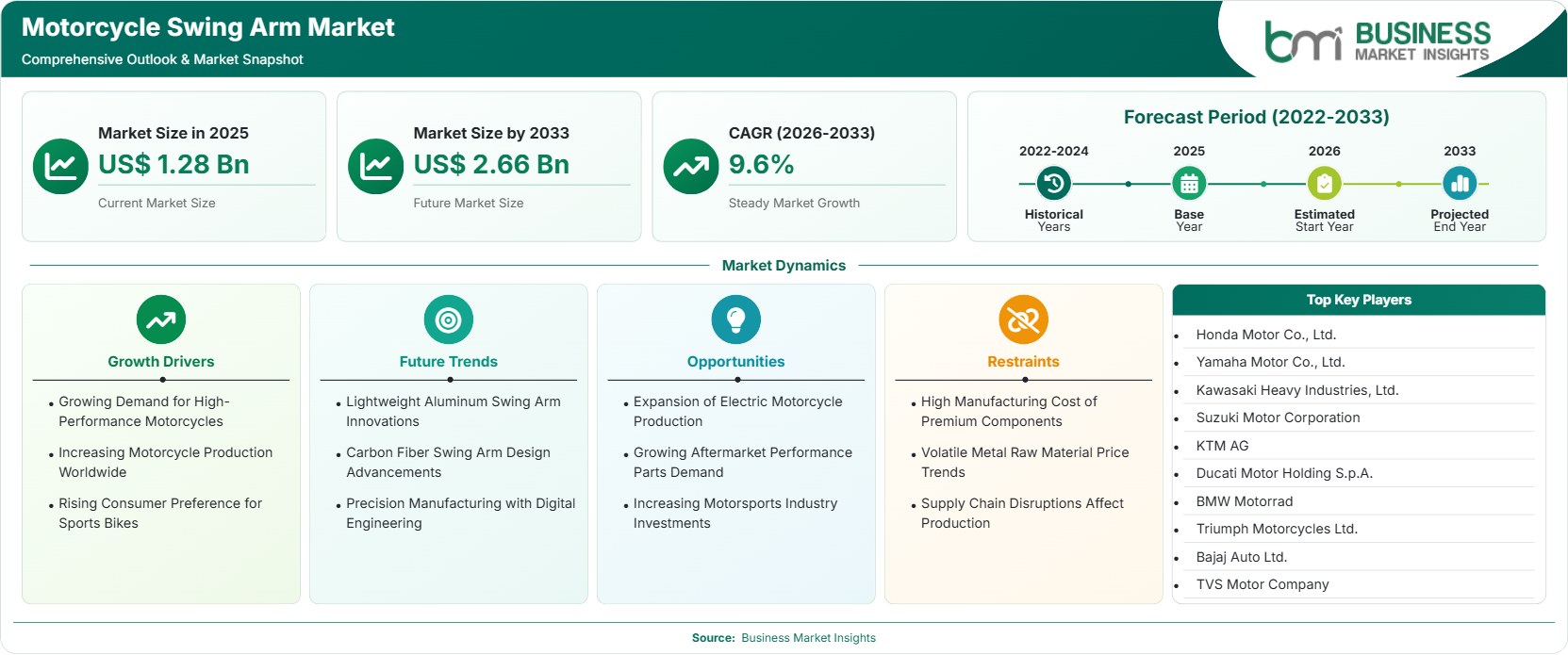
The Motorcycle Swing Arm Market size was valued at US$ 1.28 Billion in 2025 and is projected to reach US$ 2.66 Billion by 2033, growing at a CAGR of 9.6% during 2026–2033, driven by increasing production of high-performance motorcycles, rising demand for lightweight suspension components, expanding electric motorcycle manufacturing, and growing aftermarket opportunities for advanced performance-oriented motorcycle parts.

Report Coverage
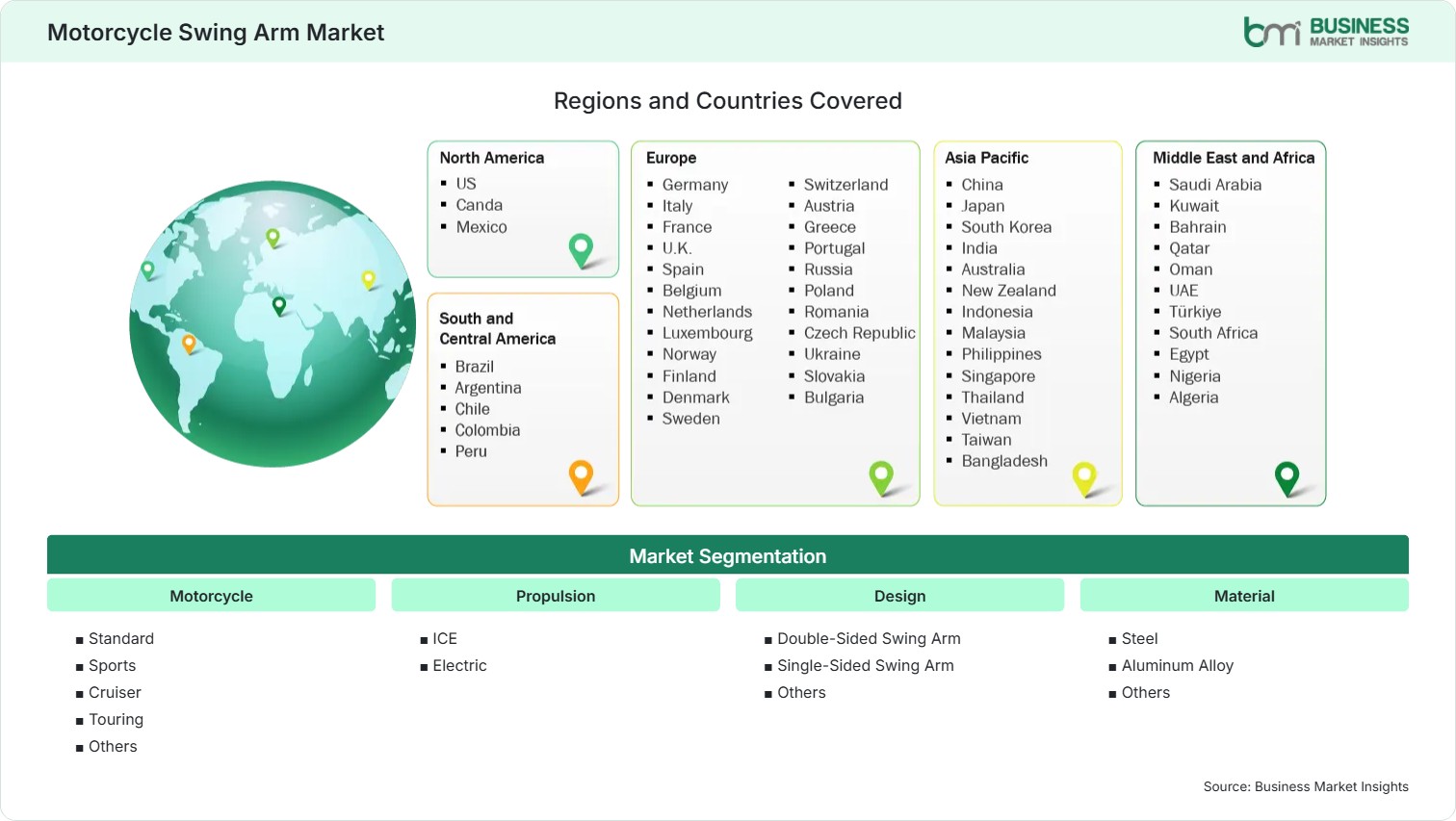
  • Motorcycle: Standard, Sports, Cruiser, Touring, Others
  • Propulsion: ICE, Electric
  • Design: Double-Sided Swing Arm, Single-Sided Swing Arm, Others
  • Material: Steel, Aluminum Alloy, Others
US$ 1.28 Bn Market size in 2025
US$ 2.66 Bn Market Size by 2033
9.6% CAGR, 2026 - 2033
2026-2033 Forecast Period

01 AI Overview

Motorcycle Swing Arm Market Summary

  • North America Region: North America holds 24%–27% of the Motorcycle Swing Arm market share in 2025, growing with a CAGR of 8.8%–9.2% during 2026–2033, supported by premium motorcycle demand, increasing recreational riding activities, aftermarket customization trends, and adoption of advanced lightweight components. The United States remains the key contributor due to strong cruiser and performance motorcycle sales, expanding at a CAGR of 8.9%–9.3%.
  • Fastest Growing Region: Asia Pacific accounts for 45%–48% market share in 2025 and is projected to expand at a CAGR of 10.1%–10.6% through 2033, driven by high motorcycle production volumes, urban mobility demand, expanding electric motorcycle adoption, and increasing investments in two-wheeler manufacturing infrastructure.
  • Leading Segment: Standard motorcycles represent the leading segment with 38%–41% market share in 2025 and are forecast to grow at a CAGR of 9.1%–9.5%, supported by high production volumes, commuter demand, cost-effective designs, and widespread adoption across emerging markets.
  • High Growth Segment: Electric motorcycles represent the high-growth segment with 12%–15% market share in 2025 and are expected to advance at a CAGR of 13.0%–13.5%, supported by battery-powered mobility expansion, lightweight component requirements, government electrification initiatives, and increasing investments from motorcycle manufacturers.
  • Key Market Opportunity: Rising electric motorcycle production and growing demand for lightweight aluminum alloy swing arms create opportunities for manufacturers to develop advanced suspension components with improved strength, durability, handling performance, and reduced vehicle weight.
  • Major Market Players: Honda Motor Co., Ltd., Yamaha Motor Co., Ltd., Kawasaki Heavy Industries, Ltd., Suzuki Motor Corporation, KTM AG, Ducati Motor Holding S.p.A., BMW Motorrad, Triumph Motorcycles Ltd., Bajaj Auto Ltd., TVS Motor Company.
02 Strategic Insights

Motorcycle Swing Arm Market: Strategic Insights

motorcycle-swing-arm-market-market-strategic-framework
FREE PDF
Request your free sample
Request free sample
03 Stakeholder View

Key Takeaways

  • The Motorcycle Swing Arm market ecosystem is becoming increasingly integrated as motorcycle manufacturers, component suppliers, material producers, and performance parts specialists collaborate to develop lightweight, durable, and high-strength suspension components. These partnerships are improving manufacturing efficiency, accelerating product innovation, and supporting the development of advanced motorcycle platforms.
  • Performance motorcycles, electric motorcycles, and premium touring models represent key growth opportunities as consumers increasingly prioritize handling performance, reduced vehicle weight, and enhanced riding experiences. Manufacturers focusing on lightweight aluminum alloy and precision-engineered swing arms are positioned to capture expanding demand across multiple motorcycle categories.
  • Material innovation is shaping product development as manufacturers increasingly explore aluminum alloys, advanced fabrication methods, and optimized structural designs to improve strength-to-weight ratios. Research and development efforts are focused on improving durability, reducing production complexity, and meeting evolving performance requirements.
  • Asia Pacific remains the most attractive regional opportunity due to large-scale motorcycle production, increasing urban mobility demand, expanding electric two-wheeler adoption, and strong presence of global and domestic motorcycle manufacturers across India, China, Japan, and Southeast Asian countries.
  • Strategic investments and partnerships are increasing as motorcycle companies strengthen supply chains, expand electric vehicle capabilities, and enhance premium motorcycle portfolios. Component manufacturers are also developing specialized solutions for aftermarket performance applications and motorsports-related demand.
04 Geographic Outlook

Motorcycle Swing Arm Market Regional Highlights

North America Motorcycle Swing Arm Market

North America accounted for 24%–27% of the global Motorcycle Swing Arm market share in 2025 and is expected to grow at a CAGR of 8.8%–9.2% during 2026–2033. The region benefits from strong demand for premium motorcycles, recreational riding culture, aftermarket customization, and increasing adoption of advanced components.

  • The United States represents the largest contributor due to strong demand for cruiser, touring, and premium performance motorcycles supported by established motorcycle communities and aftermarket customization activities.
  • Increasing consumer preference for upgraded suspension components is driving demand for high-performance swing arms designed to improve handling, stability, and overall riding performance.
  • Premium motorcycle manufacturers are increasingly adopting lightweight materials and advanced manufacturing techniques to enhance vehicle dynamics and meet customer expectations for improved performance.
  • Growing motorsports participation and enthusiast communities are supporting aftermarket demand for performance-oriented suspension components and customized motorcycle upgrades.

US Motorcycle Swing Arm Market

The United States accounted for 20%–23% of the global Motorcycle Swing Arm market share in 2025 and is projected to expand at a CAGR of 8.9%–9.3% during the Motorcycle Swing Arm market forecast period. The market is supported by premium motorcycle ownership, strong aftermarket activity, rising demand for sports and touring motorcycles, and increasing interest in performance upgrades.

  • Rising demand for high-performance motorcycles is encouraging adoption of advanced suspension components that enhance cornering ability, stability, and riding comfort.
  • Growing aftermarket customization trends are increasing demand for premium swing arms made from aluminum alloys and advanced materials.
  • Motorcycle racing and performance riding activities continue influencing component innovation and encouraging development of stronger and lighter suspension systems.
  • Increasing interest in electric motorcycles is creating opportunities for specialized lightweight swing arm designs optimized for new vehicle architectures.

Europe Motorcycle Swing Arm Market

Europe represented 18%–21% of the global market share in 2025 and is projected to grow at a CAGR of 8.5%–8.9% during 2026–2033. The region benefits from strong premium motorcycle demand, established performance motorcycle manufacturers, motorsports activities, and increasing electric mobility adoption.

  • Germany continues driving demand through premium motorcycle production, engineering innovation, and adoption of advanced suspension components designed for performance, durability, and improved riding dynamics.
  • Italy remains a key market due to the presence of globally recognized sports motorcycle manufacturers, motorsports heritage, and strong consumer preference for high-performance motorcycles.
  • The United Kingdom supports market expansion through established motorcycle brands, enthusiast communities, racing activities, and increasing demand for customized performance components.
  • European manufacturers are increasingly adopting aluminum alloy swing arms and lightweight designs to improve vehicle efficiency, handling characteristics, and compliance with evolving mobility requirements.
  • Growing electric motorcycle adoption across European countries is encouraging development of specialized lightweight suspension components optimized for battery-powered motorcycle platforms.

Asia Pacific Motorcycle Swing Arm Market

Asia Pacific accounted for 45%–48% of the global Motorcycle Swing Arm market share in 2025 and is expected to register the fastest growth with a CAGR of 10.1%–10.6% from 2026–2033. The region dominates due to high motorcycle production volumes, expanding two-wheeler ownership, urban mobility demand, and increasing electric motorcycle investments.

  • India remains a major contributor due to high motorcycle production, expanding domestic mobility demand, increasing premium motorcycle sales, and growing presence of global motorcycle manufacturers.
  • China continues supporting market growth through large-scale two-wheeler manufacturing, electric motorcycle expansion, and increasing adoption of lightweight component technologies.
  • Japan contributes through advanced motorcycle engineering capabilities, premium motorcycle production, and continuous innovation in suspension and performance component technologies.
  • Indonesia, Thailand, and Vietnam are experiencing rising demand due to expanding motorcycle ownership, manufacturing investments, and increasing consumer preference for modern motorcycle designs.

Rest of World Motorcycle Swing Arm Market

The Rest of World region accounted for 9%–12% of the Motorcycle Swing Arm market share in 2025 and is estimated to grow at a CAGR of 9.0%–9.5% during 2026–2033. Growth across Latin America, the Middle East, and Africa is supported by increasing motorcycle adoption, expanding urban transportation requirements, rising disposable incomes, and growing interest in recreational riding. Brazil, Mexico, Saudi Arabia, and South Africa represent key markets with improving motorcycle infrastructure and rising consumer demand.

The Latin American market is witnessing an increase in motorcycle use for transportation and entertainment. The markets in the Middle East and Africa are progressively growing due to increased demand for urban transportation and premium motorcycles.

  • Brazil remains a leading regional market due to strong motorcycle demand, expanding commuter applications, and increasing interest in performance-oriented motorcycles.
  • Mexico is supporting growth through rising motorcycle adoption, expanding manufacturing activities, and increasing demand for affordable and durable two-wheeler components.
  • Saudi Arabia and Middle Eastern markets are witnessing higher demand for premium motorcycles due to increasing recreational riding activities and growing consumer interest in performance vehicles.
  • African markets are gradually developing through increasing motorcycle usage for transportation, commercial mobility, and emerging urban mobility solutions.
global-market-geography
FREE PDF
Request your free sample
Request free sample
05 Segment Analysis

Motorcycle Swing Arm Market Segmentation

Motorcycle

The motorcycle segment is the largest application segment owing to varied consumer tastes across commuting, performance, touring, and recreational motorcycles. Standard motorcycles account for 38%–41% of the market share in 2025 and are expected to grow at a CAGR of 9.1%–9.5% between 2026–2033. High-volume production, cost-effectiveness, and widespread acceptance in developing nations help sustain demand. The Motorcycle Swing Arm Market scope is widening as manufacturers develop application-specific suspensions for different motorcycle types.

  • Standard: Standard motorcycles drive demand through high-volume production, commuter applications, cost-effective designs, and widespread adoption in developing markets requiring reliable suspension performance.
  • Sports: Sports motorcycles require advanced swing arm designs focused on handling precision, weight reduction, stability improvement, and enhanced performance for high-speed riding applications.
  • Cruiser: Cruiser motorcycles utilize durable suspension components designed for long-distance comfort, stability, and premium riding experiences among recreational motorcycle users.
  • Touring: Touring motorcycles demand robust swing arm solutions supporting increased vehicle loads, extended-distance riding, passenger comfort, and enhanced structural durability.
  • Others: Other motorcycle categories include specialized models requiring customized suspension solutions for niche applications, off-road usage, adventure riding, and performance-focused modifications.

Propulsion

The Propulsion segment is changing due to electrification and the decline in demand for internal combustion engine motorcycles. Internal combustion engine motorcycles have been dominating the market owing to well-established manufacturing facilities and large fleet sizes worldwide. Electric motorcycles have been the fastest-growing category, driven by sustainability programs and battery-powered mobility solutions. The Motorcycle Swing Arm Market trends suggest increased demand for lightweight, efficient swing arms for both conventional and electric motorcycles.

  • ICE (Up to 200cc): Small-engine motorcycles require cost-efficient swing arm solutions supporting commuter mobility, fuel efficiency, affordability, and large-scale production across emerging markets.
  • ICE (200cc to 400cc): Mid-capacity motorcycles require balanced suspension components offering improved handling, durability, and performance for urban commuting and recreational riding applications.
  • ICE (400cc to 800cc): Higher-capacity motorcycles utilize stronger swing arm designs supporting enhanced performance, stability, and dynamic handling characteristics across premium motorcycle segments.
  • ICE (More than 800cc): Large-engine motorcycles require advanced lightweight and high-strength swing arms designed for premium performance, touring applications, and demanding riding conditions.
  • Electric: Electric motorcycles require specialized lightweight swing arms supporting battery-powered architectures, improved efficiency, extended range, and optimized vehicle weight distribution.

Design

The Design segment shows an increase in demand for enhanced handling, an efficient structure, and improved motorcycle performance. The design of the double-sided swing arm remains popular for its cost-effectiveness, longevity, and versatility across various motorcycle types. Single-sided designs continue to gain attention among high-end motorcycles because of their aesthetic appeal and maintenance benefits.

  • Double-Sided Swing Arm: Double-sided swing arms provide enhanced structural stability, cost efficiency, and widespread application across commuter, sports, touring, and premium motorcycle categories.
  • Single-Sided Swing Arm: Single-sided swing arms offer improved visual appeal, easier wheel maintenance, and premium positioning for performance-oriented and luxury motorcycle applications.
  • Others: Other designs include specialized configurations developed for unique motorcycle applications requiring customized structural characteristics and optimized suspension performance.

Material

The Material segment plays a significant role in determining swing arm performance, durability, and vehicle weight characteristics. Aluminum Alloy adoption is increasing due to lightweight properties and improved performance benefits, while steel remains widely used due to affordability and durability. Material innovation is becoming increasingly important as manufacturers seek improved strength-to-weight ratios for conventional and electric motorcycles.

  • Steel: Steel remains widely adopted due to high durability, cost-effectiveness, manufacturing flexibility, and suitability for commuter and mass-market motorcycle applications.
  • Aluminum Alloy: Aluminum alloy swing arms provide reduced weight, improved handling, corrosion resistance, and enhanced performance characteristics for premium and high-performance motorcycles.
  • Others: Other materials include advanced composites and specialized alloys used in selected applications requiring improved strength, reduced weight, and enhanced performance capabilities.
06 Market Forces

Motorcycle Swing Arm Market Dynamics

Key Market Drivers

Growing Demand for High-Performance Motorcycles

The growing consumer curiosity about high-performance motorcycles has made the need for innovative swing arm systems more evident due to their performance-enhancing features. Modern high-end sports, adventure, and performance-based motorcycles require advanced suspension components to enhance dynamic performance. Advanced aluminum alloy designs, optimization techniques, and manufacturing methods are among the approaches manufacturers adopt to meet customer demands. The rising consumer preference for premium motorcycles and the growing trend toward motorcycle customization have led to innovations in suspension systems.

Increasing Motorcycle Production Worldwide

An increase in motorcycle production in the Asia-Pacific region, Latin America, and other emerging countries is driving demand for swing arm parts. Urbanization, personal mobility needs at reasonable prices, and increased manufacturing capacities for motorcycles are helping drive production numbers globally. Nations like India, China, Indonesia, and Thailand are continuing to expand their motorcycle manufacturing industries, driving sustained demand for suspension parts. Manufacturers are focusing on cost-effective production methods while maintaining durability and quality standards.

Rising Consumer Preference for Sports Bikes

Consumer inclination towards sports bikes is driving the production of advanced swing arms that focus on speed, weight, and handling. Sport bikers today require better acceleration and stable cornering, along with the best riding experience, which calls for lightweight, sophisticated suspension systems. The rising trend of racing-type motorbikes and performance-based motorbikes is playing an important role in this regard. This has paved the way for suppliers with advanced motorcycle parts.

Key Market Opportunities

Expansion of Electric Motorcycle Production

The expansion in the production of electric motorbikes is offering many prospects for swing arm makers, since these bikes require light, robust, and well-engineered suspension components. Motorbikes with electric drive systems are becoming popular due to environmental legislation, urban mobility needs, and government promotion of vehicle electrification. The swing arm structure will need to be revised to accommodate batteries, manage weight, and improve motorcycle riding efficiency.

Growing Aftermarket Performance Parts Demand

Growing aftermarket demand for performance parts is creating additional revenue opportunities for swing arm manufacturers and specialized component suppliers. Motorcycle enthusiasts are increasingly investing in customized components that improve handling, appearance, durability, and riding performance. Premium aluminum alloy swing arms, lightweight designs, and racing-inspired components are gaining popularity among sports and enthusiast motorcycle owners. The aftermarket segment benefits from rising motorcycle customization culture, increasing motorsports participation, and demand for personalized vehicle upgrades.

Increasing Motorsports Industry Investments

Increasing investments in motorsports activities are supporting innovation and technology transfer within the motorcycle component industry. Racing environments require high-performance suspension systems capable of delivering strength, precision, and weight optimization under demanding conditions. Technologies developed for racing applications often influence premium production motorcycles and aftermarket performance products. Growing popularity of motorcycle racing events and manufacturer participation in competitive platforms are encouraging research into advanced swing arm designs, lightweight materials, and improved manufacturing processes.

Market Restraints and Challenges

High Manufacturing Cost of Premium Components

Factor: High manufacturing costs associated with premium swing arms, advanced materials, precision machining, and specialized production processes can restrict adoption of high-end components among cost-sensitive motorcycle manufacturers and consumers. Impact: Increased production expenses may limit widespread deployment of lightweight aluminum alloy and performance-oriented swing arm designs, particularly in price-sensitive markets. Advanced manufacturing techniques require significant investment in tooling, quality control systems, and skilled labor, affecting overall component pricing. Although premium components provide improved performance, durability, and weight reduction benefits, manufacturers must balance technological improvements with affordability requirements to maintain competitiveness across different motorcycle segments.

Volatile Metal Raw Material Price Trends

Factor: Fluctuating prices of metals including steel and aluminum create uncertainty in manufacturing costs and supply chain planning for swing arm producers. Impact: Raw material price volatility can increase component production expenses, reduce profit margins, and affect pricing strategies across motorcycle manufacturing networks. Changes in global commodity markets, supply disruptions, and energy costs influence material availability and pricing conditions. Manufacturers are increasingly exploring supply chain optimization, material efficiency improvements, and alternative production strategies to manage cost pressures. However, maintaining consistent material quality while controlling expenses remains a significant challenge for companies operating in the competitive motorcycle component industry.

07 Company Analysis

Competitive Landscape

The Motorcycle Swing Arm Market analysis highlights a competitive environment shaped by motorcycle OEMs, component makers, and technology players who focus on developing lightweight materials, manufacturing technologies, and high-performance suspension systems. The market leaders are expanding their offerings through innovations, alliances, and forays into the components segment for electric motorcycles.

Company Name

Overview

Products and Services relevant to this market

Honda Motor Co., Ltd.

Global motorcycle manufacturer offering extensive two-wheeler products across multiple segments.

Motorcycle suspension systems, swing arm components, performance motorcycle technologies, and electric mobility solutions.

Yamaha Motor Co., Ltd.

Japanese manufacturer specializing in motorcycles, marine products, and mobility solutions.

Performance motorcycle components, suspension technologies, racing-inspired engineering, and electric motorcycle systems.

Kawasaki Heavy Industries, Ltd.

Industrial manufacturer producing motorcycles and advanced mobility products globally.

Sports motorcycle platforms, high-performance suspension components, and precision engineering solutions.

Suzuki Motor Corporation

Global automotive and motorcycle company with strong two-wheeler manufacturing capabilities.

Motorcycle chassis components, suspension systems, lightweight structural technologies, and performance motorcycles.

KTM AG

Premium motorcycle manufacturer focused on sports, racing, and adventure motorcycles.

High-performance motorcycle frames, suspension components, racing technologies, and lightweight designs.

Ducati Motor Holding S.p.A.

Italian premium motorcycle manufacturer known for performance-oriented motorcycles.

Advanced motorcycle chassis systems, premium suspension technologies, and racing-derived components.

BMW Motorrad

Motorcycle division of BMW Group producing premium motorcycles worldwide.

Touring and performance motorcycle components, advanced chassis systems, and premium suspension solutions.

Triumph Motorcycles Ltd.

British motorcycle manufacturer specializing in premium motorcycles.

Motorcycle chassis components, suspension systems, performance motorcycles, and customization solutions.

Bajaj Auto Ltd.

Indian manufacturer producing motorcycles and export-focused two-wheelers.

Motorcycle platforms, suspension components, commuter motorcycles, and performance models.

TVS Motor Company

Indian two-wheeler manufacturer offering motorcycles and electric mobility solutions.

Motorcycle components, electric two-wheelers, performance motorcycles, and suspension technologies.

08 Industry Activity

Recent Developments

April 2026

Motul S.A. signed a global commercial partnership with Bimota S.p.A., under which Motul became the official first-fill and after-sales lubricant supplier for all Bimota motorcycles worldwide. The agreement strengthens collaboration on high-performance motorcycle platforms featuring advanced chassis and swingarm designs.

March 2026

Honda Motor Co., Ltd. announced that Honda Motorcycle & Scooter India (HMSI) will add a new motorcycle production line at its Tapukara plant in India, increasing annual production capacity. The expansion supports higher global motorcycle output and manufacturing of key chassis assemblies, including swingarm-equipped models.

June 2025

thyssenkrupp Automotive Technology announced a major organizational realignment into four customer- and technology-focused business units to accelerate profitable growth and improve its mobility components portfolio. The restructuring strengthens capabilities across chassis and forged component technologies that are relevant to motorcycle structural parts and supply chains.

May 2025

Bajaj Auto Limited announced plans to acquire majority control of KTM AG, subject to regulatory approvals. The move is intended to strengthen global development, manufacturing, and export of KTM premium motorcycles, reinforcing production of advanced motorcycle platforms and associated chassis components such as swingarms.

10 Trust & Transparency

Research Methodology

The market analysis combines proprietary research with secondary data from government agencies, company disclosures, regulatory filings, industry databases and expert interviews. Market estimates are validated through data triangulation, cross-market benchmarking and analyst review.

View Full Research Methodology

11 Questions Answered

Frequently Asked Questions

What insights are covered in the Motorcycle Swing Arm Market Report?

The Market Report provides analysis of market size, segmentation, regional trends, competitive landscape, technological developments, growth factors, challenges, and future opportunities influencing motorcycle component demand.

How is electric motorcycle adoption affecting swing arm development?

Electric motorcycle growth is encouraging manufacturers to develop lightweight and structurally optimized swing arms that support battery integration, improved weight distribution, and enhanced riding efficiency.

Why are aluminum alloy swing arms gaining adoption?

Aluminum alloy swing arms are gaining adoption due to their lightweight characteristics, improved strength-to-weight ratio, corrosion resistance, and ability to enhance motorcycle handling and performance.

Which motorcycle category generates the highest demand for swing arm components?

Standard motorcycles generate significant demand due to large production volumes, widespread usage in emerging markets, affordability, and extensive adoption across commuter transportation applications.

What factors are driving the Motorcycle Swing Arm Market growth?

Growth is driven by increasing motorcycle production, rising demand for high-performance motorcycles, expansion of electric motorcycles, growing aftermarket customization, and increasing adoption of lightweight materials for improved vehicle performance.

Access the Full Motorcycle Swing Arm Market Report

Get segment-level forecasts, regional estimates, competitive benchmarking, company profiles and downloadable Excel datasets.

Access the full Motorcycle Swing Arm Market Report
350 pages PDF & Excel | 2026-07-29