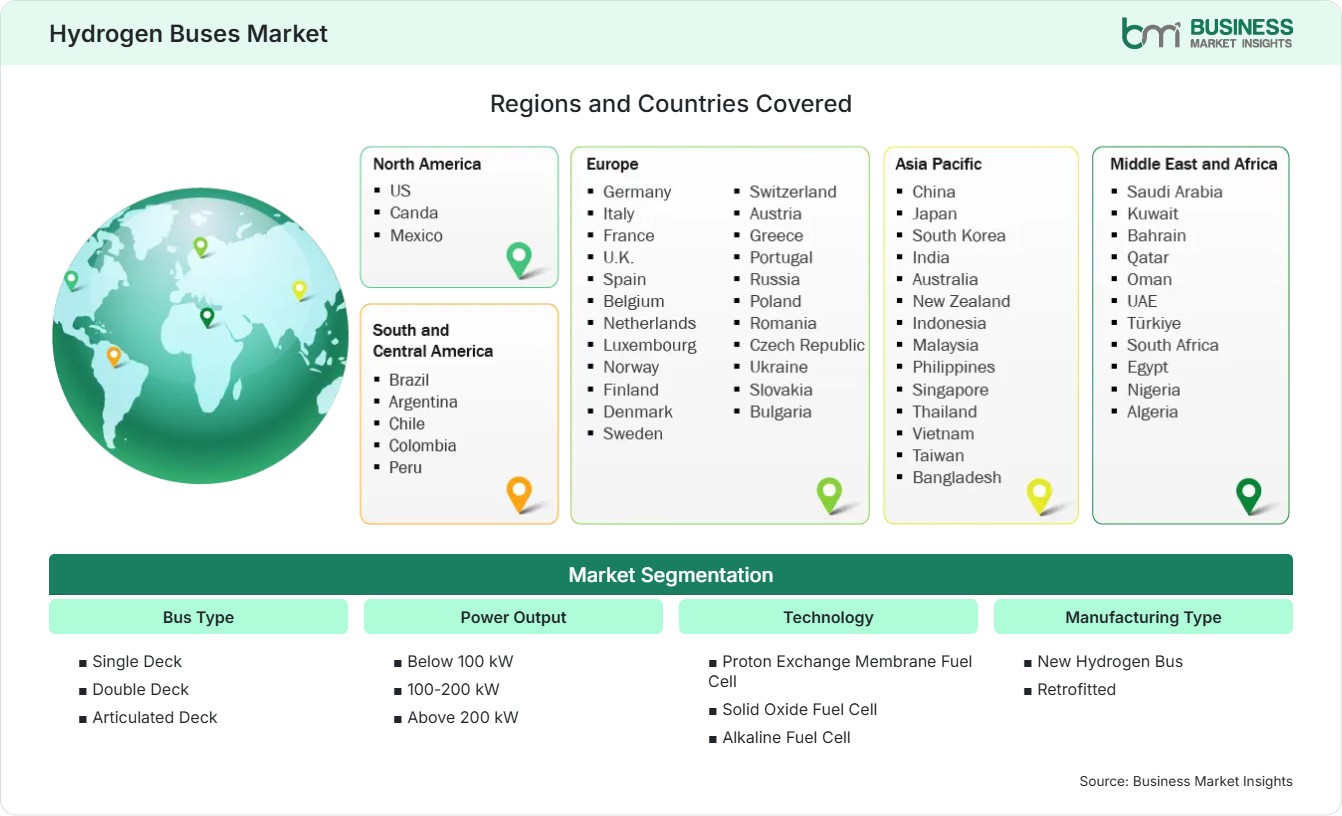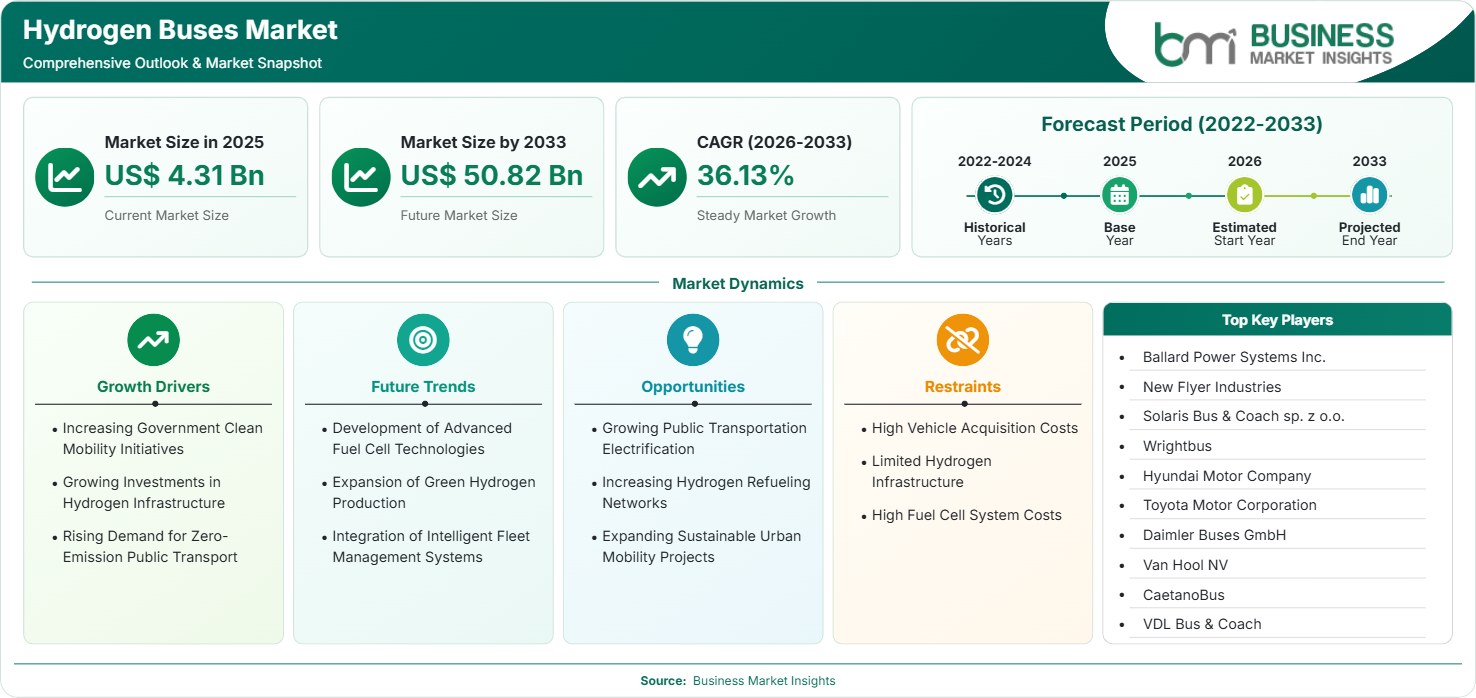
Hydrogen Buses Market Regional Highlights
North America Hydrogen Buses Market
North America accounts for 28%–31% of global revenue in 2025 and is projected to expand at a 34.5%–35.8% CAGR through 2033. Federal clean transportation funding, hydrogen production incentives, and expanding public transit decarbonization programs continue supporting commercial deployment. The Hydrogen Buses Market share remains strong as municipal transit operators increasingly replace diesel fleets with hydrogen-powered alternatives.
- Federal clean transportation funding encourages transit agencies to replace aging diesel fleets with hydrogen buses while simultaneously supporting investments in hydrogen production facilities, distribution systems, and strategically located refueling infrastructure across metropolitan transportation networks.
- Public-private partnerships between energy companies, hydrogen suppliers, bus manufacturers, and municipal operators strengthen integrated hydrogen mobility ecosystems that improve fleet reliability, operational efficiency, and long-term infrastructure utilization.
- Transit authorities increasingly prioritize hydrogen-powered buses for regional and intercity services where long operating range, rapid refueling capability, and continuous fleet availability provide significant operational advantages over alternative propulsion technologies.
- Investments in domestic fuel cell manufacturing, electrolyzer production, hydrogen storage technologies, and digital fleet management solutions strengthen local supply chains while reducing dependency on imported clean transportation components.
US Hydrogen Buses Market
The United States Hydrogen Buses Market contributes 74%–78% of North American revenue and is projected to record a 35.0%–36.0% CAGR through 2033. Federal infrastructure funding, state-level clean transportation programs, and increasing hydrogen production investments continue supporting fleet modernization. Large metropolitan transit agencies increasingly deploy hydrogen-powered buses for demanding routes requiring extended range and minimal refueling downtime.
- California remains the largest deployment market because aggressive emission regulations, hydrogen funding programs, and mature zero-emission transportation policies encourage large-scale hydrogen bus procurement.
- Transit agencies increasingly operate mixed fleets combining hydrogen and battery-electric buses to improve operational flexibility while supporting diverse route requirements and sustainability objectives.
- Government-industry collaborations accelerate construction of hydrogen refueling stations, strengthening operational confidence and enabling broader fleet expansion across multiple transportation corridors.
- Domestic investments in fuel cell production, hydrogen storage technologies, and commercial vehicle manufacturing improve supply chain resilience while supporting future growth in hydrogen-powered public transportation.
Europe Hydrogen Buses Market
Europe represents 31%–34% of global revenue in 2025 and is expected to register a 35.5%–37.0% CAGR through 2033. Germany, the Netherlands, and France lead commercial deployment, while Poland and Spain emerge as high-growth markets through expanding investments in hydrogen infrastructure and public transport modernization.
- The European Union's Hydrogen Strategy and Fit for 55 package continue encouraging investments across hydrogen production, storage, transportation, and refueling infrastructure supporting commercial public transport deployment.
- Germany remains the regional leader through significant investments in hydrogen technologies, municipal fleet modernization, fuel cell manufacturing capabilities, and collaborative research initiatives involving public and private organizations.
- France and the Netherlands continue expanding hydrogen bus fleets under national decarbonization programs while strengthening renewable hydrogen production and integrated clean mobility infrastructure.
- Poland and Spain demonstrate some of Europe's fastest adoption rates owing to increasing infrastructure investments, European funding mechanisms, and modernization of urban transportation systems.
Asia Pacific Hydrogen Buses Market
Asia Pacific Hydrogen Buses Market share accounts for 30%–33% of global revenue during 2025 and is projected to register the fastest 38.5%–40.5% CAGR through 2033. China dominates regional deployment through strong manufacturing capabilities and extensive hydrogen investments, while Japan and South Korea continue advancing fuel cell innovation.
- China continues leading hydrogen bus deployment through industrial policies, domestic manufacturing leadership, expanding hydrogen refueling infrastructure, and strong government procurement programs supporting zero-emission mobility.
- Japan strengthens commercialization by integrating hydrogen into national energy strategies while encouraging collaboration between vehicle manufacturers, technology companies, and hydrogen suppliers.
- South Korea expands hydrogen mobility through advanced fuel cell development, renewable hydrogen production, and large-scale infrastructure investments supporting sustainable commercial transportation.
- India accelerates pilot deployments under national green hydrogen initiatives while encouraging domestic manufacturing, technology partnerships, and public transportation modernization.
Rest of World Hydrogen Buses Market
The Rest of World region contributes 7%–10% of global revenue and is forecast to expand at a 34.0%–35.5% CAGR through 2033. South & Central America continue developing hydrogen mobility projects supported by renewable energy investments, while Middle East & Africa increasingly leverage abundant renewable resources for green hydrogen production.
- Brazil leads hydrogen mobility initiatives in South & Central America through renewable energy integration, pilot transportation programs, and supportive government decarbonization strategies.
- Chile utilizes abundant solar and wind resources to strengthen green hydrogen production, supporting future transportation and commercial mobility applications.
- The United Arab Emirates continues investing in hydrogen infrastructure, clean mobility projects, and sustainable transportation systems aligned with national net-zero objectives.
- Saudi Arabia expands large-scale green hydrogen production through strategic industrial investments that support long-term hydrogen mobility commercialization and export opportunities.
- South Africa advances hydrogen-powered transportation research by leveraging fuel cell expertise, mining sector capabilities, and collaborative innovation programs supporting future commercial deployment.