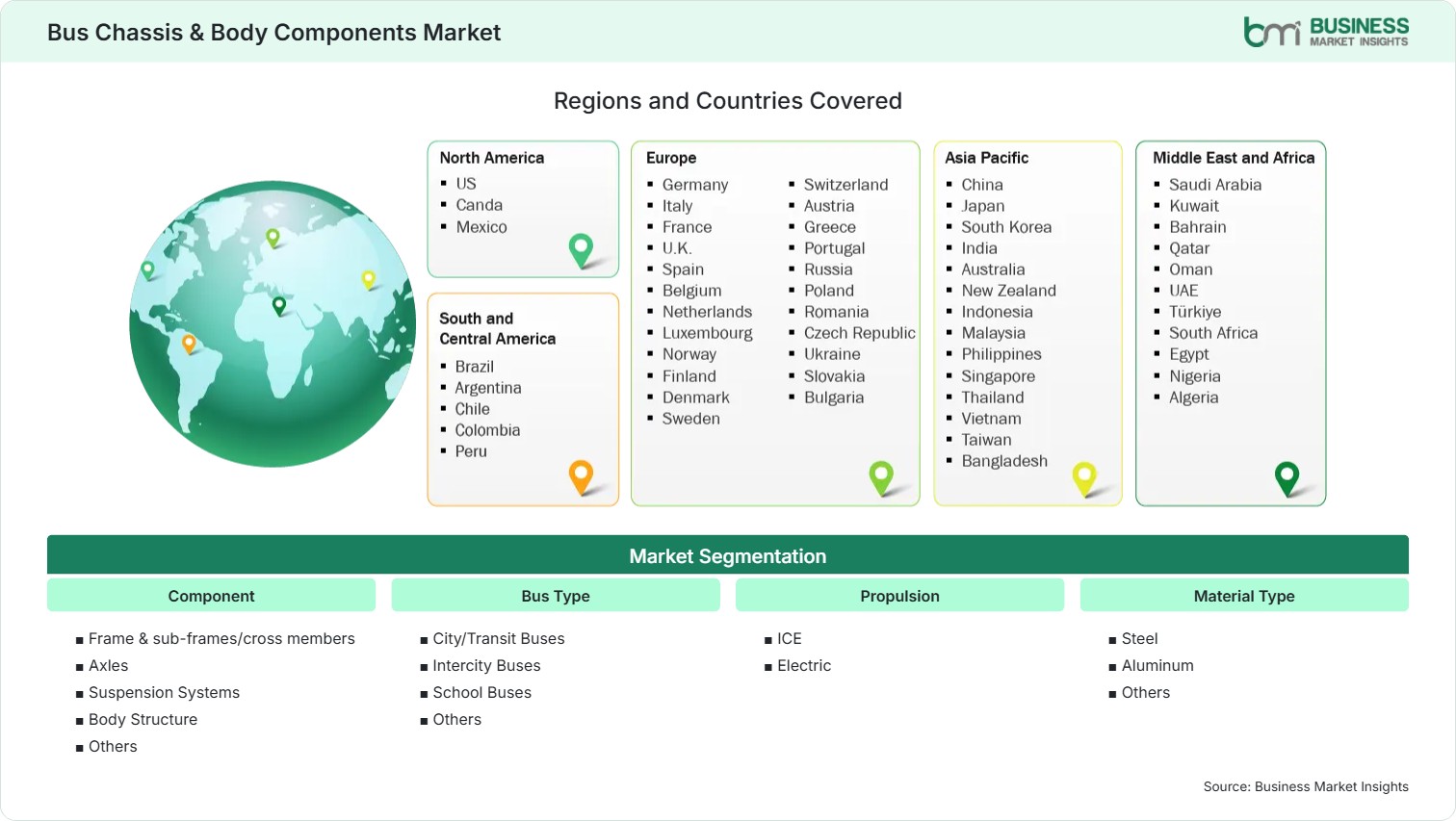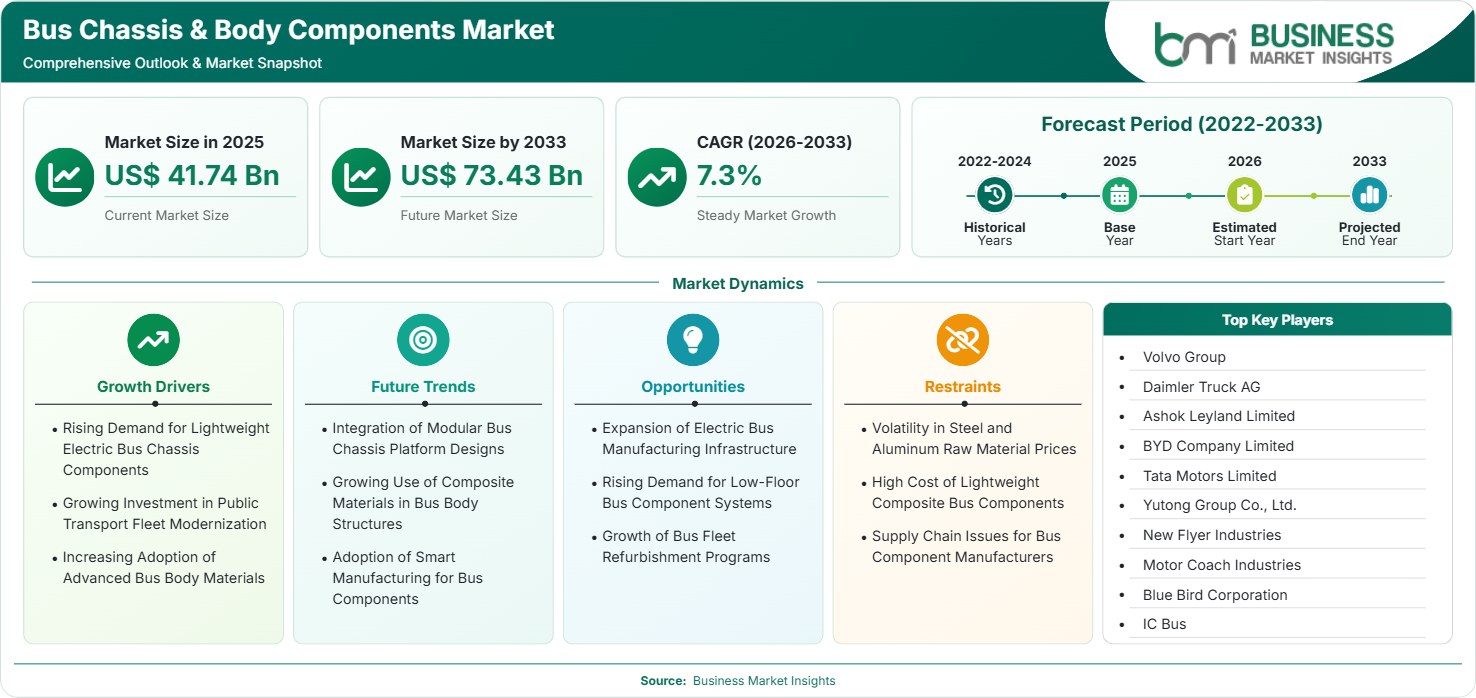
Bus Chassis & Body Components Market Regional Highlights
North America Bus Chassis & Body Components Market
North America accounted for 11–13% of the global Bus Chassis & Body Components Market share in 2025 and is projected to grow at a CAGR of 6.4–6.8% through 2033. Market expansion is supported by public transit modernization, replacement of aging school bus fleets, increasing electric bus deployment, and government investments in sustainable transportation infrastructure. Higher per-vehicle component value continues supporting supplier profitability despite comparatively lower production volumes.
- Government infrastructure spending is still being used by transportation authorities to replace old diesel buses with new electric and low emission vehicles, thus creating additional demand for lightweight chassis, structural assemblies, and new suspension designs.
- The electrification of school buses in various states is spurring the adoption of electric buses that need to be fitted with different structural assemblies and reinforced components architecture.
- The OEMs are continuing to invest in localized manufacturing and local supplier collaboration to increase their production agility and minimize dependency on imported structural assemblies.
- Increasing emphasis on passenger safety, accessibility standards, and lifecycle durability encourages adoption of premium body materials and advanced structural engineering.
US Bus Chassis & Body Components Market
The United States represents nearly 80–83% of the North American market and is expected to expand at a CAGR of 6.5–6.9% through 2033. Transit agency investments, school bus electrification, Buy America procurement policies, and modernization of municipal transportation fleets continue supporting component demand across major vehicle categories.
- Federal grants continue encouraging replacement of aging transit fleets with cleaner propulsion technologies, increasing opportunities for domestic component suppliers.
- Growing demand for zero-emission school buses accelerates adoption of reinforced chassis platforms designed specifically for battery integration.
- Local manufacturing investments improve supply chain resilience while reducing delivery lead times for OEMs and transit authorities.
- Digital manufacturing and automated fabrication technologies improve production quality and structural consistency.
Europe Bus Chassis & Body Components Market
Europe accounted for 15–17% of the global bus chassis & body components market in 2025 and is anticipated to register a CAGR of 6.8–7.2% during 2026–2033. Strong environmental regulations, increasing procurement of zero-emission buses, and continuous investments in public transport modernization are driving demand for advanced chassis and lightweight body structures. Regional OEMs continue investing in modular manufacturing platforms and sustainable materials to improve operational efficiency and regulatory compliance.
- Germany remained the largest regional market owing to its strong commercial vehicle manufacturing base, while expanding at a CAGR of 6.6–7.0% through continuous investments in electric bus production.
- The United Kingdom is projected to witness the fastest growth with a CAGR of 7.5–7.9%, supported by government-backed zero-emission bus programs and increasing replacement of aging public transport fleets.
- European manufacturers continue increasing the use of aluminum structures, high-strength steel, and recyclable materials to reduce vehicle weight and improve energy efficiency.
- Collaboration between OEMs, body builders, and component suppliers is accelerating the commercialization of modular electric bus platforms with standardized chassis architectures.
Asia Pacific Bus Chassis & Body Components Market
Asia Pacific represented the largest regional market with a 66–69% share in 2025 and is expected to grow at the fastest CAGR of 8.0–8.4% through 2033. Rapid urbanization, expanding public transportation infrastructure, increasing electric bus production, and strong domestic manufacturing capabilities continue supporting sustained demand for bus chassis and body components across major economies.
- China dominated the regional market while recording a CAGR of 8.1–8.5%, supported by large-scale electric bus manufacturing, government incentives, and a well-established commercial vehicle supply chain.
- India is projected to emerge as the fastest-growing country with a CAGR of 8.8–9.2%, driven by urban mobility initiatives, fleet electrification programs, and expanding domestic bus manufacturing capacity.
- Growing investments in metro connectivity, bus rapid transit systems, and smart city projects continue strengthening long-term component demand across Southeast Asia.
- Local manufacturers increasingly adopt automated welding, robotic fabrication, and modular production technologies to improve manufacturing efficiency and product consistency.
- Rising exports of complete buses and chassis assemblies from regional manufacturers continue reinforcing Asia Pacific's position as the global production hub.
Rest of World Bus Chassis & Body Components Market
The Rest of World accounted for 7–9% of the global market in 2025 and is forecast to expand at a CAGR of 7.0–7.4% during the forecast period. Fleet modernization, urban transportation investments, and growing adoption of electric and CNG buses continue supporting market development across South & Central America and the Middle East & Africa.
South & Central America continues witnessing steady investments in public transportation infrastructure, particularly in Brazil and Mexico, while the Middle East & Africa are increasingly adopting modern bus fleets to support urban expansion, tourism, and sustainable mobility initiatives.
- Brazil remained the leading market in South & Central America, expanding at a CAGR of 7.1–7.5%, supported by municipal bus fleet replacement and increasing domestic vehicle manufacturing.
- Saudi Arabia is expected to register the fastest growth in the Middle East & Africa with a CAGR of 7.8–8.2%, driven by smart city developments and public transportation expansion projects.
- Increasing localization of bus assembly operations and government infrastructure investments continue creating opportunities for chassis, suspension, and structural component suppliers.
- Adoption of lightweight materials and modular body designs is gradually increasing as fleet operators seek improved fuel efficiency and lower lifecycle operating costs.