
Bus Air Suspension System Market Outlook: Size, Share, Trends, Growth Analysis, Competitive Landscape & Forecast, 2026-2033

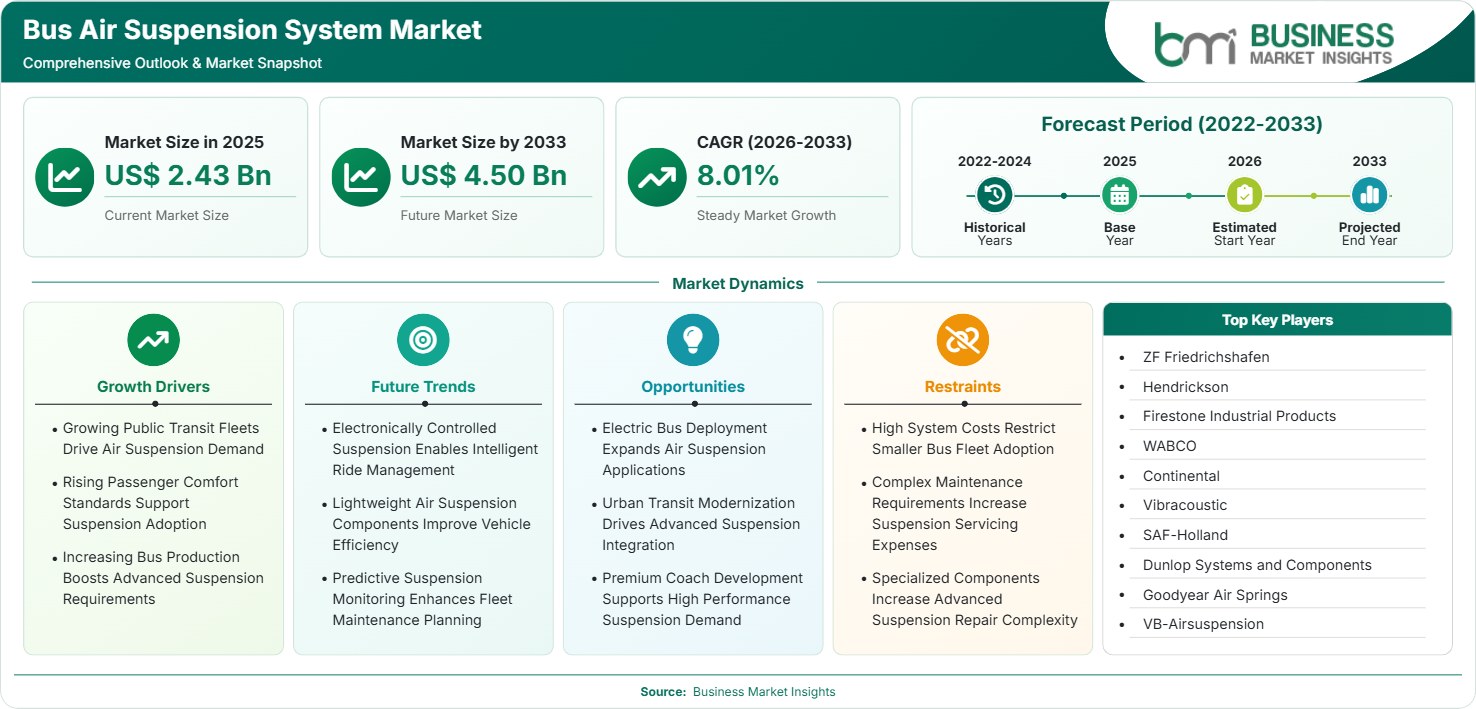
The Bus Air Suspension System Market size was valued at US$ 2.43 billion in 2025 and is projected to reach US$ 4.50 billion by 2033, growing at a CAGR of 8.01% during 2026–2033, driven by public transit expansion, passenger comfort, electric buses, fleet modernization, and advanced suspension integration.

Report Coverage
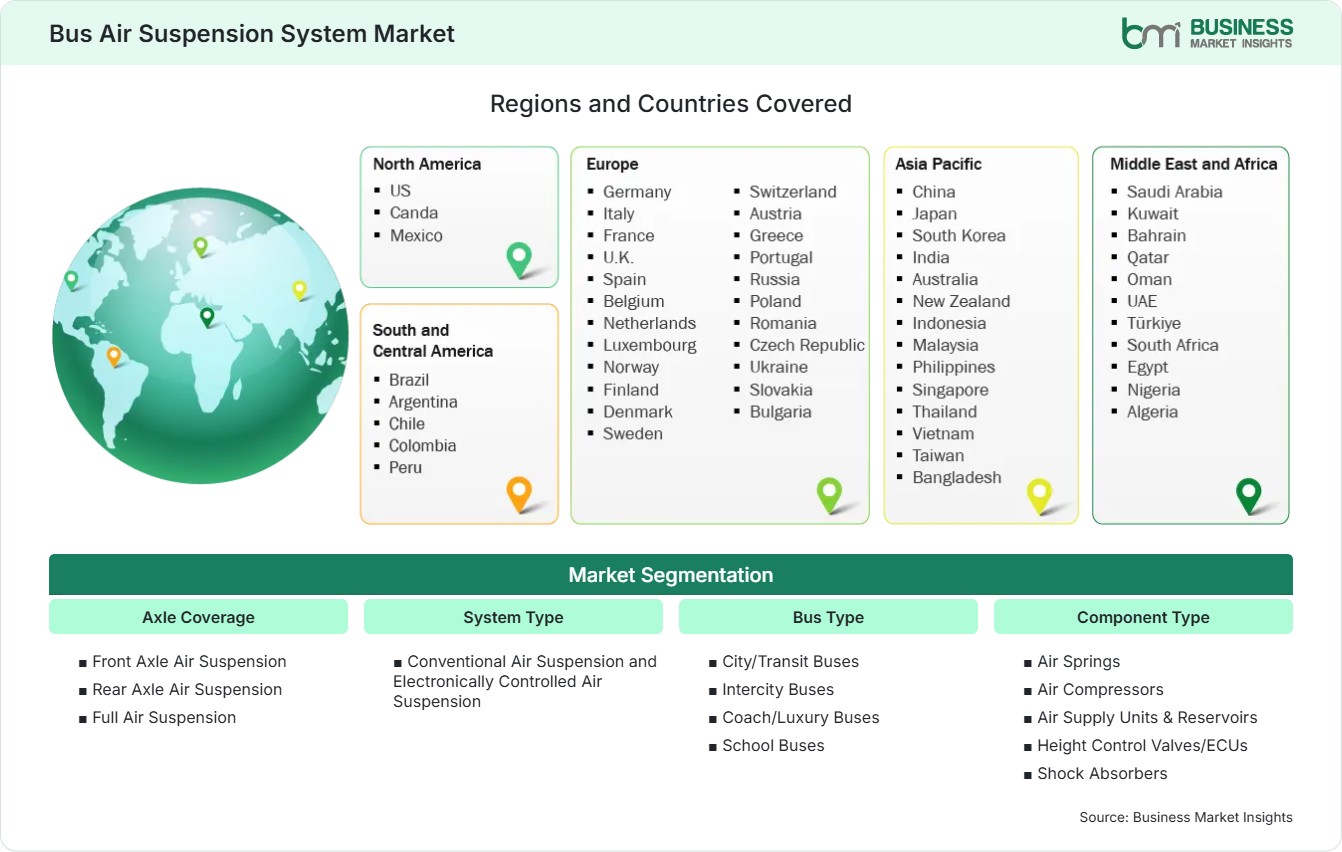
  • Axle Coverage: Front Axle Air Suspension, Rear Axle Air Suspension, Full Air Suspension
  • System Type: Conventional Air Suspension and Electronically Controlled Air Suspension
  • Bus Type: City/Transit Buses, Intercity Buses, Coach/Luxury Buses, School Buses
  • Component Type: Air Springs, Air Compressors, Air Supply Units & Reservoirs, Height Control Valves/ECUs, Shock Absorbers
US$ 2.43 Bn Market size in 2025
US$ 4.50 Bn Market Size by 2033
8.01% CAGR, 2026 - 2033
2026-2033 Forecast Period

AI Overview

Bus Air Suspension System Market Summary

  • North America Region: North America holds a market share of 20%–24% in 2025, growing with a CAGR of 6.50%–7.20% influenced by transit fleet renewal, electric bus deployment, passenger comfort requirements, and advanced suspension integration. The US Bus Air Suspension System Market remains the principal market, supported by public transportation modernization and premium coach applications. US demand is advancing at a 6.70%–7.30% CAGR as transit agencies upgrade fleets and operators prioritize ride quality.
  • Fastest Growing Region: Asia Pacific holds a market share of 34%–38% in 2025, growing with a CAGR of 9.00%–9.80% influenced by urban transit expansion, bus production, electric mobility investment, fleet modernization, and rising passenger expectations.
  • Leading Segment: Rear Axle Air Suspension holds a market share of 40%–44% in 2025, growing with a CAGR of 7.70%–8.30% influenced by passenger load management, ride comfort, improved stability, and broad adoption across transit and intercity bus platforms.
  • High Growth Segment: Electronically Controlled Air Suspension (ECAS) holds a market share of 28%–32% in 2025, growing with a CAGR of 10.00%–10.80% influenced by electronic controls, automated ride-height management, improved handling, connected diagnostics, and electric bus platform integration.
  • Key Market Opportunity: Electric buses and urban transit modernization are creating opportunities for electronically managed suspension systems that improve ride quality, accessibility, stability, energy efficiency, and fleet operating performance.
  • Major Market Players: ZF Friedrichshafen AG, Hendrickson USA, L.L.C., Firestone Industrial Products Company, LLC, WABCO Holdings Inc., Continental AG, Vibracoustic SE, SAF-HOLLAND SE, Dunlop Systems and Components Ltd., The Goodyear Tire & Rubber Company, and VB-Airsuspension Corporation.
Strategic Insights

Bus Air Suspension System Market: Strategic Insights

Bus Air Suspension System Market Strategic Framework
FREE PDF
Request your free sample
Request free sample
Stakeholder View

Key Takeaways

  • There are opportunities for integrated suspension ecosystems, including air suspension, compressors, reservoirs, electronics, valves, sensors, and shock absorbers, within the value chain.
  • Electric and low-floor buses offer immense growth prospects because of their novel architecture and suspension systems to accommodate batteries.
  • ECAS technology is gaining strategic importance as operators seek automated ride-height control, improved stability, diagnostic capabilities, and deeper vehicle electronics integration.
  • Asia Pacific offers an attractive investment environment due to expanding urban transit networks, high bus production, electric mobility initiatives, and public transportation modernization.
  • Fleet operators are placing greater emphasis on lifecycle economics, creating opportunities for suppliers offering durable components, maintenance support, diagnostics, and reliable aftermarket availability.
  • Collaboration among suspension experts, bus manufacturers, electric vehicle engineers, and transit authorities may speed up technology deployment and enhance integration into new fleet initiatives.
Geographic Outlook

Bus Air Suspension System Market Regional Highlights

North America Bus Air Suspension System Market

North America represents 20%–24% of the Bus Air Suspension System Market share in 2025 and is projected to expand at a 6.50%–7.20% CAGR during 2026–2033. The US remains dominant, supported by transit fleet renewal, electric bus programs, and demand for improved passenger comfort.

  • Public transit agencies are prioritizing fleet renewal, creating opportunities for suppliers offering durable solutions that address accessibility, passenger comfort, and demanding urban operating conditions.
  • Electric bus deployment is encouraging suspension redesign as manufacturers address battery weight, low-floor architecture, vehicle balance, and integration with electronic control systems.
  • Transit operators increasingly value lifecycle support, making component availability, diagnostic capabilities, maintenance training, and regional service coverage important competitive differentiators.
  • Premium coach operators continue seeking enhanced ride quality, supporting advanced suspension adoption where passenger experience and long-distance comfort influence vehicle selection.

US Bus Air Suspension System Market

The US accounts for 16%–19% of the Bus Air Suspension System Market share in 2025 and is projected to grow at a 6.70%–7.30% CAGR during 2026–2033. Demand is supported by public transit modernization, electric fleet deployment, school transportation, and premium coach applications.

  • Public transit modernization supports replacement demand as agencies upgrade aging fleets and seek suspension systems aligned with accessibility and passenger comfort objectives.
  • Electric buses require suspension solutions capable of accommodating battery-related weight distribution while maintaining ride quality and stability across urban routes.
  • Aftermarket providers benefit from recurring demand for air springs, valves, compressors, and related components as fleets prioritize operational continuity and maintenance efficiency.

Europe Bus Air Suspension System Market

Europe represents 23%–27% of the Bus Air Suspension System Market share in 2025 and is projected to advance at a 7.50%–8.20% CAGR during 2026–2033. Germany, France, the UK, Italy, and Spain represent leading markets, while Germany and France provide high-growth opportunities at approximately 7.90%–8.60% CAGR.

  • Germany benefits from strong commercial vehicle engineering capabilities and established bus manufacturing, supporting advanced suspension systems and integrated electronic controls.
  • France is supported by public transit modernization and low-emission mobility initiatives, creating opportunities for systems designed around electric and low-floor bus architectures.
  • The UK provides opportunities through fleet renewal and urban transportation investment, while operators increasingly prioritize passenger comfort and reliable maintenance performance.
  • Spain and Italy offer growth potential through urban mobility programs and cleaner public transport, supporting modern suspension adoption across city and intercity fleets.

Asia Pacific Bus Air Suspension System Market

Asia Pacific represents 34%–38% of the Bus Air Suspension System Market share in 2025 and is projected to expand at a 9.00%–9.80% CAGR during 2026–2033. China, India, Japan, South Korea, and Southeast Asia form key demand centers, while India and China provide high-growth opportunities near 9.40%–10.20% CAGR.

  • China provides significant opportunity through urban transportation investment and electric bus deployment, supporting integrated suspension systems across new vehicle platforms.
  • India is expanding public transportation capacity while increasing interest in electric buses, creating opportunities for localized suspension manufacturing and aftermarket service networks.
  • Japan and South Korea favor technologically advanced systems, supporting ECAS adoption, electronic diagnostics, and precision suspension solutions for premium and urban transportation applications.
  • Southeast Asian Bus Air Suspension System Markets provide emerging opportunities as cities expand public transit and operators seek improved ride quality, reliability, and passenger accessibility.

Rest of World Bus Air Suspension System Market

South and Central America provide opportunities through public transportation expansion, fleet renewal, and growing demand for improved passenger comfort. Brazil, Mexico, Colombia, and Argentina are important markets, while Brazil and Colombia offer attractive growth potential. Operators increasingly require durable suspension solutions suited to demanding road conditions and high vehicle utilization.

  • Brazil combines established bus manufacturing with extensive public transportation demand, creating opportunities for OEM suppliers and aftermarket distributors serving diverse vehicle applications.
  • Colombia offers attractive opportunities for the Bus Air Suspension System Market through urban mobility requirements and fleet modernization, supporting demand for reliable suspension components and replacement systems.
  • South Africa provides a regional aftermarket gateway, while public and commercial transportation applications create demand for durable suspension technologies.
  • Gulf markets offer premium opportunities as operators invest in modern fleets and seek advanced systems that improve comfort, stability, and passenger experience.
Global Market Geography
FREE PDF
Request your free sample
Request free sample
Segment Analysis

Bus Air Suspension System Market Segmentation

Axle Coverage

Rear Axle Air Suspension leads axle coverage, holding 40%–44% share in 2025 and expanding at a 7.70%–8.30% CAGR during 2026–2033. Its adoption reflects passenger load distribution, ride comfort, and stability requirements. Full air suspension supports advanced vehicle architectures, while front axle applications remain important for specialized configurations and improved overall handling.

  • Front Axle Air Suspension: Front axle systems improve ride quality, steering stability, and vibration control. Adoption is supported by comfort requirements, vehicle dynamics, and integration with advanced bus chassis platforms.
  • Rear Axle Air Suspension: Rear axle systems support passenger load management and ride comfort, making them widely applicable across transit, intercity, coach, and urban bus platforms.
  • Full Air Suspension (All Axles): Full air suspension provides comprehensive ride control across the vehicle. Demand benefits from premium comfort requirements, improved stability, and advanced fleet applications requiring consistent performance.

System Type

Electronically Controlled Air Suspension (ECAS) holds 28%–32% share in 2025 and is projected to grow at a 10.00%–10.80% CAGR during 2026–2033. Its adoption reflects automated ride-height control, improved vehicle stability, electronic diagnostics, and compatibility with modern bus architectures. Conventional systems remain relevant where affordability and maintenance simplicity remain priorities.

  • Conventional Air Suspension: Conventional systems offer proven performance and relatively straightforward architecture. Demand remains supported by cost-conscious fleets, established maintenance practices, and broad compatibility with existing bus platforms.
  • Electronically Controlled Air Suspension (ECAS): ECAS enables automated ride-height adjustment, improved stability, electronic monitoring, and advanced diagnostics. Adoption is increasing where operators prioritize performance, accessibility, and integration with vehicle electronics.

Bus Type

City/Transit Buses represent the largest application group, supported by high fleet utilization, urban route requirements, passenger comfort priorities, and low-floor accessibility. The Bus Air Suspension System scope is expanding as transit operators modernize fleets and introduce electric platforms.

  • City/Transit Buses: Urban buses require reliable ride control, frequent stop-start operation, accessibility, and passenger comfort. Air suspension supports low-floor designs and helps manage demanding daily fleet utilization.
  • Intercity Buses: Intercity applications prioritize ride quality, stability, and durability over extended routes. Air suspension helps reduce vibration and improve passenger comfort during longer journeys.
  • Coach/Luxury Buses: Premium coaches emphasize refined ride characteristics and passenger experience. Advanced suspension systems support smooth operation, stability, and differentiated vehicle performance for long-distance travel.
  • School Buses: School buses require durable suspension performance and dependable operation across varied road conditions. Adoption depends on safety, maintenance practicality, fleet economics, and passenger comfort requirements.

Component Type

Air Springs (Bellows) represent a leading component category, supported by recurring replacement demand and their essential role in maintaining ride quality. The Bus Air Suspension System Market trends increasingly favor integrated components that support durability, electronic control, predictive maintenance, and improved fleet uptime across increasingly sophisticated bus platforms.

  • Air Springs (Bellows): Air springs provide flexible load support and vibration isolation. Replacement demand is influenced by operating conditions, fleet age, maintenance schedules, and the need to preserve ride performance.
  • Air Compressors: Compressors supply the air required for suspension operation. Demand benefits from fleet maintenance requirements and increasing attention to reliable air management across high-utilization bus applications.
  • Air Supply Units & Reservoirs: These components support pressure management and consistent suspension operation. Adoption is linked to system reliability, efficient packaging, and integration with modern air management architectures.
  • Height Control Valves/ECUs: Height control valves and ECUs regulate ride height and suspension behavior. Advanced electronic systems increasingly support automated adjustment, diagnostics, and integration with broader vehicle control functions.
  • Shock Absorbers: Shock absorbers complement air springs by controlling oscillation and improving ride stability. Demand is supported by replacement requirements and efforts to maintain consistent passenger comfort across fleet operations.
Market Forces

Bus Air Suspension System Market Dynamics

Key Market Drivers

Growing Public Transit Fleets Drive Air Suspension Demand

Increasing fleets of public transport vehicles increase the demand for better suspension systems. The authorities need systems robust enough to handle stop-and-go traffic, passenger weight, and challenging urban conditions. The air suspension system offers clear benefits in terms of travel smoothness, load distribution, and vehicle accessibility. Renewal of the fleet creates an opportunity for suppliers to provide the entire system and offer after-sales services. With more operators considering their purchases in terms of lifetime vehicle performance, system durability becomes an important issue.

Rising Passenger Comfort Standards Support Suspension Adoption

Passenger needs are prompting bus builders and fleet operators to focus on providing a comfortable ride. The use of air suspension technology makes it easier for the bus to minimize the effects of road vibrations and ensure a consistent ride regardless of passenger weight. This is applicable in cases where the bus is used as public transport or premium coaches in intercity travel. The suppliers of air springs should incorporate technologies into their products to meet this need.

Increasing Bus Production Boosts Advanced Suspension Requirements

More bus production leads to more suspension parts required for new platforms, as well as an opportunity for suppliers to get involved with OEM programs in the long run. Manufacturers now look for a system that is adaptable to varying chassis types, passenger capacities, and propulsion systems. The modular approach may make platform development easier and allow suppliers to be involved in multiple vehicle variants. The electric bus program makes this demand even greater due to new weight-distribution challenges.

Key Market Opportunities

Electric Bus Deployment Expands Air Suspension Applications

The deployment of electric buses is presenting new opportunities for suspension system manufacturers because electric bus platforms have unique weight distribution and vehicle handling challenges. The adoption of an air suspension system will allow them to overcome those problems while providing a comfortable ride and low-floor access. According to the Bus Air Suspension System Market Forecast, there will be significant benefits for manufacturers who develop products that meet the needs of the electric bus platform.

Urban Transit Modernization Drives Advanced Suspension Integration

Modernization of urban public transport is prompting transport companies to opt for new buses that offer greater comfort, accessibility, efficiency, and digital capabilities. The suspension suppliers can take advantage of it by selling their products not only as upgrades but also as part of the larger fleet modernization system. Features such as integrated air supply and electronic control may allow the transport company to enhance maintenance schedules and vehicle performance.

Premium Coach Development Supports High Performance Suspension Demand

Development of premium coaches is a platform that gives suppliers the opportunity to design suspensions focused on high-end ride quality, stability, and comfort. Long-distance carriers have come to distinguish themselves by comfort features, hence the requirement for parts that perform consistently irrespective of passenger load and road conditions. Premium air suspension enables better vehicle operation and improved dynamics on the manufacturer’s side. Air springs of higher quality, electronically controlled suspension, and shock absorbers are among some of the solutions for suppliers.

Market Restraints and Challenges

High System Costs Restrict Smaller Bus Fleet Adoption

Factor: Air suspension systems may require a more costly initial setup than simpler mechanical designs, as they include specialized air springs, compressors, valves, tanks, control mechanisms, and other equipment. Impact: Small businesses and budget-minded organizations can delay implementing an air suspension system and stick with traditional suspensions to reduce initial costs. The problem becomes especially acute in the case of public transport, with limited funding and capital costs as the primary criterion in the buying process.

Complex Maintenance Requirements Increase Suspension Servicing Expenses

Factor: The use of air suspension technology requires technical expertise to address issues such as air leaks, compressor, valve, and electronic controller malfunctions. Impact: The challenges of maintaining air suspension technology will lead to higher costs and operational difficulties in the absence of skilled technicians or parts. Fleet owners will be less inclined towards the technology if there are no facilities to maintain it. Suppliers can alleviate this challenge through technician training and the availability of remote diagnostics and parts.

Company Analysis

Competitive Landscape

The Bus Air Suspension System Market analysis indicates competition is centered on system reliability, OEM relationships, electronic control capabilities, aftermarket service, and support for evolving bus architectures. Suppliers are increasingly differentiating through integrated suspension solutions, ECAS technology, diagnostic capabilities, and application-specific engineering. The competitive environment includes global commercial vehicle technology companies, suspension specialists, and component manufacturers with strong regional positions.

Company Name

Overview

Products and Services relevant to this market

ZF Friedrichshafen AG

Global mobility technology supplier with extensive commercial vehicle expertise and capabilities across chassis, suspension, and electronic systems.

Air suspension technologies, chassis systems, electronic controls, vehicle dynamics solutions, and integrated commercial vehicle technologies.

Hendrickson USA, L.L.C.

Major suspension specialist serving commercial vehicles with strong engineering expertise and established global manufacturing capabilities.

Air suspension systems, air springs, suspension components, axle solutions, and aftermarket replacement products for buses and commercial vehicles.

Firestone Industrial Products Company, LLC

Specialist in air spring technologies with extensive experience serving transportation and industrial applications.

Air springs, air suspension systems, pneumatic components, and replacement solutions for commercial vehicle applications.

WABCO Holdings Inc.

Commercial vehicle technology company known for braking, control, and air management expertise across heavy vehicle applications.

Air management systems, electronic controls, suspension control technologies, compressors, and commercial vehicle system solutions.

Continental AG

Global automotive technology company providing electronic and chassis solutions for commercial vehicles and mobility applications.

Air suspension components, electronic control technologies, sensors, chassis systems, and integrated vehicle electronics.

Vibracoustic SE

NVH and air spring specialist developing solutions focused on vibration isolation and ride comfort for vehicle applications.

Air springs, suspension components, vibration isolation systems, and engineered ride comfort solutions.

SAF-HOLLAND SE

Commercial vehicle component manufacturer with strong capabilities in axle and suspension systems for global transportation markets.

Air suspension systems, axle assemblies, suspension components, and related commercial vehicle technologies.

Dunlop Systems and Components Ltd.

Specialist suspension supplier with expertise in air suspension systems and components for commercial vehicle applications.

Air suspension systems, electronic control solutions, air springs, compressors, and replacement components.

The Goodyear Tire & Rubber Company

Global mobility company with air spring expertise supporting commercial transportation and suspension applications.

Air springs, pneumatic suspension solutions, commercial vehicle components, and related technical support services.

VB-Airsuspension Corporation

Suspension specialist focused on air suspension solutions for commercial vehicles and specialized vehicle applications.

Air suspension kits, complete suspension systems, air springs, compressors, and vehicle-specific suspension solutions.

Trust & Transparency

Research Methodology

The market analysis combines proprietary research with secondary data from government agencies, company disclosures, regulatory filings, industry databases and expert interviews. Market estimates are validated through data triangulation, cross-market benchmarking and analyst review.

View Full Research Methodology

Questions Answered

Frequently Asked Questions

What does the Bus Air Suspension System Market Report indicate about future competition?

Competition is moving toward integrated systems that combine air springs, compressors, electronic controls, sensors, valves, and diagnostics. Suppliers that deliver reliable performance, simplified maintenance, strong aftermarket support, and solutions tailored to electric and low-floor buses are likely to strengthen their market positions.

Why is electronic suspension control becoming more important?

Electronic control enables automated ride-height adjustment, improved vehicle stability, diagnostic capabilities, and closer integration with vehicle electronics. These features can help operators improve passenger comfort and maintenance planning while supporting increasingly sophisticated bus architectures.

How are electric buses changing suspension requirements?

Electric platforms introduce different weight distributions and packaging requirements because of battery systems. Suspension suppliers must accommodate these characteristics while maintaining ride comfort, vehicle stability, low-floor accessibility, and compatibility with electronic vehicle control architectures.

Which bus applications present the strongest opportunity for advanced suspension in the Bus Air Suspension System Market?

Electric city buses, premium coaches, intercity vehicles, and modern low-floor transit buses offer strong opportunities. These applications benefit from improved ride quality, electronic control, accessibility, stability, and suspension architectures designed around changing vehicle platforms.

What factors are improving bus air suspension return on investment?

Longer component life, improved passenger comfort, better load management, reduced vibration, and maintenance optimization can strengthen lifecycle economics. The strongest value proposition typically occurs in high-utilization transit and intercity fleets where ride quality and vehicle availability directly affect operating performance.

Access the Full Bus Air Suspension System Market Report

Get segment-level forecasts, regional estimates, competitive benchmarking, company profiles and downloadable Excel datasets.

Access the full Bus Air Suspension System Market Report
350 pages PDF & Excel | 2026-08-07
Similar Research

Related Market Reports