
Automotive Air Suspension Market Outlook: Size, Share, Trends, Growth Analysis, Competitive Landscape & Forecast, 2026-2033

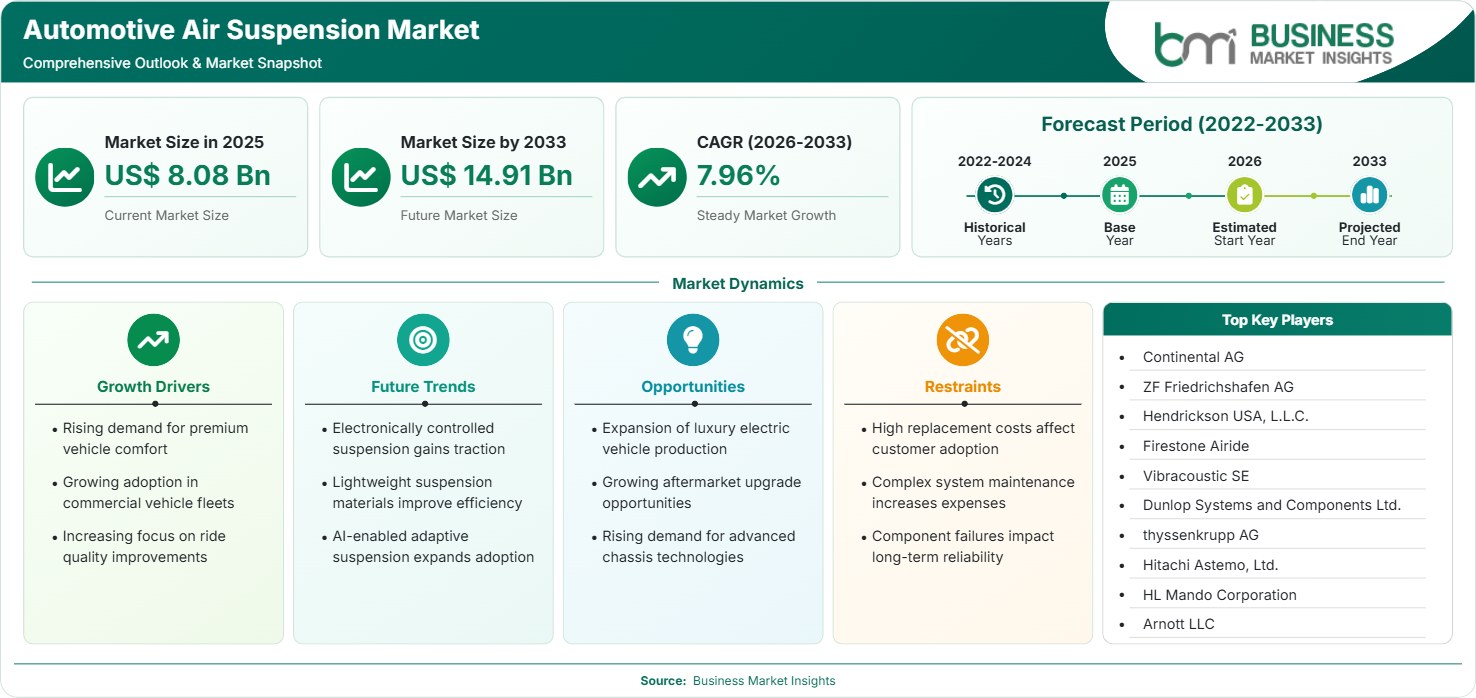
The Automotive Air Suspension Market size was valued at US$ 8.08 billion in 2025 and is projected to reach US$ 14.91 billion by 2033, growing at a CAGR of 7.96% during 2026–2033. Rising demand for premium vehicle comfort, growing adoption in commercial vehicle fleets, and increasing focus on ride quality improvements continue driving market expansion, while luxury electric vehicles and advanced chassis technologies create long-term growth opportunities.

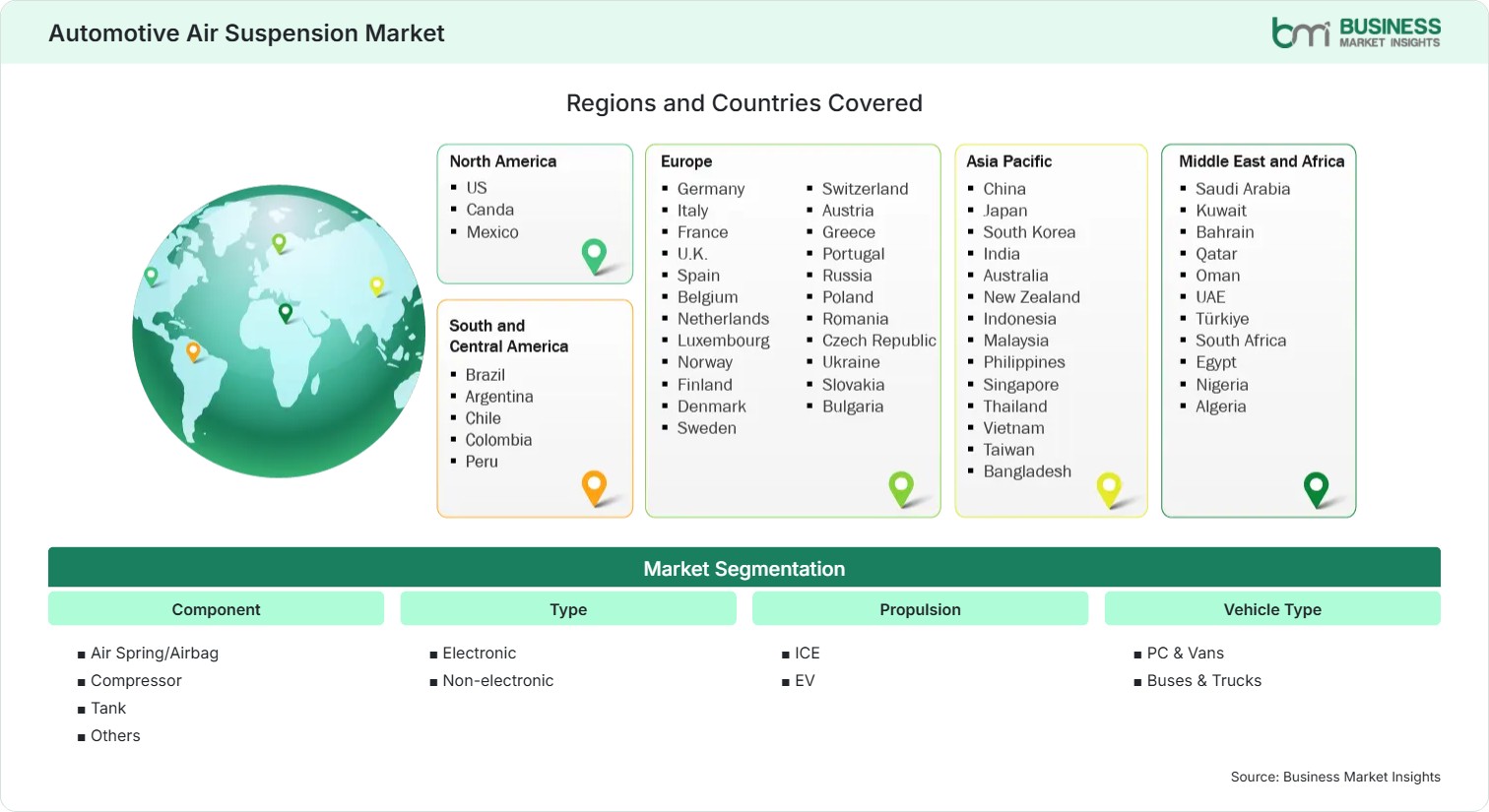
Report Coverage
  • Component: Air Spring/Airbag, Compressor, Tank, Others
  • Type: Electronic, Non-electronic
  • Propulsion: ICE, EV
  • Vehicle Type: PC & Vans, Buses & Trucks
US$ 8.08 Bn Market size in 2025
US$ 14.91 Bn Market Size by 2033
7.96% CAGR, 2026 - 2033
2026-2033 Forecast Period

01 AI Overview

Automotive Air Suspension Market Summary

  • North America Region: North America holds 31%–34% market share in 2025 and is projected to expand at a CAGR of 7.4%–8.0% during 2026–2033. Strong demand for premium vehicles, expanding pickup truck sales, and increasing commercial fleet modernization continue supporting market growth. The U.S. dominates the regional market through strong luxury vehicle sales, growing electric vehicle production, and increasing adoption of advanced suspension technologies, expanding at an estimated CAGR of 7.6%–8.2% during 2026–2033.
  • Fastest Growing Region: Asia Pacific accounts for 35%–38% market share in 2025 and is expected to register a CAGR of 8.6%–9.2% during 2026–2033. Expanding automotive manufacturing, rising premium vehicle ownership, increasing electric vehicle production, and growing commercial transportation investments continue driving regional expansion.
  • Leading Segment: Air Spring/Airbag represents 42%–45% market share in 2025 and is anticipated to grow at a CAGR of 7.8%–8.3% owing to its critical role in maintaining ride comfort, load balancing, and suspension performance.
  • High Growth Segment: EV accounts for 18%–21% market share in 2025 and is forecast to expand at a CAGR of 10.1%–10.8% during 2026–2033 as electric vehicle manufacturers increasingly integrate adaptive suspension systems to enhance driving comfort and vehicle efficiency.
  • Key Market Opportunity: Expansion of luxury electric vehicle production, increasing aftermarket suspension upgrades, and growing demand for intelligent chassis systems are creating significant long-term commercial opportunities across global automotive markets.
  • Major Market Players: Continental AG, ZF Friedrichshafen AG, Hendrickson USA, L.L.C., Firestone Airide, Vibracoustic SE, Dunlop Systems and Components Ltd., thyssenkrupp AG, Hitachi Astemo, Ltd., HL Mando Corporation, and Arnott LLC.
02 Strategic Insights

Automotive Air Suspension Market: Strategic Insights

Automotive Air Suspension Market Strategic Framework
FREE PDF
Request your free sample
Request free sample
03 Stakeholder View

Key Takeaways

  • Improved cooperation between automobile companies, suspension companies, and electronic systems companies is enhancing the value chain of automotive suspension and speeding up the integration of smart chassis systems.
  • Revenue potential exists through electric automobiles, high-end passenger cars, and commercial automobiles because of the focus on comfort, fuel efficiency, and advanced automobile dynamics.
  • Continuous innovation in electronically controlled air suspension systems, lightweight materials, and predictive suspension management is improving product performance and supporting premium vehicle differentiation.
  • Asia Pacific offers the strongest investment potential because of expanding automotive production, increasing premium vehicle ownership, rapid electric vehicle adoption, and ongoing investments in transportation infrastructure.
  • Strategic acquisitions, manufacturing capacity expansions, and long-term supply agreements between OEMs and suspension manufacturers continue strengthening competitive positioning while supporting future product innovation and commercialization.
04 Geographic Outlook

Automotive Air Suspension Market Regional Highlights

North America Automotive Air Suspension Market

North America accounted for 31%–34% of the Automotive Air Suspension Market Share in 2025 and is expected to expand at a CAGR of 7.4%–8.0% during 2026–2033. Strong demand for premium passenger vehicles, commercial trucks, luxury SUVs, and electric vehicles continues supporting regional growth. OEM investments in advanced chassis systems and adaptive suspension technologies further strengthen market expansion.

  • Premium passenger vehicle manufacturers continue integrating electronically controlled air suspension systems to improve ride comfort, handling, and overall vehicle performance.
  • Commercial fleet operators increasingly adopt air suspension technologies to enhance cargo protection, driving stability, and long-distance operating efficiency.
  • Growing electric vehicle production encourages wider adoption of lightweight adaptive suspension systems for improved energy efficiency and driving dynamics.
  • Continuous technological advancements in intelligent suspension control systems support higher OEM adoption across premium automotive segments.

US Automotive Air Suspension Market

The U.S. represented 74%–77% of the North American market in 2025 and is projected to grow at a CAGR of 7.6%–8.2% through 2033. Strong luxury vehicle sales, expanding pickup truck production, and increasing investments in electric mobility continue driving nationwide demand.

  • Luxury automakers continue equipping premium SUVs and sedans with adaptive air suspension technologies.
  • Commercial trucking companies increasingly invest in air suspension to improve vehicle durability and cargo safety.
  • Rising consumer demand for premium ride comfort supports aftermarket suspension upgrades.
  • Electric vehicle manufacturers integrate intelligent chassis technologies to enhance vehicle stability and efficiency.

Europe Automotive Air Suspension Market

Europe held 27%–30% market share in 2025 and is forecast to expand at a CAGR of 7.7%–8.3% through 2033. Germany leads regional demand, while the United Kingdom records the fastest growth owing to increasing luxury vehicle production, advanced automotive engineering, and electric vehicle investments.

  • Premium automotive brands continue introducing advanced adaptive suspension systems across new vehicle platforms.
  • Commercial vehicle manufacturers increasingly utilize air suspension to improve operational efficiency and driving comfort.
  • Growing adoption of electric luxury vehicles supports demand for electronically controlled suspension technologies.
  • Continued investment in automotive innovation strengthens component manufacturing across the region.

Asia Pacific Automotive Air Suspension Market

Asia Pacific accounted for 35%–38% market share in 2025 and is expected to register the strongest Automotive Air Suspension Market Forecasts, expanding at a CAGR of 8.6%–9.2% during 2026–2033. China leads regional revenue, while India demonstrates the fastest growth owing to expanding automotive manufacturing, premium vehicle demand, and increasing electric vehicle production.

  • Automotive production expansion continues increasing OEM demand for advanced suspension components.
  • Rising premium vehicle ownership accelerates adoption of electronically controlled air suspension systems.
  • Government support for electric mobility strengthens investment in advanced chassis technologies.
  • Commercial transportation modernization encourages greater utilization of air suspension systems.
  • Increasing localization of automotive component manufacturing supports long-term regional growth.
Global Market Geography
FREE PDF
Request your free sample
Request free sample
05 Segment Analysis

Automotive Air Suspension Market Segmentation

Component

The Component segment represents the largest, with Air Spring/Airbag accounting for 42%–45% market share in 2025 and expanding at a CAGR of 7.8%–8.3%. The Automotive Air Suspension Market Trends highlight increasing adoption of air springs because they provide superior ride comfort, load balancing, vibration isolation, and suspension durability across passenger and commercial vehicles.

  • Air Spring/Airbag: Forms the core suspension element by maintaining ride height, improving comfort, reducing vibration, and enhancing vehicle stability under varying load conditions.
  • Compressor: Supplies compressed air required for suspension height adjustment, enabling automatic leveling and improved driving performance across different road conditions.
  • Tank: Stores compressed air for rapid suspension response, improving operational efficiency and maintaining consistent system performance during vehicle operation.

Type

The Type segment is expanding as automakers increasingly adopt electronically controlled suspension systems that enhance vehicle handling, adaptive ride quality, and real-time chassis performance across premium and commercial vehicle platforms.

  • Electronic: Integrates sensors and electronic control units to automatically adjust suspension settings according to driving conditions, vehicle speed, and load distribution.
  • Non-electronic: Provides dependable mechanical air suspension performance with lower complexity, making it suitable for commercial vehicles and cost-sensitive applications.

Propulsion

The Propulsion segment reflects growing adoption across both conventional and electrified vehicles. Electric vehicles demonstrate the strongest growth owing to increasing demand for premium driving dynamics and optimized energy efficiency.

  • ICE: Continues accounting for significant installations because of large global production volumes across passenger cars, buses, trucks, and commercial vehicles.
  • EV: Increasingly integrates adaptive air suspension technologies to improve ride comfort, battery protection, handling stability, and overall driving efficiency.

Vehicle Type

The Vehicle Type segment continues expanding as OEMs integrate advanced suspension technologies into passenger and commercial vehicles to improve comfort, durability, and operational performance across diverse transportation applications.

  • PC & Vans: Growing premium vehicle production and consumer preference for superior ride quality continue supporting widespread adoption of advanced air suspension systems.
  • Buses & Trucks: Fleet operators increasingly deploy air suspension systems to improve passenger comfort, cargo protection, vehicle stability, and long-haul operational efficiency.
06 Market Forces

Automotive Air Suspension Market Dynamics

Key Market Drivers

Rising Demand for Premium Vehicle Comfort

The increasing consumer preference for premium driving comfort is a major factor supporting the Market Growth. Air suspension systems provide superior ride quality by automatically adjusting vehicle height and damping characteristics according to road conditions and vehicle load. Electronic controlled air suspension is currently being adopted in premium passenger cars, luxury SUVs, and performance vehicles because of its benefits in enhancing vehicle handling, passenger comfort, and stability. The automotive industry is also incorporating smart suspensions in tandem with ADAS to achieve improved overall vehicle performance. Consumer demand for smooth ride quality and high-quality features is increasing the rate of adoption in the automotive industry.

Growing Adoption in Commercial Vehicle Fleets

Commercial fleet operators are increasingly deploying air suspension systems to improve cargo protection, vehicle durability, and long-distance driving comfort. The air suspension system helps in minimizing vibrations and shocks, and hence reduces damage to the cargo carried. Logistic companies, public transport organizations, and manufacturers of trucks are constantly researching advanced suspension systems. This will help them be more efficient and save money on maintenance. The high frequency of transporting freight, increased use of logistics due to ecommerce, and increased need for reliable commercial transportation are helping to drive adoption.

Increasing Focus on Ride Quality Improvements

Automotive manufacturers continue prioritizing ride quality and vehicle dynamics as key competitive differentiators across both passenger and commercial vehicle segments. The modernized air suspension systems contribute to better steering, handling, braking, and occupant ride comfort, while ensuring ideal ride height automatically. Further advancements made in the field of electronically controlled suspensions, predictive chassis controls, and sensor technology have led to improved driving experience. The increasing need for luxurious mobility, electric cars, and connected vehicle technology keeps motivating manufacturers to use advanced suspension systems in their future car models.

Key Market Opportunities

Expansion of Luxury Electric Vehicle Production

The rapid expansion of luxury electric vehicle manufacturing presents significant opportunities for suspension system suppliers. Premium electric vehicles require advanced chassis technologies capable of supporting battery weight while maintaining ride comfort, handling precision, and driving efficiency. The Automotive Air Suspension Market Forecasts indicate increasing integration of electronically controlled air suspension systems across premium EV platforms. Investments worldwide in electric vehicles, luxury automobiles, and intelligent automotive systems will create continuous need for adaptive air suspensions. The companies that have the technology to provide light and efficient suspension systems controlled by software will be well positioned to capitalize on this trend.

Growing Aftermarket Upgrade Opportunities

The automotive aftermarket continues creating attractive opportunities as vehicle owners increasingly seek suspension upgrades that improve comfort, aesthetics, towing capability, and handling performance. Air suspension conversion kits are becoming increasingly popular among luxury vehicle owners, recreational vehicle users, pickup truck operators, and commercial fleet managers. Rising consumer awareness about customizable suspension systems and increasing availability of after-market services for installation are contributing to increasing demand for these systems. Companies providing reliable components for replacement, as well as digital control systems for the suspension system, will be benefiting from increasing after-market sales.

Rising Demand for Advanced Chassis Technologies

Automotive manufacturers are increasingly investing in intelligent chassis systems that integrate air suspension with electronic stability control, predictive suspension management, and vehicle dynamics technologies. These integrated solutions enhance driving safety, passenger comfort, and vehicle responsiveness under varying road conditions. Improvements in sensor technologies, software algorithms, and real-time monitoring of vehicles have made it possible to design more sophisticated control suspension systems. Increased use of autonomous driving technology and connected vehicles will drive up the demand for chassis systems, providing great potential for growth in the suspension parts market.

Market Restraints and Challenges

High Replacement Costs Affect Customer Adoption

Air suspension systems incorporate sophisticated electronic controls, compressors, air springs, and sensors that increase replacement and repair expenses compared with conventional mechanical suspension systems.

Factor: High replacement costs for suspension components.

Impact: The high cost of maintaining and replacing parts will make the technology less attractive to customers who are cost-conscious. Maintenance beyond the warranty period may involve the use of special parts and qualified mechanics, thus increasing the cost of ownership and making people revert to conventional suspensions.

Complex System Maintenance Increases Expenses

Modern air suspension systems require specialized diagnostic equipment, technical expertise, and regular inspection to maintain consistent performance throughout the vehicle lifecycle.

Factor: Complex maintenance procedures and technical servicing requirements.

Impact: Higher maintenance complexity results in high costs, extended repair time, and difficulties in operations within independent repair shops that lack specialist skills. Failures of components like compressors, sensors, valves, or electronics control modules may raise lifetime costs, thus hindering wider application of the technology in cost-sensitive categories of vehicles.

07 Company Analysis

Competitive Landscape

The competitive landscape of the Market is shaped by leading automotive component manufacturers focusing on intelligent suspension technologies, lightweight materials, electronic control systems, and strategic partnerships with global vehicle manufacturers. The Automotive Air Suspension Market Analysis indicates that companies are strengthening their competitive positions through research and development investments, manufacturing expansion, digital suspension innovations, and long-term OEM supply agreements. Market participants are also emphasizing energy-efficient compressors, electronically controlled air suspension modules, and integrated chassis management systems to support growing demand from premium passenger vehicles, commercial fleets, and electric vehicles.

Company Name

Overview

Products and Services Relevant to this Market

Continental AG

Global automotive technology company providing advanced mobility solutions, chassis technologies, and intelligent vehicle systems for passenger and commercial vehicles.

Electronic air suspension systems, chassis control modules, vehicle sensors, suspension electronics, and advanced mobility technologies.

ZF Friedrichshafen AG

Leading global supplier of driveline, chassis, and active safety technologies supporting next-generation vehicle platforms.

Air suspension modules, electronic damping systems, chassis control technologies, suspension actuators, and intelligent vehicle dynamics solutions.

Hendrickson USA, L.L.C.

Major manufacturer specializing in suspension systems for commercial vehicles, trailers, buses, and heavy-duty transportation applications.

Air suspension systems, axle systems, mechanical suspensions, trailer suspensions, and heavy commercial vehicle components.

Firestone Airide

Established manufacturer of engineered air spring technologies serving commercial vehicles, industrial equipment, and specialty transportation markets.

Air springs, air suspension components, vibration isolation systems, heavy-duty suspension products, and replacement air bags.

Vibracoustic SE

Automotive supplier specializing in vibration control, noise reduction, and advanced suspension technologies for global OEMs.

Air springs, chassis isolation systems, vibration dampers, suspension components, and ride comfort technologies.

Dunlop Systems and Components Ltd.

Manufacturer focused on air suspension products for passenger vehicles, recreational vehicles, and light commercial vehicles.

Air suspension kits, onboard compressors, air springs, electronic control systems, and aftermarket suspension solutions.

thyssenkrupp AG

Diversified industrial technology company supplying automotive components and steering technologies to global vehicle manufacturers.

Chassis components, steering systems, lightweight automotive technologies, and vehicle suspension solutions.

Hitachi Astemo, Ltd.

Automotive technology company delivering advanced mobility solutions, electronic systems, and chassis control technologies.

Electronic suspension systems, vehicle control units, chassis electronics, sensors, and integrated automotive technologies.

HL Mando Corporation

Global automotive supplier producing braking, steering, suspension, and advanced driver assistance technologies.

Electronic suspension systems, shock absorbers, chassis modules, steering systems, and automotive safety technologies.

Arnott LLC

Specialized manufacturer supplying premium replacement air suspension products for passenger vehicles and luxury automotive brands.

Replacement air springs, compressors, suspension struts, electronic suspension components, and aftermarket repair solutions.

10 Trust & Transparency

Research Methodology

The market analysis combines proprietary research with secondary data from government agencies, company disclosures, regulatory filings, industry databases and expert interviews. Market estimates are validated through data triangulation, cross-market benchmarking and analyst review.

View Full Research Methodology

11 Questions Answered

Frequently Asked Questions

What does the Automotive Air Suspension Market Report include?

The Market Report provides comprehensive insights into market size, segmentation, competitive landscape, regional developments, technology trends, growth drivers, restraints, investment opportunities, company profiles, and long-term industry outlook.

What are the biggest challenges for manufacturers?

Manufacturers continue facing challenges related to high replacement costs, complex maintenance requirements, sophisticated electronic integration, and the need to balance premium performance with cost-effective production for broader vehicle adoption.

Why are electric vehicles creating new growth opportunities?

Electric vehicles require advanced suspension systems to manage battery weight, improve driving dynamics, maximize passenger comfort, and enhance vehicle efficiency. This has accelerated OEM adoption of intelligent electronically controlled air suspension technologies.

Which component dominates the Market?

Air Spring/Airbag is the leading component because it serves as the primary load-bearing element of the suspension system, providing ride height adjustment, vibration isolation, improved stability, and enhanced passenger comfort across multiple vehicle categories.

What is driving the Automotive Air Suspension Market?

The market is primarily driven by rising demand for premium ride comfort, growing commercial vehicle fleet modernization, increasing adoption of electric vehicles, and continuous advancements in electronically controlled suspension technologies that improve vehicle handling, safety, and passenger comfort.

Access the Full Automotive Air Suspension Market Report

Get segment-level forecasts, regional estimates, competitive benchmarking, company profiles and downloadable Excel datasets.

Access the full Automotive Air Suspension Market Report
350 pages PDF & Excel | 2026-08-05