
Automotive Multi Link Suspension Market Outlook: Size, Share, Trends, Growth Analysis, Competitive Landscape & Forecast, 2026–2033

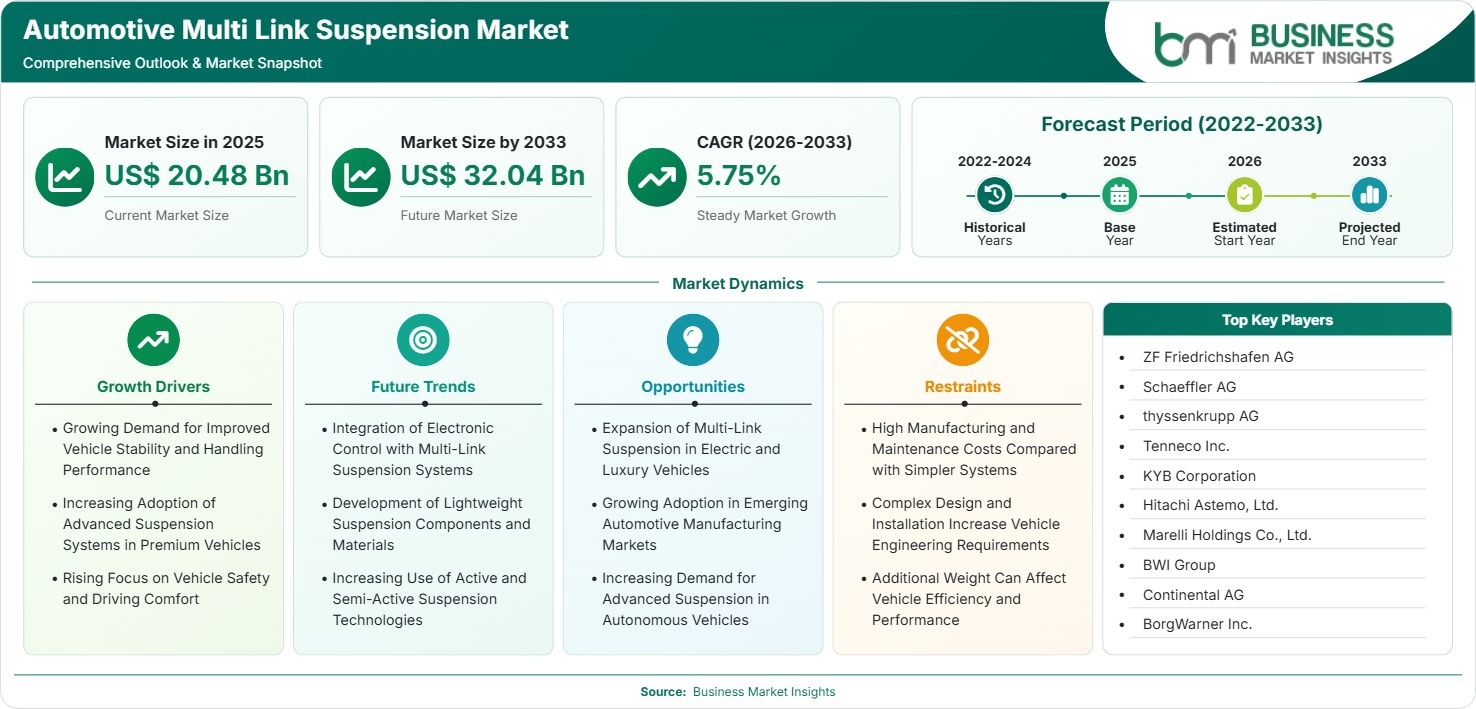
The Automotive Multi Link Suspension market size was valued at US$ 20.48 Billion in 2025 and is projected to reach US$ 32.04 Billion by 2033, growing at a CAGR of 5.75% during 2026–2033, driven by rising demand for enhanced vehicle dynamics, increasing adoption of advanced suspension systems in premium vehicles, and opportunities from electric, luxury, and autonomous vehicle platforms.

Report Coverage
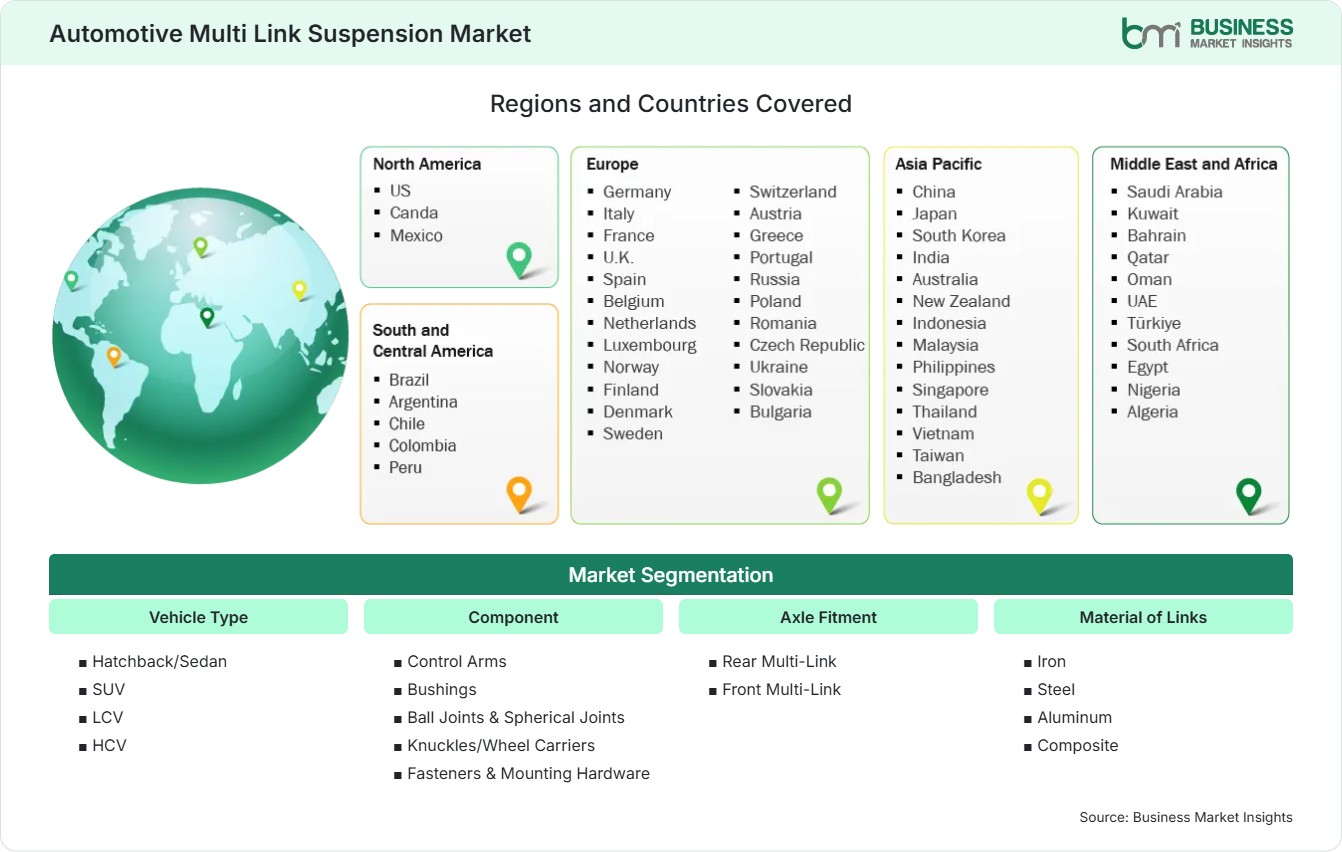
  • Vehicle Type: Hatchback/Sedan, SUV, LCV, HCV
  • Component: Control Arms, Bushings, Ball Joints & Spherical Joints, Knuckles/Wheel Carriers, Fasteners & Mounting Hardware
  • Axle Fitment: Rear Multi-Link, Front Multi-Link
  • Material of Links: Iron, Steel, Aluminum, Composite
  • Propulsion: ICE, Electric
US$ 20.48 Bn Market size in 2025
US$ 32.04 Bn Market Size by 2033
5.75% CAGR, 2026 - 2033
2026-2033 Forecast Period

AI Overview

Automotive Multi Link Suspension Market Summary

  • North America Region: North America holds a 29%–32% automotive multi link suspension market share in 2025, growing with a CAGR of 5.40%–5.90% during 2026–2033, supported by premium vehicle demand, advanced automotive engineering, and increasing adoption of electric vehicles. The U.S. market is expanding at a CAGR of 5.50%–6.00% during 2026–2033, driven by luxury vehicle production, consumer preference for improved ride comfort, and advanced chassis technologies.
  • Fastest Growing Region: Asia Pacific represents a 34%–37% share in 2025, expanding at a CAGR of 6.10%–6.60% during 2026–2033, supported by automotive manufacturing growth, electric vehicle adoption, premium vehicle production, and increasing investments from global automakers.
  • Leading Segment: SUV vehicle type accounts for a 38%–41% share in 2025, growing at a CAGR of 5.80%–6.30% during 2026–2033, driven by rising consumer preference for SUVs, demand for improved handling, and increasing integration of advanced suspension systems.
  • High Growth Segment: Electric propulsion segment holds a 20%–23% share in 2025, achieving a CAGR of 7.00%–7.50% during 2026–2033, supported by EV platform development, lightweight component adoption, and demand for enhanced driving performance.
  • Key Market Opportunity: Automotive manufacturers are expanding multi-link suspension adoption in electric, luxury, and autonomous vehicles by integrating lightweight materials, advanced chassis systems, and electronically controlled suspension technologies.
  • Major Market Players: ZF Friedrichshafen AG, Schaeffler AG, thyssenkrupp AG, Tenneco Inc., KYB Corporation, Hitachi Astemo, Ltd., Marelli Holdings Co., Ltd., BWI Group, Continental AG, BorgWarner Inc.
Strategic Insights

Automotive Multi Link Suspension Market: Strategic Insights

Automotive Multi Link Suspension Market Strategic Framework
FREE PDF
Request your free sample
Request free sample
Stakeholder View

Key Takeaways

  • Automotive suspension value chains are becoming more technology-focused, with component manufacturers, automakers, and engineering suppliers collaborating on advanced chassis development.
  • Electric vehicles, luxury vehicles, and SUVs represent high-growth opportunities as manufacturers prioritize improved handling, comfort, and vehicle dynamics.
  • Innovation is shifting toward lightweight aluminum and composite suspension links, electronically controlled systems, and integration with intelligent vehicle platforms.
  • Asia Pacific offers strong investment potential due to expanding automotive production, increasing EV manufacturing capacity, and rising adoption of premium vehicles.
  • Strategic partnerships and technology collaborations among suspension suppliers are increasing as companies seek capabilities in lightweight materials and advanced chassis systems.
  • Growing autonomous vehicle development is creating demand for suspension systems capable of supporting advanced vehicle control and enhanced passenger comfort.
Geographic Outlook

Automotive Multi Link Suspension Market Regional Highlights

North America Automotive Multi Link Suspension Market

North America accounted for a 29%–32% automotive multi link suspension market share in 2025 and is projected to grow at a CAGR of 5.40%–5.90% during 2026–2033. The region benefits from premium vehicle demand, strong automotive research capabilities, and increasing electric vehicle adoption. Automotive Multi Link Suspension share is supported by luxury vehicle manufacturers and advanced chassis technology adoption.

  • The United States represents the largest contributor due to strong demand for premium SUVs, electric vehicles, and advanced automotive technologies.
  • Canada is witnessing adoption through luxury vehicle assembly and increasing investments in electric mobility infrastructure.
  • Automakers are integrating advanced suspension technologies to improve vehicle comfort and handling characteristics.
  • Technology suppliers are focusing on lightweight components to support fuel efficiency and electric vehicle performance.

US Automotive Multi Link Suspension Market

The U.S. automotive multi link suspension market accounted for a 24%–27% share of the global market in 2025 and is expected to expand at a CAGR of 5.50%–6.00% between 2026–2033. Demand is driven by premium vehicle sales, SUV popularity, electric vehicle expansion, and consumer preference for enhanced driving experience. Automakers are adopting advanced suspension systems to improve stability, comfort, and performance across multiple vehicle platforms. Increasing investments in EV manufacturing are further supporting market growth.

  • Luxury vehicle manufacturers are increasing multi-link suspension adoption to deliver improved ride quality and handling performance.
  • Electric vehicle platforms are incorporating advanced suspension systems to optimize weight distribution and driving dynamics.
  • Automotive suppliers are developing lightweight suspension components to improve efficiency and reduce vehicle weight.

Europe Automotive Multi Link Suspension Market

Europe automotive multi link suspension market represented a 25%–28% share in 2025 and is projected to grow at a CAGR of 5.20%–5.70% during 2026–2033. The region is driven by premium automotive production, strong engineering capabilities, and increasing vehicle electrification. Germany, France, the United Kingdom, and Italy remain key markets, with Germany leading due to luxury vehicle manufacturing. Increasing demand for advanced chassis systems is supporting adoption among European automakers.

  • Germany leads adoption due to strong presence of premium automotive manufacturers and advanced vehicle engineering capabilities.
  • France is increasing demand through electric vehicle production and automotive technology investments.
  • The United Kingdom is adopting advanced suspension systems across premium and performance-oriented vehicle segments.
  • European automakers are focusing on lightweight materials to improve vehicle efficiency and sustainability.
  • Growing EV production is creating opportunities for advanced suspension component suppliers.

Asia Pacific Automotive Multi Link Suspension Market

Asia Pacific accounted for a 34%–37% share in 2025 and Asia Pacific automotive multi link suspension market forecast to achieve a CAGR of 6.10%–6.60% during 2026–2033. The region represents the fastest-growing market due to expanding automotive production, electric vehicle adoption, and increasing premium vehicle sales. China, Japan, South Korea, and India are major contributors. Increasing investments by global and regional automakers are strengthening demand for advanced suspension technologies.

  • China is expanding adoption due to large-scale EV production and increasing premium vehicle manufacturing.
  • Japan continues to support demand through advanced automotive engineering and technology development.
  • India is witnessing growth due to increasing vehicle production and rising consumer preference for premium features.
  • South Korea is adopting advanced suspension systems through electric and luxury vehicle manufacturing.
  • Regional automotive investments are creating opportunities for global suspension technology suppliers.

Rest of World Automotive Multi Link Suspension Market

Rest of World accounted for a 7%–10% share in 2025 and is projected to grow at a CAGR of 4.80%–5.30% during 2026–2033. South America, the Middle East, and Africa are witnessing gradual adoption due to expanding automotive sales, increasing premium vehicle availability, and growing interest in advanced vehicle technologies. Brazil, Mexico, Saudi Arabia, and the UAE are emerging markets supported by vehicle modernization, luxury vehicle demand, and increasing investments in automotive infrastructure.

  • Brazil and Mexico are expanding adoption through increasing passenger vehicle production and rising demand for improved ride comfort.
  • Middle Eastern countries are adopting advanced suspension systems due to growing luxury vehicle sales and premium automotive imports.
  • Saudi Arabia and the UAE are witnessing demand growth through luxury vehicle segments and automotive diversification initiatives.
  • African automotive markets are gradually adopting advanced chassis technologies as vehicle ownership and manufacturing capabilities increase.
  • Regional automotive suppliers are developing partnerships with global manufacturers to improve access to advanced suspension technologies.
Global Market Geography
FREE PDF
Request your free sample
Request free sample
Segment Analysis

Automotive Multi Link Suspension Market Segmentation

Vehicle Type

The Vehicle Type segment accounted for a 42%–45% automotive multi link suspension market share in 2025 and is expected to grow at a CAGR of 5.60%–6.10% during 2026–2033. Increasing demand for enhanced handling, ride comfort, and vehicle stability is driving adoption across passenger and commercial vehicle categories.

  • Hatchback/Sedan: Hatchback and sedan vehicles utilize multi-link suspension systems to improve ride comfort, handling precision, and stability. Adoption is mainly concentrated in premium and performance-oriented passenger vehicle models requiring advanced chassis performance.
  • SUV: SUVs represent a major application segment due to consumer preference for improved driving dynamics, off-road capability, and enhanced passenger comfort. Automakers are increasingly integrating multi-link systems in premium and electric SUV platforms.
  • LCV: Light commercial vehicles are adopting advanced suspension systems to improve load handling, stability, and ride quality. Increasing demand for efficient commercial mobility solutions is supporting gradual integration of multi-link designs.
  • HCV: Heavy commercial vehicles utilize advanced suspension technologies to enhance durability, load management, and operational performance. Adoption remains focused on specialized applications requiring improved stability and vehicle control.

Component

The Component segment accounted for a 36%–39% share in 2025 and is projected to expand at a CAGR of 5.50%–6.00% during 2026–2033. Increasing focus on lightweight construction, improved durability, and optimized vehicle performance is driving demand for advanced suspension components. Component manufacturers are investing in material innovation and precision engineering to support next-generation automotive platforms.

  • Control Arms: Control arms are essential suspension components responsible for maintaining wheel alignment and vehicle stability. Increasing demand for lightweight and durable designs is driving innovation in aluminum and composite control arms.
  • Bushings: Bushings improve vibration isolation and ride comfort by reducing suspension noise and impact transfer. Advanced materials are being developed to enhance durability and performance under demanding driving conditions.
  • Ball Joints & Spherical Joints: Ball joints and spherical joints enable controlled wheel movement and suspension flexibility. Increasing demand for precise handling characteristics is supporting adoption in premium and performance vehicles.
  • Knuckles/Wheel Carriers: Knuckles and wheel carriers provide structural support and improve wheel control. Manufacturers are developing lightweight solutions to enhance vehicle efficiency and suspension performance.
  • Fasteners & Mounting Hardware: Fasteners and mounting hardware ensure secure suspension assembly and durability. Increasing focus on reliability and safety standards is driving demand for high-strength materials.

Axle Fitment

The Axle Fitment segment represented a 48%–51% share in 2025 and is expected to grow at a CAGR of 5.70%–6.20% during 2026–2033. Multi-link suspension adoption varies according to vehicle architecture, performance requirements, and manufacturer preferences. Rear multi-link systems remain widely adopted due to improved handling characteristics, while front systems are gaining importance in advanced vehicle platforms.

  • Rear Multi-Link: Rear multi-link suspension systems are widely used in premium vehicles due to improved stability, cornering performance, and ride comfort. Increasing SUV and luxury vehicle production is supporting adoption.
  • Front Multi-Link: Front multi-link systems enhance steering precision and vehicle control. Adoption is increasing in advanced vehicle platforms requiring improved handling performance and optimized driving dynamics.

Material of Links

The Material of Links segment accounted for a 30%–33% automotive multi link suspension market share in 2025 and is projected to grow at a CAGR of 6.00%–6.50% during 2026–2033. Automotive manufacturers are increasingly focusing on lightweight materials to improve fuel efficiency and electric vehicle range.

  • Iron: Iron-based suspension links provide durability, strength, and cost advantages. They remain common in vehicles where affordability and structural reliability are primary considerations.
  • Steel: Steel links offer high strength and cost efficiency. They continue to be widely used due to durability, manufacturing availability, and suitability across multiple vehicle segments.
  • Aluminum: Aluminum links reduce vehicle weight while maintaining structural performance. Increasing EV adoption and efficiency requirements are driving demand for aluminum suspension components.
  • Composite: Composite materials provide lightweight characteristics and corrosion resistance. Growing focus on advanced vehicle design is encouraging research and adoption of composite suspension components.

Propulsion

The Propulsion segment accounted for a 52%–55% automotive multi link suspension market share in 2025 and is expected to grow at a CAGR of 6.00%–6.50% during 2026–2033. Both ICE and electric vehicles are adopting advanced suspension technologies to improve driving comfort and performance.

  • ICE: Internal combustion engine vehicles continue to represent a significant application base due to large global vehicle fleets. Premium ICE vehicles increasingly integrate advanced suspension technologies.
  • Electric: Electric vehicles are driving adoption due to higher performance requirements, battery weight considerations, and demand for improved ride quality and stability.

Sales Channel

The Sales Channel segment accounted for a 70%–73% automotive multi link suspension market share in 2025 and is projected to grow at a CAGR of 5.50%–6.00% during 2026–2033. OEM channels dominate due to direct integration into new vehicle production. Aftermarket demand is increasing gradually due to vehicle maintenance requirements and replacement component needs.

  • OEM: OEM sales represent the dominant channel due to direct supply agreements between automotive manufacturers and suspension component suppliers. Increasing vehicle production supports consistent demand.
  • Aftermarket: Aftermarket sales are supported by replacement requirements, vehicle aging, and demand for performance-enhancing suspension upgrades among consumers.
Market Forces

Automotive Multi Link Suspension Market Dynamics

Key Market Drivers

Growing Demand for Improved Vehicle Stability and Handling Performance

Increasing consumer preference for enhanced driving dynamics, superior cornering ability, and improved ride stability is accelerating the adoption of multi-link suspension systems across passenger vehicles. Unlike conventional suspension architectures, multi-link systems provide independent control of wheel movement, enabling manufacturers to optimize handling characteristics and passenger comfort. The Automotive Multi Link Suspension market trends indicate increasing integration of lightweight components and electronically controlled suspension systems to enhance vehicle performance.

Increasing Adoption of Advanced Suspension Systems in Premium Vehicles

Growing production of luxury and premium vehicles is driving adoption of advanced suspension technologies, including multi-link systems, due to their ability to deliver superior comfort and handling performance. Premium automotive manufacturers are increasingly using sophisticated suspension architectures as a key differentiating feature in high-end models. Rising demand for SUVs, sports utility vehicles, and performance-oriented vehicles is expanding application opportunities for multi-link suspension components. The integration of lightweight materials, electronic control systems, and adaptive suspension technologies is further strengthening adoption.

Rising Focus on Vehicle Safety and Driving Comfort

Increasing emphasis on vehicle safety standards and passenger comfort is encouraging automotive manufacturers to adopt advanced suspension solutions. Multi-link suspension systems improve tire contact with the road, enhance vehicle stability, and support better handling during different driving conditions. Consumers are increasingly prioritizing comfort features, especially in premium passenger vehicles and electric vehicles where driving experience is a major purchasing factor. Automotive manufacturers are integrating advanced suspension systems to complement safety technologies such as electronic stability control and autonomous driving features.

Key Market Opportunities

Expansion of Multi-Link Suspension in Electric and Luxury Vehicles

The rapid expansion of electric and luxury vehicle segments is creating significant opportunities for multi-link suspension manufacturers. Electric vehicles require optimized suspension systems due to increased vehicle weight from battery packs and the need for improved handling performance. Luxury vehicle manufacturers are increasingly adopting multi-link architectures to deliver premium ride quality and advanced driving experiences. As global automakers expand electric vehicle portfolios, demand for lightweight and high-performance suspension components is increasing. Suppliers are developing aluminum and composite suspension links to reduce weight while maintaining durability.

Growing Adoption in Emerging Automotive Manufacturing Markets

Expansion of automotive manufacturing capabilities in emerging markets is creating new opportunities for multi-link suspension adoption. Countries across Asia Pacific, Latin America, and other developing regions are witnessing increasing vehicle production, rising consumer purchasing power, and growing demand for premium automotive features. Global automakers are establishing manufacturing facilities in these regions to support local production and supply chain development. As vehicle specifications become more advanced, manufacturers are increasingly integrating sophisticated suspension systems into higher-value vehicle models.

Increasing Demand for Advanced Suspension in Autonomous Vehicles

The development of autonomous vehicles is creating opportunities for advanced suspension technologies capable of improving stability, comfort, and vehicle control. Autonomous driving systems require enhanced chassis performance to ensure smooth operation under varying road conditions. Multi-link suspension systems provide improved wheel control and can be integrated with electronic vehicle control platforms. Automotive manufacturers and technology providers are investing in intelligent suspension solutions that support future mobility requirements.

Market Restraints and Challenges

High Manufacturing and Maintenance Costs Compared with Simpler Systems

Factor: The multi-link suspension system needs many parts and involves complicated manufacturing procedures that make it more expensive than other types of suspension systems. Impact: More expensive manufacturing and maintenance could hinder the use of the multi-link suspension system in certain vehicle markets where price sensitivity is high. Even though the industry is exploring lighter materials for making this system less expensive, its complexity is still a factor.

Complex Design and Installation Increase Vehicle Engineering Requirements

Factor: The multi-link suspension system is based on complicated geometry and several connections, and its engineering is rather sophisticated when the vehicle is developed and installed. Impact: Higher level of engineering complexity can result in longer development times, higher costs, and the need for specialized knowledge on the part of automotive companies. These factors are capable of delaying the implementation of the technology, especially in the case of manufacturers creating affordable platforms.

Company Analysis

Competitive Landscape

The Automotive Multi Link Suspension market analysis highlights a competitive environment driven by global automotive component manufacturers, suspension specialists, and technology providers focusing on advanced chassis solutions. Companies are investing in lightweight materials, electric vehicle suspension systems, and integrated chassis technologies to strengthen their market position.

Company Name

Overview

Products and Services relevant to this market

ZF Friedrichshafen AG

Global automotive technology company specializing in chassis systems and vehicle dynamics solutions.

Multi-link suspension systems, chassis components, dampers, steering systems, and advanced mobility technologies.

Schaeffler AG

Automotive supplier providing precision components and systems for passenger and commercial vehicles.

Suspension components, chassis solutions, control arms, and advanced vehicle systems.

thyssenkrupp AG

Industrial technology company supplying automotive components and lightweight solutions.

Suspension links, chassis components, lightweight structures, and engineered automotive systems.

Tenneco Inc.

Automotive supplier specializing in ride performance and emission control technologies.

Suspension systems, shock absorbers, ride control solutions, and chassis components.

KYB Corporation

Japanese manufacturer focused on automotive suspension and hydraulic technologies.

Dampers, suspension components, ride control systems, and vehicle stability solutions.

Hitachi Astemo, Ltd.

Automotive technology company providing advanced mobility and chassis solutions.

Suspension systems, vehicle dynamics technologies, steering systems, and electronic control solutions.

Marelli Holdings Co., Ltd.

Global automotive supplier developing components for advanced vehicle platforms.

Suspension components, chassis technologies, automotive systems, and mobility solutions.

BWI Group

Automotive supplier specializing in intelligent suspension and chassis technologies.

Active suspension systems, dampers, chassis modules, and suspension components.

Continental AG

Automotive technology company providing systems for vehicle safety and mobility.

Chassis systems, electronic suspension solutions, vehicle dynamics technologies, and components.

BorgWarner Inc.

Global automotive technology company supporting electrification and vehicle performance.

Advanced vehicle systems, lightweight components, and technologies for electric mobility platforms.

Trust & Transparency

Research Methodology

The market analysis combines proprietary research with secondary data from government agencies, company disclosures, regulatory filings, industry databases and expert interviews. Market estimates are validated through data triangulation, cross-market benchmarking and analyst review.

View Full Research Methodology

Questions Answered

Frequently Asked Questions

What factors will influence the Automotive Multi Link Suspension market Report outlook?

The Automotive Multi Link Suspension Report outlook will be shaped by vehicle electrification, autonomous mobility development, premium vehicle demand, lightweight materials, and advanced chassis innovation.

What materials are being used to improve multi-link suspension performance?

Automotive suppliers are increasingly using aluminum, composites, and advanced steel materials to reduce weight, improve durability, and enhance vehicle efficiency.

How are electric vehicles influencing multi-link suspension adoption?

Electric vehicles require advanced suspension systems to manage higher vehicle weight, optimize handling, and improve passenger comfort, creating new opportunities for lightweight suspension technologies.

Which vehicle segments are driving demand for multi-link suspension technology?

SUVs, luxury vehicles, and electric vehicles are major growth areas due to increasing demand for enhanced driving comfort, advanced safety features, and improved vehicle dynamics.

Why are automotive manufacturers adopting multi-link suspension systems?

Multi-link suspension systems provide improved wheel control, handling performance, ride comfort, and stability compared with simpler suspension architectures, making them suitable for premium, electric, and performance vehicles.

Access the Full Automotive Multi Link Suspension Market Report

Get segment-level forecasts, regional estimates, competitive benchmarking, company profiles and downloadable Excel datasets.

Access the full Automotive Multi Link Suspension Market Report
350 pages PDF & Excel | 2026-08-25
Similar Research

Related Market Reports