
Automotive Air Fuel Module Market Outlook: Size, Share, Trends, Growth Analysis, Competitive Landscape & Forecast, 2026-2033

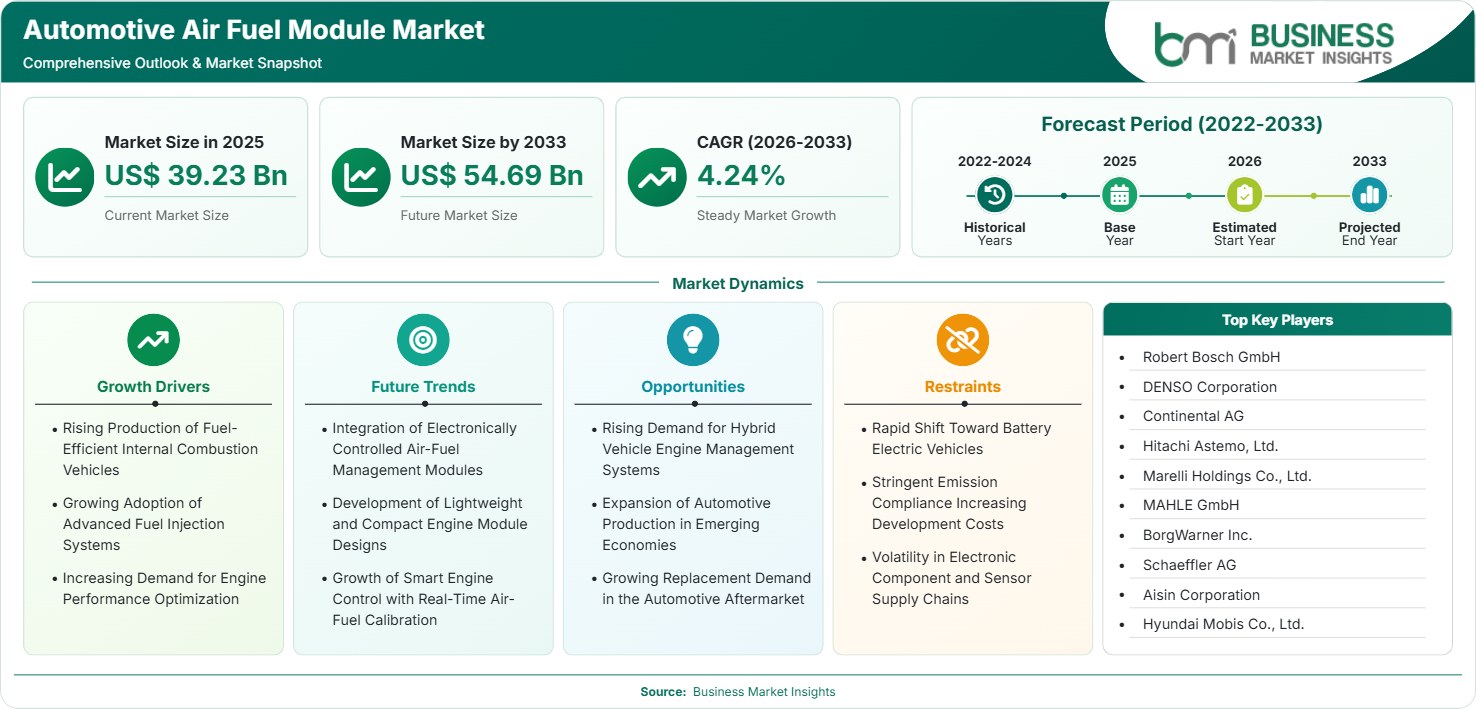
The Automotive Air Fuel Module Market size was valued at US$ 39.23 Billion in 2025 and is projected to reach US$ 54.69 Billion by 2033, growing at a CAGR of 4.24% during 2026–2033. Rising vehicle production, increasing adoption of fuel-efficient engine technologies, tightening emission regulations, and growing demand for advanced fuel delivery systems continue driving market expansion while creating opportunities for intelligent air and fuel management solutions.

Report Coverage
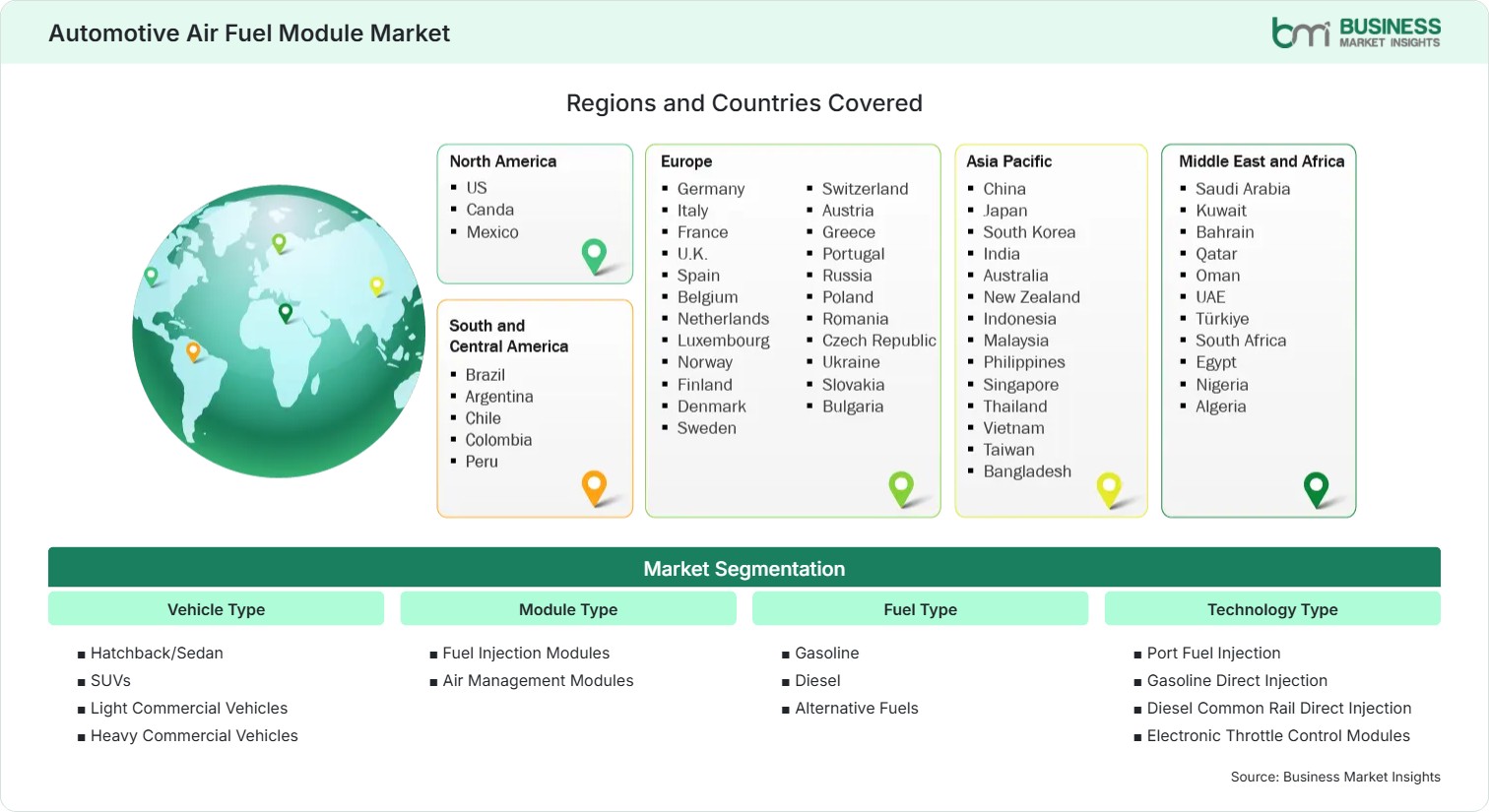
  • Vehicle Type: Hatchback/Sedan, SUVs, Light Commercial Vehicles, Heavy Commercial Vehicles
  • Module Type: Fuel Injection Modules, Air Management Modules
  • Fuel Type: Gasoline, Diesel, Alternative Fuels
  • Technology Type: Port Fuel Injection, Gasoline Direct Injection, Diesel Common Rail Direct Injection, Electronic Throttle Control Modules
  • Propulsion Type: ICE, Hybrid
US$ 39.23 Bn Market size in 2025
US$ 54.69 Bn Market Size by 2033
4.24% CAGR, 2026 - 2033
2026-2033 Forecast Period

AI Overview

Automotive Air Fuel Module Market Summary

  • North America Region: North America holds 24%–27% market share in 2025 and is projected to grow at a CAGR of 3.9%–4.3% during 2026–2033. Vehicle production, stringent emission standards, and increasing adoption of advanced engine management technologies continue supporting regional demand. The U.S. dominates the regional market through strong automotive manufacturing, increasing integration of fuel-efficient powertrain systems, and continuous investments in engine optimization technologies, registering a CAGR of 4.0%–4.4% during the forecast period.
  • Fastest Growing Region: Asia Pacific accounts for 43%–46% market share in 2025 and is expected to expand at a CAGR of 4.8%–5.2%. Rising automobile production, expanding component manufacturing, and increasing demand for fuel-efficient passenger vehicles continue accelerating regional growth.
  • Leading Segment: Fuel Injection Modules account for 54%–57% market share in 2025 while growing at a CAGR of 4.4%–4.8%. Increasing adoption of electronically controlled fuel delivery systems and stricter emission norms continue strengthening segment demand.
  • High Growth Segment: Passenger Cars (Hatchback/Sedan) represent 46%–49% market share in 2025 and are projected to register a CAGR of 4.5%–4.9% owing to sustained passenger vehicle production and continuous engine efficiency improvements.
  • Key Market Opportunity: Development of electronically controlled fuel management systems, hybrid-compatible modules, lightweight engine components, and integrated air-fuel control technologies is creating long-term opportunities for automotive suppliers.
  • Major Market Players: Robert Bosch GmbH, DENSO Corporation, Continental AG, Hitachi Astemo, Ltd., Marelli Holdings Co., Ltd., MAHLE GmbH, BorgWarner Inc., Schaeffler AG, Aisin Corporation, and Hyundai Mobis Co., Ltd.
Strategic Insights

Automotive Air Fuel Module Market: Strategic Insights

Automotive Air Fuel Module Market Strategic Framework
FREE PDF
Request your free sample
Request free sample
Stakeholder View

Key Takeaways

  • Automotive OEMs increasingly collaborate with engine management specialists, electronic component manufacturers, and software developers to optimize air-fuel control systems and improve vehicle efficiency.
  • Fuel injection modules continue presenting the strongest commercial opportunity in the automotive air fuel module market owing to increasing deployment of electronically controlled fuel delivery technologies across modern passenger vehicles.
  • Product innovation increasingly focuses on lightweight materials, electronic throttle control integration, intelligent fuel management software, and improved combustion optimization.
  • Asia Pacific remains the most attractive investment destination due to expanding automotive production, strong supplier ecosystems, and increasing localization of automotive component manufacturing.
  • Strategic collaborations between OEMs and Tier-1 suppliers continue accelerating development of next-generation engine management technologies supporting hybrid and low-emission vehicles.
  • Continuous regulatory pressure on fuel efficiency and emissions encourages manufacturers to invest in advanced air-fuel module technologies that improve combustion efficiency without compromising engine performance.
Geographic Outlook

Automotive Air Fuel Module Market Regional Highlights

North America Automotive Air Fuel Module Market

North America accounted for approximately 24%–27% of global revenue in 2025 and is projected to register a CAGR of 3.9%–4.3% through 2033. The Automotive Air Fuel Module Market share remains supported by strong OEM production, advanced engine technology adoption, and continuous investments in fuel-efficient vehicle platforms. Growing demand for hybrid vehicles and technologically advanced gasoline engines further supports regional expansion.

  • Strong demand for fuel-efficient passenger vehicles encourages adoption of advanced fuel injection technologies across major automotive manufacturers.
  • Tightening emission standards continue driving investments in intelligent engine management and combustion optimization systems.
  • Increasing hybrid vehicle production supports demand for electronically controlled air-fuel modules.
  • Established automotive supply chains enable continuous product innovation and large-scale manufacturing capabilities.

US Automotive Air Fuel Module Market

The United States accounts for approximately 84%–87% of North American demand and is projected to expand at a CAGR of 4.0%–4.4% during the forecast period. Continuous investments in advanced engine technologies and strong automotive manufacturing continue supporting long-term automotive air fuel module market development.

  • Major OEMs increasingly integrate advanced fuel delivery technologies into new vehicle platforms.
  • Hybrid vehicle production strengthens demand for intelligent engine control systems.
  • Automotive R&D investments accelerate innovation in combustion optimization.
  • Component suppliers continue expanding domestic manufacturing capabilities.

Europe Automotive Air Fuel Module Market

Europe represented approximately 24%–27% of global revenue during 2025 and is forecast to grow at a CAGR of 3.8%–4.2% through 2033. Germany leads regional demand due to strong automotive manufacturing, while Poland records the fastest growth supported by expanding automotive component production.

  • Germany maintains leadership through advanced automotive engineering and premium vehicle manufacturing.
  • Poland attracts new automotive component manufacturing investments.
  • Emission regulations encourage deployment of efficient fuel management technologies.
  • Hybrid vehicle production continues supporting advanced engine system demand.

Asia Pacific Automotive Air Fuel Module Market

Asia Pacific accounted for approximately 43%–46% of global revenue in 2025 and is expected to expand at a CAGR of 4.8%–5.2% through 2033. China remains the largest regional automotive air fuel module market, while India records the fastest growth owing to expanding automotive manufacturing and rising domestic vehicle demand.

  • China continues leading automotive production and engine component manufacturing.
  • India experiences rapid supplier expansion supported by automotive localization initiatives.
  • Japan and South Korea remain major technology innovation hubs.
  • Growing passenger vehicle ownership increases long-term component demand.

Rest of World Automotive Air Fuel Module Market

The Rest of World represented approximately 7%–9% of global revenue during 2025 and is projected to register a CAGR of 4.1%–4.5% through 2033. Brazil leads Latin American demand, while Saudi Arabia records the fastest growth across the Middle East through increasing automotive investments.

  • Brazil remains the leading automotive production center in Latin America.
  • Saudi Arabia continues expanding automotive manufacturing initiatives.
  • Increasing commercial vehicle demand supports replacement component sales.
  • Growing regional assembly operations strengthen local supplier opportunities.
Global Market Geography
FREE PDF
Request your free sample
Request free sample
Segment Analysis

Automotive Air Fuel Module Market Segmentation

Vehicle Type

The Vehicle Type segment accounted for approximately 46%–49% of the market in 2025 and is projected to expand at a CAGR of 4.5%–4.9% during 2026–2033. Vehicle production volumes, emission regulations, and consumer demand for fuel-efficient transportation continue influencing adoption of advanced air fuel modules. The Automotive Air Fuel Module Market scope continues expanding as manufacturers improve combustion efficiency across passenger and commercial vehicle platforms through advanced engine management technologies.

  • Hatchback/Sedan: Hatchback and sedan models generate the largest demand due to high production volumes, widespread gasoline engine adoption, and continuous integration of electronically controlled fuel management systems for improved fuel economy.
  • SUVs: SUVs increasingly utilize sophisticated air fuel modules to optimize combustion efficiency, improve torque delivery, and comply with stringent emission regulations while maintaining higher engine performance.
  • Light Commercial Vehicles: Light commercial vehicles require durable air fuel modules capable of supporting frequent operation, improved fuel efficiency, and lower maintenance costs across logistics and urban transportation fleets.
  • Heavy Commercial Vehicles: Heavy commercial vehicles adopt advanced air and fuel management technologies to improve combustion efficiency, reduce emissions, and maximize engine durability under demanding operating conditions.

Module Type

Module technology continues evolving with increasing integration of electronic engine management systems. This segment represented approximately 54%–57% of market revenue during 2025 and is expected to register a CAGR of 4.4%–4.8% through the forecast period. The Automotive Air Fuel Module Market trends indicate growing adoption of electronically controlled fuel delivery systems across modern vehicles.

  • Fuel Injection Modules: Fuel injection modules dominate the market by enabling precise fuel delivery, improved combustion efficiency, enhanced engine responsiveness, and compliance with increasingly stringent global emission regulations.
  • Air Management Modules: Air management modules optimize intake airflow, throttle response, and air-fuel balance, improving engine performance, fuel efficiency, and overall vehicle drivability across multiple engine configurations.

Fuel Type

Fuel type remains a major factor influencing air fuel module design and system performance. The segment accounted for approximately 61%–64% of automotive air fuel module market revenue in 2025 and is projected to expand at a CAGR of 4.2%–4.6% through 2033.

  • Gasoline: Gasoline-powered vehicles continue generating the largest demand owing to widespread passenger vehicle production and extensive deployment of advanced fuel injection technologies.
  • Diesel: Diesel engines continue requiring sophisticated fuel management systems that support high-pressure fuel injection, improved combustion, and reduced emissions across commercial transportation applications.
  • Alternative Fuels: Alternative fuel vehicles increasingly utilize specialized air fuel modules designed to optimize combustion characteristics for compressed natural gas, ethanol blends, and other alternative fuels.

Technology Type

Technological advancements continue improving combustion precision, engine efficiency, and emission control. This segment represented approximately 43%–46% of the market during 2025 and is projected to register a CAGR of 4.6%–5.0% throughout the forecast period.

  • Port Fuel Injection: Port fuel injection remains widely used due to cost-effectiveness, reliable performance, simpler maintenance, and compatibility with a broad range of gasoline-powered passenger vehicles.
  • Gasoline Direct Injection: Gasoline direct injection improves fuel atomization, combustion efficiency, engine power, and fuel economy while supporting compliance with modern emission standards.
  • Diesel Common Rail Direct Injection: Diesel common rail technology enables precise high-pressure fuel delivery, improving combustion efficiency, engine performance, emissions reduction, and fuel consumption in commercial vehicles.
  • Electronic Throttle Control Modules: Electronic throttle control modules enhance engine responsiveness, optimize airflow management, improve fuel efficiency, and enable integration with advanced driver assistance and vehicle control systems.

Propulsion Type

Powertrain evolution continues influencing air fuel module demand across conventional and electrified vehicles. The segment accounted for approximately 88%–91% of market revenue in 2025 and is expected to expand at a CAGR of 3.8%–4.2% during the forecast period.

  • ICE: Internal combustion engine vehicles remain the primary users of air fuel modules because combustion optimization directly influences fuel efficiency, emissions, and engine performance.
  • Hybrid: Hybrid vehicles continue utilizing advanced engine management modules that optimize transitions between electric and combustion power while improving overall vehicle efficiency.

Sales Channel

Both original equipment manufacturing and replacement demand continue supporting market expansion. This segment represented approximately 69%–72% of global revenue in 2025 and is projected to grow at a CAGR of 4.3%–4.7% through 2033.

  • OEM: OEM sales dominate through direct integration of advanced air fuel modules into new vehicle production, supported by long-term supply agreements with automotive manufacturers.
  • Aftermarket: The aftermarket continues expanding as aging vehicle fleets require replacement air fuel modules to maintain engine efficiency, fuel economy, and compliance with emission standards.
Market Forces

Automotive Air Fuel Module Market Dynamics

Key Market Drivers

Rising Production of Fuel-Efficient Internal Combustion Vehicles

Despite increasing vehicle electrification, internal combustion engine vehicles continue representing the largest share of global vehicle production. Manufacturers increasingly integrate advanced air fuel modules to improve combustion efficiency, reduce fuel consumption, and meet tightening emission standards without sacrificing engine performance. The Automotive Air Fuel Module Market growth remains supported by sustained production of passenger cars, commercial vehicles, and hybrid powertrains across developed and emerging automotive markets. Continuous optimization of gasoline and diesel engines ensures long-term demand for sophisticated fuel management technologies capable of delivering higher efficiency and lower environmental impact.

Growing Adoption of Advanced Fuel Injection Systems

The modern engines have come to depend on electronics for the fuel injection system, which is capable of providing accurate amounts of fuel under diverse operational environments. Modern technologies like the gasoline direct injection and common rail injection for diesel fuel injection help in achieving a clean burn of fuel, reduce the emissions, increase engine efficiency and ensure optimum use of fuel. The automobile makers are continuously upgrading from the traditional mechanical systems to intelligent electronic fuel injection system.

Increasing Demand for Engine Performance Optimization

Consumers and automotive manufacturers increasingly prioritize engines that deliver improved fuel economy, higher power output, lower emissions, and enhanced driving performance. Air-fuel modules that offer real-time measurement and adjustment of air-to-fuel ratios, throttle settings, and fuel injection timings have made significant contributions to this end. In addition, integration of such technology into electronic control units results in increased accuracy of engine combustion process and reliability.

Key Market Opportunities

Rising Demand for Hybrid Vehicle Engine Management Systems

Hybrid vehicles continue creating attractive opportunities for suppliers of intelligent air fuel modules because internal combustion engines remain an integral component of hybrid propulsion systems. These vehicles require highly sophisticated engine management technologies capable of coordinating combustion and electric propulsion while maximizing overall efficiency. The Automotive Air Fuel Module Market Forecasts remain favorable as governments encourage hybrid vehicle adoption through emission regulations and fuel efficiency initiatives. Suppliers developing hybrid-specific air fuel management technologies are expected to strengthen their long-term competitive position.

Expansion of Automotive Production in Emerging Economies

The countries that have recently started automotive manufacturing continue to attract investments by companies that manufacture vehicles all over the world in search of low-cost production, increased consumer base, and supply chain efficiency. The increasing number of passenger vehicles, industrial development, and supportive policies of the governments will create demand for improved engine parts, such as air fuel modules. Companies that develop their manufacturing, engineering, and distribution operations in the region are likely to gain from vehicle production growth.

Growing Replacement Demand in the Automotive Aftermarket

Aging global vehicle fleets continue generating stable replacement demand for engine management components. Air fuel modules require replacement due to wear, contamination, electronic failures, or declining engine performance after extended vehicle operation. Independent repair workshops, authorized dealerships, and aftermarket distributors continue expanding service capabilities to meet growing maintenance requirements. Manufacturers offering high-quality replacement modules with broad vehicle compatibility are expected to capture significant long-term aftermarket opportunities.

Market Restraints and Challenges

Rapid Shift Toward Battery Electric Vehicles

Factor: Battery electric vehicles eliminate conventional internal combustion engines and therefore do not require traditional air fuel modules or fuel injection systems for propulsion.

Impact: Accelerating electric vehicle adoption gradually reduces long-term demand for conventional air fuel management technologies, particularly in passenger vehicle markets. Component manufacturers increasingly diversify product portfolios by investing in hybrid systems, thermal management technologies, electric powertrain components, and next-generation mobility solutions to reduce dependence on conventional combustion engine applications.

Stringent Emission Compliance Increasing Development Costs

Factor: Compliance with increasingly rigorous emission regulations requires continuous investment in advanced fuel injection technologies, electronic controls, precision sensors, and combustion optimization systems.

Impact: Rising research, development, validation, and certification costs increase financial pressure on component manufacturers while extending product development cycles. Companies must continuously innovate to satisfy evolving global emission standards, improve fuel efficiency, and maintain competitive differentiation, making technology development more complex and capital intensive across the automotive supply chain.

Company Analysis

Competitive Landscape

The Automotive Air Fuel Module Market analysis is highly competitive, with global Tier-1 automotive suppliers focusing on intelligent fuel delivery systems, electronic engine management, lightweight module designs, and advanced combustion optimization technologies. Companies continue investing in hybrid-compatible engine systems, software-controlled fuel management, manufacturing localization, and strategic OEM partnerships to strengthen their competitive positions across global automotive markets.

Company Name

Overview

Products and Services Relevant to this Market

Robert Bosch GmbH

Robert Bosch GmbH is a leading global automotive technology supplier offering advanced powertrain, engine management, and fuel system technologies for passenger and commercial vehicles.

Fuel injection systems, air management modules, engine control units, electronic throttle control, fuel pumps, sensors, and powertrain technologies.

DENSO Corporation

DENSO Corporation develops advanced automotive components supporting fuel efficiency, emissions reduction, and intelligent engine management for global automotive manufacturers.

Fuel injection modules, engine management systems, electronic control units, air intake systems, sensors, and hybrid powertrain technologies.

Continental AG

Continental AG provides innovative automotive technologies focused on intelligent powertrain management, electronic control systems, and vehicle efficiency solutions.

Fuel delivery systems, electronic throttle control modules, engine sensors, air management systems, engine control software, and fuel injection technologies.

Hitachi Astemo, Ltd.

Hitachi Astemo develops advanced automotive systems supporting electrification, efficient combustion engines, and integrated vehicle control technologies.

Fuel injection systems, air management modules, engine control units, throttle control systems, sensors, and hybrid powertrain components.

Marelli Holdings Co., Ltd.

Marelli is a global automotive supplier specializing in advanced engine management, electronic systems, and powertrain technologies for modern vehicles.

Fuel injection modules, intake air management systems, throttle bodies, engine electronics, sensors, and combustion optimization technologies.

MAHLE GmbH

MAHLE develops innovative engine systems and filtration technologies that improve combustion efficiency, emissions performance, and fuel economy.

Air intake modules, fuel management systems, filtration products, engine components, thermal management systems, and hybrid technologies.

BorgWarner Inc.

BorgWarner delivers advanced propulsion technologies supporting cleaner combustion engines, hybrid vehicles, and next-generation mobility platforms.

Fuel system technologies, air management components, electronic controls, turbocharging systems, emissions technologies, and hybrid propulsion solutions.

Schaeffler AG

Schaeffler develops precision automotive technologies supporting engine efficiency, intelligent motion control, and advanced powertrain applications.

Engine management components, powertrain systems, electronic control technologies, hybrid vehicle solutions, and precision automotive components.

Aisin Corporation

Aisin Corporation supplies advanced automotive systems that improve engine efficiency, drivetrain performance, and vehicle reliability for global manufacturers.

Engine management systems, fuel delivery technologies, throttle control systems, hybrid powertrain components, and automotive electronic modules.

Hyundai Mobis Co., Ltd.

Hyundai Mobis develops integrated automotive modules and intelligent electronic systems supporting connected, hybrid, and fuel-efficient vehicles.

Engine control modules, fuel management systems, electronic throttle technologies, sensors, hybrid vehicle components, and integrated automotive modules.

Trust & Transparency

Research Methodology

The market analysis combines proprietary research with secondary data from government agencies, company disclosures, regulatory filings, industry databases and expert interviews. Market estimates are validated through data triangulation, cross-market benchmarking and analyst review.

View Full Research Methodology

Questions Answered

Frequently Asked Questions

What does an automotive air fuel module market report include?

The report provides detailed insights into market size, segmentation, regional outlook, competitive landscape, technology trends, supply chain developments, growth opportunities, and long-term industry forecasts.

Which region is expected to witness the fastest market growth?

Asia Pacific is projected to record the fastest growth due to expanding automotive production, increasing passenger vehicle demand, strong component manufacturing ecosystems, and rising investments in fuel-efficient vehicle technologies.

Why are hybrid vehicles creating opportunities for this market?

Hybrid vehicles continue using internal combustion engines alongside electric motors, requiring advanced air fuel management systems to optimize combustion efficiency, engine performance, and seamless powertrain operation.

Which module type dominates the market?

Fuel injection modules hold the largest market share because they provide precise fuel delivery, improve combustion efficiency, reduce emissions, and support compliance with increasingly stringent global emission regulations.

What is an automotive air fuel module?

An automotive air fuel module is an integrated engine management system that regulates the supply of air and fuel entering the combustion chamber to optimize engine performance, fuel efficiency, and emissions.

Access the Full Automotive Air Fuel Module Market Report

Get segment-level forecasts, regional estimates, competitive benchmarking, company profiles and downloadable Excel datasets.

Access the full Automotive Air Fuel Module Market Report
350 pages PDF & Excel | 2026-08-07