Market Summary
Executive Summary and Global Market Analysis
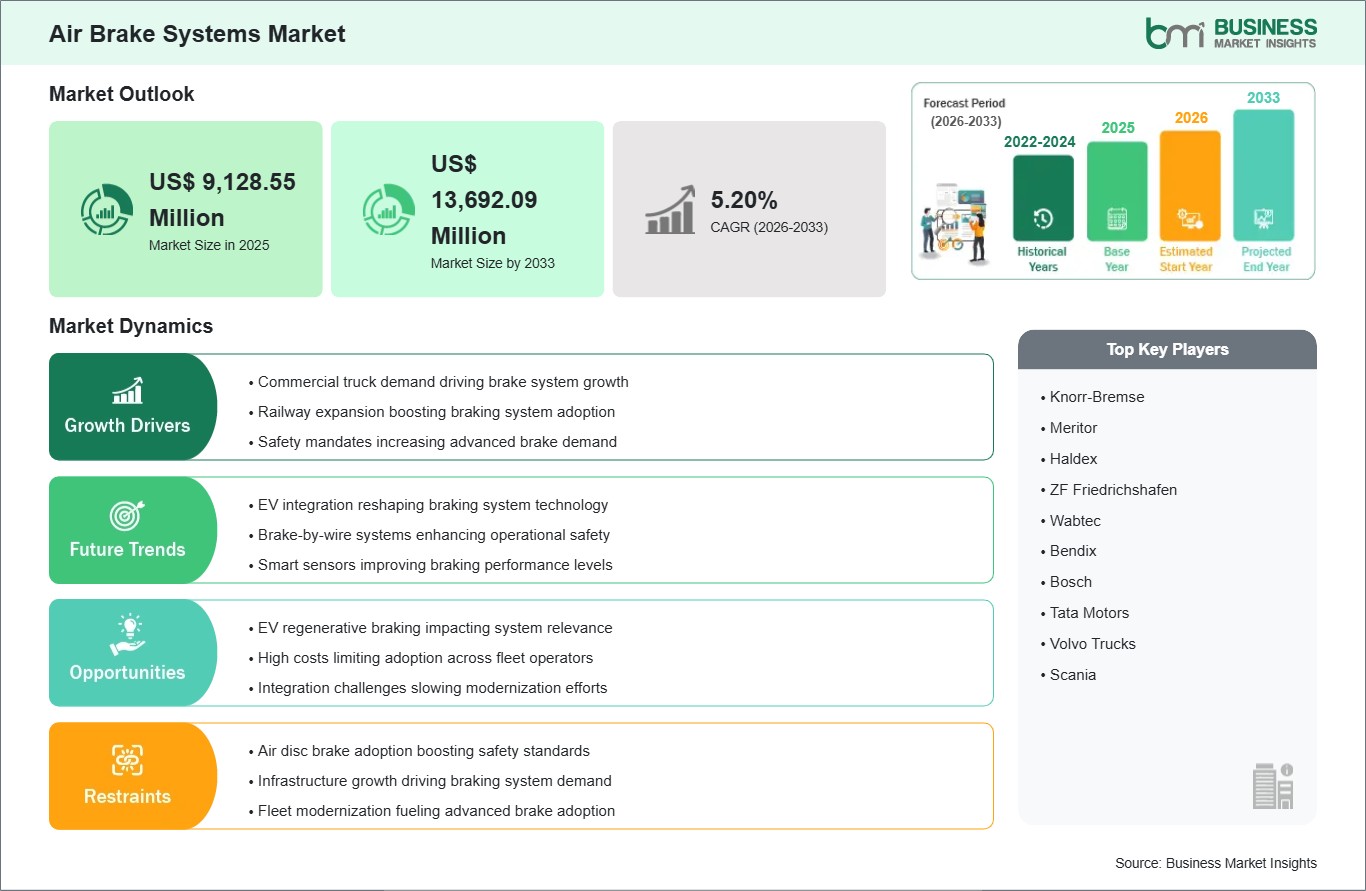
Air Brake Systems are vehicle braking technologies that use compressed air to activate braking mechanisms in commercial and heavy-duty vehicles. These systems are widely used in rigid trucks, semi-trailers, buses, and heavy-duty transportation vehicles due to their reliability, durability, and ability to provide effective braking performance under demanding operating conditions. Air brake systems include components such as compressors, governors, tanks, air dryers, and brake chambers that work together to ensure safe vehicle operation and braking efficiency. Increasing demand for commercial transportation, growing focus on vehicle safety regulations, and expanding logistics and freight transportation activities are supporting the adoption of Air Brake Systems across global automotive and transportation industries. Fleet operators and vehicle manufacturers are increasingly focusing on advanced braking technologies to improve road safety, vehicle stability, and operational performance.
Several operational and industry-related challenges continue to influence the Air Brake Systems market. High maintenance requirements associated with air brake components, increasing raw material costs, and the complexity of integrating advanced braking technologies into modern vehicle platforms can affect market growth. Manufacturers also face challenges related to component wear, moisture accumulation, and system leakage issues that may impact braking performance and maintenance costs. In addition, fluctuations in commercial vehicle production, supply chain disruptions, and evolving emission and safety compliance requirements continue to create operational uncertainties for industry participants. The growing shift toward electrification in commercial vehicles may also require modifications to traditional braking system architectures.
Despite these challenges, the market continues to expand due to rising investments in transportation infrastructure and increasing focus on commercial vehicle safety. Disc-type air brake systems are gaining attention because of their improved braking efficiency, reduced stopping distance, and lower maintenance requirements. By component, compressors and air dryers account for a significant share due to their critical role in maintaining compressed air quality and system functionality. Heavy-duty trucks and semi-trailers remain major adopters because of increasing freight transportation and logistics activities globally. Competitive activity within the market is focused on lightweight braking components, electronic braking integration, improved air management systems, and enhanced durability technologies.
Segment Analysis
Air Brake Systems Market Segmentation
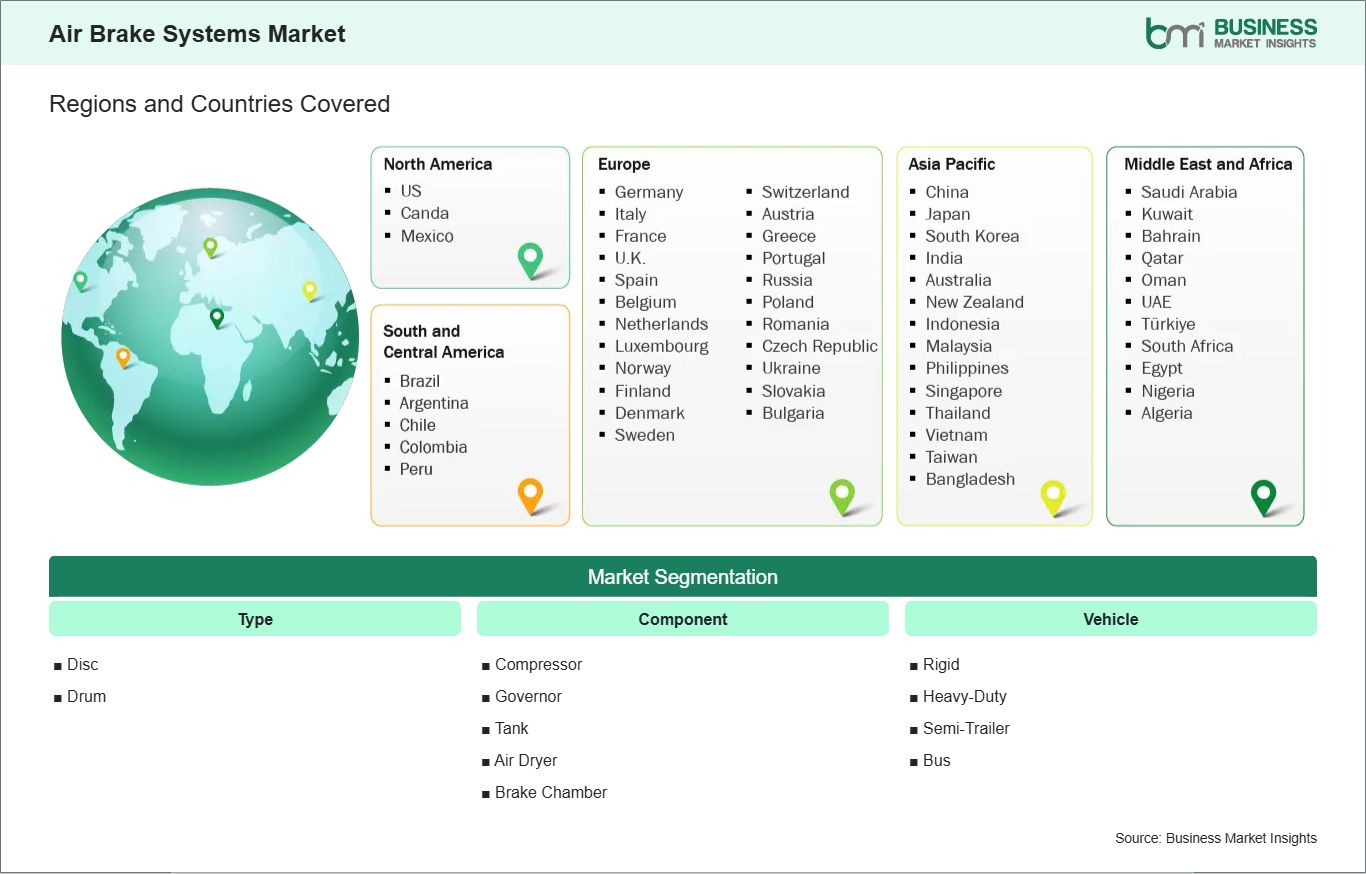
The Air Brake Systems market is segmented based on type, component, and vehicle category. Growing commercial transportation activities and increasing safety requirements continue to support demand across multiple market segments.
By Type
- Disc: Increasingly adopted due to improved braking performance, reduced heat buildup, and lower maintenance requirements.
- Drum: Widely used in heavy-duty applications because of durability and cost-effective braking operations.
By Component
- Compressor: Essential for generating compressed air required for braking operations.
- Governor: Regulates air pressure levels within the braking system for operational stability.
- Tank: Stores compressed air to support continuous brake functionality.
- Air Dryer: Prevents moisture accumulation and improves braking system reliability.
- Brake Chamber: Converts compressed air into mechanical braking force for vehicle stopping operations.
By Vehicle
- Rigid: Demand supported by increasing use in regional transportation and industrial logistics.
- Heavy-Duty: Major segment due to high adoption across freight and long-haul transportation activities.
- Semi-Trailer: Increasing use driven by expanding global logistics and cargo transportation industries.
- Bus: Adoption supported by growing public transportation infrastructure and passenger safety requirements.
Market Forces
Air Brake Systems Market Drivers and Opportunities
Rising Commercial Vehicle Safety Regulations Supporting Market Growth
The increasing implementation of vehicle safety regulations and transportation compliance standards is a major factor driving the Air Brake Systems market. Governments and transportation authorities across multiple countries are strengthening commercial vehicle safety requirements to reduce road accidents and improve braking efficiency for heavy-duty transportation operations. Commercial fleet operators are increasingly adopting advanced braking technologies to improve vehicle stability, reduce stopping distance, and ensure operational safety under varying road conditions. The growth of freight transportation, construction activities, and industrial logistics operations is also supporting demand for reliable braking systems across commercial vehicle categories.
Technological advancements in braking systems are further contributing to market expansion. Manufacturers are increasingly focusing on integrating electronic braking systems, anti-lock braking technologies, and intelligent air management solutions into commercial vehicles. These systems help improve braking response, reduce maintenance requirements, and enhance vehicle control during emergency situations. Increasing investments in transportation infrastructure and cross-border logistics operations are also creating additional demand for heavy-duty vehicles equipped with advanced braking technologies. Continuous improvements in component durability, compressed air efficiency, and lightweight braking materials are expected to support long-term market growth across the transportation industry.
Integration of Electronic and Intelligent Braking Technologies
The increasing adoption of intelligent vehicle technologies and electronic braking integration is creating significant growth opportunities for the Air Brake Systems market. Commercial vehicle manufacturers are focusing on advanced braking architectures capable of supporting connected vehicle systems, automated safety functions, and predictive maintenance capabilities. Electronic braking systems integrated with air brake technologies are improving braking precision, vehicle control, and operational efficiency across heavy transportation applications. These advancements are becoming increasingly important as logistics companies and fleet operators prioritize safety, fuel efficiency, and reduced vehicle downtime.
The growing development of electric and hybrid commercial vehicles is also supporting future market opportunities. Manufacturers are focusing on next-generation braking systems capable of supporting regenerative braking technologies and electronically controlled vehicle operations. Expanding urban transportation infrastructure and increasing investments in smart mobility solutions are creating additional demand for efficient and reliable braking systems in buses and commercial transportation fleets. Emerging markets are also witnessing increasing adoption of advanced commercial vehicle technologies due to industrialization and expanding logistics activities. Continuous innovation in braking automation, sensor technologies, and electronic control systems is expected to create long-term opportunities for Air Brake Systems manufacturers and suppliers.
Size and Share Analysis
Air Brake Systems Market Size and Share Analysis
The Air Brake Systems Market is projected to grow from US$ 9,128.55 Million in 2025 to US$ 13,692.09 Million by 2033 , registering a CAGR of 5.20% from 2026 to 2033.
By type, disc air brake systems are gaining increasing attention due to improved braking efficiency, reduced stopping distance, and lower maintenance requirements. Drum brake systems continue to maintain significant adoption across commercial vehicle categories because of their durability and cost-effectiveness. By component, compressors and air dryers account for a major share of the market due to their critical role in maintaining compressed air quality and system performance. Brake chambers and tanks also remain essential components supporting efficient braking operations.
By vehicle, heavy-duty trucks and semi-trailers represent major demand segments due to increasing cargo transportation and long-haul logistics operations globally. Buses are also witnessing growing adoption of advanced braking systems as public transportation authorities prioritize passenger safety and operational efficiency. Continuous advancements in electronic braking technologies, intelligent vehicle systems, and lightweight braking components are expected to support long-term market development.
Report Coverage
Air Brake Systems Market Report Coverage and Deliverables
The "Air Brake Systems Size and Forecast (2022-2033)" report provides a detailed analysis of the market covering below areas:
- Market size and forecast at global, regional, and country levels for all the key market segments covered under the scope
- Market trends, as well as market dynamics such as drivers, restraints, and key opportunities
- Market analysis covering key market trends, global and regional framework, major players, regulations, and recent market developments
- Industry landscape and competition analysis covering market concentration, heat map analysis, prominent players, and recent developments for the market
- Detailed company profiles, including SWOT analysis
Geographic Insights
Air Brake Systems Market Geographic Insights
The Air Brake Systems Market shows diverse regional adoption patterns influenced by commercial vehicle production, transportation infrastructure development, freight logistics expansion, and vehicle safety regulations.
North America remains a mature market for Air Brake Systems due to strong commercial transportation networks and strict vehicle safety standards. The United States continues to witness steady adoption of advanced braking technologies across heavy-duty trucks, buses, and logistics fleets. Fleet operators are increasingly focusing on electronically controlled braking systems and enhanced air management technologies to improve vehicle safety and operational efficiency. Canada is also supporting market growth through increasing investments in freight transportation infrastructure and expanding long-haul logistics operations. Rising adoption of connected commercial vehicles and intelligent transportation technologies continues to strengthen demand for advanced air brake solutions across the region.
Asia Pacific is witnessing growing adoption of Air Brake Systems due to expanding industrialization, increasing freight transportation activities, and rising commercial vehicle production. China remains a major market because of its large logistics industry and strong manufacturing capabilities in heavy-duty transportation vehicles. India is experiencing increasing demand for advanced braking systems as government authorities strengthen commercial vehicle safety regulations and transportation infrastructure investments. Japan and South Korea continue to focus on technologically advanced braking systems integrated with intelligent vehicle safety solutions. Growing public transportation projects, urban mobility initiatives, and industrial logistics expansion are further supporting regional market development across Asia Pacific.
Industry Activity
Recent Developments
The Air Brake Systems Market is analyzed using a mix of primary and secondary research sources, including corporate publications, industry associations, and verified databases. This approach ensures accurate tracking of innovation trends and strategic developments influencing the market.
- In September 2024, Knorr-Bremse introduced advanced electronic air braking technologies for commercial vehicle applications aimed at improving braking efficiency and vehicle safety performance. The company focused on integrating intelligent braking controls and predictive maintenance capabilities to support modern fleet operations. The development reflects growing industry focus on smart braking technologies and connected commercial vehicle systems.
- In April 2023, ZF Group expanded its commercial vehicle braking solutions portfolio, launching upgraded Intelligent Air Management systems built on integrated WABCO technology. These updated platforms deploy smart engine-overrun algorithms to regulate clutch compressors and electronic processing units, significantly improving compressed air efficiency and reducing system maintenance for heavy-duty transportation fleets.
Trust & Transparency
Research Methodology
The market analysis combines proprietary research with secondary data from government agencies, company disclosures, regulatory filings, industry databases and expert interviews. Market estimates are validated through data triangulation, cross-market benchmarking and analyst
review.
View Full Research Methodology
Key Sources Referred:
World Bank - Global Trade Indicators World Trade Organization (WTO) International Monetary Fund (IMF) International Trade Administration (ITA) Company Websites Company Annual Reports Company Investor Presentations