Market Summary
Executive Summary and Global Market Analysis
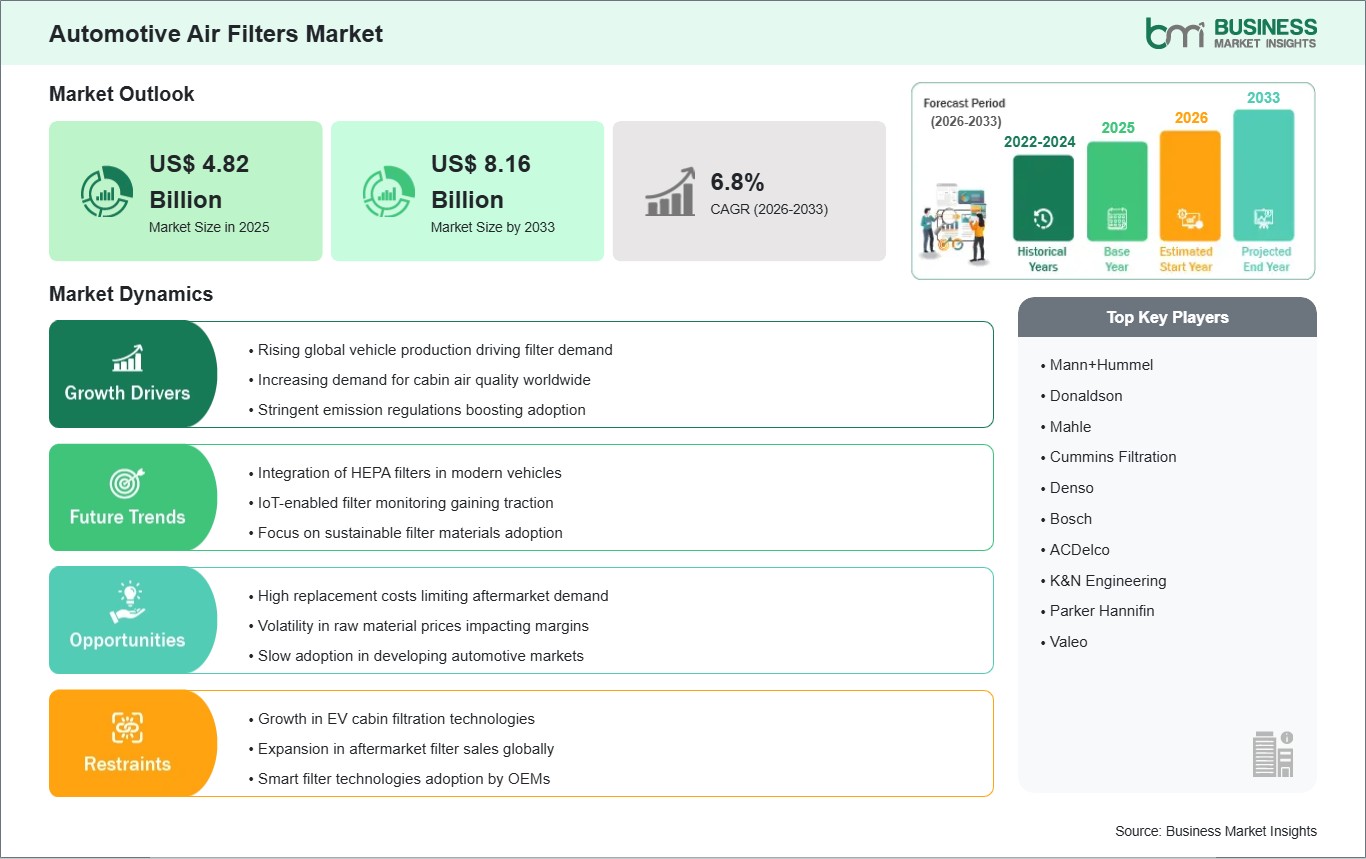
Automotive air filters are used to remove dust, dirt, pollen, and other contaminants from the air entering vehicle engines and passenger cabins. Common types include air intake filters and cabin air filters. These filters help improve engine performance, fuel efficiency, and passenger comfort by ensuring clean airflow. They are widely used across passenger cars, commercial vehicles, and two-wheelers. The market is growing as vehicle production increases, consumers become more aware of vehicle maintenance, and governments implement stricter emission and air quality regulations. Growing concerns about urban pollution are also increasing demand for advanced cabin air filtration systems.
There are some challenges that could slow market growth. Frequent fluctuations in raw material prices can affect manufacturing costs and profit margins for filter producers. The availability of low-cost counterfeit products in the aftermarket can also impact the adoption of high-quality filters. In some developing regions, limited awareness regarding timely filter replacement reduces aftermarket sales potential. Additionally, modern vehicles require increasingly specialized filtration technologies, which can increase product development costs and create challenges for smaller manufacturers. These factors may limit market expansion in certain regions.
Even with these challenges, the market is expected to grow as the automotive industry moves toward cleaner, more efficient, and technologically advanced vehicles. New opportunities are emerging through the development of high-efficiency filtration media, activated carbon cabin filters, and eco-friendly filter materials. Electric vehicles are creating demand for advanced cabin air quality solutions that improve passenger comfort. Manufacturers are also investing in smart filtration technologies and sustainable materials to meet environmental goals. The growing focus on vehicle health, passenger safety, and environmental sustainability is expected to support the long-term growth of the Automotive Air Filters market.
Segment Analysis
Automotive Air Filters Market Segmentation
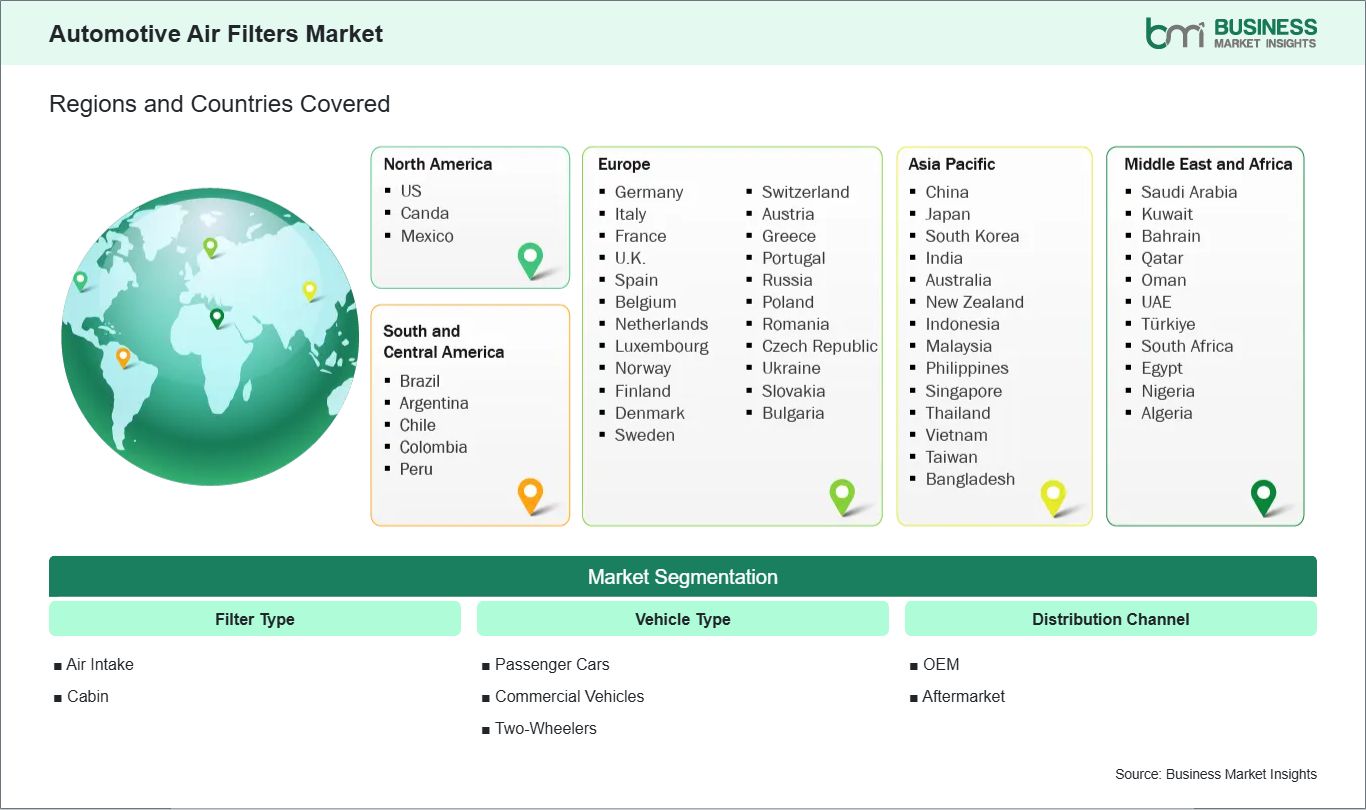
The Automotive Air Filters market is segmented based on filter type, vehicle type, and distribution channel, reflecting different product applications and customer requirements.
By Filter Type
- Air Intake: Protects engines from dust and contaminants while supporting efficient combustion and engine performance
- Cabin: Improves in-vehicle air quality by filtering dust, pollen, pollutants, and allergens
By Vehicle Type
- Passenger Cars: Largest demand segment driven by high vehicle ownership and replacement requirements
- Commercial Vehicles: Uses durable filtration systems to support heavy-duty operations and engine protection
- Two-Wheelers: Growing adoption due to increasing vehicle production and maintenance awareness
By Distribution Channel
- OEM: Supplies filters directly to vehicle manufacturers for factory installation
- Aftermarket: Provides replacement filters through service centers, retailers, and independent distributors
Market Forces
Automotive Air Filters Market Drivers and Opportunities
Growing Focus on Vehicle Performance and Emission Compliance
The demand for automotive air filters is increasing because vehicle manufacturers and consumers are placing greater emphasis on engine performance, fuel efficiency, and compliance with environmental regulations. Air intake filters help maintain clean airflow to engines, which supports optimal combustion and reduces wear on critical components. Governments across multiple regions continue to implement stricter emission standards, encouraging the use of efficient filtration systems that help vehicles meet regulatory requirements.
At the same time, growing vehicle ownership and longer vehicle operating life are increasing the need for regular filter replacement. Commercial fleet operators are particularly focused on preventive maintenance practices that reduce downtime and improve operating efficiency. Rising awareness regarding the impact of poor filtration on engine performance and maintenance costs is supporting consistent demand across OEM and aftermarket channels. These factors continue to strengthen the role of automotive air filters in modern vehicle maintenance and performance management.
Rising Demand for Advanced Cabin Air Quality Solutions
The automotive industry is witnessing increasing opportunities through the development of advanced cabin air filtration technologies. Consumers are becoming more conscious of air pollution, allergens, and airborne contaminants, leading to higher demand for premium cabin air filters. Manufacturers are introducing multi-layer filtration systems, activated carbon technologies, and specialized filter media capable of removing finer particles and odors from vehicle interiors.
The growing adoption of electric vehicles is creating additional opportunities because cabin comfort and passenger experience are becoming important differentiating factors. Smart filtration systems integrated with air quality monitoring technologies are also emerging as a future growth area. In urban regions with high pollution levels, vehicle owners increasingly seek enhanced cabin protection, encouraging innovation in filter design and performance. Sustainability initiatives are further supporting research into recyclable and environmentally friendly filter materials. These developments are expected to expand application opportunities and support long-term market growth.
Size and Share Analysis
Automotive Air Filters Market Size and Share Analysis
The Automotive Air Filters Market size is expected to reach US$ 8.16 billion by 2033 from US$ 4.82 billion in 2025. The market is estimated to record a CAGR of 6.8% from 2026 to 2033.
By filter type, air intake filters account for a significant share due to their critical role in protecting engine systems and maintaining efficient vehicle performance. Cabin filters are gaining importance as consumers become more aware of air quality concerns and passenger comfort requirements.
By vehicle type, passenger cars dominate the market owing to their large production volumes and frequent replacement cycles. Commercial vehicles maintain strong demand due to intensive operating conditions and maintenance requirements, while two-wheelers continue to contribute steadily with expanding vehicle ownership in emerging economies.
Report Coverage
Automotive Air Filters Market Report Coverage and Deliverables
The "Automotive Air Filters Market Size and Forecast (2022-2033)" report provides a detailed analysis of the market covering below areas:
- Market size and forecast at global, regional, and country levels for all the key market segments covered under the scope
- Market trends, as well as market dynamics such as drivers, restraints, and key opportunities
- Market analysis covering key market trends, global and regional framework, major players, regulations, and recent market developments
- Industry landscape and competition analysis covering market concentration, heat map analysis, prominent players, and recent developments for the market
- Detailed company profiles, including SWOT analysis
Geographic Insights
Automotive Air Filters Market Geographic Insights
The Automotive Air Filters Market shows diverse regional adoption patterns influenced by vehicle production levels, environmental regulations, and increasing awareness of vehicle maintenance practices.
North America, being a developed region, has a well-established automotive industry and a high rate of adoption of advanced filtration technologies. The region comprises the United States and Canada, where strong vehicle ownership levels and mature aftermarket networks support consistent demand for automotive air filters. The region focuses on improving vehicle performance, maintaining air quality standards, and complying with emission regulations. It has well-developed automotive manufacturing capabilities and distribution infrastructure, allowing for the widespread adoption of automotive air filters across passenger cars, commercial vehicles, and specialty vehicles.
Asia Pacific is growing significantly, driven by rising vehicle production and expanding automotive ownership. The region comprises countries such as China, India, and Japan, where increasing urbanization and industrial growth are creating strong demand for automotive filtration products. The region focuses on improving vehicle efficiency, reducing emissions, and enhancing passenger comfort through advanced filtration solutions. The expansion of automotive manufacturing facilities and aftermarket service networks is also contributing to the growth of the Automotive Air Filters Market, along with increasing government support for cleaner transportation and environmental sustainability initiatives.
Both regions are contributing significantly to the growth of the Automotive Air Filters Market, focusing on automotive production expansion, increasing vehicle maintenance activities, and rising demand for efficient filtration solutions.
Industry Activity
Recent Developments
The Automotive Air Filters Market is analyzed using a mix of primary and secondary research sources, including corporate publications, industry associations, and verified databases. This approach ensures accurate tracking of innovation trends and strategic developments influencing the market.
- In May 2025, MANN+HUMMEL launched the innovative MANN-FILTER C 29 046 air filter for commercial vehicles. The new product features a patented design that simplifies servicing and installation while delivering high filtration efficiency. The launch strengthens the company's automotive air filtration portfolio and supports growing demand for advanced filtration solutions in commercial vehicles.
- In December 2025, Premium Guard Inc. announced a licensing partnership with Procter & Gamble to launch Febreze Cabin Air Filters powered by PUREFLOW Air Filtration Technology. The new cabin air filter line combines particulate filtration, activated charcoal, and odor-neutralizing technology to improve in-vehicle air quality and passenger comfort. The collaboration reflects growing innovation in the automotive cabin filtration segment.
Trust & Transparency
Research Methodology
The market analysis combines proprietary research with secondary data from government agencies, company disclosures, regulatory filings, industry databases and expert interviews. Market estimates are validated through data triangulation, cross-market benchmarking and analyst
review.
View Full Research Methodology
Key Sources Referred:
World Bank - Global Trade IndicatorsWorld Trade Organization (WTO)International Monetary Fund (IMF)International Trade Administration (ITA)Company WebsitesCompany Annual ReportsCompany Investor Presentations