Automotive Filters Market Regional Highlights
North America Automotive Filters Market
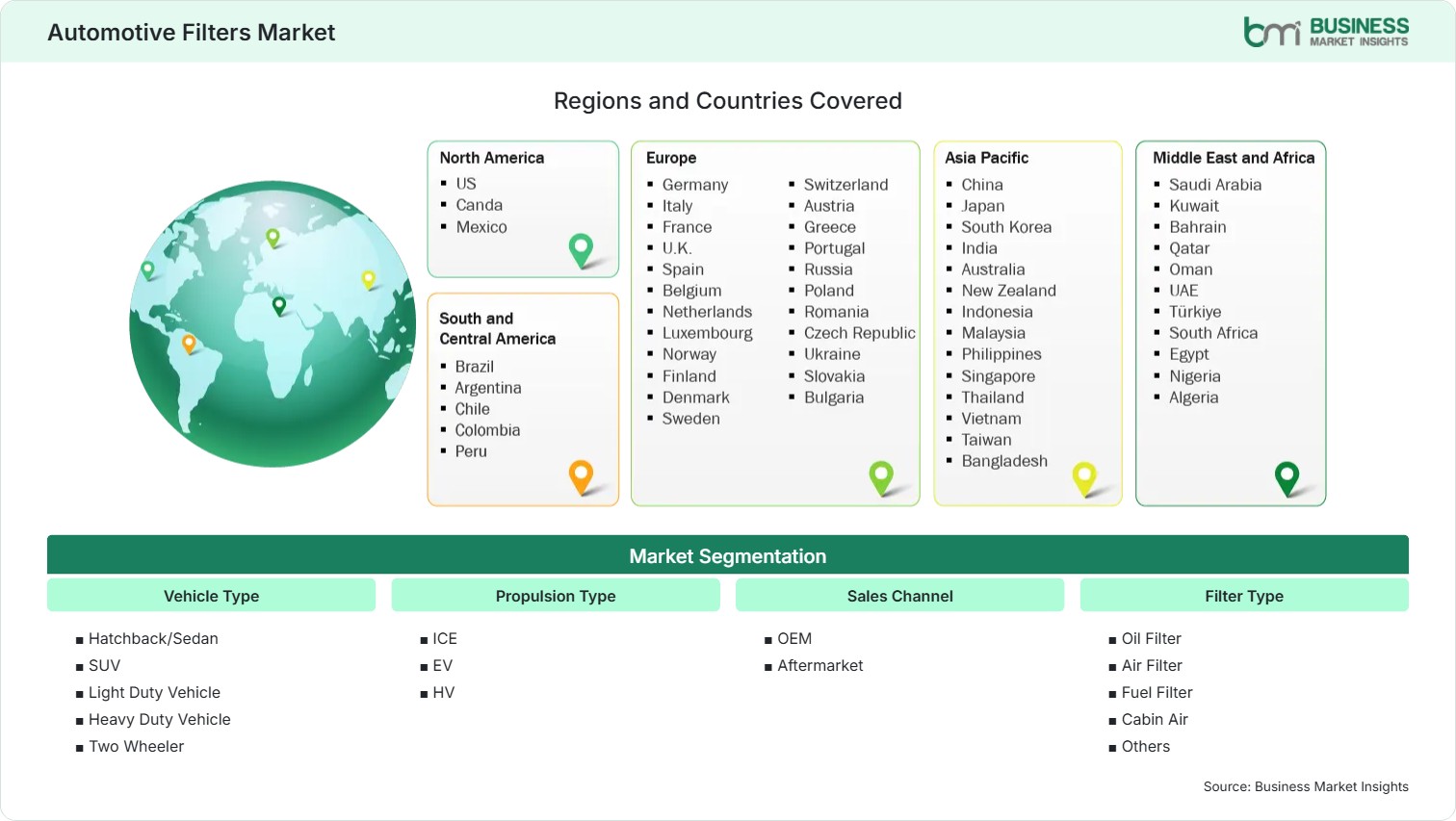
North America accounts for approximately 32%–35% of the Automotive Filters Market share in 2025 and is forecast to expand at 11.2%–12.0% CAGR through 2033. Strong aftermarket networks, high vehicle ownership, and significant light truck penetration support steady demand. Commercial transportation, construction activity, and emissions compliance requirements continue influencing replacement cycles. Growth remains supported by premium cabin filtration adoption and increasing fleet maintenance investments.
- Large independent aftermarket networks support recurring replacement demand across passenger and commercial vehicle categories.
- Fleet operators increasingly prioritize filtration performance to reduce engine wear and optimize operating efficiency.
- Advanced cabin air filtration gains traction due to consumer awareness regarding pollution and allergens.
- Heavy-duty vehicle applications maintain strong demand through freight, logistics, and infrastructure-related activity.
US Automotive Filters Market
The United States represents nearly 78%–82% of North American share and advances at 11.5%–12.3% CAGR. High vehicle parc levels, extensive highway transportation, and fleet modernization programs strengthen demand. OEM production recovery and growing adoption of premium replacement products contribute to revenue generation. Commercial vehicle maintenance remains a critical demand driver.
- Strong pickup truck and SUV ownership sustains replacement rates across multiple filter categories.
- Freight transportation activity supports recurring purchases of heavy-duty filtration products.
- Growing EV adoption creates opportunities in cabin and thermal-management filtration solutions.
Europe Automotive Filters Market
Europe maintains 25%–28% market share in 2025 and is expected to record 10.8%–11.7% CAGR. Regulatory requirements regarding emissions and air quality encourage advanced filtration adoption. Germany remains the leading market, while Eastern European manufacturing hubs gain importance. France and the UK continue supporting aftermarket demand. Spain demonstrates comparatively faster growth approaching 12%–13% CAGR.
- Premium vehicle production encourages adoption of technologically advanced filtration solutions.
- Euro emission standards support continuous innovation in filtration media and efficiency.
- Strong aftermarket structure benefits from aging vehicle fleets across several countries.
- Sustainability initiatives promote recyclable and environmentally optimized filter products.
Asia Pacific Automotive Filters Market
The Asia-Pacific region accounts for 30% to 33% in 2025 and registers the fastest growth, with a 13.5% to 14.5% CAGR. China leads demand in the region owing to its massive vehicle production capability, whereas India is the fastest-growing major market in the region with a CAGR of more than 15%. Industrialization, urbanization, and rising ownership rates support both OEM and replacement demand. Regional manufacturing investments strengthen supply-chain competitiveness.
- China remains the largest production and consumption center for automotive filtration products.
- India benefits from expanding vehicle parc and robust aftermarket development.
- Rising urban pollution supports higher penetration of advanced cabin filtration systems.
- Localization strategies help reduce costs and improve supply reliability.
Rest of World Automotive Filters Market
Rest of the World region holds 10% to 13% market share and grows at 11.8% to 12.8% CAGR. South America is dominated by Brazil, owing to high vehicle replacement needs and industrialization. The Middle East & Africa region is driven by Saudi Arabia & the UAE, which benefit from transportation and fleet growth.
- Brazil remains the largest South American opportunity due to automotive manufacturing capabilities.
- GCC countries support demand through logistics, construction, and commercial mobility expansion.
- Aftermarket channels remain essential because of extended vehicle operating life.
- Increasing environmental awareness encourages adoption of higher-performance filtration products.